HC 8: symbiosis
 Call Kai
 Learn
Learn Practice Test
 Spaced Repetition
 Match
Match Flashcards
 Knowt Play
1/8

There's no tags or description
Looks like no tags are added yet.
Name | Mastery | Learn | Test | Matching | Spaced | Call with Kai | Chat |
|---|
No analytics yet
Send a link to your students to track their progress
9 Terms
Cross-feeding
a looser interaction where one microbe consumes the metabolic byproduct of another, but neither organism is strictly dependent on the other for survival or energy production
Syntrophy
a very tight metabolic partnership between microbes where one organism can only efficiently (or sometimes only at all) carry out its metabolism because another organism removes its waste products.
This keeps the energy-yielding reactions favorable for both partners.
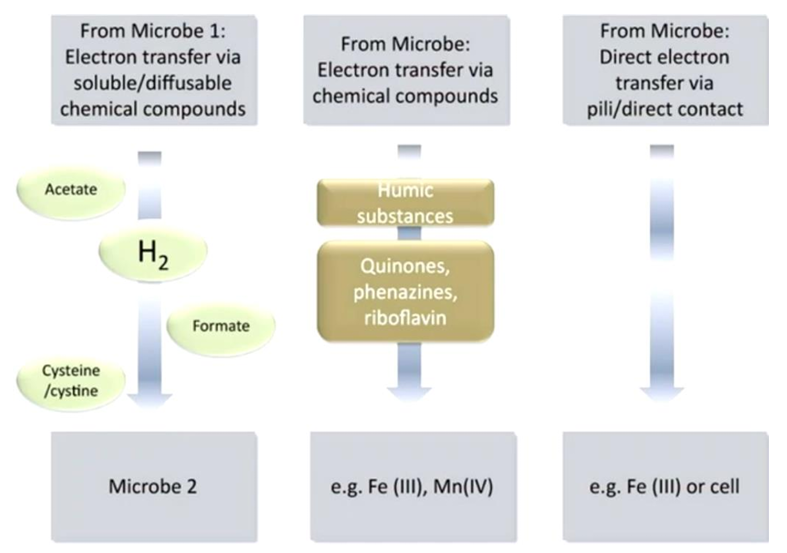
In syntrophy, electron transfer is central: one microbe produces reduced compounds (like H₂ or formate) that carry electrons, and a partner organism immediately consumes them
External electron transfer
The Black Queen hypothesis: evolution of interdependency
The idea is, the question whether you should be a generalist of a specialist.
When you’re a generalist, you need the machinery to degrade everything.
When you’re a specialist, you become very good in the specific thing you do.
When you have enough specialism, there is a certain tipping point where its better to be a specialist in one thing, so each organism in the community becomes good at one thing, without having to carry the other baggage.
So first there is a whole bunch of generalists, than evolve into different very efficient specialist, but now they do be dependent on each other.
Functions of the microbiome
Metabolism
Immunity
Nutrient acquisition
Hormone adjustment
Mode of microbiome transmission
Vertical transmission (parent → offspring) usually increases specificity because microbes are passed down together with the host lineage, leading to long-term co evolution and often strong, specialized partnerships.
Horizontal transmission (from environment or other hosts) tends to reduce specificity because hosts repeatedly acquire microbes from outside, making associations more flexible and less fixed.
The paradox of cooperation; Two problems:
➔ Selfish individuals can exploit mutualism, reaping benefits while paying no costs. So, why cooperate at all?
➔ Costs and benefits of cooperation depend on a suite of external factors, which vary hugely over time and space.
example of how you can study the ecology of cooperation
- forceren van “cheating”. Kan door stikstof te vervangen door argon à blokkeert stikstoffixatie
»» vervolgens kijk je of de plant de “cheaters” straft door de toevoer van zuurstof/suikers te beperken
- isotopen-tracking: door planten gelabelde suiker (14C) te geven en schimmel gelabeld fosfaat (33P) à aantonen dat planten meer koolstof geven aan schimmels die meer nutriënten terugleveren
the range of types of symbioses involving microbes (and their hosts)
1. Holobiont: de gastheer (plant of dier) + al zijn geassocieerde microben als één eenheid
2. Mycorrhizae: Schimmels die plantenwortels koloniseren (zowel in als om de wortels)
3. Korstmossen (Lichens): mutualisme tussen een schimmel (meestal Ascomycete) en een alg/cyanobacterie.
4. Dierlijke symbiosen: f.e. het menselijke darmmicrobioom dat essentieel is voor spijsvertering en immuniteit.
5. Endosymbionten bij insecten: f.e. de mealybug, waar zelfs endosymbionten binnenin andere endosymbionten leven