AP Psychology Unit 0 & 1
 Call Kai
 Learn
Learn Practice Test
 Spaced Repetition
 Match
Match Flashcards
 Knowt Play
1/43

There's no tags or description
Looks like no tags are added yet.
Name | Mastery | Learn | Test | Matching | Spaced | Call with Kai | Chat |
|---|
No analytics yet
Send a link to your students to track their progress
44 Terms
Rationalism
Considers reasons as the source of knowledge
Believe in intuition
Claim that individuals have innate knowledge or concepts
Empiricism
Considers experience as the source of knowledge
Do not believe in intuition
Claim that individuals have no innate knowledge
The belief that all knowledge comes from sensory experience and real-world observation. John Locke's "tabula rasa".
Cynicism
A strong lack of trust in people. It is the belief that people only act for selfish reasons instead of doing good
Pragmatism
An approach that emphasizes practicality and considers whether information and ideas make sense together
Innatism
Philosophical idea that the mind is born with a set of pre-existing knowledge, ideas, or mental structures rather than being a blank slate
Hindsight bias
Our belief, after learning an outcome, that we would have foreseen it. The “I-knew-it-all-along” phenomenon
Overconfidence
We tend to think we know more than we do, and we are certain that our beliefs are correct
Crticial thinking
Does not blindly accept arguments and conclusions
Examines assumptions
Discerns hidden values
Evaluates evidence
Hypothesis
A testable, verifiable, refutable prediction
Theory
An explanation using an integrated set of principles that organizes and predicts observations
Operational definition
A carefully worded statement of the exact procedures used in a research study, since not everyone agrees on the meanings of terms
Case study
Studies one or more individuals in great depth in the hope of revealing data points true of us all
The subject is atypical, results may not be applicable to to others
Useful in cases where the subject has a rare condition
Replication
Repeating the essence of a research study, usually with different participants in different situations, to see whether the basic finding extends to other participants and circumstances
Naturalistic observation
Observing and recording behavior in naturally occurring situations without trying to manipulate and control the situation, generally without the subjects’ awareness
Focuses exclusively on observable behavior
Lack of contact with subjects means there is no ability to understand motives causing behavior
Survey
Technique for ascertaining the self-reporting attitudes or behaviors of people, usually be questioning a representative, random sample of people
Gets large amounts of data quickly and easily
Sampling bias issues, wording of questions can impact results, people are not always honest
Random sample
Everyone has a change of being included (names from a hat)
Correlation
Means association, it is a measure of the extent to which two numeric variables are related
Shows relationships between variables
Doesn’t prove causality, can be influenced by third party variables
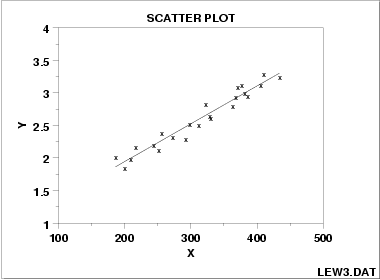
Positive correlation
If an increase in one variable tends to be associated with an increase in the other
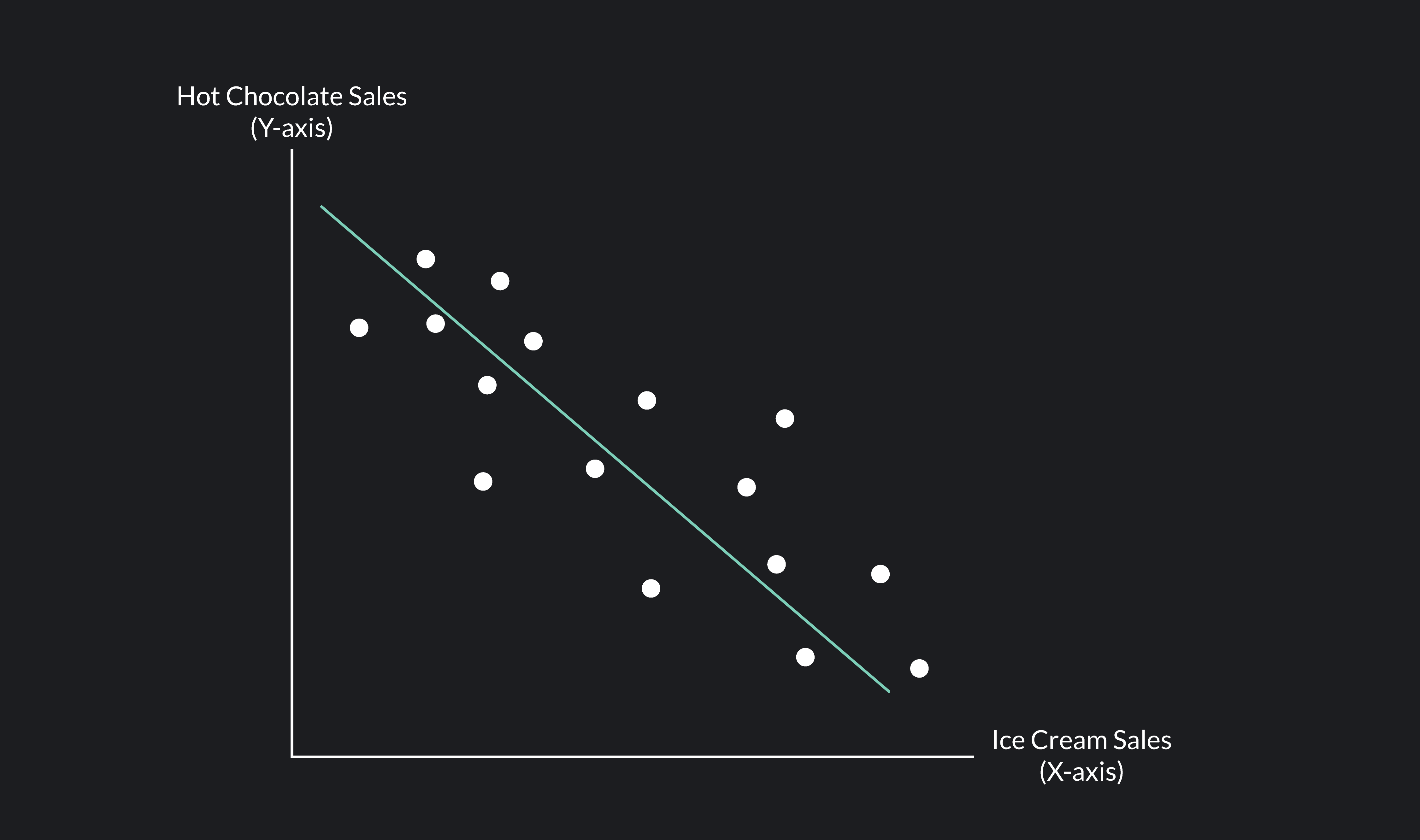
Negative correlation
If an increase in one variable tends to be associated with a decrease in the other
Zero correlation
There is no relationship between the two variables

Experimentation
Used to demonstrate cause and effect and involves random assignment
Experimental group
The condition that exposes participants to the treatment, that is, to one version of the independent variable (receives the treatment)
Control group
The condition that contrasts with the experimental treatment (does not receive the treatment). Serves as a comparison for evaluating the effect of the treatment
Placebo
An inert substance administered instead of an active agent, such as a drug, to see if it triggers the effects believed to characterize the active agent
Double blind procedure
Both the research participants and the research staff are ignorant about whether the research participants have received the treatment or a placebo
Avoids placebo effect and researcher’s bias
Independent variable
The experimental factor that is being manipulated; the variable whose effect is being studied
Dependent variable
One that depends on other factors, namely the treatment
Confounding variable
A factor other than the independent variable that might produce an effect in an experiment by impacting the relationship between the dependent variable and independent
Experimenter bias
Occurs when a researcher acts in a manner that encourages subjects to respond in a way that supports their hypothesis
Longitudinal Study
A study that examines the same group of people repeatedly over a long period of time
Cross-Sectional Study
A study that compares different groups of people at one point in time, often different age groups
Cohort Effect
Differences between groups caused by historical experiences unique to a generation, rather than age itself
Hawthorne Effect
The tendency for people to change their behavior when they know they are being observed or studied
Illusory correlation
A cognitive bias where a relationship is perceived between two variables when none exists, often leading to misunderstanding of data
Validity
The degree to which a test, measure, or experiment actually measures what it claims to measure
Informed consent
The ethical principle that research participants must be told enough about a study (purpose, procedures, risks, and the right to withdraw)
Debriefing
The post-study process where researchers explain the true purpose, procedures, and findings to participants and answer their questions
Descriptive statistics
Numerical data used to measure and describe characteristics of groups
Histogram
A graphical representation of data using bars to show the frequency or distribution of numerical variables
Mode
The mode is the value that appears most frequently in a data set
Mean
Tthe average value of a set of numbers
Median
The middle value in a data set
Skewed distribution
One in which scores are not distributed symmetrically around the mean
Correlation coefficient
Numerical measure of relationship strength ranging from -1.00 to +1.00