Structure 1.4 & 1.5
 Call Kai
 Learn
Learn Practice Test
 Spaced Repetition
 Match
Match Flashcards
 Knowt Play
1/44

Earn XP
Description and Tags
This is the things you have to memorize for this chapter things that are not here are either in data booklet or all calculation stuff + questions I got wrong
Name | Mastery | Learn | Test | Matching | Spaced | Call with Kai | Chat |
|---|
No analytics yet
Send a link to your students to track their progress
45 Terms
What units does relative atomic mass have?
no unit (Since the units in the expression for the Ar cancel)
The difference between relative atomic mass and molar mass?
Molar mass got units and relative atomic mass does not
Empirical formula vs Molecular formula
Empirical formula: the simplest whole number ratio of atoms of each element in the compound
Molecular formula: the actual number of atoms of each element in one structural unit the compound or the actual amount in mol in one mole of compound
Molecular formula can be calculated from the empirical formula if the relative molecular mass (or molar mass) is known
Shorthand for concentration
[HCl]: shorthand for concentration of hydrochloric acid
Standard solution
a solution with an accurately known mass of a solute in a given volume of solution
A student is preparing a 1 mol dm⁻³ sodium chloride solution. Explain why he does not simply dissolve 58.44 g of NaCl in 1 dm³ of distilled water
Adding 58.44g of sodium chloride will add more volume to the solution. The total volume of the solution will be more than 1 dm³, which will lead to different concencentration for the solution.
What is serial dilution?
the step-wise reduction of a substance's concentration in a solution, where each step uses a portion of the previous dilution with a consistent dilution factor
Explain the advantages and disadvantages of preparing standard solutions by serial dilution
Advantage
avoid the need to measure very small volumes / to make huge volumes of solution
very low concentrations are possible, with a high level of precision
Disadvantage
the more dilutions you make, the more solution concentration has an uncertainty associated with it
the accuracy of the concentrations of the dilutions depends on the concentration of the stock solution, as well as the correct use of volumetric glassware employed in the serial dilution
Experimental % yield formula
mass of product obtained / maximum possible mass of product * 100%
What are the assumptions of the ideal gas model? (5)
Molecules (or atoms) of an ideal gas are in constant random motion
Collisions between molecules of an ideal gas are perfectly elastic
The volume occupied by ideal gas molecules is negligible compared to the volume of the container that they occupy
There are no intermolecular forces between molecules in an ideal gas
The kinetic energy of the molecules is directly proportional to the temperature on the Kelvin scale
What are the problems with the assumptions of ideal gas?
some energy will be lost as heat, sound, etc
molecules (or atoms) in a gas do have a volume
The volume occupied by atoms/molecules becomes more significant when the gas is condensing to a liquid (ie. close to B.P.)
There are forces of attraction between molecules. If not, gases will not turn to liquid at low temperature (Forces of attraction becomes more significant at low temp)
Explain why real gases deviate using pressure and temperature
At High Pressures: Particles are pushed very close together. The actual volume of the gas particles themselves becomes significant relative to the empty space, making the observed volume greater than predicted by 𝑃𝑉=𝑛𝑅𝑇
At Low Temperatures: Particles slow down. Intermolecular attractive forces (like London dispersion forces) become significant, causing molecules to stick slightly and hit the container walls with less force, making the observed pressure lower than predicted
What is condition for ideality of a gas?
Most Ideal Behavior: High temperatures and low pressures.
Least Ideal Behavior: Low temperatures and high pressures.
Gas Choice: Smaller, non-polar molecules (like Helium) behave most ideally because they have minimal intermolecular forces and tiny particle volume

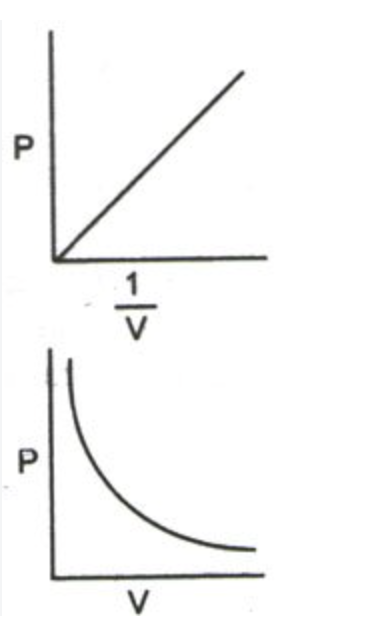
Boyle’s law
The pressure of a fixed mass of gas is inversely proportional to the volume if the temperature is constant
P ∝ 1/V (P1V1 = P2V2)

Charles’s law
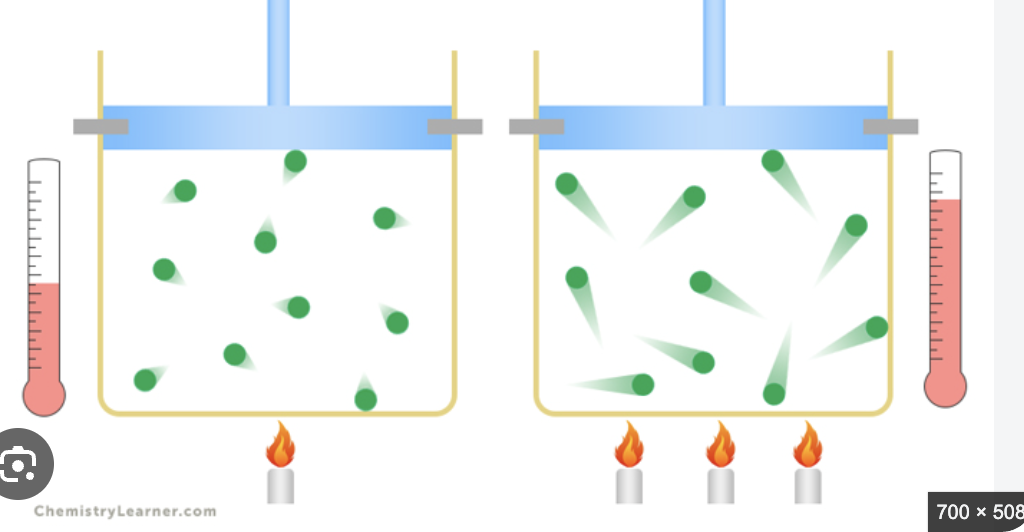
The volume of a fixed mass of gas at constant pressure is directly proportional to the absolute temperature
V ∝ T (V1/T1 = V2/T2)
Increase T → particles move faster & more frequent collisions with the walls of the container
Since P = F/A, pressure will increase BUT we need to keep P constant
→ volume must increase to keep collision frequency the same

Gay’s Lussac’s law
The pressure of a fixed volume of gas at constant volume is proportional to the temperature
P ∝ T (P1/T1 = P2/T2)

The units for the formula PV = nRT
P = Pressure in Pa when volume is in m³
pressure in kPa when volume is in dm³
Temperature in Kelvin
nR is constant
Explain how to make a standard solution (6)
Calculate the Required Mass: Determine the exact mass of solute needed to achieve the target concentration for the specific volume of your volumetric flask (e.g., calculating 0.20 g of NaCl for a 100 mL volumetric flask to get a 2.00 g/dm3 solution).
Weigh the Solute: Place a weighing boat on an electronic balance, tare it, and use a spatula to add the solute. Record the exact mass obtained.
Critical Step: If you add too much solute, dispose of the excess into the trash rather than putting it back into the stock container to avoid contamination.
Dissolve the Solute: Transfer the weighed solute from the weighing boat into a clean beaker. Rinse the weighing boat thoroughly with distilled water and pour those washings into the beaker to ensure no solute particles are left behind. Add a small volume of distilled water (less than the final volume of the flask) and stir with a spatula until the solute is completely dissolved.
Transfer to the Volumetric Flask: Pour the dissolved solution carefully from the beaker into the clean volumetric flask.
Critical Step: Rinse the inside of the beaker and the spatula with distilled water, and transfer the washings directly into the volumetric flask to prevent any loss of solute (avoiding dilution/concentration errors).
Fill to the Graduation Line: Pour distilled water into the volumetric flask until the liquid level sits just below the graduation mark. Use a pipette to add the final drops of distilled water slowly until the bottom of the meniscus sits perfectly on top of the graduation line at eye level.
Mix Thoroughly: Secure the stopper tightly onto the volumetric flask, then repeatedly invert and shake the flask to ensure the solution is completely uniform and has a stable concentration.
Explain how to carry out titration
Pre-rinse and Label Equipment (Avoid Dilution Errors):
Wear safety goggles and gloves. Label all beakers and flasks clearly since the solutions are transparent.
Wash the volumetric pipette with distilled water, then rinse it twice with the alkali solution to ensure residual water drops do not dilute your sample. Discard the rinsings.
Wash the burette with distilled water, then rinse it twice with the acid solution. Open the tap briefly to rinse the bottom tip, then discard the rinsings into a "trash" beaker.
Prepare the Conical Flask (Alkali):
Use the pre-rinsed volumetric pipette and a pipette filler to measure a fixed volume (e.g., 10.00 mL) of alkali. Ensure the bottom of the meniscus aligns with the pipette line. Let it drain completely into a clean conical flask.
Rinse down the inner walls of the conical flask with distilled water (this keeps all alkali particles at the bottom and does not alter the number of reacting moles).
Add a few drops (e.g., 5 drops) of phenolphthalein indicator to the flask and swirl; the solution will turn a vibrant pink color.
Prepare the Burette (Acid):
Clamp the burette vertically. With the tap closed (horizontal), place a funnel at the top and fill it with acid before the 0.00 mark. Lift the funnel slightly while filling to prevent air locks.
Remove the funnel. Run a small amount of acid out into the trash beaker to flush out any air bubbles trapped in the bottom tap/tip.
Record the initial volume reading to the nearest 0.05 cm³ with the scale facing you at eye level.
Perform a Rough Trial:
Place the conical flask on a piece of white paper under the burette to make color changes highly visible.
Control the burette tap with your non-dominant hand and continuously swirl the conical flask with your dominant hand.
Run the acid in quickly until the pink solution just turns completely colorless. Record the final volume to establish an estimated endpoint.
Perform Accurate Trials:
Empty and rinse the conical flask with distilled water, and refill it with a fresh alkali/indicator sample.
Refill the burette and record the new initial volume.
Run the acid down rapidly until you are a few milliliters below the expected rough endpoint. From that point on, add the acid slowly, drop by drop.
As you get closer to the endpoint, use a distilled water bottle to rinse any partial drops clinging to the inner sides of the flask into the solution.
Stop adding acid the exact moment the solution changes from very pale pink to completely colorless. Record the final volume reading to the nearest 0.05 cm³
Data Analysis & Selection:
Repeat the accurate trials until you have consistent, concordant results (within 0.1 cm3).
Do not calculate a blind mathematical average of all your trials. Instead, select the best value by evaluating both quantitative consistency and qualitative notes (e.g., choosing a trial where the endpoint was reached strictly within 1 drop from a pale pink state) to eliminate values skewed by experimental errors.
What is dilution error?
an inaccuracy in the concentration of a solution due to wrong methods: a standard solution becomes more dilute if put in a container that has water drops in it.
Weigh a clean, dry crucible.
Obtain a piece of magnesium ribbon (between 0.3 g and 1.0 g) from your teacher. Measure its exact mass.
Twist the magnesium into a loose coil and place it inside the crucible.
Heat the crucible, with its lid on, over a roaring Bunsen flame. Periodically lift the crucible lid to allow air to enter the crucible.
Continue heating until the magnesium no longer lights up. Then, remove the heat source and allow the crucible to cool for a few minutes.
When the crucible is cool, weigh it.
Heat the crucible and its contents strongly for an additional minute. Allow to cool and re-weigh. Repeat this heating-cooling-weighing cycle until the mass is constant
a) Explain why you repeatedly heated and weighed the crucible until a constant mass was achieved
b) identify and explain two major sources of error in this procedure
c) suggest realistic improvements to the methology that could minimize the sources of error you have identified
a) to ensure the magnesium has all reacted
b)
- Formation of side products
- Loss of magnesium oxide when the crucible lid was lifted
- Presence of unreacted magnesium
- Deposition of soot on the crucible, leading to an incorrect crucible mass
c)
- Forming a loose Mg coil to allow plenty of air to come into contact with it
- Lifting the crucible lid very slightly to minimise loss of MgO
- Use of a roaring Bunsen flame to ensure no deposition of carbon soot due to incomplete combustion
- repeating trials
Using five standard solutions, in which the concentrations of potassium permanganate, KMnO4, varied from 0.100 to 0.500 mmol dm-3
Describe how you would prepare these solutions using serial dilution
a. Prepare a stock solution of potassium permanganate using volumetric glassware and a milligram
balance. Typical concentration of the stock solution is 50.0 mmol dm–3, although other
concentrations could be used.
b. Dilute the stock solution to 5.0 mmol dm–3. Using a volumetric pipette, transfer 10.0 cm3 of the
solution into a clean 100 cm3 volumetric flask, add deionized water to the graduation mark, stopper
the flask and turn it over at least 10 times to ensure complete mixing.
c. Dilute the 5.00 mmol dm–3 solution to 0.500 mmol dm–3 by repeating step (b).
d. Dilute the 0.500 mmol dm–3 solution to 0.100 mmol dm–3 by repeating step (b) and using a 20 cm3
volumetric pipette instead of the 10 cm3 volumetric pipette.
e. Other solutions (0.400, 0.300 and 0.200 mol dm–3) can be prepared in the same way either from the
5.00 mmol dm–3 or 0.500 mmol dm–3 solution.
Concentration and volume formula useful for serial dilution
C1V1 = C2V2
: Making the 5.0 mmol dm⁻³ solution
C₁ (Starting Stock) = 50.0 mmol dm⁻³
C₂ (Target) = 5.0 mmol dm⁻³
V₂ (Flask Size) = 100 cm³
V₁ = (5.0 × 100) / 50.0 = 10.0 cm³
👉 Result: This matches the answer perfectly. You pipette exactly 10 cm³ of stock solution.
Consider how each of the following might affect the validity of the ideal gas model
a) strong intermolecular forces
b) large molecular volume
a. Strong intermolecular forces reduce the elasticity of the collisions between particles. Gases with stronger intermolecular forces deviate more from ideal gas behaviour.
b. Large molecular volume increases the significance of the volume of molecules. Gases with larger molecular volume deviate more from ideal gas behaviour
Predict which is more likely to exhibit ideal behavior and give a reason:
a) gas at low pressure or gas at high pressure
b) gas at low temperature or gas at high temperature
c) hydrogen fluoride, HF(g) or hydrogen bromide, HBr(g)
d) methane, CH4(g) or decane, C10H22(g)
e) propanone, CH3COCH3(g), or butane, C4H10(g)
a) More likely to exhibit ideal behaviour: gas at low pressure because at low pressures, an inverse pressure–volume relationship is expected.
Picture gas molecules inside a giant stadium. Because the pressure is low, they are spaced incredibly far apart. Because they are so far apart, they never feel each other's tiny attractive forces, and their actual physical size doesn't matter because the stadium is so huge. If you compress them into a tiny shoebox (high pressure), they are forced close together; suddenly, their physical size takes up a big percentage of the box, and they start sticking to each other
b) More likely to exhibit ideal behaviour: gas at high temperature because the particles have higher kinetic energy, rendering any intermolecular forces insignificant
Temperature is just a measure of how fast molecules are moving. At high temperatures, the molecules fly around like supersonic jets. When two molecules zoom past each other at extreme speeds, they don't have time to attract or stick together—they just smash and bounce off instantly. At low temperatures, they slow down to a crawl. Because they are moving slowly, their natural attractive forces have time to grab hold of each other, making them clump together
c) More likely to exhibit ideal behaviour: HBr because, unlike HF, hydrogen bonds are not present between HBr molecules. Strong intermolecular forces called hydrogen bonds exist between HF molecules (this is the reason behind the fact that the boiling point of HF is higher than that of HBr).
Fluorine is a bully when it comes to electrons (it is highly electronegative). This makes HF incredibly sticky, polar molecule that grabs onto other HF molecules using strong "hydrogen bonds". Because HF molecules actively clump together, they break Rule #1 of ideal gases. HF molecules are much less polar and don't form hydrogen bonds, so they act much more like independent, non-sticky particles
d) More likely to exhibit ideal behaviour: methane, because it is smaller molecule, with smaller molecular volume, and weaker London (dispersion) forces between its molecules
Methane CH4 is tiny—just one carbon and four hydrogens. Decane C10H22 is a massive, heavy, elongated monster chain of 10 carbons. Because decane is physically large, it breaks Rule #2 (it takes up too much actual space). Furthermore, because it is so large, its electrons can slosh around easily, creating strong temporary magnetic attractions (London dispersion forces) that make the molecules drag against each other. Methane is so small it barely takes up space and has almost no attraction
e) More likely to exhibit ideal behaviour: butane, because of the weaker intermolecular forces between its molecules. Unlike butane, which is non-polar, propanone molecules are polar and therefore experience stronger dipole-dipole interactions.
Propanone (acetone/nail polish remover) has an oxygen atom that pulls electrons toward itself, creating a permanent positive end and negative end on the molecule (like a magnet). These molecular magnets pull on each other heavily. Butane (lighter fluid) is perfectly symmetrical and non-polar—it has no magnetic ends. Because butane molecules do not actively attract each other, they behave much more like the independent, non-interacting particles required to be ideal
When studying gases, it is important to convert all temperature values into Sl units (kelvin). Discuss why this is the case for temperature, whereas pressure and
volume units can vary depending on the source.
Zero on the Kelvin scale corresponds to zero particle motion. Unlike Celsius (or other temperatures),
kelvin temperatures are directly proportional to both pressure and volume of gases.


Why does the temperature remain constant at the melting point?
Added energy is used to overcome the intermolecular forces of attraction between particles in the solid latticei
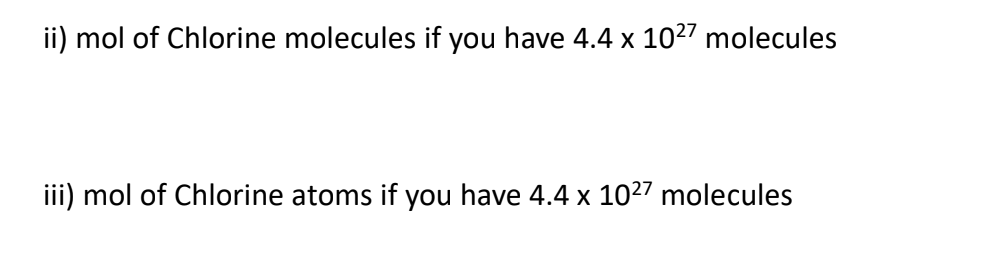
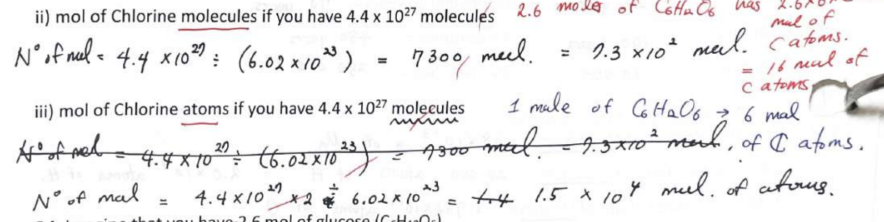

do c and e
c) 24.00g e) 36.87g

do b and d
b) 11.4 g
d) 66.5 g

do b c and e
b) 2.7 × 10⁻² mol
c) 6.29 × 10⁻³ mol
e) 1.00 × 10⁻¹ mol

do b, c, and d
b) 6.86 × 10²² atoms
c) 1.34 × 10²³ atoms
d) 7.07 × 10²³ atoms

Mass per molecule = 2.99 × 10⁻²² g
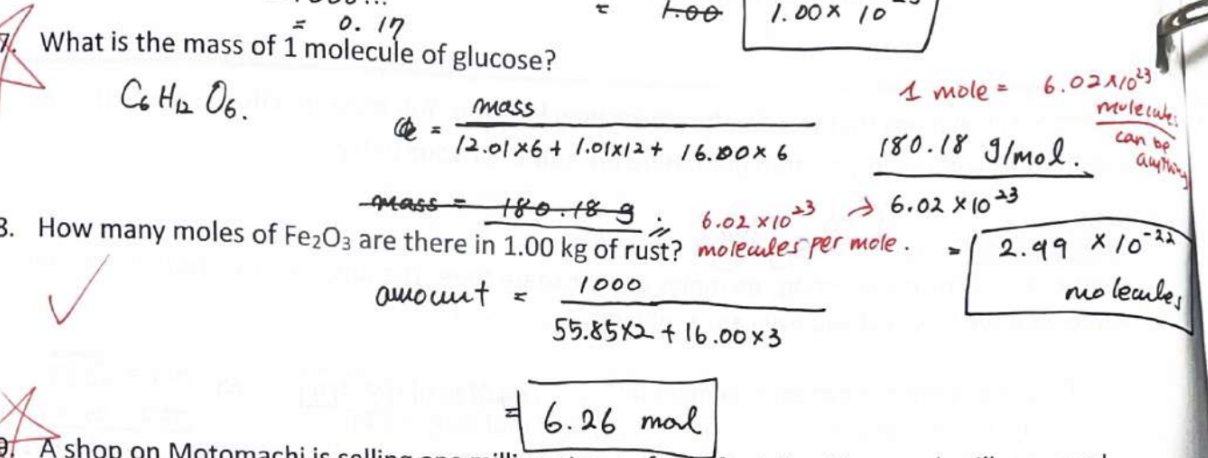

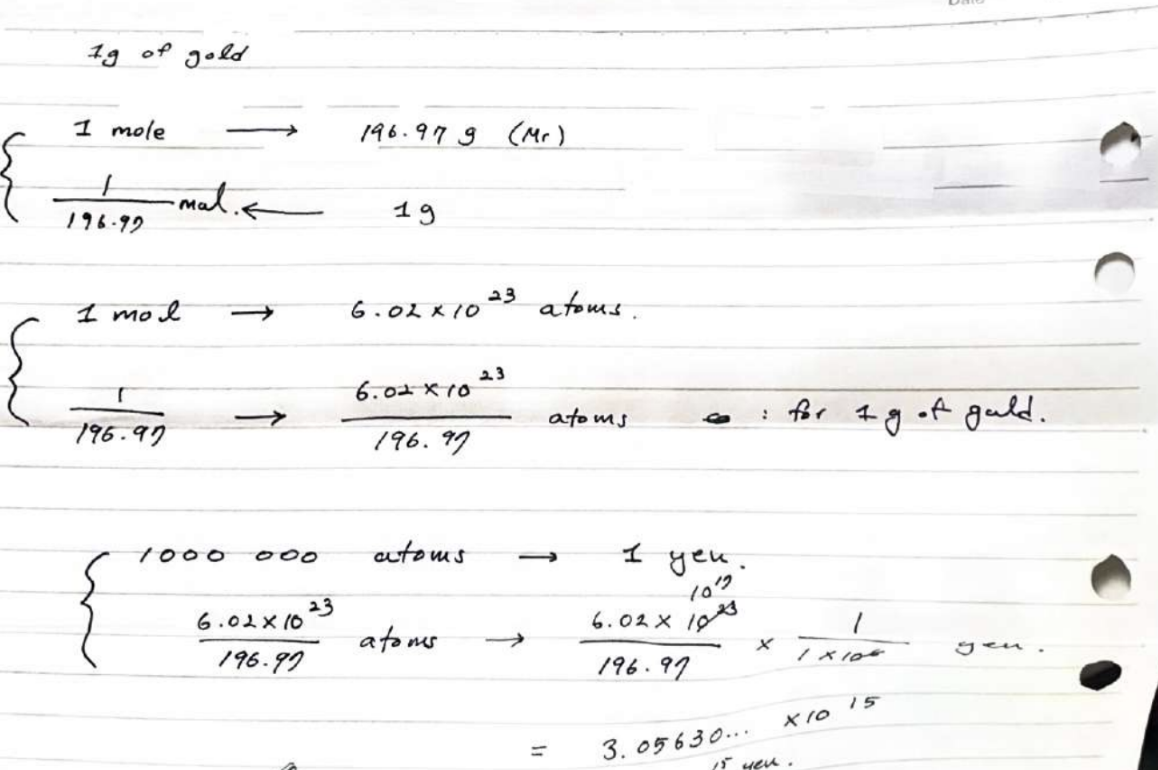
3.06 × 10¹⁵ yen
why should we never dissolve solid in a volumetric flask when making a standard solution
the narrow neck prevents proper mixing, stubborn solids can be difficult to dissolve or require unsafe heating, and undissolved solute changes the final solution volume and concentration

do b


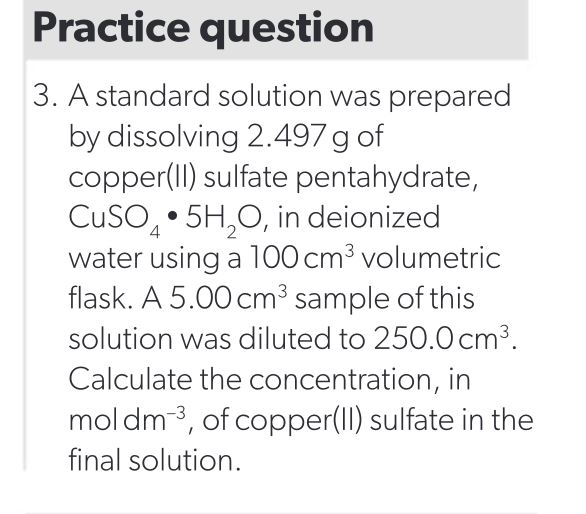
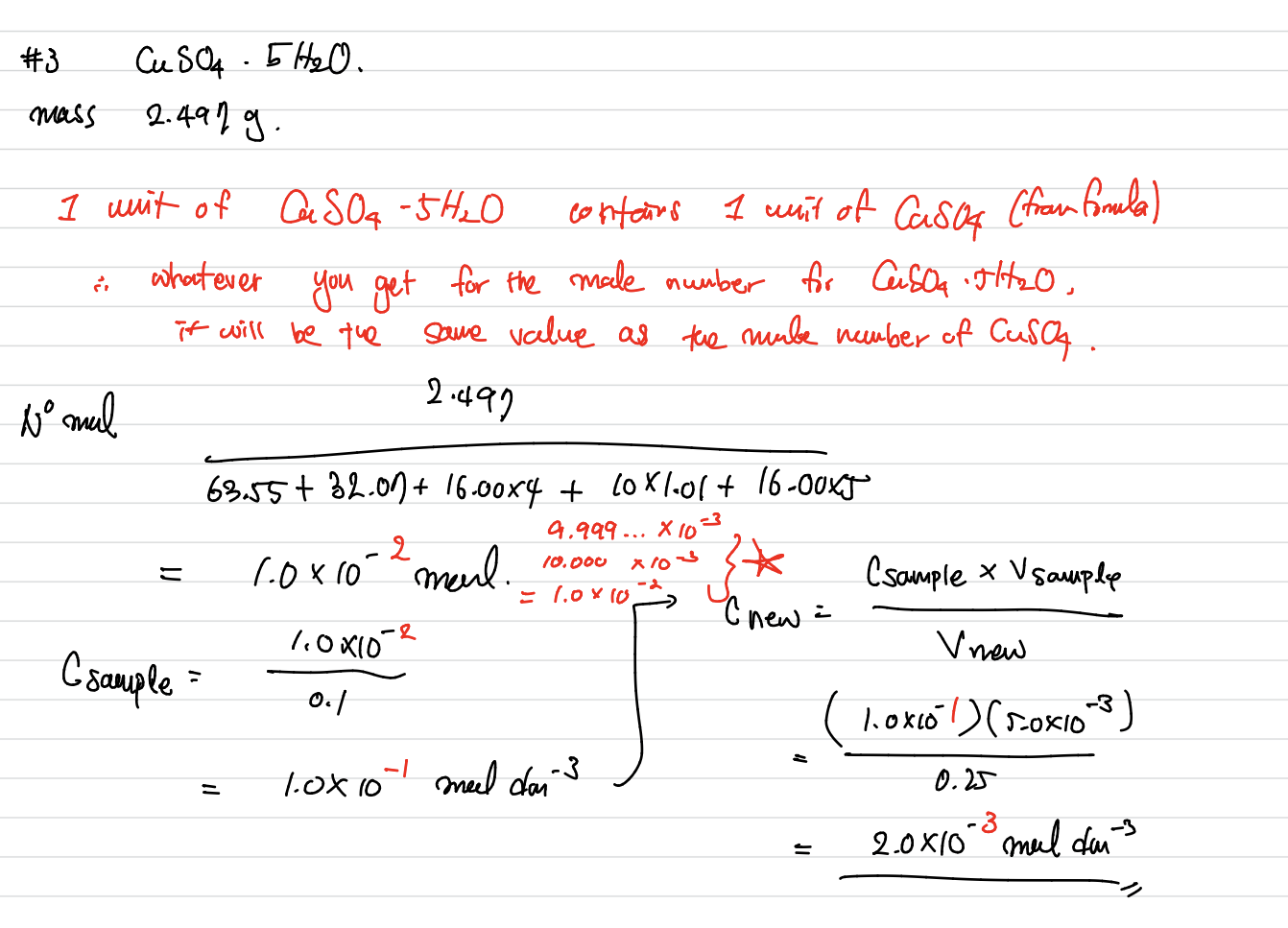
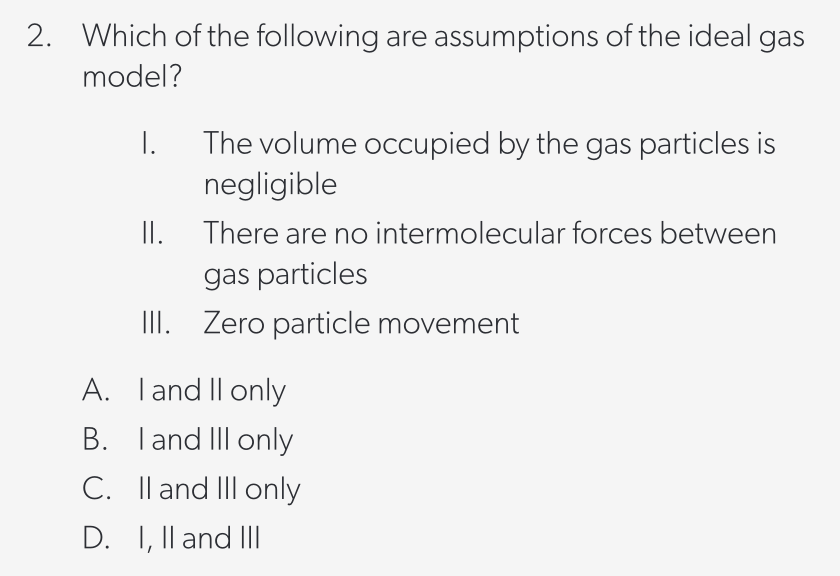
A
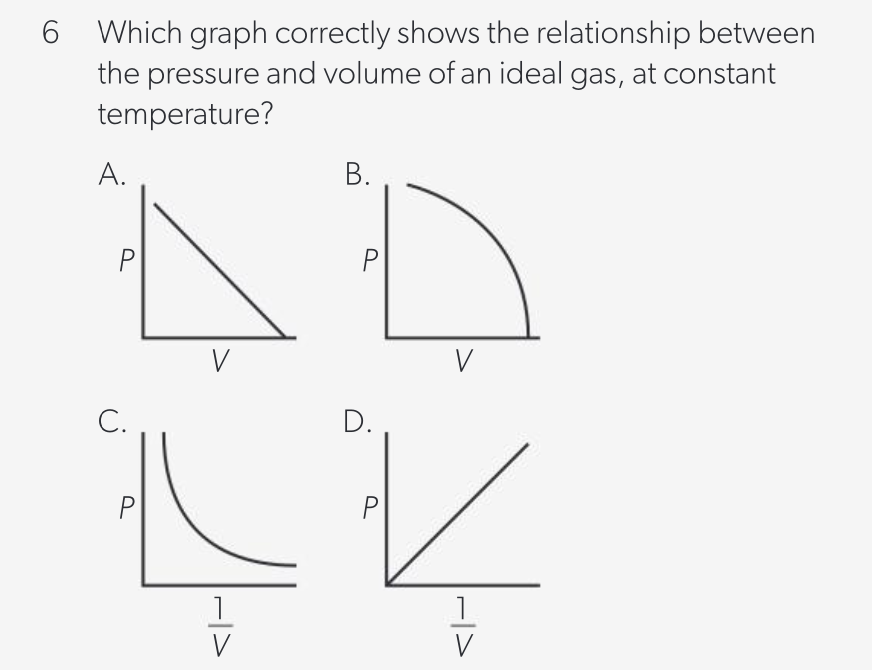
D
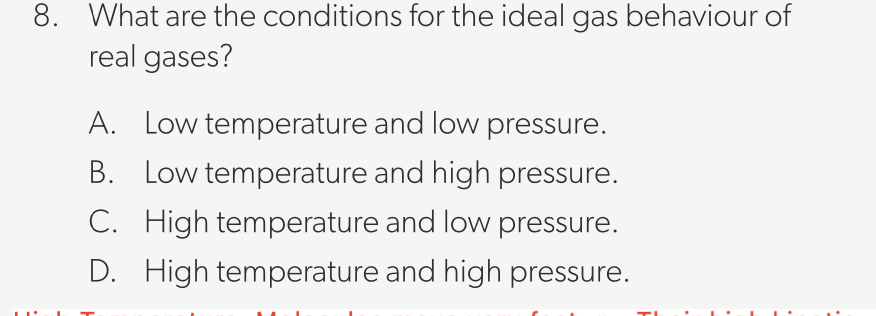
C
High Temperature: Molecules move very fast <>. Their high kinetic energy lets them overcome any weak intermolecular attractions.Low Pressure: Molecules are spaced very far apart. The actual volume of the gas particles becomes extremely small compared to the vast empty space around them

C

At low temperatures, the molecules of gases move slowly, so the intermolecular forces in real gases
cannot be neglected. If the temperature is low enough, a real gas will condense into a liquid while an
ideal gas will not. At high pressures, the volume occupied by the molecules of a real gas becomes
significant and thus cannot be neglected. The molecules themselves cannot be compressed, so the
relationship between pressure and volume deviates from that predicted by the ideal gas model.
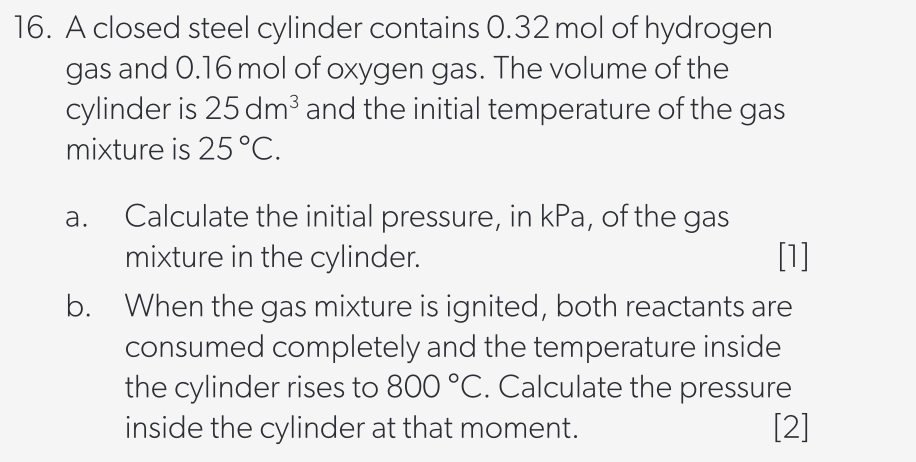
do b
