IB Microeconomics
0.0(0)
Studied by 0 people Call Kai
 Learn
Learn Practice Test
 Spaced Repetition
 Match
Match Flashcards
 Knowt Play
Card Sorting
1/288

There's no tags or description
Looks like no tags are added yet.
Last updated 3:45 AM on 7/27/26
Name | Mastery | Learn | Test | Matching | Spaced | Call with Kai | Chat |
|---|
No analytics yet
Send a link to your students to track their progress
289 Terms
1
New cards
Why might government regulation not always be the most effective policy for negative consumption externalities?
Regulation (e.g., age limits for tobacco) delivers immediate consumption reductions and clear compliance rules, but it is rigid: it cannot be practically applied to all goods (e.g., petrol use is hard to ration), imposes high monitoring and enforcement costs, and generates no government revenue. Indirect taxes are often more flexible: they internalize the externality via price signals, raise public revenue, and allow market-led adjustment, but they are far less effective when demand is price inelastic. Most governments use a combination of both policies.
2
New cards
What are the main barriers to entry that lead to monopoly formation?
Monopolies emerge when high barriers to entry block competing firms from joining the market. Key drivers include: natural economies of scale, where average costs fall continuously with output, making a single large firm the lowest-cost producer (a natural monopoly); legal protections like patents, copyrights, and exclusive government licenses that grant sole production rights; strategic entry deterrence, where incumbents control critical inputs, use predatory pricing, or build excess capacity to undercut new rivals; and network effects, where a product’s value rises with user numbers, creating a self-reinforcing dominant position that new firms cannot match.
3
New cards
What are the distributional consequences of price ceilings across different stakeholder groups?
Consumers: gain from lower prices and improved affordability for essential goods, but face permanent shortages and may incur time costs from queuing or rely on unregulated black markets. Producers: suffer from lower revenues and weaker profit incentives, and often cut product quality to reduce costs. Society as a whole incurs deadweight welfare loss due to underallocation of resources. Low-income households may gain access to goods, but non-price rationing can still exclude the most vulnerable groups.
4
New cards
Evaluate progressive income taxation as a tool for equity in terms of its efficiency trade-offs.
Progressive taxation narrows the income gap by taxing higher earners a larger share of their income, but extremely high top rates can reduce work incentives, discourage domestic investment, and drive high-skilled workers and firms abroad (e.g., France’s 75% top tax rate led to high-profile departures). However, moderate progressive taxes have minimal efficiency costs and can fund public goods that boost long-term economy-wide productivity. Empirically, the correlation between tax rates and work effort is weak for most income groups.
5
New cards
How effective are Pigouvian indirect taxes at correcting negative production externalities?
They internalize external costs by raising MPC to match MSC, generate government revenue, and create long-term incentives for firms to adopt cleaner technology. Key limitations: it is nearly impossible to accurately measure the monetary value of external costs (e.g., health damage from air pollution), so tax rates are rarely set at the socially optimal level. If demand for the good is price inelastic, equilibrium quantity falls very little, limiting environmental benefits. They also tend to be regressive, disproportionately burdening low-income households.
6
New cards
Compare the strengths and weaknesses of tradable pollution permits versus carbon taxes.
Permit advantages: directly cap total pollution levels, minimize total abatement costs across firms via trading, and reward firms that cut emissions fastest. Permit disadvantages: require costly monitoring and emissions verification; if the cap is set too high, permits have negligible environmental effect; large firms can hoard permits to block new market entrants. Carbon tax advantages: deliver predictable energy prices, are simpler to implement, and raise steady government revenue. Carbon tax disadvantages: do not guarantee a specific emission reduction quantity.
7
New cards
Is perfect competition always socially preferable to monopoly?
Perfect competition achieves static efficiency (allocative and productive) with lower prices and higher output, but it lacks dynamic efficiency: normal profits mean firms cannot fund large-scale R&D, and homogeneous products offer no consumer choice. Monopolies cause static welfare loss (higher prices, restricted output) but can deliver dynamic efficiency via supernormal profit-funded innovation, and may achieve such large economies of scale that unit costs fall below competitive levels. Natural monopolies in particular are more cost-efficient than multiple competing firms.
8
New cards
Why are formal cartel agreements inherently unstable in oligopolistic markets?
Each cartel member has a strong individual incentive to cheat by secretly undercutting the agreed price or exceeding output quotas to gain market share and higher short-run profit. Additional destabilizing factors: differences in production costs across members make quota agreements hard to negotiate; new non-cartel firms can enter the market and undercut prices; antitrust authorities impose heavy fines and offer leniency for whistleblowers, eroding trust between colluding firms.
9
New cards
Evaluate the overall effectiveness of nudge theory as a public policy tool.
Nudges are low-cost, preserve full consumer freedom of choice, and can effectively drive gradual behavioral change (e.g., opt-out pension schemes dramatically increase retirement savings rates). Limitations: they do not address structural causes of poor decision-making; effectiveness varies widely across income and cultural groups; they can be manipulative if used for commercial gain rather than social welfare. They work best alongside education and regulation, not as a standalone solution.
10
New cards
What are the economic arguments for and against agricultural price floors?
Arguments for: stabilize farmer incomes, protect rural livelihoods, and support national food security by maintaining domestic production capacity. Arguments against: create persistent surpluses that require costly government purchase and storage; raise food prices for consumers (with a regressive impact on low-income households); cause allocative inefficiency and deadweight welfare loss; surplus disposal can distort global trade via dumping.
11
New cards
How does bounded rationality challenge the traditional utility maximization model of consumer behavior?
Standard theory assumes consumers process all available information to calculate utility-maximizing choices. Bounded rationality recognizes that consumers face cognitive limits, time constraints, and imperfect information, so they rely on heuristics (rules of thumb) to "satisfice" — achieve acceptable outcomes — rather than maximize utility. This explains systematic deviations from rational choice, such as status quo bias and impulse purchasing, that standard theory cannot account for.
12
New cards
Is direct government provision the optimal solution for positive consumption externalities like healthcare?
Direct provision ensures universal access and can push output to the socially optimal level, correcting market underconsumption. Drawbacks: high fiscal opportunity cost funded via taxation; lack of profit incentive can lead to bureaucratic inefficiency, long waiting times, and underinvestment in innovation; governments may not accurately measure consumer preferences, leading to resource misallocation. Subsidies to private providers can preserve market incentives while expanding access.
13
New cards
What are the main barriers to international cooperation on global common-pool resources like the atmosphere?
The free-rider problem: individual nations benefit from global emission cuts without bearing the costs, so they have a strategic incentive to avoid commitments. National economic self-interest often overrides long-term environmental goals (e.g., developing nations prioritize growth over decarbonization). There is no global enforcement authority to penalize non-compliance. Historical inequities in emissions also create disagreement over which nations should bear the largest adjustment costs.
14
New cards
Evaluate the impact of a statutory minimum wage on both employment levels and equity.
Equity benefit: raises living standards for low-wage workers who remain employed and reduces pay inequality; employment effects are minimal in monopsony labor markets where firms have wage-setting power. Efficiency risk: if set well above market equilibrium in competitive labor markets, it can cause real-wage unemployment as firms cannot afford higher labor costs, particularly harming young and low-skilled workers. Empirical studies (e.g., Card & Krueger) show moderate minimum wage increases have negligible employment effects.
15
New cards
Why can governments almost never set the perfectly optimal Pigouvian tax or subsidy rate?
External costs and benefits are non-market goods with no observable market price, so their monetary value cannot be precisely measured (e.g., there is no definitive value for a human life saved by cleaner air). Policy makers also lack perfect information about individual firm costs and consumer preferences. Political lobbying pressures often lead to taxes being set too low or subsidies too high, failing to fully internalize the externality.
16
New cards
Does privatization of natural monopolies improve economic efficiency?
Potential benefits: private firms have profit incentives to cut operating costs and improve service quality; reduces government fiscal burden and debt. Risks: private monopolies have strong incentives to raise prices and restrict output to maximize profit, worsening allocative inefficiency; they may underinvest in long-term infrastructure to boost short-term dividends. Most countries use regulated privatization with price caps (e.g., RPI-X) to limit monopoly power, but this creates risks of regulatory capture by the industry.
17
New cards
How does the principal-agent problem distort firm objectives and reduce efficiency?
The separation of ownership (shareholders) and control (managers) creates conflicting incentives: shareholders want maximum profit, while managers may pursue revenue growth, market share, or prestige perks that maximize their own utility at the expense of shareholder returns. This leads to profit satisficing rather than profit maximization. Common solutions include performance-related pay, share option schemes, and active shareholder oversight to align manager and owner interests.
18
New cards
Evaluate education and awareness campaigns as a policy to reduce demerit good consumption.
Strengths: address the root cause of overconsumption (imperfect information and bounded rationality); can permanently shift consumer preferences and reduce demand long-term; avoid the regressive impact of indirect taxes on low-income households. Weaknesses: require large government spending with significant opportunity cost; take years to change population behavior; may be ineffective for highly addictive goods like opioids or tobacco. They work best when combined with taxation and regulation.
19
New cards
What are the economic arguments for and against corporate social responsibility (CSR)?
Arguments for: builds long-term brand reputation and customer loyalty; reduces regulatory and reputational risk; improves employee morale and productivity; can drive innovation in sustainable technologies. Arguments against: diverts resources from profit maximization, the primary fiduciary duty to shareholders; many CSR initiatives are superficial "greenwashing" with no measurable social benefit; higher operating costs can make firms less competitive in international markets.
20
New cards
Can collective self-governance solve the tragedy of the commons?
Elinor Ostrom’s research shows local communities can successfully manage shared resources via self-imposed rules, community monitoring, and peer enforcement — without state intervention or private property rights. Success depends on strong social trust, clear community boundaries, and small-scale, geographically defined resources. It reliably fails for large, global commons (e.g., open-ocean fisheries, climate) where users are dispersed, social norms are weak, and cross-border enforcement is impossible.
21
New cards
How does price elasticity of demand determine the effectiveness of indirect taxes on demerit goods?
If demand is price elastic (PED > 1), a tax raises price and causes a proportionally larger fall in quantity demanded, making the tax highly effective at reducing consumption. If demand is price inelastic (PED < 1, typical for addictive demerit goods like cigarettes), the same tax causes only a small fall in quantity consumed — the tax mostly raises prices for consumers rather than changing behavior. In this case, taxes generate large government revenue but do little to reduce overconsumption.
22
New cards
Evaluate the welfare effects of third-degree price discrimination for consumers and firms.
Firms benefit: higher total revenue and profit by charging higher prices to consumers with inelastic demand and lower prices to elastic-demand consumers, capturing more consumer surplus. Consumer outcomes are mixed: price-sensitive groups (e.g., students, seniors) benefit from lower prices and greater access; other groups pay higher prices and lose consumer surplus. Overall, price discrimination can increase total market output and reduce deadweight loss compared to a single-price monopoly, improving allocative efficiency.
23
New cards
What are the short-run vs long-run efficiency outcomes in monopolistic competition?
Short run: firms can earn supernormal profit by differentiating products, but they are allocatively inefficient (P > MC) and productively inefficient (produce above minimum ATC). Long run: free market entry erodes supernormal profit, leaving firms earning normal profit with persistent excess capacity. Consumer benefit from product variety partially offsets the static inefficiency, as differentiated goods better match diverse consumer preferences.
24
New cards
Is high market power always detrimental to consumer welfare?
High market power creates static welfare losses (higher prices, lower output), but it can benefit consumers dynamically: supernormal profits fund R&D that leads to better products and lower long-run costs (e.g., pharmaceutical innovation relies on patent monopolies). Large firms also achieve economies of scale that lower unit costs, some of which may be passed to consumers. The net welfare effect depends on whether dynamic efficiency gains outweigh static efficiency losses.
25
New cards
Why do governments typically use multiple policy tools rather than one single tool to correct market failure?
No single policy addresses all causes of a given market failure. For example, reducing smoking requires: taxes to raise prices, regulation to restrict public consumption, and education campaigns to shift long-term preferences — each targeting a different driver of overconsumption. Combining policies also mitigates the weaknesses of individual tools: taxes raise revenue to fund education; regulation delivers immediate reductions while education works gradually over the long term.
26
New cards
How does contestable market theory change our assessment of monopoly performance?
In contestable markets, the credible threat of new entry forces incumbent firms to behave more competitively even if they currently hold 100% market share. Incumbents will limit price increases, reduce costs, and invest in innovation to deter entry, approaching competitive efficiency outcomes. The theory implies that market structure alone does not determine performance — barriers to entry and exit are far more important. However, sunk costs and strategic entry deterrence (e.g., predatory pricing) can make markets far less contestable in practice.
27
New cards
How does adverse selection cause market failure in private insurance markets?
Adverse selection occurs before a transaction: insurance buyers know more about their own risk level than insurers. High-risk consumers are most likely to buy insurance at average prices, while low-risk consumers drop out, driving up average costs and premiums. This creates a "death spiral": as premiums rise, more low-risk consumers exit, until only the highest-risk buyers remain and the market collapses. Mandatory universal insurance is a common policy solution.
28
New cards
Evaluate production subsidies as a tool to correct positive production externalities like clean energy R&D.
Benefits: lower production costs, increase output to the socially optimal level, reduce consumer prices, and accelerate green technology adoption. Limitations: impose large fiscal costs with high opportunity cost for government budgets; it is difficult to calculate the exact size of the external benefit, so subsidies may be too small or excessively large; they can protect inefficient firms from market competition if kept in place permanently.
29
New cards
What are the economic consequences of black markets emerging under price ceilings?
Black markets allow sellers to charge prices far above the legal maximum, undermining the original policy goal of affordability. Goods are allocated to consumers willing to pay the highest price rather than those most in need, worsening equity outcomes. They also reduce government tax revenue, erode respect for the law, and often involve unregulated lower-quality goods that pose consumer safety risks.
30
New cards
Does the law of diminishing marginal returns apply in the long run?
No — the law of diminishing marginal returns is strictly a short-run concept. It depends entirely on at least one fixed factor of production (usually physical capital). In the long run, all factors of production are variable, so firms can scale up all inputs proportionally. Long-run cost behavior is instead explained by economies and diseconomies of scale, which determine the shape of the long-run average cost curve.
31
New cards
Evaluate whether monopolies are overall beneficial or harmful to social and consumer welfare?
Monopolies impose clear static welfare losses: they restrict output below the competitive equilibrium level and set prices above marginal cost, creating deadweight loss and transferring consumer surplus to producer profit. However, they can deliver meaningful dynamic benefits: persistent supernormal profits fund large-scale research and development, driving product innovation and long-run cost reductions that benefit consumers over time. Natural monopolies also achieve economies of scale that deliver lower unit costs than fragmented competitive markets could. The net effect depends on whether dynamic efficiency gains and scale economies outweigh static allocative inefficiency, and whether the market faces credible entry threats.
32
New cards
Must public goods always be directly produced and operated by the government?
Government funding is necessary to solve the free-rider problem, but direct operation is not the only option. Contracting out (outsourcing delivery to private firms via competitive tender) can retain private sector efficiency while ensuring public funding. However, contracting out requires strong independent monitoring to prevent private firms from cutting service quality to boost profits. For impure public goods, user charges (e.g., road tolls) can partially fund provision. The government’s core role is funding, not necessarily direct operation.
33
New cards
What determines whether the burden of an indirect tax falls more on consumers or producers?
(PED < PES): Consumers bear most of the tax burden because they cannot easily switch away from the good.
(PED > PES): producers bear most of the burden because they cannot easily pass price increases to consumers without losing large sales volume.
34
New cards
Evaluate individual transferable fishing quotas for managing common-pool fish stocks.
Advantages: cap total allowable catch to prevent overfishing; allocate catch efficiently via trading (low-cost fishermen catch more, high-cost fishermen sell quotas); reward sustainable operators. Disadvantages: quota allocation rules (e.g., grandfathering) often favor large incumbent firms unfairly; monitoring and enforcement at sea are costly; illegal, unreported fishing undermines the total cap. They work best for well-defined coastal fisheries, not for high-seas migratory stocks.
35
New cards
How does moral hazard reduce efficiency in insurance and financial markets?
Moral hazard occurs after a transaction: insured parties take more risks because they do not bear the full cost of negative outcomes. For example, deposit insurance can encourage banks to make riskier loans; health insurance can lead patients to overuse medical services. This raises overall system costs and premiums, creating allocative inefficiency. Common policy responses include deductibles, co-pays, and regulatory capital requirements.
36
New cards
What is the relationship between economies of scale and market concentration?
Large economies of scale mean average costs fall sharply as output increases, so a single large firm can produce far more cheaply than multiple small firms. This creates natural monopoly, where high market concentration is both inevitable and cost-efficient. If economies of scale are modest (minimum efficient scale is small relative to total market size), many firms can operate efficiently, leading to competitive market structures. Very large economies of scale are also a major structural barrier to entry.
37
New cards
What are the most important causes of government failure in market intervention?
1) Imperfect information: policy makers lack precise data on external costs and benefits, leading to incorrectly calibrated tax or subsidy rates. 2) Political self-interest: politicians prioritize short-term electoral gains over long-term economic efficiency. 3) Regulatory capture: regulated industries influence regulators to set rules favorable to firms rather than society. 4) Administrative costs: enforcement and bureaucracy eat into net welfare gains. 5) Unintended consequences: e.g., price ceilings create parallel black markets.
38
New cards
Is product differentiation in monopolistic competition socially beneficial?
Benefits: product variety allows consumers to find goods that match their unique tastes, increasing overall utility. Differentiation also drives innovation in quality and design as firms compete on non-price factors. Costs: firms spend heavily on persuasive advertising that wastes resources and manipulates consumer preferences; excess capacity means each firm operates above minimum average cost, raising prices for consumers.
39
New cards
How does the kinked demand curve model explain price stickiness in oligopolies?
The model assumes rival firms will always match price cuts but will never match price increases. If a firm raises its price, it loses many customers (elastic demand above the kink). If it cuts its price, rivals match immediately so it gains very few customers (inelastic demand below the kink). This creates a vertical gap in the MR curve, meaning marginal costs can fluctuate within a wide range without changing the profit-maximizing price or output, leading to stable prices even when costs change.
40
New cards
Evaluate universal basic income (UBI) as a policy to reduce poverty and inequality.
Advantages: eliminates the poverty trap by not withdrawing benefits as earnings rise; simple to administer with low bureaucracy; gives recipients full freedom to spend according to their own needs. Disadvantages: extremely high fiscal cost requiring large tax increases; may reduce labor supply for low-wage workers; does not target help to the most vulnerable groups (universal payments go to wealthy households too). It is far less cost-effective than targeted welfare at reducing poverty per dollar spent.
41
New cards
Why are primary commodity prices much more volatile than prices of manufactured goods?
Both demand and supply of primary commodities are highly price inelastic. Supply is inelastic due to long agricultural production cycles and fixed land or resource stocks. Demand is inelastic because primary goods are necessities with few close substitutes. Small shifts in supply (e.g., harvest failures) or demand (e.g., minor income changes) therefore cause very large price swings. Manufactured goods have more elastic supply (flexible factory production) and more elastic demand (more substitutes), so prices are far more stable.
42
New cards
Evaluate the impact of advertising on market efficiency and consumer welfare.
Informative advertising improves efficiency by reducing asymmetric information, helping consumers compare products and make better choices. Persuasive advertising is welfare-reducing: it manipulates consumer tastes, creates artificial brand loyalty that raises barriers to entry, and wastes resources that could be used for productive purposes. Advertising can also increase market power by differentiating products, allowing firms to charge higher markups over marginal cost.
43
New cards
Why is the production possibilities frontier (PPF) bowed outward (concave to the origin)?
The concave shape reflects the principle of increasing opportunity cost. As an economy produces more of one good, it must give up increasing amounts of the other good because resources are not equally suited to both uses. Workers and capital specialized in Good A become progressively less productive when shifted to Good B, so each additional unit of Good B costs more and more Good A foregone.
44
New cards
Does a national minimum wage reliably reduce household poverty?
It directly raises earnings for low-wage workers who remain employed, reducing in-work poverty. However, if it causes significant low-skilled unemployment, it pushes some workers out of formal work entirely, increasing poverty. The net effect depends on: how high the minimum wage is set relative to the market equilibrium; the elasticity of labor demand; and whether there is monopsony power in the labor market. In monopsony labor markets, a moderate minimum wage can both raise wages and increase employment.
45
New cards
What is the relationship between marginal cost and average total cost, and why does it matter for efficiency?
When MC < ATC, ATC is falling. When MC > ATC, ATC is rising. The MC curve always intersects the ATC curve at its minimum point. This matters because minimum ATC is the point of productive efficiency — the lowest possible unit production cost. Firms operating at this point are using resources in the most productively efficient way; producing anywhere else means higher average costs and wasted resources.
46
New cards
Does deregulation always improve market efficiency?
Deregulation reduces entry barriers, increases competitive pressure, and cuts administrative costs, which can improve allocative and productive efficiency in markets with excessive red tape. However, deregulation can worsen outcomes in markets with natural monopolies, information asymmetries, or large negative externalities. For example, financial deregulation can lead to excessive risk-taking and systemic crisis; environmental deregulation increases pollution externalities and public health costs.
47
New cards
How do minimum wage laws affect firms, workers, and government differently?
Workers: low-wage employees get higher take-home pay, but some may lose jobs or have working hours reduced. Firms: face higher labor costs and lower profits, which may lead them to substitute capital for labor or raise product prices. Government: pays less in in-work welfare benefits, collects more payroll tax revenue, but may face higher unemployment benefit costs if jobs are lost. Overall employment effects are small in most real-world cases with moderately set minimum wages.
48
New cards
Can brand reputation solve asymmetric information problems without government intervention?
Brand reputation is an important private-market solution to adverse selection: firms invest in building trusted brands to signal high quality to uninformed consumers. Reputable firms can charge price premiums and retain repeat customers, while low-quality firms cannot easily build such reputations. Limitations: reputation takes years to build, creating barriers to entry for new firms; firms may slowly cut quality to exploit reputation for short-term profit.
49
New cards
Why is the marginal cost curve the supply curve for a perfectly competitive firm?
A perfectly competitive firm maximizes profit where P = MC. For any given market price, the firm will choose the output level where price equals marginal cost, as long as price is above average variable cost (the shut-down condition). Therefore, the upward-sloping portion of the MC curve above the minimum AVC point directly shows how much quantity the firm will supply at each price — which is exactly the definition of a firm supply curve.
50
New cards
Why can government intervention to regulate monopolies sometimes reduce overall economic efficiency?
Monopoly regulation often backfires due to information limitations and unintended consequences. Price caps set below the optimal level can erode firms’ profit margins, cutting investment in infrastructure, innovation, and service quality over the long run. Rigid regulatory rules fail to adapt to shifting market conditions, creating productive inefficiency and bureaucratic delay. Regulatory capture allows incumbent firms to influence rule-setting to protect their market power, raising barriers for new entrants rather than promoting competition. Forcibly breaking up natural monopolies destroys economies of scale, leading to higher average production costs for society. Excessive antitrust enforcement can also penalize firms that grew large through legitimate innovation, discouraging entrepreneurial risk-taking economy-wide.
51
New cards
Law of Demand
The inverse relationship between price and quantity demanded, ceteris paribus. As price increases, quantity demanded decreases because consumers face higher opportunity costs and reduced purchasing power.
52
New cards
Income Effect
Explanation for the downward slope of demand: as price falls, consumer purchasing power (real income) rises, enabling consumers to buy more of the product with the same nominal income.
53
New cards
Substitution Effect
Explanation for the downward slope of demand: as the price of a good falls, it becomes relatively cheaper compared to alternatives, prompting consumers to substitute away from higher-priced substitutes toward this good.
54
New cards
Law of Diminishing Marginal Utility
The economic principle stating that as additional units of a good are consumed within a given timeframe, the extra satisfaction (marginal utility) derived from each successive unit decreases, meaning buyers will only purchase additional units at lower prices.
55
New cards
Market Demand
The total horizontal summation of all individual consumer demand curves in a market at every price point.
56
New cards
Non-Price Determinants of Demand (RIPEN)
Factors that shift the entire demand curve left or right: Related goods (substitutes/complements), Income, Preferences/tastes, Expectations of future prices, and Number of buyers.
57
New cards
Shift vs Movement along Demand Curve
A change in price causes a movement along the static demand curve (change in quantity demanded), whereas a change in a non-price determinant shifts the entire demand curve (change in demand).
58
New cards
Normal Good vs Inferior Good
A normal good experiences increased demand when real consumer income rises (YED > 0), whereas an inferior good experiences decreased demand as income rises because consumers switch to superior alternatives (YED < 0).
59
New cards
Substitute Goods
Goods that satisfy similar needs. An increase in the price of Good A shifts the demand curve for Good B to the right as consumers substitute away from A to B.
60
New cards
Complementary Goods
Goods consumed together. An increase in the price of Good A increases its cost of joint consumption, shifting the demand curve for Good B to the left.
61
New cards
Law of Supply
The direct relationship between price and quantity supplied, ceteris paribus. Higher prices increase producer revenue per unit, covering rising marginal production costs and incentivizing expanded output.
62
New cards
Non-Price Determinants of Supply
Factors shifting the entire supply curve: costs of factors of production, technology, government intervention (taxes/subsidies), price expectations, prices of related goods in competitive/joint supply, and number of sellers.
63
New cards
Market Equilibrium
The state where quantity demanded equals quantity supplied (Qd = Qs), establishing a market-clearing price where there is neither excess demand (shortage) nor excess supply (surplus).
64
New cards
Price Mechanism - Signaling Function
Prices act as information signals in free markets; a price rise signals to producers that demand is high, prompting them to allocate more resources to that market.
65
New cards
Price Mechanism - Incentive Function
Price changes incentivize profit-oriented producers to adjust production; higher market prices raise profitability per unit, incentivizing firms to expand output.
66
New cards
Price Mechanism - Rationing Function
Prices ration scarce goods among buyers; when market supply is limited, prices rise until quantity demanded shrinks to equal available supply, limiting consumption to those willing and able to pay.
67
New cards
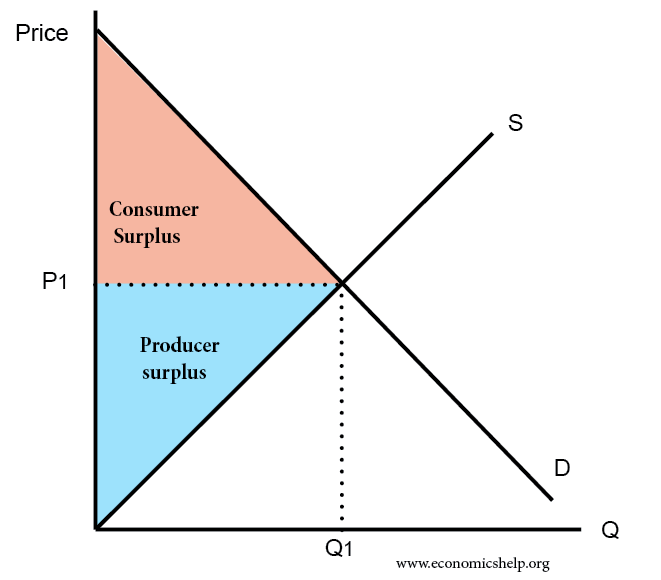
Consumer Surplus
The difference between the maximum price consumers are willing to pay for a product and the actual market price they pay, measured visually as the area under the demand curve and above the market price.
68
New cards
Producer Surplus
The difference between the minimum price producers are willing to accept to supply a product and the actual market price received, measured visually as the area above the supply curve and below the market price.
69
New cards
Community Surplus
The total social benefit generated in a market, calculated as Consumer Surplus plus Producer Surplus. It is maximized at free market equilibrium where MSB = MSC.
70
New cards
Allocative Efficiency
A state where resources are allocated to produce the exact combination of goods most desired by society, occurring where price equals marginal cost (P = MC) or marginal social benefit equals marginal social cost (MSB = MSC).
71
New cards
Consumer Rationality Assumption
Traditional economic assumption that consumers possess stable preferences, act out of self-interest, and logically calculate costs and benefits to make optimal purchasing decisions.
72
New cards
Utility Maximization Assumption
The assumption that rational consumers spend their limited income across goods in a manner that maximizes their total utility, allocating expenditure until marginal utility per dollar spent is equalized across all goods.
73
New cards
Perfect Information Assumption
The assumption that buyers and sellers possess complete, instantaneous, and symmetric knowledge regarding prices, quality, utility, and market alternatives.
74
New cards
Bounded Rationality
Herbert Simon's concept that human decision-making is constrained by cognitive limits, incomplete information, and time constraints, leading individuals to "satisfice" rather than optimize.
75
New cards
Bounded Self-Control
The human limitation where individuals lack the willpower to execute decisions that align with their long-term best interests, resulting in impulsive choices or overconsumption of short-term rewards.
76
New cards
Bounded Selfishness
The behavioural observation that humans are not purely self-interested economic agents but routinely demonstrate altruism, fairness, and social preferences even at personal financial cost.
77
New cards
Rule of Thumb (Heuristics)
Mental shortcuts or general rules used to simplify complex decision-making, which reduce cognitive load but often introduce systemic cognitive biases.
78
New cards
Anchoring Bias
The tendency for individuals to rely excessively on the first piece of information received (the "anchor") when making subsequent estimates or financial decisions.
79
New cards
Framing Bias
The phenomenon where decision-making is heavily influenced by how information or choices are presented (e.g., highlighting positive vs negative aspects).
80
New cards
Availability Bias
The cognitive bias where consumers overestimate the probability of events based on how easily recent or dramatic examples can be recalled from memory.
81
New cards
Choice Architecture
The intentional design of environments in which choices are presented to consumers to influence their decisions without removing their freedom of choice.
82
New cards
Default Choices
A choice architecture strategy where a specific option is pre-selected for consumers if they take no active action, dramatically increasing participation rates (e.g., organ donation opt-out systems).
83
New cards
Restricted Choice
Limiting the number or variety of options available to consumers to prevent decision paralysis and guide them toward optimal selections.
84
New cards
Mandated Choice
A choice architecture structure forcing individuals by law or procedure to make an explicit decision among alternatives before proceeding (e.g., required decision on voter registration).
85
New cards
Nudge Theory
Richard Thaler's concept of altering choice architecture to predictably steer human behavior toward socially desirable outcomes without banning options or altering financial incentives.
86
New cards
Profit Maximization Objective
The traditional assumption that firms operate to achieve the maximum possible difference between total revenue and total cost, producing where marginal cost equals marginal revenue (MC = MR).
87
New cards
Corporate Social Responsibility (CSR)
A business objective where firms integrate environmental, social, and ethical considerations into their operations, accepting lower short-term profits to build long-term stakeholder value.
88
New cards
Market Share Maximization
A strategic objective where a firm lowers prices or expands marketing to capture the largest percentage of total industry sales revenue, gaining economies of scale and market dominance.
89
New cards
Satisficing Objective
An alternative corporate goal where managers aim to achieve an acceptable baseline level of profit or performance to satisfy shareholders while simultaneously pursuing non-monetary goals.
90
New cards
Revenue Maximization Objective
A firm goal focused on maximizing total sales revenue rather than profit, producing at the output level where marginal revenue equals zero (MR = 0).
91
New cards
Growth Maximization Objective
An operational objective prioritizing business expansion (by sales volume, physical assets, or employee count) over profit maximization, often driven by managerial power and salary incentives.
92
New cards
Price Elasticity of Demand (PED)
A measure of the responsiveness of quantity demanded to a change in price, calculated as % change in Quantity Demanded divided by % change in Price.
93
New cards
PED Formula
PED = (% change in Quantity Demanded) / (% change in Price). Because price and quantity move in opposite directions, PED is always negative, but economists evaluate its absolute value.
94
New cards
Price Elastic Demand (PED > 1)
Condition where quantity demanded changes by a larger percentage than price. The demand curve is relatively flat; price increases lead to a fall in total revenue.
95
New cards
Price Inelastic Demand (PED < 1)
Condition where quantity demanded changes by a smaller percentage than price. The demand curve is relatively steep; price increases lead to an increase in total revenue.
96
New cards
Unitary Price Elasticity of Demand (PED = 1)
Condition where percentage change in quantity demanded exactly equals percentage change in price. A change in price leaves total revenue completely unchanged.
97
New cards
Perfectly Inelastic Demand (PED = 0)
A vertical demand curve showing that quantity demanded remains completely unchanged regardless of price changes (e.g., lifesaving medications like insulin).
98
New cards
Perfectly Elastic Demand (PED = infinity)
A horizontal demand curve showing that consumers will purchase any quantity at price P, but quantity demanded drops to zero if price increases even slightly.
99
New cards
Determinants of PED (HINTS)
Factors determining PED elasticity: Habits/addictiveness, Income proportion spent on the good, Necessity level, Time period available to adjust, and Substitutes available (number and closeness).
100
New cards
PED and Total Revenue Relationship
If demand is elastic (PED > 1), price and total revenue move in opposite directions. If demand is inelastic (PED < 1), price and total revenue move in the same direction. Total revenue is maximized where PED = 1.