HUMAN BIO - MEACHNISMS AND EVIDENCE OF EVOLUTION
 Call Kai
 Learn
Learn Practice Test
 Spaced Repetition
 Match
Match Flashcards
 Knowt Play
1/68

There's no tags or description
Looks like no tags are added yet.
Name | Mastery | Learn | Test | Matching | Spaced | Call with Kai | Chat |
|---|
No analytics yet
Send a link to your students to track their progress
69 Terms
define mutation
A permanent change in the DNA sequence of an organism
define Autosomal
non-sex chromosomes in human cells
define Sex-linked
genetic traits or disorders whose controlling genes are located on the
define karyotype
an individual’s complete set of chromosomes
define Genotype
an organisms genetic information
define Phenotype
Set off observable physical traits
define population
group of individuals of the same species
define gene pool
the combination of all the genes (including alleles) present in a reproducing population or species
define allele
A specific variation of a gene
define allele frequency
measures how common a specific variant (allele) is within a population
define mutant
An organism with a characteristic resulting from a mutation
Define mutagen. Give 4 examples.
An environmental agent that increase the rate of mutation
1. Mustard gas
2. X-rays
3. Cosmic rays
4. Sulphur dioxide
Distinguish between Somatic and germline mutations
Somatic- only the individual’s body cells is affected with the mutations and can’t pass onto the next generation
Germline- affects reproductive cells and can be passed onto the next generation, individual is usually not affected by the mutation.
Distinguish between Induced and spontaneous mutations
Induced- mutagens in the environment
Spontaneous- random error in a biological process such as mitosis or meiosis
Distinguish between Missense, Nonsense, neutral and silent mutations.
Nonsense- change in the base sequence to the code STOP (causes a shorter protein)
Neutral- cause a change in the amino acid, however, the amino acid is of the same type and does not change the structure of the protein enough to change its function.
Silent- do not cause any change in the amino acid, and therefore in the protein produced.
Distinguish between Frameshift mutations and Point mutations
Frameshift- occurs when a base has been added or removed and affects all DNA from that point
Point- changed in a single nucleotide and therefore 1 base
Name and describe the types of chromosome mutations (eg, translocation, non-disjunction, inversion, deletion)
Translocation- part of a chromosome breaks off and is rejoined to the wrong chromosome
Non-disjunction- during meiosis, a chromosome pair does not separate and so one daughter cell has an extra chromosome, and the other cell has one less than the normal number
Inversion- breaks occur in a chromosome and the broken piece joins back in, but the wrong way around
Define aneuploidy, monosomy, trisomy.
Aneuploidy- when a cell has an abnormal number of chromosomes
Monosomy- when a cell is missing a single chromosome from a pair
Trisomy- when a cell has an extra chromosome in a pair
Briefly outline the structure of DNA?
A double helix, each side of which is a long string of four types of nucleotides.
Where is DNA found? Are there any cells that do not contain DNA?
In eukaryotic cells- it is stored in the nucleus but small amounts are also found in the mitochondria. Red blood cells, platelets and mature skin, hair and nail cells don’t contain a nucleus
What is DNA sequencing and what is it used for?
DNA sequencing is the determination of the order of nucleotides in a DNA sample. Used to compare DNA between different species, also used in the comparison between sequences in families to identify those affected and not affect by a disease.
9. How has DNA sequencing helped in the treatment of disease?
It can identify point mutations as well as insertions and deletions in DNA.
Explain the process of gel electrophoresis.
1. DNA is cut using special enzymes called restriction enzymes at a specific base sequence.
2. the fragments are then placed in small wells on a bed of semi solid electrophoresis gel
3. an electrical current is then passed through the gel and the negatively charged DNA moves through the gel towards the positive electrode
4. smaller DNA fragments move faster and further through the gel than larger fragments producing a banding pattern.
What is a "DNA profile"? Describe the benefits have arisen as a result of this technique.
-DNA profile is banding pattern formed in Gel electrophoresis
- is used in forensic science and tracing ancestry
-Used in identification of hereditary diseases like Cystic fibrosis and Huntington’s disease
What is the main purpose of Polymerase chain reaction (PCR)?
To amplify specific fragments of DNA
Outline the steps in PCR.
1. denaturing- DNA heated to sperate it into 2 strands
2. Annealing- A primer with complementary base sequences is added to bind with the DNA to initiate replication
3.Extension- DNA polymerase and free nucleotides are added so that the DNA is replicated
What is meant by "amplification"?
To make more copies of
What is Taq polymerase? Why is it used?
A DNA polymerase extracted from a heat loving bacterium, it is used because it doesn’t denature when heated
What is meant by "gene therapy"? What is meant by "gene therapy"?
Gene therapy is a technique that treats or cures genetic abnormalities by identifying faulty genes and inserting healthy ones.
Darwin's theory of Natural Selection is based on 3 observations... what are they?
- Variation
- Birth rate
- Nature’s balance
Explain Darwin's theory of Natural Selection. Be sure to include an explanation of the terms "struggle for existence" and "survival of the fittest"
Because of excessive birth rates and limited resources, there must be a struggle for existence and those with characteristics best suited to the environment are more likely to survive and reproduce, this is called survival of the fittest.
Explain how the peppered moth is used as an example of Natural Selection
Some moths are light in colour, some are dark. Because of the trees being covered in black soot, the light-coloured moths were killed before they can reproduce and over time, the favoured camouflaged black coloured moths dominated over the light coloured moths.
What effect does Natural Selection have on allele frequencies of a population?
If the environment tends to favour a particular characteristic, more of the alleles for that trait will be passed on to the next generation.
Provide human examples of traits favoured by Natural Selection.
Body stature:
- Short body, long limbed physical of Africans in hot climates
-Long body and short limbs stature of the Inuit people in cold climates
Provide examples of diseases that are favoured by Natural Selection.
-Sickle-cell anaemia (heterozygous) is able to prevent malaria
-Tay-sachs disease (heterozygous) is able to prevent tuberculosis
Define Evolution
Is the change in characteristics of a species over time.
Explain what is meant by "random genetic drift". Give an example.
The occurrence of characteristics in a population because of chance rather than natural selection.
An example is the populations of Bentinck and Mornington islands where rising sea levels cut them off and their populations became isolated.
Explain the "founder effect. Provide a human example of the founder effect
When a small group moves away from its homeland to a totally new area and establishes a population.
Example include the Dunkers in Pennsylvania that came from Hesse, their religion does not allow them to marry outside their group so they constitute an isolated breeding population within the total population of the US
Explain the "bottleneck effect. Provide a human example of the bottleneck effect.
When events such as natural disaster severely reduces the size of the population.
Example include the population of Pingelap, a typhoon reduced the population to 20 and since there was a surviver with Achromatopsia, after a number of generations, 5% of the population was affected by Achromatopsia.
Explain what is meant by "gene flow"
The movement of genetic material from one population to another.
Explain how blood grouping has been affected by migration.
When a foreign species migrate to another environment, they introduce new alleles to the current population.
What are the 2 main types of barriers of gene flow - give examples of each.
- Geographical barriers (oceans, mountains, large lakes, deserts)
-Sociocultural barriers (economic status, educational background, social position)
Define speciation.
When two populations are isolated for a very long period of time, and the different environments influences enough, the two populations may become so different to the point where interbreeding is no longer possible.
With the aid of a diagram explain the process of speciation.
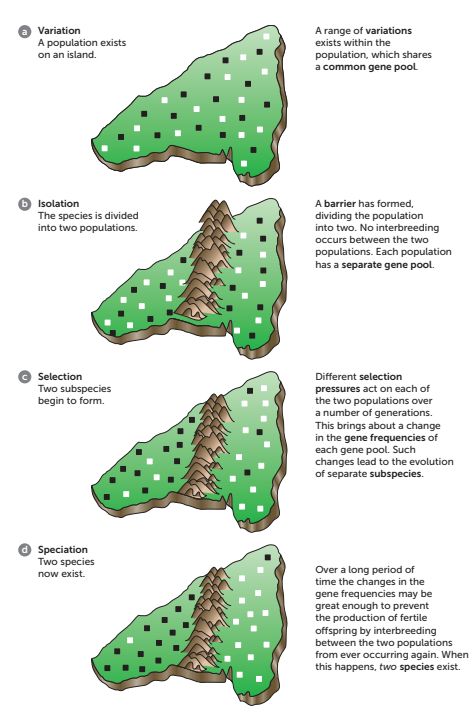
What is meant by "heterozygous advantage"?
When being heterozygous (Bb) or having one allele for the trait provides a survival advantage.
Explain the cause and effect on the body of Tay Sach's Disease. Despite this allele being fatal in a homozygous individual, why does the allele still persist in present day populations? What particular populations have a high frequency of this allele?
- Cause: a lethal condition caused by a mutation and have at least 1 recessive allele
-Effect: it causes an absence of the enzyme beta-Hexosaminidase but if heterozygous it is only reduced
-The allele still persists because homozygous recessive die to the disease before reproducing and therefore don’t pass on the allele. Heterozygous survive tuberculosis and can pass on both alleles. Homozygous dominant may die from tuberculosis before reproducing. Populations affected by tuberculosis have a high frequency of this allele.
What is a lethal recessive"?
A recessive allele that, inherited in the homozygous condition, results in the death of the embryo, foetus or child.
Explain the inheritance of Sickle Cell Anaemia and its effect on the body. Explain how this allele provides a heterozygous advantage. What populations have a considerably high frequency of this allele?
Due to a point mutation in the DNA sequence of the HHB gene, it effects the blood by adding the amino acid valine instead of glutamic acid. This distorts the shape of red blood cells to become sickle shaped. It provides a survival advantage to individuals in malarial prone areas by making heterozygous individuals more resistant to malaria.
What would be the long-term effect on the allele frequency if a mutation suddenly produced a favourable allele that gave a natural resistance to all forms of heart disease.
Areas where heart disease is prevalent will kill off the people who don’t have the favourable allele that protects them from it. Therefore the allele frequency of the ones that do have the favourable allele will be able to survive heart disease and pass those alleles onto the next generation, and therefore increasing the frequency of that allele in the population.
Describe what is meant by a selectively advantageous mutation"
A genetic change that increases an organism's chances of survival and reproduction
People of short stature tend to live in cold climates, people with long limbs and short trunks tend to live in hot climates. Explain how these adaptations to hot and cold environments may have come about.
In hot environments, the environment would favour those who can loss heat the most and people with short statures would not favourable adaptations as they cannot loss heat as quick as long-limbed/short trunked people. In cold environments, the environment favours those who can minimise heat loss and so the short stature tend to be in favour than the long limbs and short trunked bodies which loss heat faster.
What are endogenous retroviruses?
It is a viral sequence that has become part of an organisms genome
How do retroviruses become endogenous?
When it inserts into a cell whose chromosomes will be inherited by the next generation
What is the value of ERV's in the study of evolution?
It can show what species are from a common ancestor.
What is mitochondrial DNA (mtDNA)? How is it inherited? How is it helpful in providing evidence for evolution?
DNA that is located in the mitochondria; all of its DNA comes form the egg as the sperms Mitochondrias are all destroyed. It can help trace ancestry of species
Other biochemical evidence - What is a ubiquitous protein? Give an example. How are they helpful in providing evidence for evolution?
One group of protein that appears in all species, and example is Cytochrome C. Helpful in comparing protein sequences, more similar means more closely related.
What is a fossil? Give examples.
Artefacts are objects that have been purposely made by humans like stone tools, beads, cave painting, carvings.
What soil types are best for the preservation of fossils? Why?
Alkaline soils as the minerals in the bone are not dissolved but replaced by the minerals in the soil.
Why is it that fossilised soft tissue, such as muscle, is rarely found by those searching for fossils?
soft parts decay rapidly through microorganisms before mineral replacement can occur
Distinguish between relative and absolute dating.
Absolute- the actual age of the specimen in year
Relative- a comparison of fossils to tell us whether one sample is older or younger than another.
Explain the principles, uses and limitations of Potassium Argon Dating
Principle | uses | limitations |
Based on potassium 40 turning into argon 40 at a slow fixed rate. | To find the age of the fossil as the fossil is inferred to be the same age as the rock in which its found | 1. Only usable on igneous rocks 2. Most useful on rock older than 200000 years old 3. Only dates the rock around the fossil |
Explain the principles, uses and limitations of Carbon 14 Dating
Principle | uses | limitations |
Based on the face all living organisms have the same measurable ratio of carbon 14 to carbon 12 | To find the age of the specimen | 1. It can only date living things 2. Only date fossils up to 60000 years old 3. Tradition methods need at least 3g of organic material |
What does "half life" mean?
the time required for a quantity of a substance to reduce to half of its initial value
What is Accelerated Mass Spectrometry?
A technique used to date samples as small as 100 micrograms
What is stratigraphy? What does "correlation of rock strata" mean?
It is the study of layers or strata. Correlation of rock strata means matching layers of rock from different areas
What is an index fossil? Give an example. How are they useful in dating?
Fossils of organisms that were on earth for a short period of time and therefore useful in the relative dating of rock strata. And example is trilobite fossil.
What is the principle of superposition? How is it helpful in dating fossils?
Layer of sedimentary rock at the top are younger than that underneath. It can help date fossils by showing which fossils are older/younger.
What are some of the problems with the fossil record?
The fossil record is very incomplete as fossilisation is a chance to occur and many gaps in it are cause organisms have not been preserved properly. Also, another reason is only a very small portion of fossils have been found as most are hidden,destroyed or inaccessible.
Explain how comparative studies in DNA provides evidence for evolution. In what ways is the DNA compared?
Comparative studies in DNA provides evidence for evolution through the comparison between species ancestry, where species are more closely related share more DNA.
DNA can be compared through DNA Sequencing or Gel Electrophoresis.