Geometry Logic and Reasoning

call kaiCall Kai
learnLearn
examPractice Test
spaced repetitionSpaced Repetition
heart puzzleMatch
flashcardsFlashcards
Card Sorting

1/18

encourage image

There's no tags or description

Looks like no tags are added yet.

Last updated 9:48 AM on 9/10/26
Name
Mastery
Learn
Test
Matching
Spaced
Call with Kai
Chat
Add student to class section state
Add studentsNo students in these sections. Invite them to track progress!

19 Terms

1
New cards

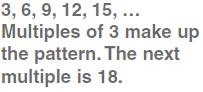
Inductive reasoning

drawing conclusions based on examples
<p>drawing conclusions based on examples</p>
2
New cards

Conjecture

an "educated guess", a rule based on a pattern, but it is not proven to be true.

<p>an "educated guess", a rule based on a pattern, but it is not proven to be true. </p>
3
New cards

Counterexample

an example that proves that a conjecture or statement is false

<p>an example that proves that a conjecture or statement is false</p>
4
New cards
<p>deductive reasoning: LOGIC</p>

deductive reasoning: LOGIC

Using facts, true statements, and logic to reach a true statement or conclusion.

<p>Using facts, true statements, and logic to reach a true statement or conclusion. </p>
5
New cards

conditional statement

a statement that can be written in “if-then” form

<p>a statement that can be written in “if-then” form</p>
6
New cards

Hypothesis

The part of an if-then statement right after the word "if".

7
New cards

Conclusion

The part of an if-then statement right after the word "then".

8
New cards

negation

the opposite of the original statement

<p>the opposite of the original statement</p>
9
New cards

converse statement

A statement made by swapping the "if" and "then" parts (If q, then p) For example, the converse of "If it rains, then the ground is wet" is "If the ground is wet, then it rains."

<p><span>A statement made by swapping the "if" and "then" parts (If </span><span style="font-family: KaTeX_Main, &quot;Times New Roman&quot;, serif; line-height: 1.2; font-size: 1.21em;"><em>q</em></span><span>, then </span><span style="font-family: KaTeX_Main, &quot;Times New Roman&quot;, serif; line-height: 1.2; font-size: 1.21em;"><em>p</em></span><span>) For example, the converse of "If it rains, then the ground is wet" is "If the ground is wet, then it rains." </span></p>
10
New cards

Inverse statement

Made by adding "not" to both the "if" and "then" parts (If not p, then not q) For example, the inverse of "If it rains, then the ground is wet" is "If it does not rain, then the ground is not wet."
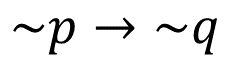
<p><span>Made by adding "not" to both the "if" and "then" parts (If not </span><span style="font-family: KaTeX_Main, &quot;Times New Roman&quot;, serif; line-height: 1.2; font-size: 1.21em;"><em>p</em></span><span>, then not </span><span style="font-family: KaTeX_Main, &quot;Times New Roman&quot;, serif; line-height: 1.2; font-size: 1.21em;"><em>q</em></span><span>) For example, the inverse of "If it rains, then the ground is wet" is "If it does not rain, then the ground is not wet." </span></p>
11
New cards

Contrapositive

Made by swapping and adding "not" to both parts (If not q, then not p). For example the contrapositive of "If it rains, then the ground is wet" is "If the ground is not wet, then it does not rain."

<p>Made by swapping and adding "not" to both parts (If not <span style="font-family: KaTeX_Main, &quot;Times New Roman&quot;, serif; line-height: 1.2; font-size: 1.21em;"><em>q</em></span>, then not <span style="font-family: KaTeX_Main, &quot;Times New Roman&quot;, serif; line-height: 1.2; font-size: 1.21em;"><em>p</em></span>). For example the contrapositive of "If it rains, then the ground is wet" is "If the ground is not wet, then it does not rain." </p>
12
New cards

biconditional statement

When the conditional statement and its converse are both true then you can make it as only one "if and only if" (iff) statement.

<p>When the conditional statement and its converse are both true then you can make it as only one "if and only if" (iff) statement. </p>
13
New cards

Conjunction

two or more statements joined together with the word “and”

<p> two or more statements joined together with the word “<em>and”</em></p>
14
New cards

Disjunction

two statements joined with the word “or” to form a compound statement.

<p>two statements  joined  with the word “or” to form a compound statement. </p>
15
New cards

Law of Detachment

If a conditional is true and its hypothesis is true, then its conclusion is true.

<p>If a conditional is true and its hypothesis is true, then its conclusion is true.</p>
16
New cards

Law of Syllogism

If p-->q and q-->r are true statements, then p-->r is a true statement.
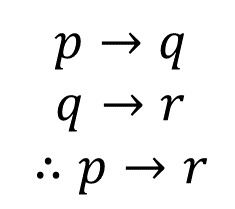
<p>If p--&gt;q and q--&gt;r are true statements, then p--&gt;r is a true statement. </p>
17
New cards

Law of Contrapositive

if a conditional statement is true then the contrapositive is true
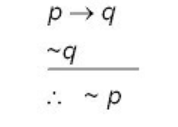
<p>if a conditional statement is true then the contrapositive is true</p>
18
New cards

Converse Error

A mistake in logic where you wrongly assume that because the "then" part is true, the "if" part must be true. If p is true then q is true. q is true. Therefore, p is true.

<p><span>A mistake in logic where you wrongly assume that because the "then" part is true, the "if" part must be true. </span>If p is true then q is true. q is true. Therefore, p is true.</p>
19
New cards

Inverse Error

A mistake in logic where you wrongly assume that because the "if" part is false, the "then" part must be false. If p is true then q is true. ~P is true. Therefore, ~q is true.

<p><span>A mistake in logic where you wrongly assume that because the "if" part is false, the "then" part must be false. </span>If p is true then q is true. ~P is true. Therefore, ~q is true.</p>