Lect 4: Spine Osteology
 Call Kai
 Learn
Learn Practice Test
 Spaced Repetition
 Match
Match Flashcards
 Knowt Play
1/50

Earn XP
Name | Mastery | Learn | Test | Matching | Spaced | Call with Kai | Chat |
|---|
No analytics yet
Send a link to your students to track their progress
51 Terms
What components make up the axial skeleton?
cranium
vertebral column
sternum
ribs
the vertebral column is composed of
vertebrae and deformable discs
vertebral column function (4)
provide riggid but flexible axis for movement
firm base for suspendin structures (let body maintain relative posture)
link upper/lower extremities
protect spinal cord
What are te 5 regions of the vertebral column?
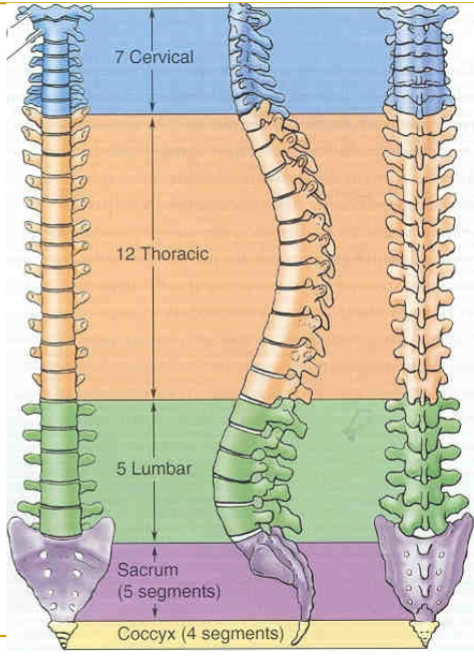
cervical (7)
thoracic (12)
Lumbar (5)
sacrum (5 fused)
Coccyx (4 fused)
How many vertebrae are in eac region of the spinal column?
cervical (7)
thoracic (12)
Lumbar (5)
sacrum (5 fused)
Coccyx (4 fused)
What is the function of the cervical vertebrae?
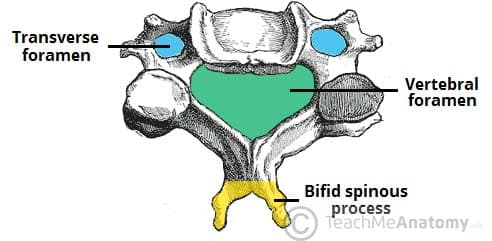
connect the head
allow for lots of movement
What is a distinct feature of the cervical vertebrae?
transverse foramen
*C1-C7 vary reatly but C are happy!
happy = big eyes (anterior)
What is the function of the thoracic vertebrae?
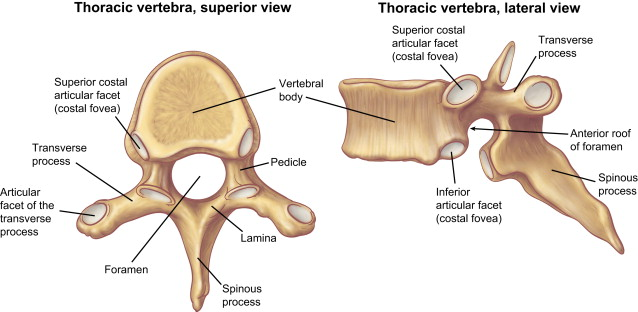
suspends ribs (and therefore the respiratory cavity)
so less flexible and more stable
What is a distinct feature of the thoracic vertebrae?
costal facets
What is the function of the lumbar vertebrae?
allow mobility between the thorax and pelvis
and support upper skeleton + extremities
What is a distinct feature of the lumbar vertebrae?
mamillary processes
(major muscle attachment for deep back muscles—- thhink mound of muscle)

What is the function of the Sacrum?
strongly binds vertebral column to the pelvic girdle
support body weigt + transmit upper extremity forces to lower extremities

What joint strongly binds the sacrum to the pelvic girdle?
sacroiliac joint

What are the curves of the spine listed Superior to Inferior?
cervical- lordotic (tilt head back ‘oh lord’)
thoracic- kyphotic (less mobile - stabilizes ribs)
lumbar - lordotic (mobility between thoracic and sacral, LL)
sacral- kyphotic (stable pelvic girdle)
Lordotic vs Kyphotic Curves
lordotic: more movement ‘loose’, convex anteriorly (tilt head back)
kyphotic: more stable (hard k sound), concave anteriorly
What vertebral landmarks are present in almost all vertebrae?
vertebral body
vertebral arche
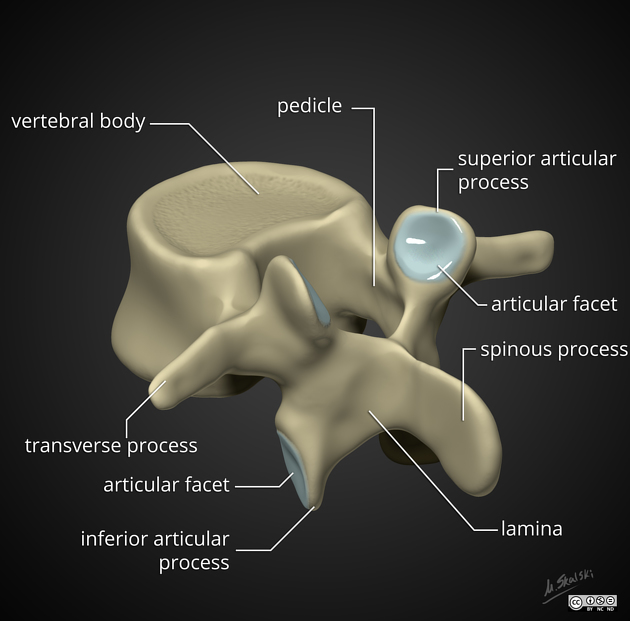
7 processes
What are the 7 processes on a vertebra?
2 superior articular processes
2 inferior articular processes
2 transverse processes
1 sinous process
What 7 processes are on almost all vertebrae?
inferior (2) + superior (2) articular processes
transverse processes (2)
spinal process

What happens to vertebrae size you move inferiorly?
vertebrae increase in size to accomodate for increasing load
What are the components of the vertebral body?
trabeculae (spongy bone)
ring of apophyses
vertebral end plates

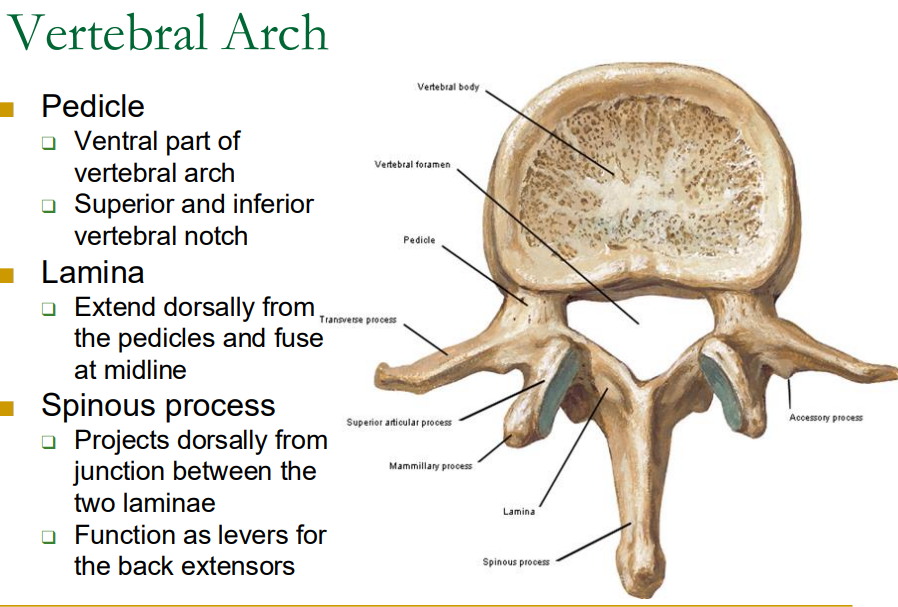
What forms the vertebral arch?
pedicle (ventrally) - form sup/inf vertebral noches ‘walls of house’
lamina (dorsal) ‘roof of house’
spinous process (project from where lamina join)
The vertebral arch is primarily made of what type of bone?
cortical (hard)
Function of the spinous process
act as levers for back extensors
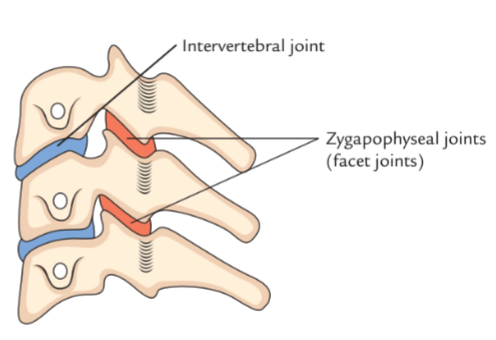
What are the zygapophyses?
articular processes from junctions of pedicles/laminae

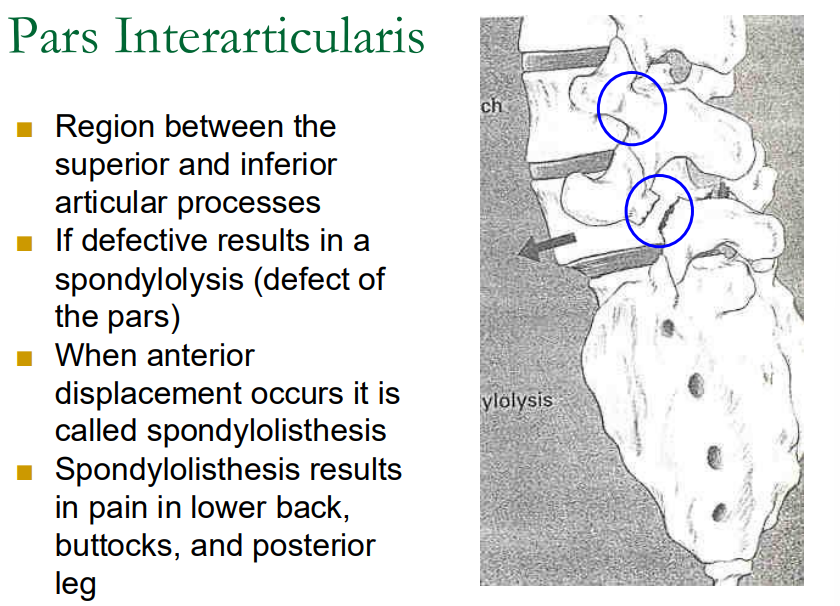
What are the pars interarticularis?
between sup/inf facets
What is the function of the vertebral foramen?
house the spinal cord
What is the function of the intervertebral foramen?
‘highway exits’ for nerves
made from inferior + superior vertebral notches

What are the zygapophyses “facets”?
synovial joints between superior/inferior vertebrae
What does a defective pars interarticularis result in?
spondylolysis
What is spondolisthesis?
anterior displacement of the pars interarticularis
result in lower back, butt and post leg pain

Names for transitional vertebrae
cervicothoracic
thoracolumbar
lumbosacral
*morphologically change
What protects the spinal cord?
the vertebral arch
(the vertebral foramen is just the space that holds it)
Where are intervertebral discs located in the spine?
C2-S1
General characteristics of intervertebral discs (2)
fibrocartilaginous
relatively avascular
What are the structural components of the intervertebral discs?
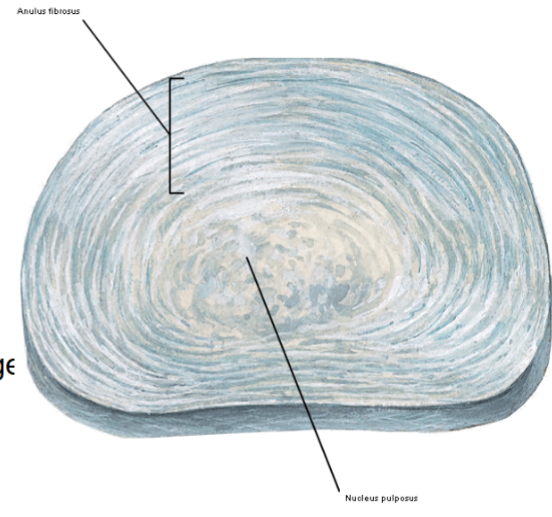
nucleus pulposus (fibrous strands in proteoglycan gel) smallest in cervical
annulus fibrosis (concentric fibrocartilagenous + collagen bands) (annual- circular)

Nucleus pulposus
squishy part of intervertebral disc
fibrous strands in proteoglycan gel
smallest in cervical
Annulus Fibrosus
attaches rim of intervertebral disc to rim of vertebral body
concentric fibrocartilagenous / collagen bands
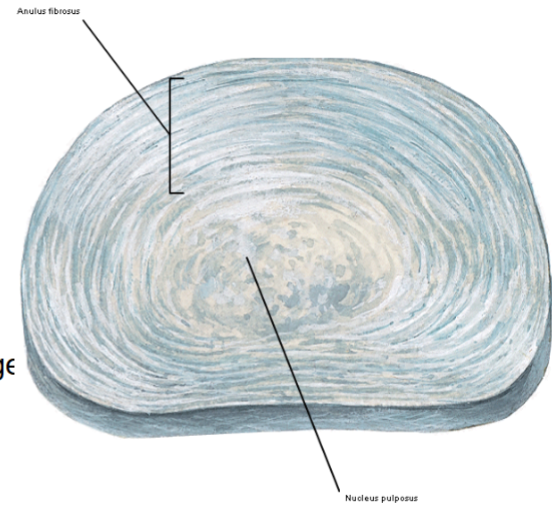
Function of intervertebral discs
major compression bearing
How do the intervertebral discs impact spine curvature?
deeper anteriorly in cervical + lumbar
contributes to anterior convex
(like stack of binders)
Ligament######
slide 33
Anterior Longitudinal Ligament
slide 34
PLL
slide 35
Ligamentum Flavum
slide 36
Supraspinous Ligament
extends from C7 to Sacrum
connects tips of spinous processes
relatively thick in the lumbar spine
break these cards out too***
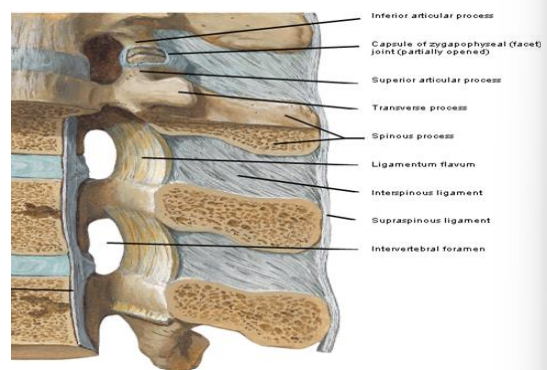
When is the supraspinous ligament lax and when does it act as (inhibitor?)
2:15 slide 37
Interspinous Ligament
limitation in forward flexion and some rotational movements
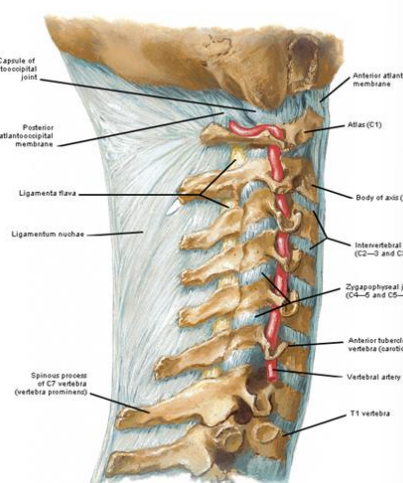
Nuchal Ligament
continuous with supraspinous ligament
trianggle base of skull and C1-7 and T1, stability and head flexion gaurd
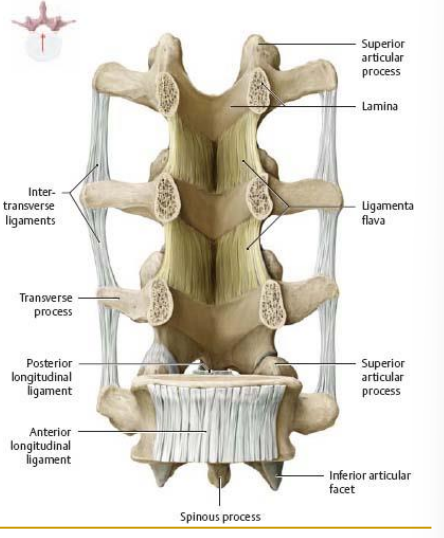
Intertransverse Ligament
between transverse processes
limit contralateral side-bending (lateral flexion)
Spinal cord
contained in vertebral canal
enlargements in gray matter in cervical in lumbar regions
gives off spinal nerves that combine in plexi to form peripheral nerves
developmentally cord segments initially line up with the bony vertebral column (eventully spine is longer)
Conus Medullaris- inferior end of spinal cord L2/3 (bellybuttonish)
filum terminale anchored to coccyx terminal nerves = cauda equina

This ligament limits contralateral side bending:
A. Nuchal
B. Intertransverse
C. Supraspinous
D. Anterior longitudinal
intertransverse
Intervertebral joints are classified as:
A. Synarthrosis
B. Amphiarthrosis
C. Diarthrosis
amphiarthrosis