Lecture 14 and 15 Flatworms and related phyla
 Studied by 0 people
 Call Kai
 Learn
Learn Practice Test
 Spaced Repetition
 Match
Match Flashcards
 Knowt Play
1/39

There's no tags or description
Looks like no tags are added yet.
Name | Mastery | Learn | Test | Matching | Spaced |
|---|
No study sessions yet.
40 Terms
The Bilateria are the most diverse group of animals. What does bilateral symmetry allow the animal to do?
It allows the animal to move forward with directed movement.
Bilateral symmetry also allowed for cephalisation (the development of head region)
Having movement through the environment allowed for diversification of animals
Bilateral animals are triploblastic organisms. What does this mean?
It means they have three germ layers. An endoderm, mesoderm and ectoderm.
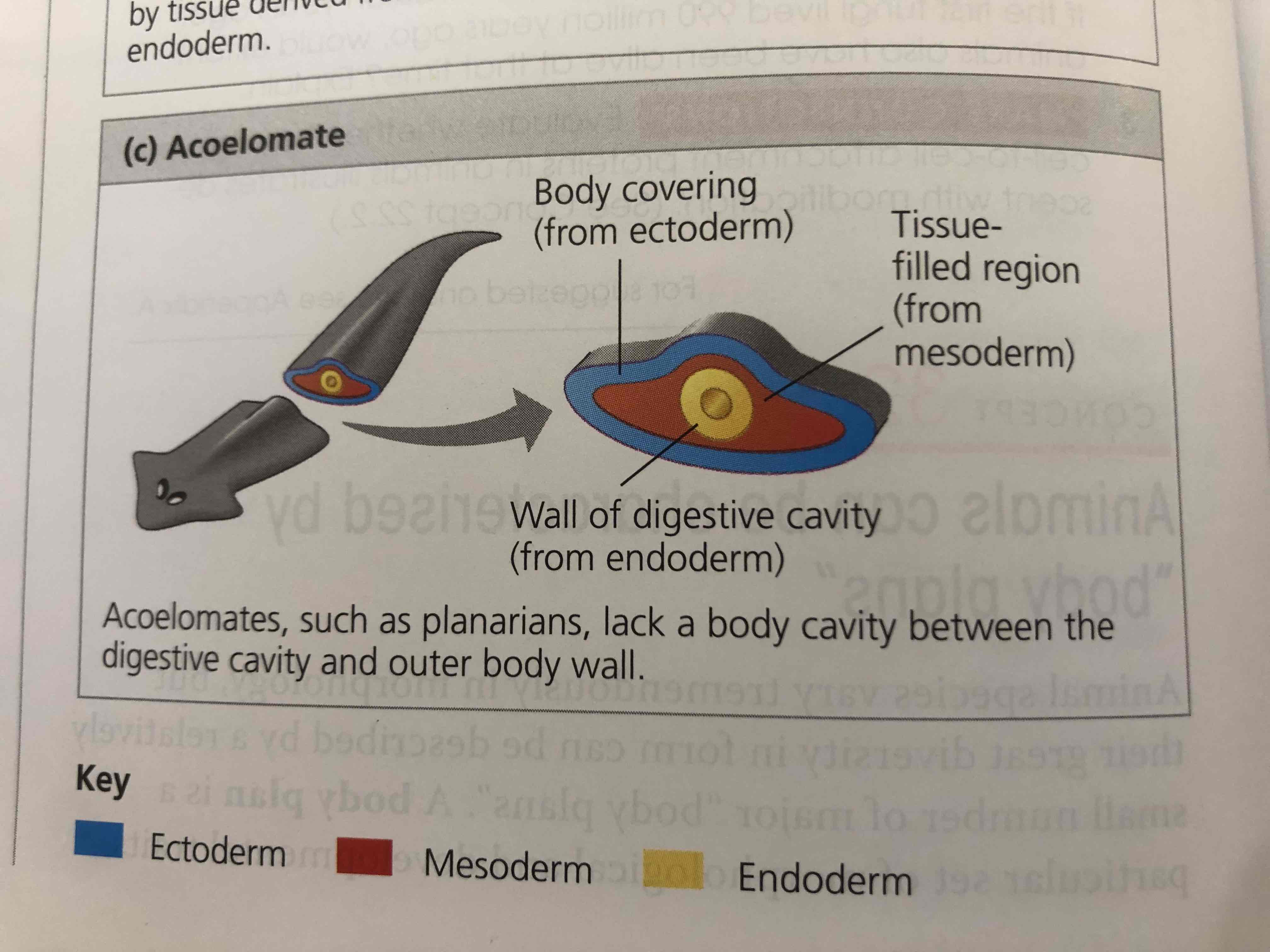
What are the advantages of gaining germ layers?
Germ layers give rise to specific tissues and organs. The advantage then is development of tissue level organisation, greater body complexity and formation of different body organs
In mammals, what is the ectoderm?
Skin, hair, nails, mouth lining, tooth enamel (but also brain, nerves, peripheral nerves)
In mammals, what is the mesoderm?
Kidneys, gonads, circulatory system, muscles notochord and body cavity
In mammals, what is the Endoderm?
Lining of the gastrointestinal tract, respiratory tubes, liver, pancreas
What are the three clades of Bilateria?
Lophotrochozoa
Ecdysozoa
Deuterostomia
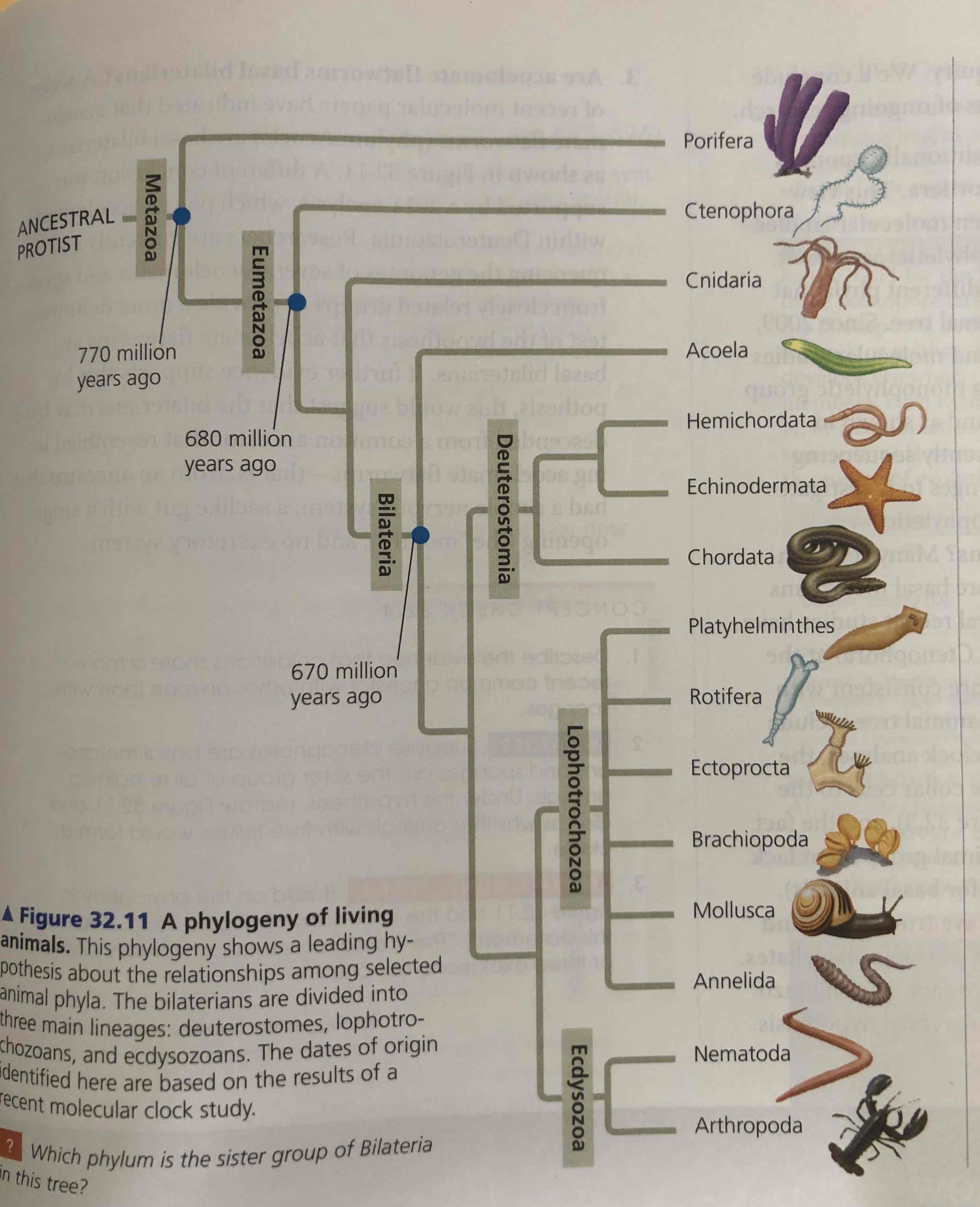
Flatworms belong to the clade Lophotrochozoa. They are the common name for which phylum, and what are their key features?
They are the common name for the phylum platyhelminthes. Their key features are that they are acoelomate (in that they have no body cavity). They have no circulatory system and they have a simple gut with no anus. They are flattened dorsoventrally. They exchange gas and elimination of waste by diffusion across the body surface. They are blind.
What kind of reproduction to platyhelminthes conduct?
They conduct sexual and asexual reproduction. Because they are parasites. They clean copies of themselves and flood the environment with their clones.
What are ganglia?
Nerve cells that form a brain
There are four major classes of Platyhelminthes. List these.
Tubellaria
Monogenea
Trematoda
Cestoda
Give an example of a turbellaria
Planarian. Crayfish have many turbellaria ectoparasites living on them
Give an example from the class Trematoda
Flukes
What is an ectoparasite?
A parasite that lives on the surface of the host
What is an endoparasite?
The parasite that lives inside their host
What are some key features of the class turbellaria?
They are mostly free living. Some are commensal, some are parasitic. They have a ciliated epidermis for locomotion. Their excretory system is simple. It drains directly from the body across the wall. They are Protonephridial.
What does Protonephridial mean?
It is an excretory tube that lacks an internal opening. In flatworms, flame cells function like a kidney removing waste materials through filtration.
What does metanephridial mean?
It is a system where filtrate is filtered from blood through the kidneys and out and excretory system.
And important species of flatworm, is Dugesia tigrina (the planarian). Why is this an important species for stem cell research?
They can be cut into many (279) pieces, each theoretically able to regenerate an entire worm. The generative cell is a neoblast (a pluripotent cell, which can develop into many tissue types). They get used as models for ageing. The planarian is potentially immortal, which has to do with the telomeres (caps on the ends of chromosomes).
Turbellaria are mostly free living and predatory. The other classes of the phyla platyhelminthes are parasitic or commensal. The epidermis in Turbellaria is cellular and ciliated. What is the epidermis in the other classes like?
In larva, it is ciliated and partly cellular, but in adults, it is syncytial (an epidermis comprising cells with a large number of nuclei)
The class, Monogenea are obligate ectoparasites of fish and sometimes, but rarely aquatic amphibians, reptiles and mammals. Describe the life cycle of Monogenea.
The life cycle of most Monogeneans is simple. The eggs are laid, they fall off the host, they hatch. The hatched larvae seek a new host and attach. Monogeneans are very hosts specific.
The gyrodactylus is part of the Monogenea Class. It has a special way of reproduction. Describe this.
It is like a babushka doll there are already babies inside each offspring. They can have four generations within the one animal
The Class Trematoda are the flukes. Describe some of their characteristics.
They usually have a flat leaf like a body.
They are obligate parasites.
The adults (usually) live in the intestines of vertebrate hosts.
They attach the mucosal wall by suckers.
They feed on mucus, tissue fluid and blood.
Most are hermaphrodites.
They have a complex life cycle requiring two or more hosts
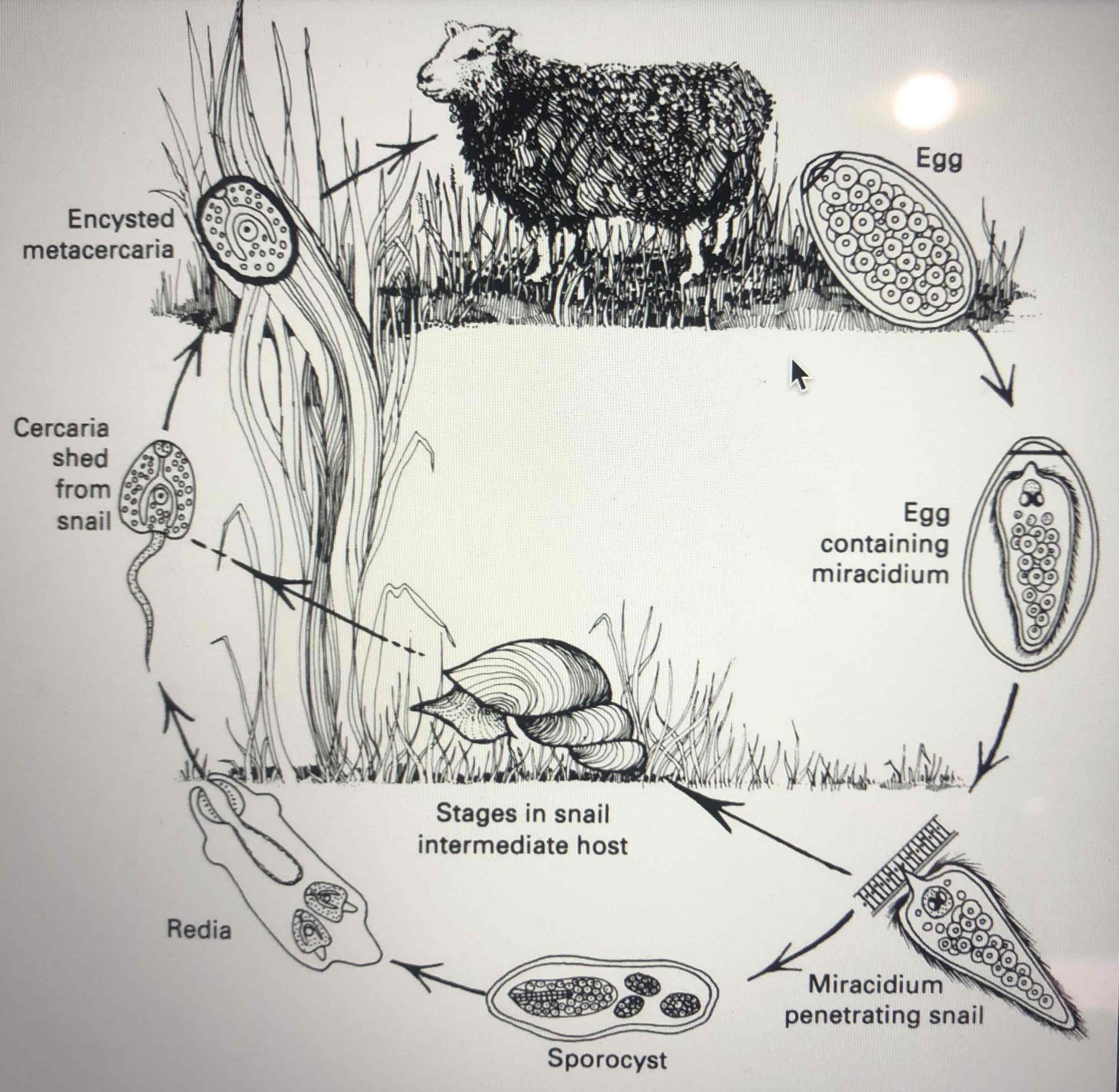
Fasciola hepatica is commonly known as the liver fluke. It affects sheep cattle are the grazing animals and humans. Why is it of major veterinary significance?
It causes disease and death in ruminants. Therefore it is a public health concerns and it is present on the east coast of Australia. They feed on blood and burrow their oral sucker into the lining of the intestine. They then migrate through the intestine and liver to the bile ducts.
Explain the life cycle of a Fasciola hepatica.
And the sheep or other ruminant is their definitive (final) host. The eggs leave the host through their faeces. The eggs contain miracidium. The miracidium penetrates the snail, which is the intermediate host. They reproduce in the snail through asexual reproduction. The cercaria exit the snail and undergo encystation. Then they are eaten by the definitive host.
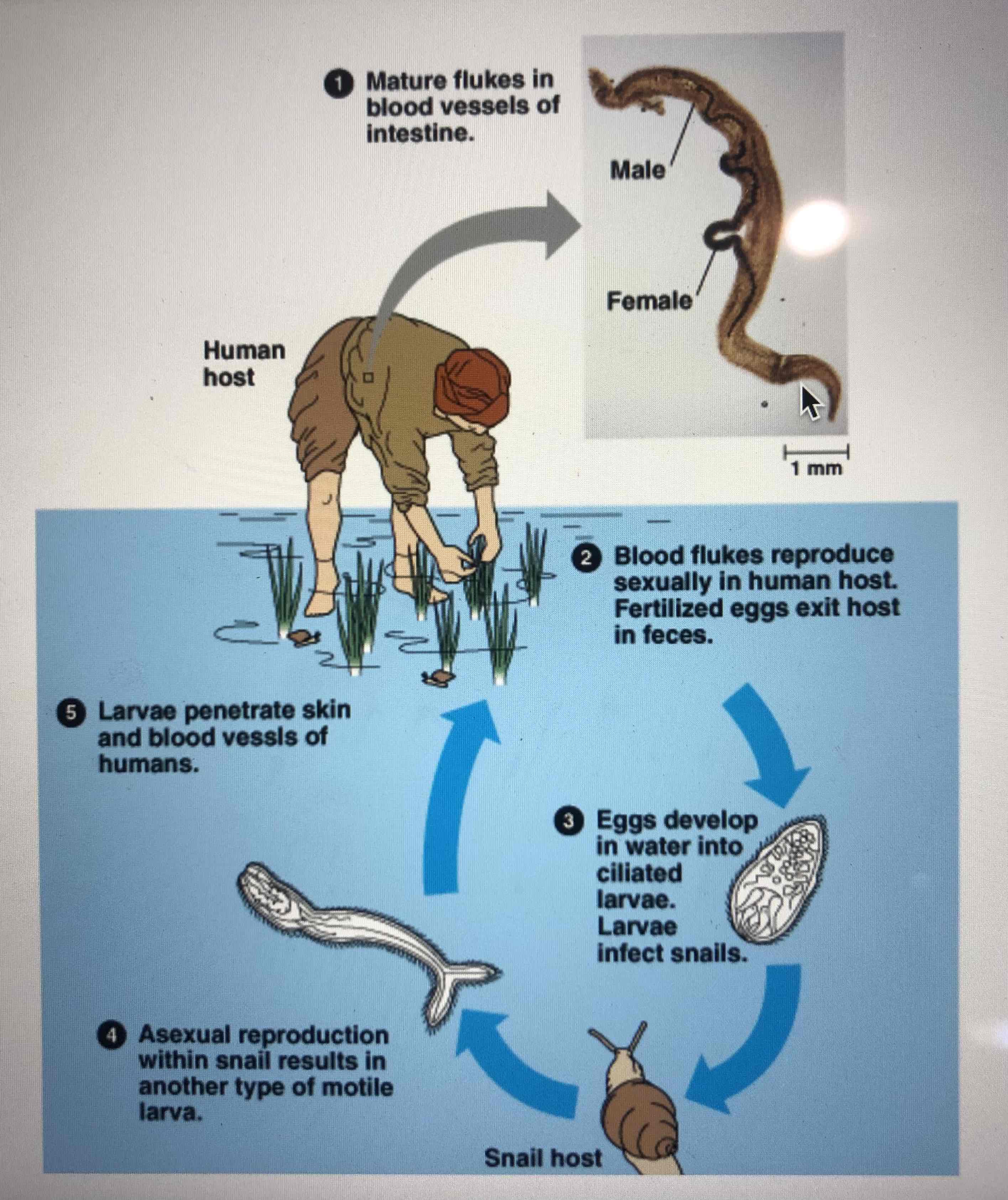
Schistosome are also called blood flukes, and they cause schistosomiasis, a disease whose symptoms include pain, anaemia, and diarrhoea. It is the second most important parasite after malaria. It infects humans and domesticated animals. Describe the life cycle of schistosomes.
Schistosomes have different sexes. They live in the blood system of their host. The eggs will induce an enormous immune response, and this will form a large pimple-like structure which bursts and the eggs will be distributed. The host will often urinate blood, and it is common in children. The host will excrete the parasites with blood in faeces or urine and the eggs will hatch in the water. Then they infect a snail. Asexual reproduction occurs within the snail, and then the larvae will be released into the water where they find another human or animal host by penetrating the skin and blood vessels of the host.
One common parasite of the class Cestoda is the tapeworm. Describe where that tapeworm lives and how it reproduces.
Tapeworms are parasites of the small intestine of vertebrates. They have a tape like body with no mouth, digestive tract or anus. They absorb nutrients across their body surface. The neck region of the tapeworm is the site of reproductive processes. They produce copious amounts of offspring by replicating. Tapeworms can also reproduce sexually with other tapeworms, or with themselves.
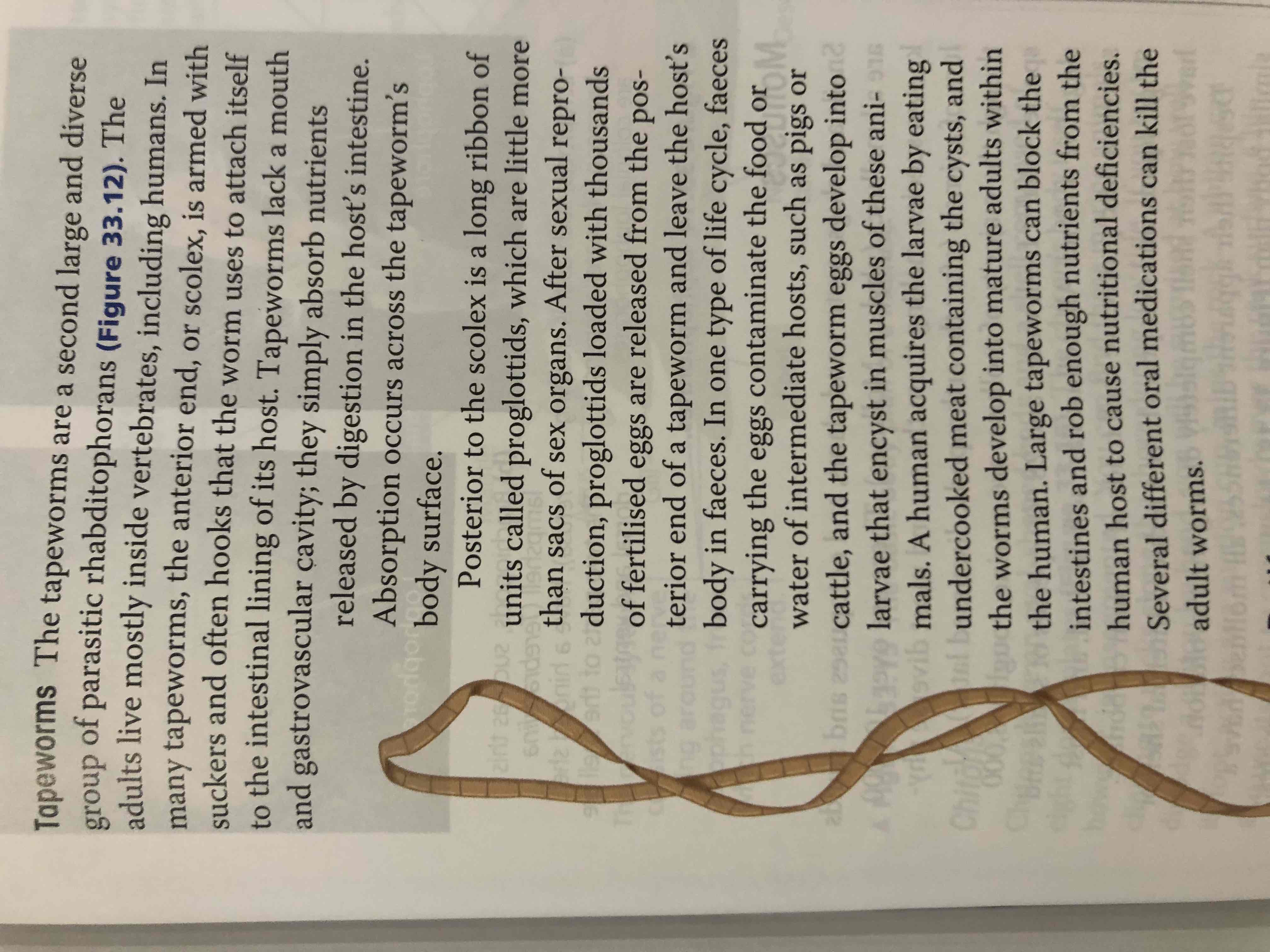
What is the definitive an intermediate hosts of the beef and pork tapeworms? How do these tapeworms develop in the intermediate host?
The human is the (final) definitive host. The intermediate hosts are a cow for the beef tapeworm and a pig for the pork tapeworm. The tapeworms eggs develop into larvae that encyst in the muscles of the animals. The human acquires the larvae by eating under cooked meat containing the cysts and the worms develop into mature adults within the human.
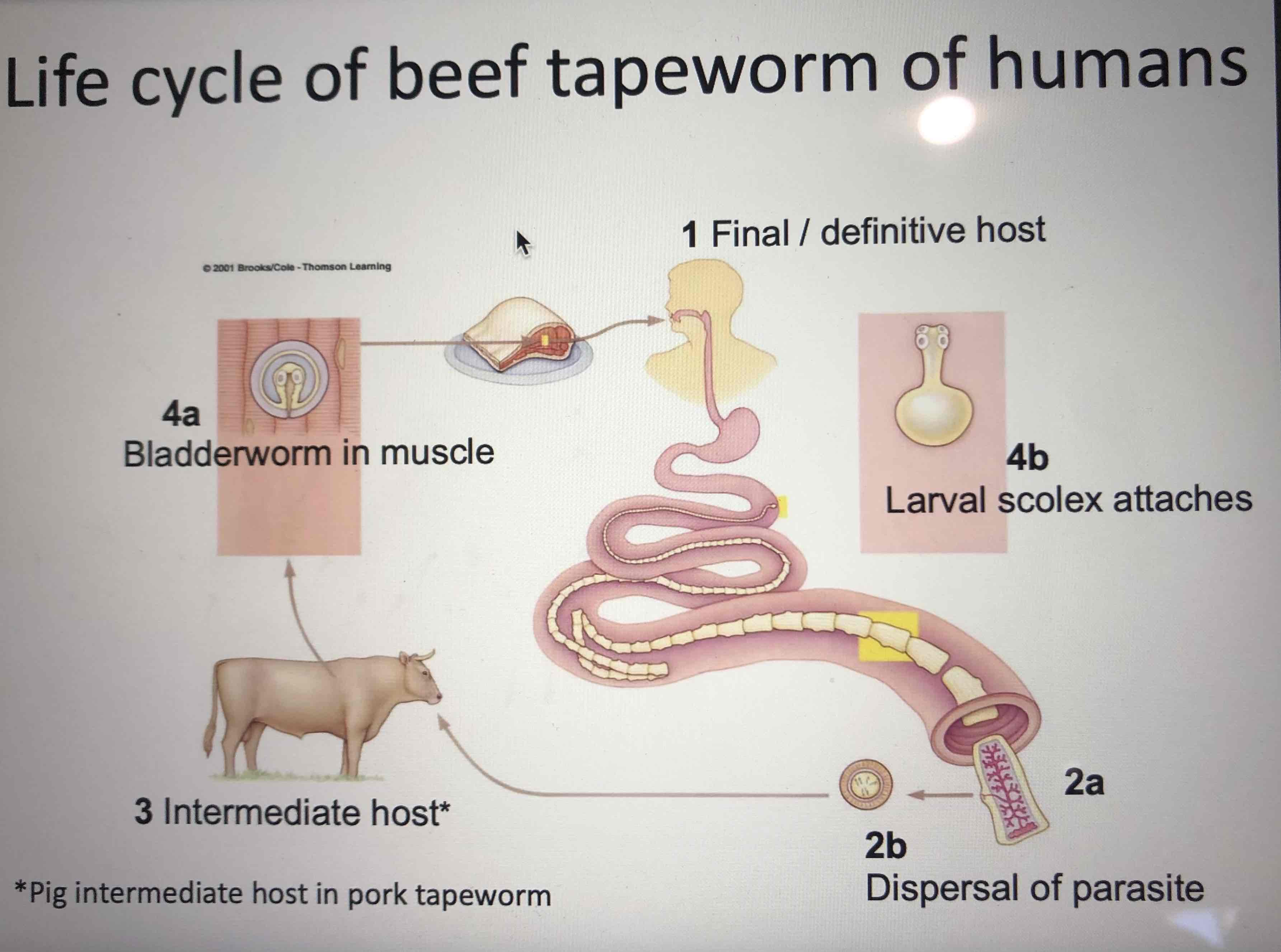
What is the head of it tapeworm called?
Scolex
What is the larval stage of a tapeworm called and how big are they?
Bladderworm and they are approximately 1 cm in diameter
The Hydatid tapeworm (Echinococcus granulosus) is one of the smallest cestodes of domestic animals. What is the definitive host and the intermediate host and how is the definitive host infected?
The definitive host is the dog, dingo or fox. The intermediate hosts are sheep, cows, marsupials, humans and many other mammals. The definitive host is infected by ingesting the contents of the hydatid cyst from raw offal of infected immediate hosts.
Hydatid tapeworm can infect the human liver. You need to be aware that you are using biosecurity precautions at what times?
When working with dogs in rural areas.
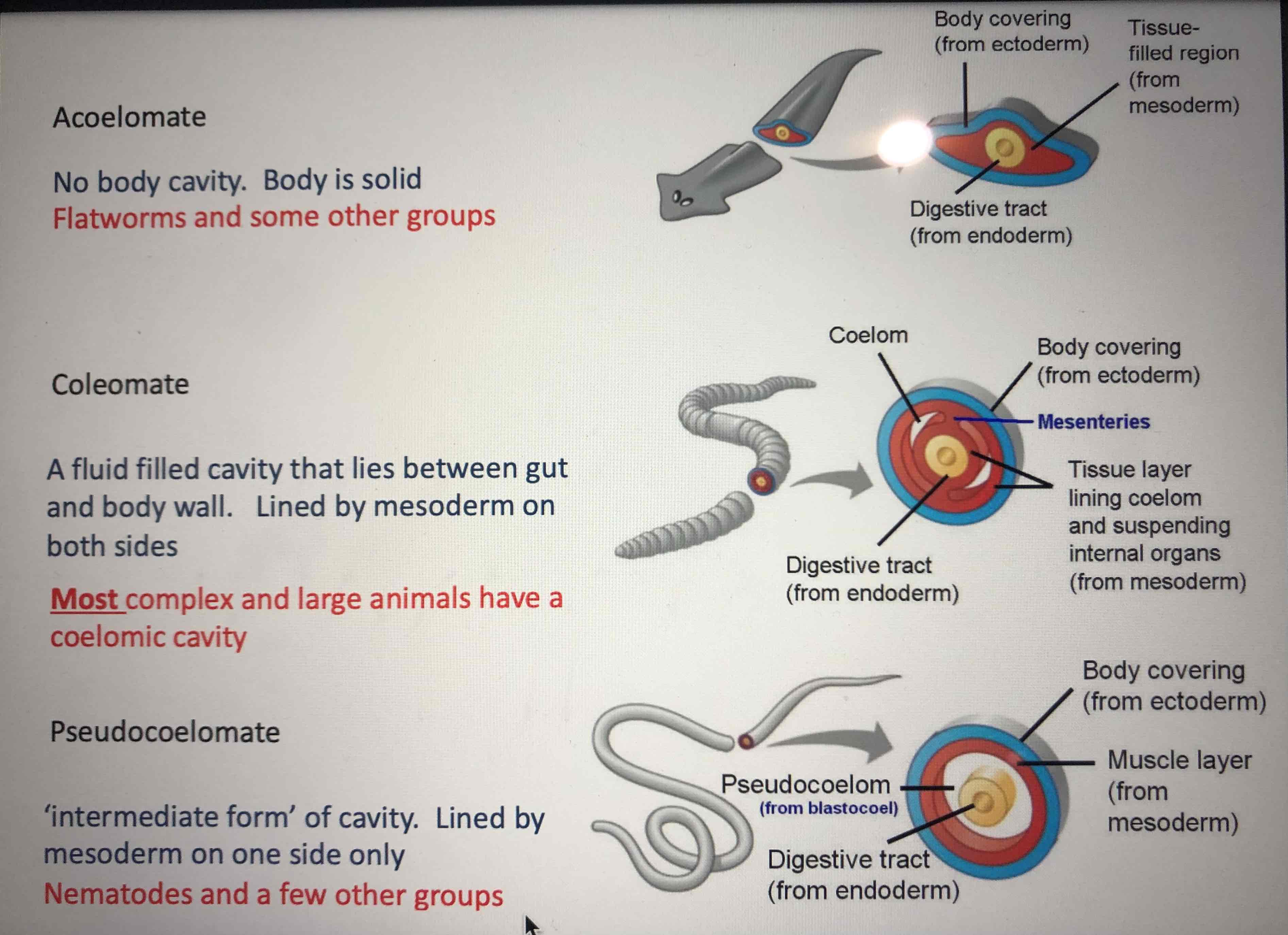
What is an acoelomate?
An animal with no body cavity
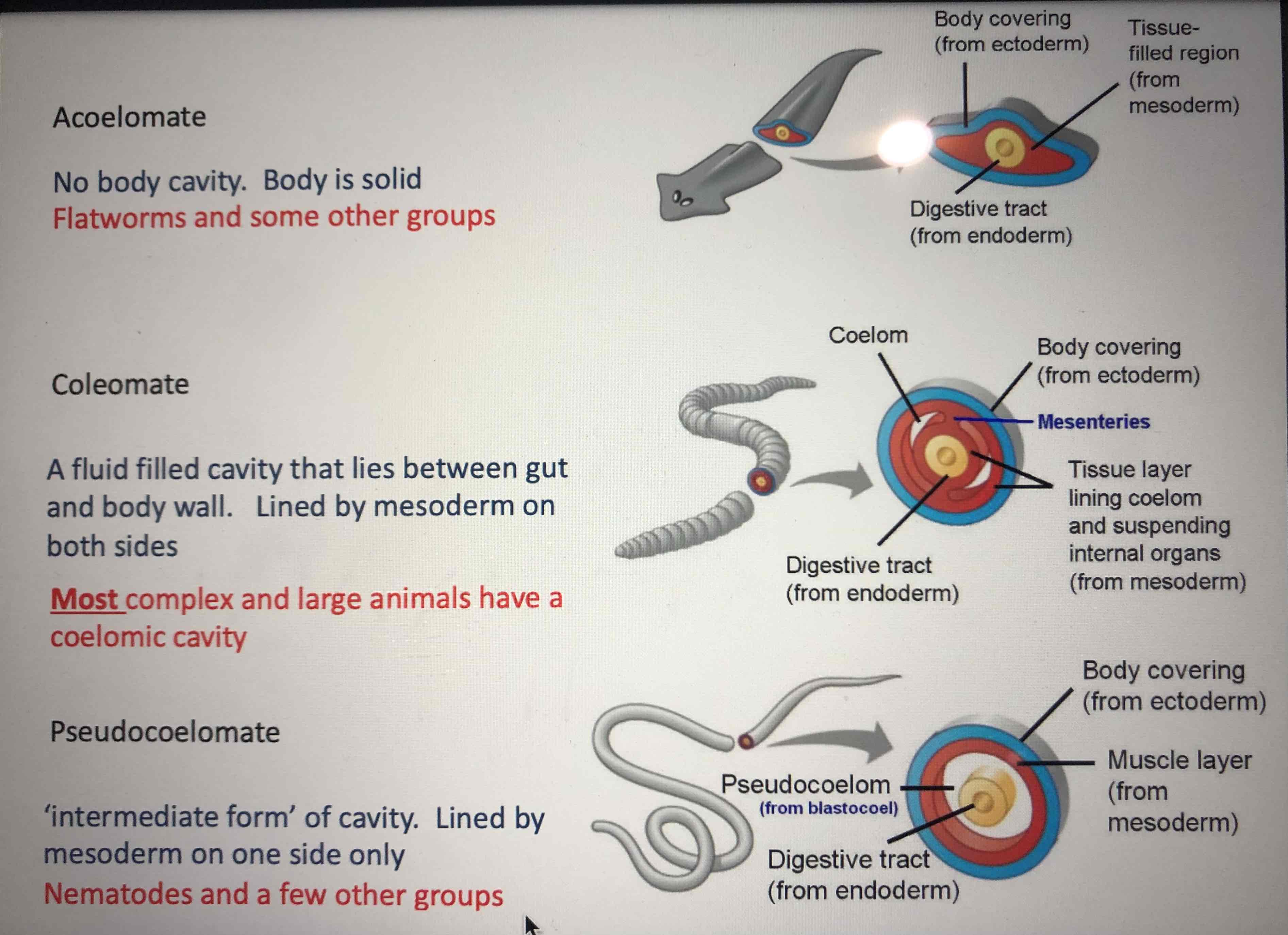
What is a coelomate?
An animal with a body cavity, which separates the organs with a fluid filled space
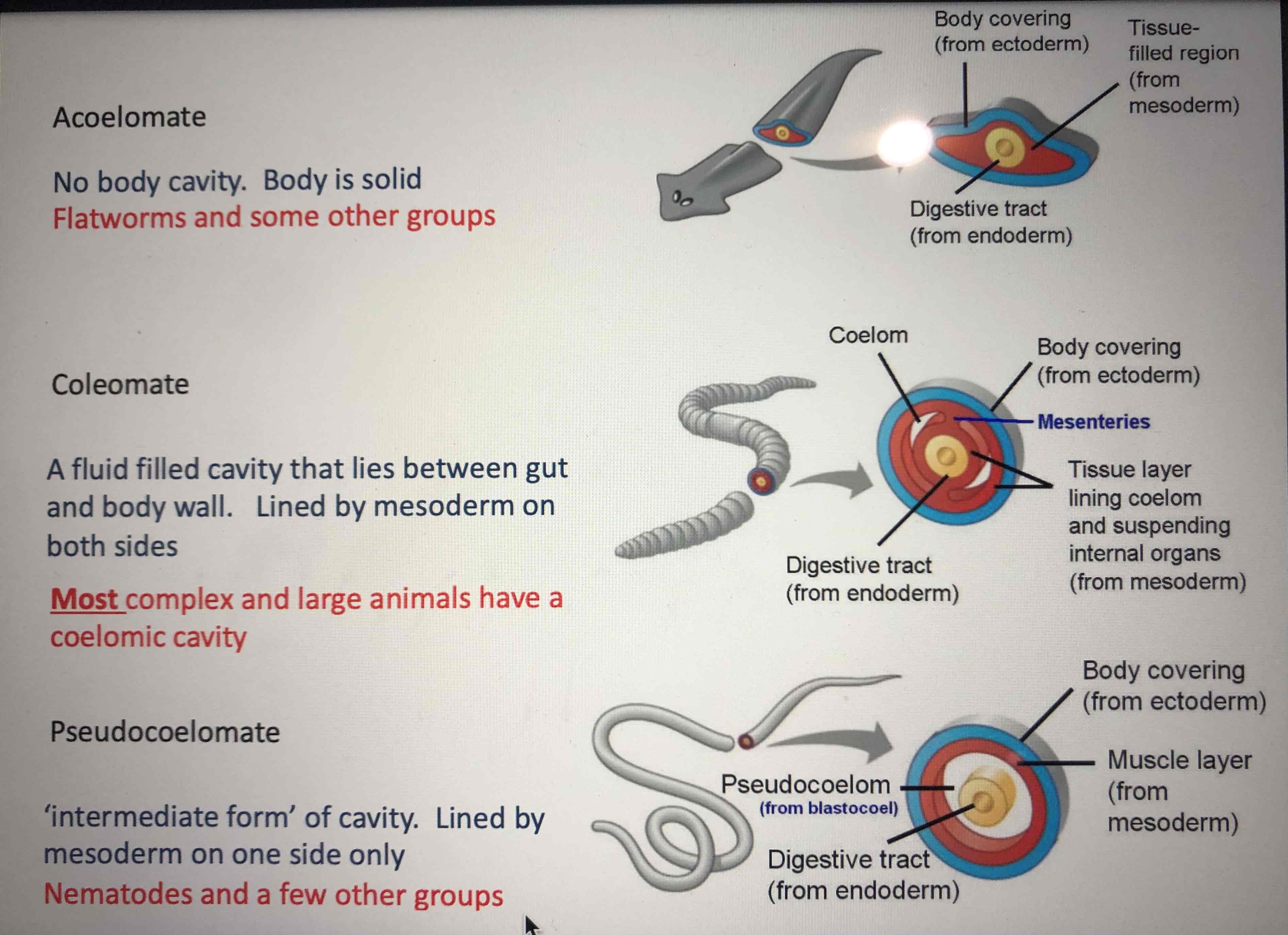
What is a pseudocoelomate?
An animal with a partially formed body cavity. They have a fluid-filled body cavity, separating the gut of the organism from the body wall, but it is not lined by mesoderm, unlike true coelomates.
What are the other Lophotrochozoan phyla?
Molluscs, which are non-segmented A Annelids, which are segmented
The phylum Acanthocephala are a strange group of organisms (parasites) that have a two hosts life cycle. With an arthropod, such as a beetle, being the intermediate host a vertebrate as the definitive host. Explain the life cycle of the giant thorny headed worm (Macracanthorhynchus hirundinaceus).
The eggs of the worm pass with the faeces. The eggs are ingested by beetle larvae. The beetles are ingested by the pigs and the larvae grow to adults in the pigs. This is not a problem for domestic pigs in Australia, but it is found in wild pig populations.
Molluscs are unsegmented and they all have a similar body plan. They are all coelomates and their bodies have three main parts: a muscular foot used for movement, a visceral mass containing most of the internal organs and a mantle, a fold of tissue that drapes over the visceral mass and excretes a shell. Name some types of molluscs.
Gastropods, such as snails and slugs
Bivalves, such as clams and oysters
Cephalopods, such a squid, octopus and cuttlefish
Chitons
The name, annelid means little rings referring to the annelids segmented body. Annelids are coelomates. Name some types of annelids.
Leeches and earthworms
List some advantages of having a body cavity
Independent movement of body wall and enclosed organs.
More space for complex organ and organ systems
Storage for eggs and sperm.
Coelomic fluid protects internal organs
Waste removal
Functions as a hydrostatic skeleton.