fractional distillation
 Call Kai
 Learn
Learn Practice Test
 Spaced Repetition
 Match
Match Flashcards
 Knowt Play
1/11

There's no tags or description
Looks like no tags are added yet.
Name | Mastery | Learn | Test | Matching | Spaced | Call with Kai | Chat |
|---|
No analytics yet
Send a link to your students to track their progress
12 Terms
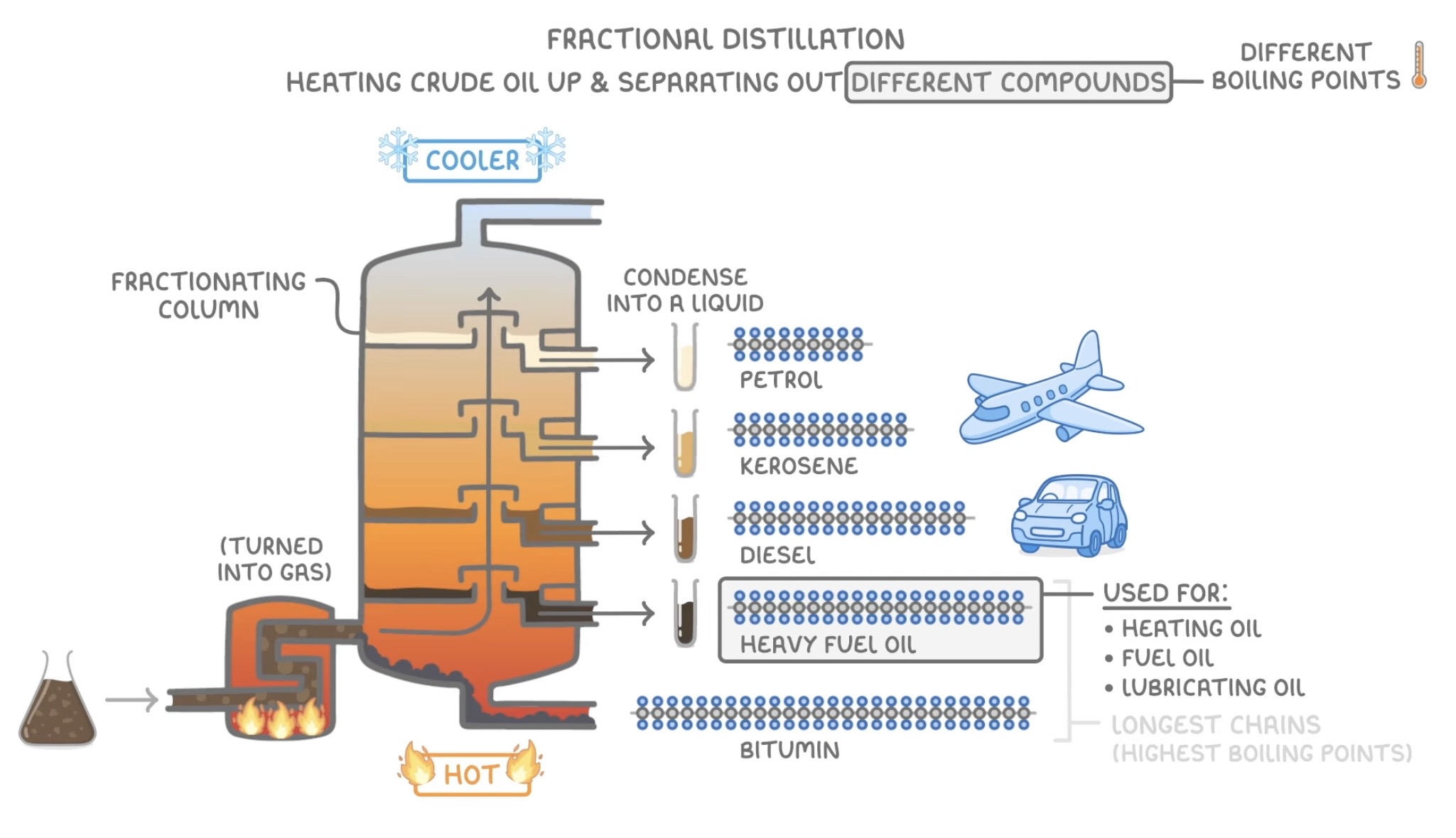
Describe the process of fractional distillation
Crude oil is heated to vaporise it into a gas and passed into the fractionating column.
As the gas rises up the column, it cools down, as the column is cooler at the top.
When the hydrocarbons reach a temperature lower than their boiling point, they condense into a liquid. This liquid is collected in trays and drained out.
The longer chain hydrocarbons condense lower down the fractionating column (where it is hotter) because they have higher boiling points.
The shorter chain hydrocarbons condense at the top of the column because they have lower boiling points.
Why do short chain hydrocarbons stay as a gas much longer than long chain
Because they have much lower boiling points so they we stay as a gas much longer as they rise up column until they reach a cool enough temperature to condense into liquid
Why do long chain hydrocarbons quickly condense back into a liquid
Long chain hydrocarbons have the highest boiling points so they will quickly condense back into a liquid and drain column early on because the column isn’t hot enough to keep them in their gaseous state
What are some examples of long chain hydrocarbons and short chain hydrocarbons
Long chain hydrocarbons- bitumen and heavy fuel oil
Short chain hydrocarbons - diesel , kerosene, petrol
What is crude oil
Crude oil is a fossil fuel deep under the ground and contains a mixture of different compound consisting mainly of hydrocarbons
How is crude oil formed
Crude oil is formed from the remains of dead plants and animals, particularly plankton.
These organic remains were covered by mud and sand, and buried in the earth.
Over millions of years, these organic remains were compressed under a lot of heat and pressure.
The heat and pressure chemically changed the organic remains into crude oil.
NOTE
Because crude oil takes so long to form it’s a finite resource (non renewable)
What is the properties of shorter chain hydrocarbons
They are most flammable so make the best fuels
Why are long-chain hydrocarbons bad fuels?
They are not very flammable or volatile. This means they are hard to combust for energy.
Fractionating column
What can crude oil be used for
Provide the fuel for most transport - diesel oetrol kerosene heavy fuel oil and LGP are used to fuel cars trains planes
What does the petrochemical industry use some of hydrocarbons from crude oil for
Use as a feedstock to make new compounds for use in things like polymers , solvents , lubricants and detergents