Astrophysics S1
 Studied by 0 people
 Call with Kai
 Learn
Learn Practice Test
 Spaced Repetition
 Match
Match Flashcards
 Knowt Play
1/88

There's no tags or description
Looks like no tags are added yet.
Name | Mastery | Learn | Test | Matching | Spaced | Call with Kai |
|---|
No study sessions yet.
89 Terms
what is sensitivity of astronomical observations determined by
sign-to-noise ratio (SNR)
signal of source (S)
# of photons collected in a given exposure time
noise level (N)
uncertainty in photon count (N = sqrt(S))
SNR
SNR = S / N = sqrt(S)
what is SNR proportional to
sqrt(F) sqrt(texp) D
F = flux
texp= exposure time
D = diameter of telescope
Spectral resolution
R = λ/Δλ
the minimum spectral width that can be measured (Δλ) at some wavelength (λ)
[just a ratio!!]
spatial resolution
smallest size of source/feature that can be measured in an image at some wavelength λ
diffraction limited imaging
telescopes in space
θ = λmirror / Dmirror
seeing limited imaging
θ = 1.22λ / r0 (r0 ~ 10-30cm, Fried’s coherence length)
single telescope on earth
interferometery
θ = 1.22λ / Dbaseline (Dbaseline = maximum possible distance between any two telescopes)
multiple telescopes on earth
light wave equations
c = vλ
E = hv
energy with flux F passing through area dA in time dt
E = FdAdt
luminosity for spherically steady source
L = 4πr² F(r)
Flux of a spherically steady object, in terms of its radius
F(r) = L / 4πr²
note about L and F
L is integrated over all wavelengths but real detectors are sensitive to certain values. SO, consider incident radiation distribution over frequency. F = ∫ Fv (v) dv where Fv is flux density
black body radiation
source in thermodynamic equilibrium with surroundings and emits as a black body (opaque and non reflective)
Wien Displacement Law
λmax = 2.9e-3 / T
hvmax = 2.8kBT
[for temperature of a black body]
Stefan-Boltzman Law
F = σT4
therefore L = 4πR²σT4
[for flux and luminosity of a black body]
Luminosity of a black body
L / L0 = (R / R0)2 (T / T0)4
Intensity of a blackbody at temperature T
(Planck Function)
Bv(T) = (2hv3 / c2) / (exp(hv / kT) - 1)
Bλ(T) = (2hc2 / λ5) / (exp(hc / λkT) - 1)
Rayleigh-Jean
hv << kT
Bv ~ 2v² kT / c²
Wien Law
hv >> kT
Bv ~ (2hv3 / c²) exp(-hv/kt)
Synchotron Radiation
charge particle accelerated in spiral path around magnetic field line, leading to photon emission over a continuous power law spectrum: P(v) ∝ v-8
e.g. radio galaxies, supernovae remnants
Brehmstrahlung Radiation
‘breaking radiation’: charged particle accelerated due to Coulomb force, leading to photon emission (largely in high temperature thermal plasmas where spectrum is continuous i.e. no spectral lines)
P(v, t) ∝ exp(-hv / kT)
e.g. in ionised gas clusters in galaxies
Spectral lines (bound-bound)
electrons make transitions between different states, leading to photon emission. hv = | Einitial - Efinal |
emission lines
from optically thin volume of gas with no background light
absorption lines
cold gas in front of higher temperature source
finite width of spectral lines is given by
ΔEΔt = h/2 → natural linewidth
collisional broadening Δv ∝ collisions per second ∝ density
doppler broadening: resulting from particles with M-B velocity distribution on small scales
doppler effect
spectral lines not always measured at rest wavelength (λrest). this difference can be used to detect exoplanets, weighing galaxies/clusters etc.
doppler effect (non relativistic)
λobs = λrest [1 + v/c]
therefore: Δλ / λ = v / c because Δλ = λobs - λrest
doppler effect (relativistic)
λobs = λrest [(1 + v/c) / (1 - v/c)]½
red shift
z = Δλ / λ
circular velocity
velocity of an object undergoing uniform circular motion:
vcirc = sqrt( GM / r )
escape velocity
minimum velocity needed for an object at distance r to escape gravitational interference of a body with mass M. (equate gravitational potential energy to kinetic energy)
vesc = sqrt( 2GM / r )
solar system
terrestrial planets, giant (jovian) planets, small bodies e.g. comets …
comets
primordial remains of early solar system
mostly ice and dust
eccentric oribits
in Kuiper belt (>30 Au) or Oort Cloud (3000 - 10,000 Au)
asteroids
minor planets of size ~ 30m - 1000 km
locked in resonant orbits of main planets e.g. jupiter due to gravitational influence
in asteroid belt between mars and jupiter
Kepler I
each planet moves in an ellipse with the sun at one focus
Kepler II
line connecting a planet and its sun sweeps out equal areas in equal times
Kepler III
For all planets:
square of orbital period ∝ cube of semi-major axis
P2 = ka3
periapsis
closest point to star at the focus F
apoapsis
furthest point from star at F
formation of planets
proto-planetary disks have particles that collide and stick together through electrostatic forces (they dissipate KE upon contact). They later become large enough for their gravity to attract other bodies
dust (microns) → pebbles(cm) → planetesimals (km) → planets (1000 km)
distribution of rocky planets / gas giants
because of temperature gradient in protoplanetary disk. surface density of planetesimals was larger beyond the snow line which led to quick formation of planets which grow very quickly to large sizes. The sun heats up and gas in blown outwards and there isn’t enough left for slow-forming rocky planets to capture
snow line
distance from star/sun at which protoplanetary disk has temperature T = 273K
shape of orbits
all orbits are circular if the shape of the protoplanetary disk was circular
finding central pressure
hydrostatic equilibrium dP/dr = -ρ(r)(GM / r²) (planetary atmospheres, interiors, stars etc.)
M = 4/3 π R3 <ρ>
assume density is constant and surface pressure = 0
∫dP (Pc to 0) = -<ρ>² (4/3) π G ∫ r dr (0 to R)
which = 1.4e-10 <ρ>² R²
how to measure temperature of planets
estimate it by assuming absorbed solar energy flux is re-radiated as a black body
albedo (A)
the fraction of incident sunlight reflected by the object i.e. (1 - A) fraction of sunlight was absorbed
subsolar temperature
for slow rotating planets
absorbing area = emitting area
equilibrium temperature
for planets with atmosphere and/or in rapid rotation. assumes absorbing area is cross-sectional (πR²) and emitting area is the whole thing (4/3 π R²)
planetary atmospheres
assume atmosphere behaves like ideal gas with Maxwellian distribution of particle velocities:
most probably velocity vmp = sqrt(2kT / m)
RMS velocity vrms = sqrt(3kT / m)
standard deviation σv = sqrt(kT / m)
timescale of atmosphere loss is dependent on
ratio of vesc / vrms
timescale for different ratios
>10: billions of years
~5: few 100 years
~3: few years
~2: few days
use for radial velocity
as stars and planets orbit each other, their spectral lines are doppler shifted when they are moving towards/away from the observer. Exoplanets can be detected using the radial velocity (RV) curves of stars
radial velocity of a star
vs,r = vssin(i) = 2πas / P
i - inclination
as - average distance of star from system CoM
P - binary system’s orbital period
centre of mass
Mpap = Msas
orbital separation between a star and an exoplanet (a)
a = as + ap = as ((Ms + Mp)/ Mp) = Pvs,r / 2π
binary mass function
(Mp sin(i))3 / Ms² = P(vs,r)3 / 2πG
exoplanet binary mass system (Mp << Ms)
Mp + Ms ~ Ms
(Mp sin(i))3 / Ms2 = P(vs,r)3 / 2πG
Star
an object bound by self gravity which radiates energy primarily released by nuclear fusion reactions in the stellar interior. When fusion is not dominant, stellar birth is too cold so GPE is radiated as radius of protostar contracts. During stellar death, the remnants radiate stored thermal energy and cool down.
composition of stars
expressed as ratios of gases over M* of Hydrogen (X), Helium (Y) and metals/other elements (Z) such that X + Y + Z = 1
distance to stars
distance to nearby stars can be found using the parallax (apparent stellar motion due to orbit of star around earth)
parallax for small angles (radians)
θ = 1 AU / D (1 astronomical unit)
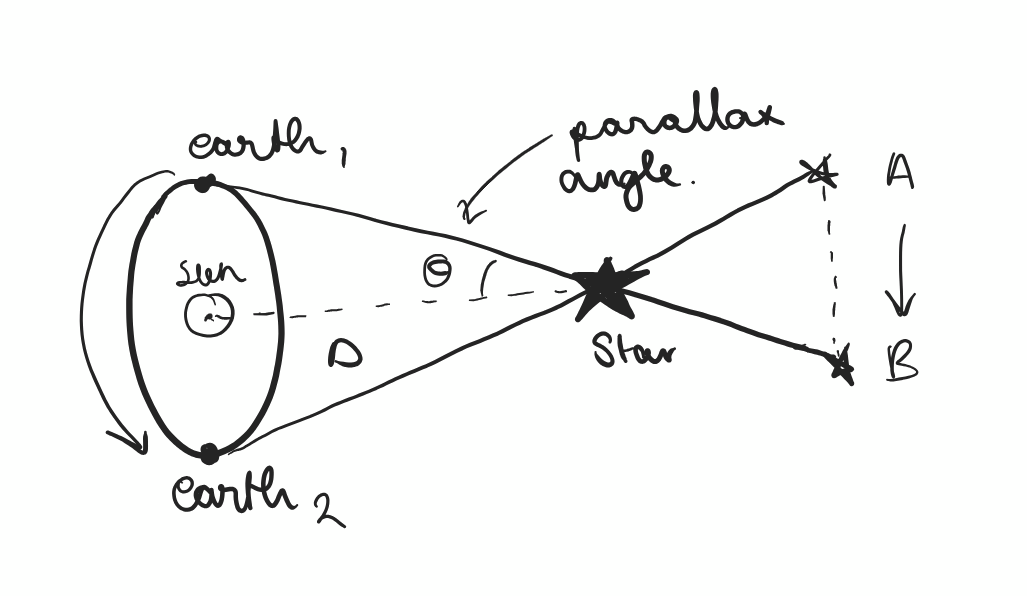
parallax in arcseconds
D = 1 / θ
Magnitudes
source brightness is expressed in Magnitudes (m) related to the source’s flux (F)
m = -2.5log10F + constant
zero point
observed magnitude of star with F = 1
used to calibrate different telescopes with each other (the constant added onto the end of the magnitude equation)
bolometric magnitude
magnitude over all possible wavelengths
since F is total flux integrated over all wavelengths, m will be bolometric as well.
magnitude with colour filters (e.g. V)
mv = -2.5 log10Fv + constant
only certain wavelengths are considered
common colour filters
U (ultraviolet) ~ 365 nm
B (blue) ~ 440 nm
V (visible) ~ 550 nm
R (red) ~ 641 nm
K (infrared) ~ 2.2 μm
colour of star
the difference in magnitude of the two band passes e.g. B-V colour is mB - mV
colour/surface temperature of stars
stars radiate s black bodies, so colour reflects the surface temperature (hotter stars have smaller B-V band i.e. bluer colour)
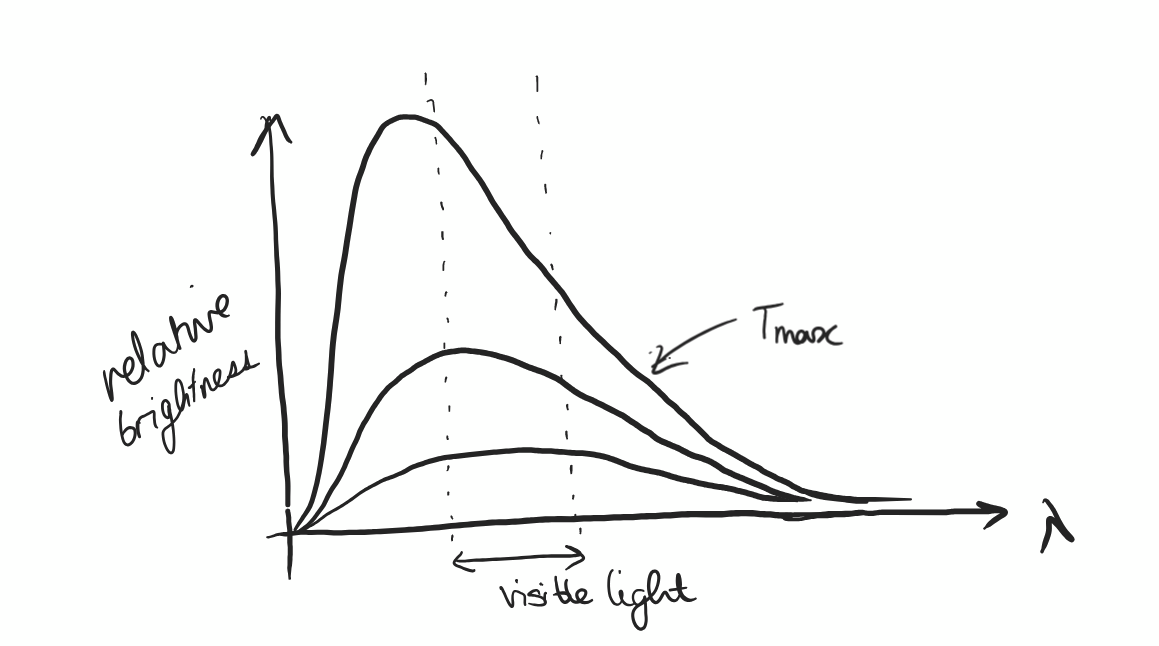
absolute magnitude (M)
apparent magnitude a source would have at a distance of 10pc (30.86e18 m). It is an intrinsic property of a source and a measure of luminosity in some waveband
distance modulus (μ)
difference between apparent magnitude (m) and absolute magnitude (M) [similar convention for flux f/F)
μ = m - M = 5log10(d/10pc) = 2.5 log10(F / f)
flux and luminosity ratio
2.5 log10(F / f) = 2.5 log10(L / l)
extinction
If light is attenuated between the source and the observer (e.g. due to interstellar/atmospheric extinction) the observed flux F(λ) at some given wavelength λ relates to the emitted flux F0(λ):
F(λ) = F0(λ) exp(𝜏λ)
𝜏 - the optical depth (larger when material is more opaque)
extinction formula
m(λ) -m0(λ) = 1.086 𝜏λ = Aλ
Aλ - extinction (magnitudes), which is λ dependent (increasing with decreasing λ). This shows that extinction changes the colour of the source by making it redder
colour excess
How much attenuating material there is towards a given source
E(B-V) = (B-V) - (B-V)0 = AB - AV
stellar mass
M* - a key property of stars used to determine a star’s evolution/life cycle
measuring M* using stellar spectrum
details in the absorption spectrum of stars depends on surface gravity g = GM / R². If we can measure g and R, M can be determined. Also, g ∝ 𝜌R, so stars of different densities will have different g value, which can be observed in collisional broadening in spectral lines
measuring M* using binary stars
Main way to measure stellar mass - use the properties of two stars in a binary system to determine M*
visual binary
each of the stars can be resolved individually.
If motion can be seen, then we can measure the ration of orbital radii a1/a2
M1a1 = M2a2 ⇒ a1/a2 = M1/M2 and so mass ratio can be determined
eclipsing binary
line of sight to observer lies in orbit so that forground star blocks light from background star. Only radius of these stars can be measured, not mass
spectroscopic binary (ratio of masses)
where we see periodic doppler shifts in the positions of the spectral lines from both stars in the binary, from which we can measure P, vr,1 and vr,2.
vr,2 / vr,1 = 2𝜋a2/P / 2𝜋a1/P = M1 / M2
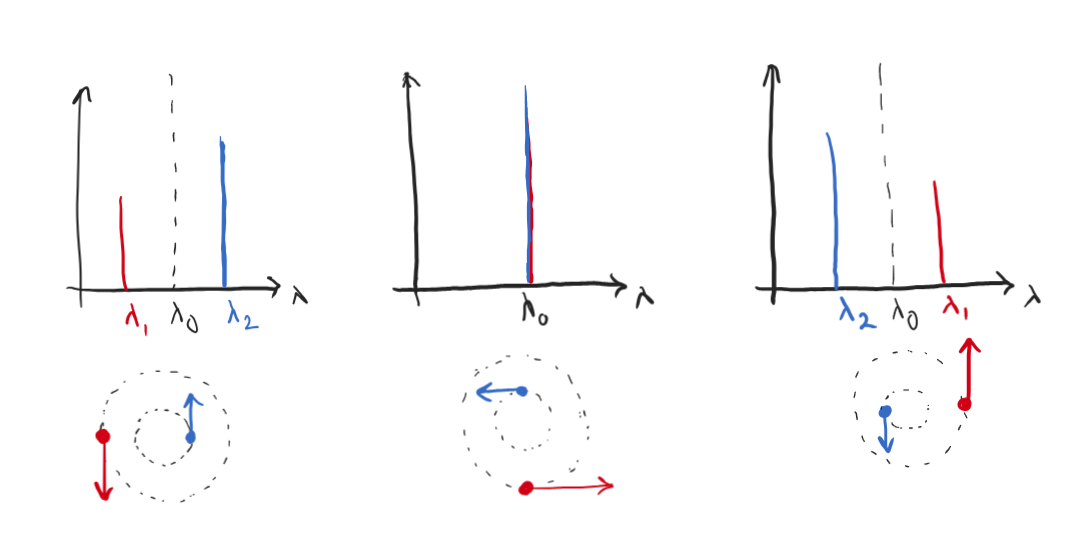
spectroscopic binary (sum of masses)
a = a1 + a2 = P/2𝜋 (v1 + v2)
⇒ M1 + M2 = (P/2𝜋G) (vr,2 + vr,1)3 / sin3i (from substituting into K3)
(you need to know the inclination i to find the sum of masses)
grav acceleration on test particle distance r away from body of mass M
agrav = GM / r²
differential of grav acceleration felt by 2 different test particles at different locations
dagrav = -(2GM / r3) dr
strength of tides
differential of grav acceleration can be translated to macroscopic bodies to tell us the strength of tides exerted by body of mass M on a second body of size Rm at distance d:
∝ MRm / d3
Roche Limit
tides slow down rotation and can lead to tidal locking, or even disruption of satellite. Roche limit is max distance at which satellite of density 𝜌m (held together by self gravity) is torn apart by tidal forces from primary body of size RM and density 𝜌M