intro to proteins: amino acids, peptides and proteins
 Call Kai
 Learn
Learn Practice Test
 Spaced Repetition
 Match
Match Flashcards
 Knowt Play
1/44

There's no tags or description
Looks like no tags are added yet.
Name | Mastery | Learn | Test | Matching | Spaced | Call with Kai | Chat |
|---|
No analytics yet
Send a link to your students to track their progress
45 Terms
what is pKa?
is the pH at which the protonated and deprotonated forms are present in equal amounts
if pH is below pKa (pH < pKa), what does it mean?
protonated form predominates
acidic environment
if pH is equal to pKa (pH = pKa), what does it mean?
about 50:50
if pH is above pKa (pH > pKa), what does it mean?
deprotonated form predominates
basic environment
an ionizable group has pKa = 7. what predominates at pH 6?
protonated predominates
there’s more hydrogen ions around
an ionizable group has pKa = 7. what predominates at pH 7?
about 50:50
an ionizable group has pKa = 7. what predominates at pH 8?
deprotonated predominates
there’s less hydrogen ions around
which form is protonated?

HA
because the proton is still attached
which form is protonated?

BH+
because the proton is still attached
which form is deprotonated?

A-
there is no proton attached
which form is deprotonated?
B
there is no proton attached
how can you tell which form is protonated?
it is if the proton is still attached. if it is still attached, then that form is protonated
every amino acid shares one backbone. what are all the parts of the amino acid?
carbon: centerpiece
α-amino group: (shown as NH3+)
α-carboxyl group: shown as COO-
R group: side chain

the amino acid residues in proteins are (D/L) stereoisomers
L
phosphorylation is a common way that signal transduction pathways are regulated. what can Ser, Thr, and Tyr act as?
they can act as molecular switches because they have hydroxyl groups (-OH)
you have a protein that contains a serine group, but something happened in the lab and it was swapped to a valine. will it still be able to phosphorylate?
no
serine group (contains OH)
valine group (nonpolar and no OH)
OH group is for phosphorylation
isoelectric point, pI
of a protein is defined as the pH at which the net charge of a protein molecule is zero
ex: milk
pH ~6.6-6.8 casein well stabilized
when you make it more acidic, there are more H+, so it’s approaching casein’s pI region
then it would coagulate because the pH has hit 0, the charge stabilization lost → aggregation/curd
what joins together amino acids?
peptide bonds
how should the amino acid sequence be written?
N → C
by convention, the free amino end comes first

what are essential amino acids?
they are amino acids that you need to obtain from eating. some amino acids are produced from our bodies
basically, just eat a healthy diet that contains all the necessary amino acids for our bodies
what does “essential” mean?
must-obtain

what are the 9 amino acids that are most essential in adults?
His, Ile, Leu, Lys, Met, Phe, Thr, Trp, Val
do all amino acids have the same backbone?
yes, the side chains create all the diversity
what do functional groups allow you to do?
they allow you to predict a side chain’s interactions
pH is relative to pKa. what do they allow you to predict?
they allow you to predict protonation and therefore charge
what do peptide bonds create?
directional, relatively rigid chains
what do peptide charge come from?
the termini and ionizable side chains
side chain pKa 4
cellular pH 7
the group COOH ⇌H⁺ + COO⁻
is pH 7 below or above the pKa?
above → deprotonated
side chain pKa 4
cellular pH 7
the group COOH ⇌H⁺ + COO⁻
which form predominates?
COO-
side chain pKa 4
cellular pH 7
the group COOH ⇌H⁺ + COO⁻
what charge predominates?
negative
can you determine the charge of this peptide at pH 7.4?
Glu —— Ala —— Lys
0
N-terminus : +1
Glu side chain : -1
Ala side chain : 0
Lys side chain : +1
C-terminus : -1
total = 0
a drink contains 18g of glucose in 500mL. what is the molecular weight?
180
glucose: C6H12O6
(6×12) + (12×1) + (16×6) = 180 = Mw
a drink contains 18g of glucose in 500mL. how many moles do we have?
0.10 mol
given: 18g
glucose: C6H12O6 → 180 = Mw
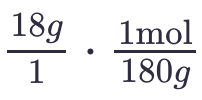
a drink contains 18g of glucose in 500mL. how many molecules do we have?
6E22
given: 18g
glucose: C6H12O6 → 180 = Mw

molecules = moles x 6E23

a drink contains 18g of glucose in 500mL. what is the molarity?
0.20 M
given 500mL
glucose: C6H12O6 → 180 = Mw
molarity = moles of solute/liters of solution


an amino acid side-chain carboxyl group has a pKa of approx. 4.0. which statement best describes its predominant protonation state and charge at pH 3.0 versus pH 7.0?
a) at pH 3.0 it is mostly deprotonated and negative; at pH 7.0 it is mostly protonated and neutral
b) at pH 3.0 it is mostly protonated and neutral; at pH 7.0 it is mostly deprotonated and negative
c) it is mostly protonated and positively charged at both pH values
d) it is approx. 50% protonated at both pH values because its pKa does not change
b
pH 3 is more acidic than pKa so it is protonated
3 and 4 are pretty close in numbers so it’s neutral
pH 7 is more basic than pKa so it is deprotonated
7 and 4 are far from each other so it’s negative
a solution is prepared by dissolving 36 of glucose, with a molar mass of 180 g/mol, in enough water to make a final volume of 2.0L. what is the glucose concentration?
a) 10mM
b) 50 mM
c) 100 mM
d) 200 mM
c
36 goes into 180 5 times

now solve for molarity, M
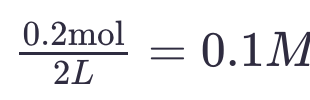
solve for mM

a leucine residue is buried in a nonpolar region of a protein. a mutation replaces this leucine with aspartate. which change is most directly introduced by the mutation?
a) a polar, ionizable carboxyl-containing side chain is introduced into a region that favored nonpolar interactions
b) a positively charged sulfur-containing side chain is introduced that can form a disulfide bond
c) an uncharged aromatic side chain is introduced that strengthens hydrophobic packing
d) a neutral amide side chain is introduced without substantially changing polarity
a
leucine is part of the nonpolar group
aspartate is part of the negative group → shows polarity
the local environment of an enzyme active site shifts the pKa of a histidine side chain from approx. 6.0 to 7.8. at pH 7.4, what effect would this shift have compared with a histidine whose pKa remains near 6.0?
a) a greater fraction of the histidine side chains would be protonated and positively charged
b) a greater fraction would be deprotonated and negatively charged
c) the histidine side chain would no longer be able to accept or donate a proton
d) the histidine side chain would remain neutral because the pH is above 7.0
a
pKa = 7.8
pH 7.4
pH is lower so protonated
a purified protein has an isoelectric point near 5.0. as the solution is acidified from a higher pH toward pH 5.0, the protein begins to aggregate. which explanation best connects the change in pH with the observed aggregation?
a) at the pI, all ionizable groups in the protein become chemically uncharged
b) near the pI, the average net charge approaches zero, reducing electrostatic repulsion between protein molecules
c) near the pI, peptide bonds become ionized and hydrolyze spontaneously
d) at the pI, every acidic and basic side chain has reached its individual pKa
b
pI is a protein molecule that has no net electrical charge (net zero)
the pH moves closer to the pI, making the net charge zero
a tripeptide is written Ser-Gly-Ala using the standard convention for peptide sequences. which statement correctly describes this peptide?
a) Ser has a free alpha-amino group at the N-terminus, and Ala has a free alpha-carboxyl group at the C-terminus
b) Ala has a free alpha-amino group at the N-terminus, and Ser has a free alpha-carboxyl group at the C-terminus
c) the alpha-amino and alpha-carboxyl groups of Gly are both free and titratable
d) all three residues retain free alpha-amino and alpha-carboxyl groups because peptide bonds form only between side chains
a
N-terminus—Ser—Gly—Ala—C-terminus
Ser sits at the start of the chain, so its alpha-amino group is free
Gly sits in the middle of the chain, so it uses both alpha-amino and alpha-carboxyl groups (so not free)
Ala sits at the end of the chain, so its alpha-carboxyl group is free
the peptide Glu-Ala-Lys is placed at pH 7.4. use these approx. pKa values: N-terminal alpha-amino = 9.5; C-terminal alpha-carboxyl = 2.0; Glu side chain = 4.1; Asp side chain = 3.9; Lys side chain = 10.5. the alanine side chain is nonionizable. what is the approx. net charge of the peptide?
a) -2
b) -1
c) 0
d) +1
b
compare the pKa values to the given pH 7.4
if pH is higher it is -1
if pH is lower it is +1
nonionizable = 0
(+1) + (-1) + (0) + (-1) + (+1) + (-1) = -1
a reducing treatment breaks the disulfide bonds in a protein but does not hydrolyze any peptide bonds. which statement best describes the immediate chemical consequence?
a) each S-S bond is converted to two cysteine thiols, while the amino-acid sequence linked by peptide bonds remains intact
b) peptide bonds between cysteine residues are selectively hydrolyzed
c) cysteine residues are converted into positively charged amino acids
d) the N-terminus and C-terminus of every residue become free
a
a reducing agent donates electrons to break the covalent disulfide (S-S) bond. that reducing agent reduced each bond back into two independent thiol (-SH) groups on individual cysteine residues
the question itself says that the reducing treatment doesn’t hydrolyze and peptide bonds. that means that the primary structure and amino acid sequence remains the same
a molecular-modeling program treats every bond in a polypeptide backbone as a freely rotating single bond. why would this model overestimate the number of conformations available to the protein?
a) resonance gives the peptide C-N bond partial double-bond character, making the peptide unit relatively planar and restricting rotation
b) ionizable side chains prevent backbone rotation whenever the pH differs from their pKa values
c) disulfide bonds form between every pair of adjacent amino acids and immobilize the backbone
d) each alpha-carbon forms an ionic bond with the alpha-carbon of the next residue
a
a peptide bond is not a freely rotating single bond
resonance → partial C–N double-bond character → a planar, relatively rigid peptide unit
a person with classic phenylketonuria has markedly reduced phenylalanine hydroxylase activity. which statement best explains both the phenylalanine warning on foods containing aspartame and the altered amino-acid requirement in PKU?
a) aspartame blocks phenylalanine absorption, causing phenylalanine deficiency and excess tyrosine formation
b) phenylalanine hydroxylase normally converts tyrosine to phenylalanine, so PKU causes tyrosine accumulation
c) aspartame directly inhibits phenylalanine hydroxylase, causing otherwise normal individuals to develop PKU
d) aspartame provides phenylalanine; impaired conversion of phenylalanine to tyrosine allows phenylalanine to accumulate and can make tyrosine conditionally essential
d
aspartame is a sweetener that metabolizes into phenylalanine, aspartic acid, and methanol. that’s why food labels has “phenylketonuria (PKU)” on it
people PKU lack phenylalanine hydroxylase (PAH) enzyme
because PAH converts phenylalanine into tyrosine, a lack of PAH would cause toxic levels of phenylalanine to build up
because tyrosine is not converted from phenylalanine, and is not synthesized in adequate amounts, tyrosine becomes an essential amino acid that must be obtained from food