Astro Week 5
 Call Kai
 Learn
Learn Practice Test
 Spaced Repetition
 Match
Match Flashcards
 Knowt Play
1/17

There's no tags or description
Looks like no tags are added yet.
Name | Mastery | Learn | Test | Matching | Spaced | Call with Kai | Chat |
|---|
No analytics yet
Send a link to your students to track their progress
18 Terms
Summarize the general surface features of the rocky planets and the moon
recurring pattern: older, heavily cratered highlands and younger, smoother volcanic plains
Impact craters
Volcanic features
some impacts so intense they weakened the Moon’s crust, leading to cracks where lava welled up and filled the crater
Moon
Moon highlands: most of the surface, made of low-density silicate rock
Moon maria: made of volcanic lava (basalt)
Mars
Cratered southern highlands vs. younger northern lowland plains
Venus
Mostly lowland lava plains and two continent sized highlands
Mercury
Does not show a clean highland/lowland split
Describe the history of the lunar surface
Highlands solidified as low-density silicate rock and floated to the top of the cooling moon
Maria formed when lava flooded large impact basins
Age range (youngest to oldest): volcanism ended (3.3billion years ago) Apollo samples (3.3-4.4billion years ago), highlands age (4.1-4.4billion years)
Now, dominant surface changing process is impact cratering
Explain the process of impact crater formation
Minimum impact speed = escape velocity + whatever orbital/approach speed the projectile already had
Energy converts into a shock wave and heat, vaporizing the projectile and surrounding rock
Crater diameter is 10-15x the projectile’s diameter
Four features of a crater
Central peak → flat floor → raised rim
Nearly perfectly circular crater forms, no matter what direction the impactor moves
Describe the lunar properties which are used to constrain how the Moon formed (What facts does a Moon formation theory need to explain?)
The Earth is the only rocky planet with a large moon
The average density of the moon is 60% of the Earth’s average density
The Moon’s chemical composition for all elements except oxygen very closely resemble the composition of Earth’s mantle
Moon has very little iron or other metals (compared to Earth) and is much richer in lighter elements like Oxygen
Earth and Moon have nearly identical oxygen isotope ratios
Moon’s orbital plane is tilted 5 degrees with respect to the Earth-Sun orbital plane
Rules out Capture Theory (says that moon has an independent origin elsewhere in the solar system – less important and wasn’t mentioned in class)
Rules out Fission Theory (says that the Earth spun so fast that material spewed and formed the Moon — doesn’t work because the current angular momentum of the Earth-Moon system is moderate, and much less than the angular momentum required for this to happen)
Summarize the current “giant impact” concept of how the Moon formed
A young Earth collided with a Mars-sized planet, and the debris (from the mantles of both planets) formed the moon
Explains
The Moon’s lack of a metal core
The shared oxygen isotopes with Earth
Summarize our ideas about the origin and evolution of Mercury
About 60% of Mercury’s mass is the core
Competing explanations
One or more giant impacts stripped away much of its rocky mantle/crust early on
Heat from the young Sun evaporated the lighter, more volatile silicates before the planet fully formed
The cooling of Mercury’s interior causes Mercury to contract, forming ridges and scarps
Mercury has a large iron core, similar in size to Earth’s iron core, yet has a smaller radius than Earth
Mercury has a similar ratio of volatile elements to other rocky planets (volatile elements have low boiling points, and are easily vaporized)
Summarize the general crater features of the rocky planets and Earth's moon.
The Moon and Mercury preserve craters of all sizes because they have no atmosphere to burn up incoming projectiles
On Venus, craters under 10km are rare because the thick atmosphere stops projectiles that small before they reach the ground
Describe and contrast tectonic and volcanic activity on the rocky planets.
Volcanic activity: molten rock (lava) erupting onto or near the surface
Olympus Mons → largest volcano in the solar system (on Mars)
Tectonic activity: crustal stress/deformation (cracking, folding, faulting) driven by mantle convection
Venus does not have plate tectonics because it lacks subduction zones, so mantle convection stresses the crust without moving separate plates (mountains)
One of its massive continents (Ishtar Terra) resembles the Himalayas because was formed from crustal compression driven by mantle convection, not subduction
Mars’ huge canyon system (Valles Marineris) is evidence of tectonic cracking
Summarize the evidence for active volcanoes on the surface of Venus.
The freshness of large craters (little erosion of lava infill) tells us there’s very low ongoing erosion, and not much has happened since a major resurfacing event
Volcanic hotspots and coronae (large, crown-like features shaped like rings formed by hot magma pushing up from inside the planet) suggest ongoing activity
Hot surface temperatures and strong mantle convection give rise to a thin crust
Describe the atmosphere of rocky planets
Mercury has virtually no atmosphere (its extremely thin atmosphere consists of particles from the solar wind, or particles ejected from the surface due to impact of meteorites)
Earth
Nitrogen and Oxygen
Carbon Cycle
Venus
Carbon dioxide and nitrogen
Mars
carbon dioxide and nitrogen
Atmospheres all began with materials outgassed by volcanoes (water capour, carbon dioxide, sulfur dioxide, and nitrogen)
What has kept our carbon dioxide levels low compared to Venus?
Carbon dioxide dissolved into the oceans and chemically bound into the surface rocks/sediments
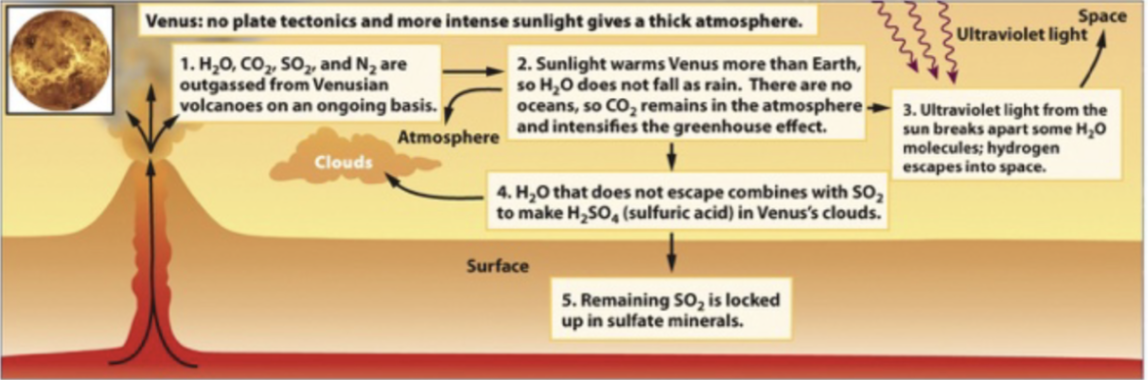
Identify the key processes which have modified the atmosphere of Venus
Runaway greenhouse effect
1/Water, Carbon dioxide, and sulfur dioxide outgassed from volcanoes on an ongoing basis
2/ Sunlight warms Venus more than Earth, so water does not fall as rain, therefore carbon dioxide stays in the atmosphere and intensifies the greenhouse effect
3/ UV light from the sun breaks apart some water molecules and hydrogen escapes into space
4/ Remaining water does not escape, it combines with sulfur dioxide to make sulfuric acid that forms Venus’s clouds
5/ Remaining sulfur dioxide is locked up in sulfate minerals
In one sentence: a self-reinforcing cycle where a small amount of extra heat evaporates more water and releases more carbon dioxide, which traps more heat, which releases even more gas, continuing until a much hotter equilibrium is reached
Why could Mars lose its atmosphere more easily than Earth or Venus?
Runaway icehouse effect
1/ Water, carbon dioxide, sulfure dioxide, and nitrogen were outgassed from volcanoes (stopped billions of years ago as planet cooled)
2/ Sunlight warms Mars less than Earth, so water falls as rain and carbon dioxide and sulfure dioxide dissolve in the water
3.1/ UV light from the sun broke apart some of the water and nitrogen molecules; the weak gravity allowed H, N, and O atoms to escape into space
3.2/ Removing carbon dioxide and water from the atmosphere reduced the greenhouse affect, lowering temperatures. Water froze beneath the surface, while carbon dioxide and sulfur dioxide went into rocks
4/ No plate tectonics on Mars because it is so small, so gasses that go into the surface are not recycled into the atmosphere
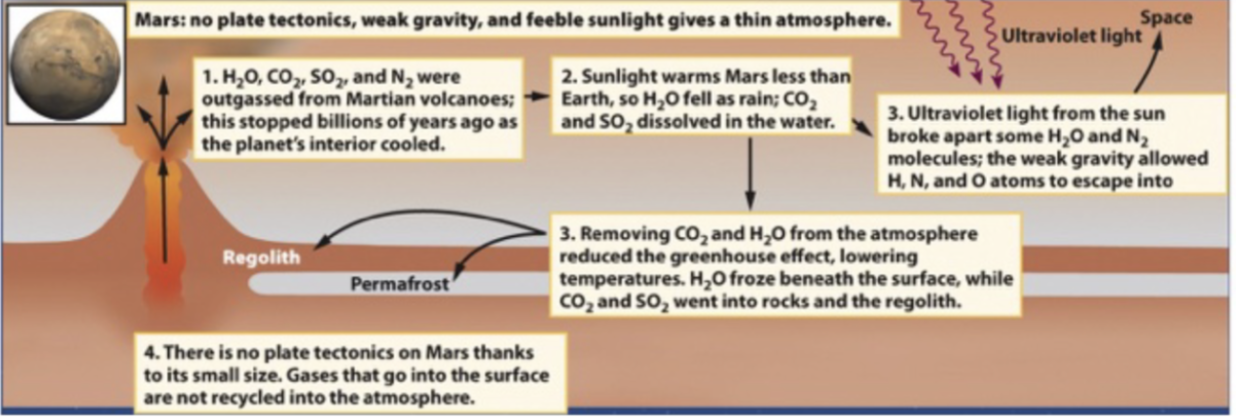
Explain Mars’ atmospheric losss
Ancient atmosphere was 2 to 20 times denser than current atmosphere
Mars has lost ⅔ of its Argon, and could have lost a large fraction of its carbon dioxide
Describe the general conditions on the surface of Mars
Clays and iron oxides explain the red colour
Highest temperature in the summer is -33C, lowest measured -100C
Types of clouds:
Dust clouds and carbon dioxide (dry ice) clouds, in addition to Earth-like water-ice clouds
Liquid water could not exist stably on the surface today because temperatures are too cold, and atmospheric pressure is so low, that water goes straight from ice to vapour without becoming a liquid
Summarize our understanding of the internal structure of Mars based on seismic data
InSight NASA mission (2018)
Mars is seismically active (magnitude 3-4 earthquakes somewhat common)
Core: Seismic data revealed a large liquid iron core, more than half of the planet’s radius
Mantle: Mars has single rigid lithospheric plates — no plate tectonics
No surface waves on mars probably due to the fact that the upper 10ish km of the crust is highly fractured/damaged due to asteroid impacts
Summarize the evidence obtained by orbiting spacecraft for ancient liquid water on the surface of Mars, and liquid water on or below the surface of Mars today
We see polar frozen ice caps on Mars (very low atmospheric pressure on Mars today means that standard liquid water is not stable at the surface—it would immediately boil or freeze)
Current research today is focused on:
How much frozen water there is on Mars today
Was there ever liquid water on Mars
Whether liquid brines (Very salty water) exist on the surface of Mars today
Evidence
Images from orbiting spacecrafts have revealed a variety of features which are likely the result of water erosion in the distant past
Drainage system into the Semeykin crater
Someone identified recurring, seasonal linear features on the sides of steep slopes (formed by liquid brings—water and salt—near the surface(?))
Could be sand flows
Use the concepts of physics and light introduced earlier in the course to explain how observations of Martian water are made.
Gamma ray and neutron spectrometer can be used to detect the presence of hydrogen (likely locked up in the form of water ice)
Visible and infrared spectra from two Mars missions have been used to create the first detailed global map of hydrated mineral deposits on Mars
Predominantly clays and salt that can be used to tell the history of water on the planet