Psych Unit 4 AOS 2
 Call Kai
 Learn
Learn Practice Test
 Spaced Repetition
 Match
Match Flashcards
 Knowt Play
1/110

There's no tags or description
Looks like no tags are added yet.
Name | Mastery | Learn | Test | Matching | Spaced | Call with Kai | Chat |
|---|
No analytics yet
Send a link to your students to track their progress
111 Terms
Mental wellbeing
An individual’s psychological state, including their ability to think, process information, and regulate emotions
across emotional, cognitive and social domains.
Level of functioning
The degree to which an individual can complete day-to-day tasks in an independent and effective manner.
High levels of functioning
carry out basic everyday tasks
be productive in completing daily tasks
set goals and take steps towards achieving them
Low levels of functioning
struggle to carry out basic tasks
feel uncharacteristically tired
unable to set goals in life
Resilience
The ability to cope with and manage change and uncertainty
High levels of resilience
seek solutions to problems
use appropriate coping strategies
be flexible in changing circumstances
Low levels of resilience
enduring feelings of being overwhelmed when problems arise
rely on unhealthy coping strategies
unable to adapt to change
Social wellbeing
The ability for an individual to form and maintain meaningful bonds with others,
and adapt to different social situations
High levels of social wellbeing
have a strong support network
be able to form and maintain meaningful relationships
be able to effectively communicate with others.
Low levels of Social wellbeing
isolation
difficulty forming and maintaining meaningful relationships
struggle to effectively communicate with others.
Emotional wellbeing
The ability for an individual to appropriately control and express their own emotions
in an adaptive way,
as well as understand the emotions of others
High levels of emotional wellbeing
be aware of their own and others’ current emotional state
experience a wide range of emotions
express emotions at appropriate times.
Low levels of emotional wellbeing
unable to understand or name emotions
unable to experience certain emotions
express emotions inappropriately or at inappropriate times
Wellbeing Continuum
A tool used to track fluctuating mental wellbeing.
Why is mental wellbeing considered to be on a continuum?
Because mental wellbeing is a dynamic state
Characteristics of high levels of mental wellbeing
Able to function independently within everyday life
able to cope w/ everyday demands w/out excessive levels of distress
may experience stress, sadness, and anger- able to cope with these experiences
Characteristics of moderate levels of mental wellbeing
not functioning at an optimal level
less severe and more temporary in nature compared to low levels
Characteristics of low levels of mental wellbeing
high levels of distress
unable to independently complete tasks
unable to meet demands of their environment
Internal factors that influence mental wellbeing
Factors that arise from within the individual
For example:
Stress response
Thought patterns
Genetic predisposition
External factors that influence mental wellbeing
Factors that arise from an individual’s environment
For example:
Loss of a significant relationship
Level of education
Difficulty within certain environments, e.g work or school
Stress
A psychological and physiological experience that occurs when an individual
encounters something of significance that demands their attention and/or
efforts to cope.
Characteristics of stress
Normal part of life, not necessarily a sign of low levels of mental wellbeing.
Distress→ when an individual does not feel that they have adequate resources to cope with a stressor→lower an individual’s mental wellbeing.
Usually in response to a known cause.
Anxiety
A psychological and physiological response that involves feelings of worry and
apprehension about a perceived threat.
Characteristics of anxiety
Typically only involves negative feelings (distress).
May be due to an unknown stimulus.
Usually future-oriented
Specific Phobia
A type of diagnosable anxiety disorder
categorised by excessive and disproportionate fear
when encountering or anticipating the encounter of a particular stimulus.
Specific phobia characteristics
going to great lengths to avoid phobic stimulus
significant disruption to daily functioning at work, home, social life, or with family
low levels of mental wellbeing when encountering or attempting to avoid the phobic stimulus
Biopsychosocial approach
a holistic, interdisciplinary framework for understanding the human experience
in terms of the influence of biological, psychological, and social factors.
Biological factors
internal, genetic, and/or physiologically based factors
Psychological contributing factors defintion
internal factors relating to an individual’s mental processes, including their
cognition
affect
thoughts,
beliefs
attitudes
Social factors
external factors relating to an individual’s interactions with others and their external environment
includes relationships and community involvement
What is GABA ?
The primary inhibitory neurotransmitter in the nervous system
How does GABA regulate the flight-or-fight-or-freeze and anxiety?
By slowing or halting the excitatory neural impulse responsible for these reactions.
GABA dysfunction
insufficient neural transmission or reception of GABA in the body
low levels of GABA→hgh levels of anxiety
How does GABA dysfunction contribute to the development of a specific phobia?
stress response= more easily triggered by certain stimuli than someone with adequate GABA levels.
recurrent stress responses to specific stimuli= can lead to development of a phobia.
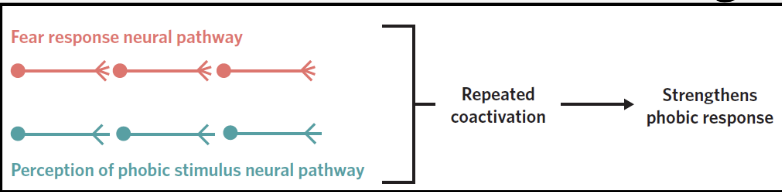
Long-term potentiation
the long-lasting and experience-dependent strengthening of synaptic connections that are
regularly coactivated
How does LTP continue the feeling of anxiety in relation to a specific phobia?
Aids in learning and memory of fear→strengthens synaptic connections in the neural pathway formed during the learning process.
The more the phobic stimulus is encountered, the more the connection is strengthened→ harder it is to forget the fear.
precipitating risk factor
increases our susceptibility to and contributes to the development of a mental health disorder.
classical conditioning
classical conditioning model response- before conditioning
Before conditioning,
The neutral stimulus (NS) of — produced no relevant response.
The unconditioned stimulus (UCS) of — produced an unconditioned response (UCR) of —
classical conditioning model response- during conditioning
During conditioning
the (NS) was repeatedly paired with the (UCS).
The (NS) was presented half a second before the (UCS).
This produced the UCR of (UCR- link to it being in response to the UCS)
classical conditioning model response- after conditioning
After conditioning,
The once neutral stimulus (NS) is now the conditioned stimulus of (insert CS here)
which produces the conditioned response of (insert CR here)
without the presence of the unconditioned stimulus (insert UCS here)
perpetuating risk factor
a risk factor that inhibits an individual’s ability to recover from a mental health disorder.
operant conditioning
stigma
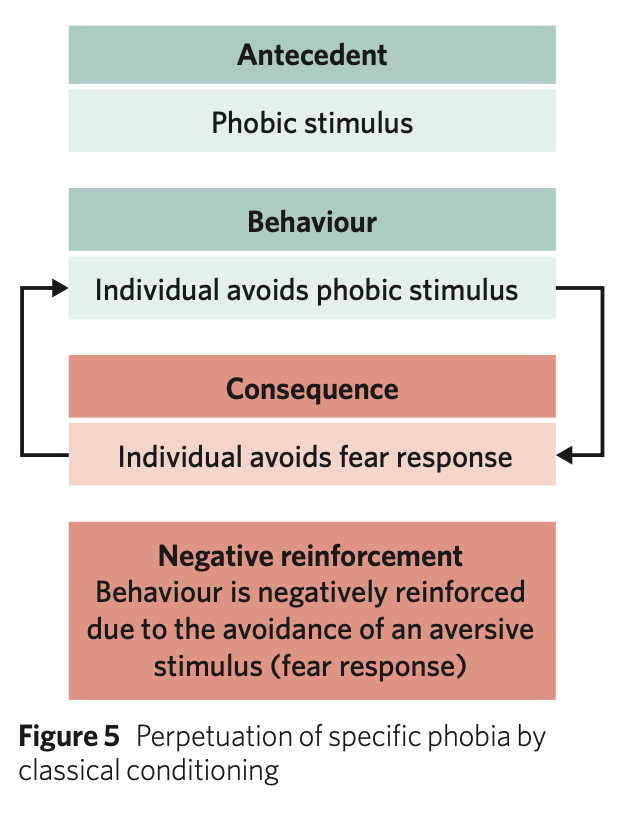
Operant conditioning of a phobia
Antecedent= phobia
Behaviour= avoidance
Consequence= removal of fear response
This is negative reinforcement as the removal of the undesirable stimulus (anxiety) increases the likelihood of repeating the behaviour of avoiding the phobic stimulus again, perpetuating the phobia.
Cognitive biases defintion
a predisposition to think about and process information in a certain way.
This can cause errors in judgements and thoughts.
Memory bias definition
refers to the tendency to recall or recognise negative or threatening information better than positive or neutral information.
Memory bias example
Fear of horses- remember the one and only time a horse attacked them and forget every other positive interaction with a horse.
Catastrophic thinking
A thinking style which involves overestimating, exaggerating or magnifying an object or situation and predicting the worst possible outcome.
Catastrophic thinking example
Eg: A person with a phobia of a particular animal may believe that any encounter with that animal will kill them.
Specific environmental triggers
stimuli or experiences in a person’s environment that prompt an extreme stress response,
leads to development of phobias.
three types of specific environmental triggers.
Direct confrontation (e.g. being bitten by snake)
Observation of another person
Indirect learning (e.g. through a movie)
Stigma
the feeling of shame or disgrace experienced by an individual for a characteristic that differentiates them from others
how does stigma act as a barrier to treatment?
b/c it can stop patients from receiving help and support they need.
This can worsen anxiety symptoms associated with their phobia.
Biological interventions
GABA antagonists
Breathing retraining
Psychological interventions
cognitive behavioural therapy (CBT)
Systematic desensitisation
Social interventions
Psychoeducation
Challenging unrealistic or anxious thoughts
Not encouraging avoidance behaviours
Agonists
a type of drug that imitates neurotransmitters
and works to initiate a neural response (excitatory or inhibitory)
when it binds to the receptor sites of a neuron
Benzodiazepines
a type of medication that depresses CNS activity and is often used
as a short-acting anti-anxiety medication
How benzodiazepines work as GABA antagonists
Benzodiazepines bind to a GABA receptor site on a postsynaptic neuron.
The benzodiazepines increase the effectiveness of GABA when it later binds to the same receptor sites + mimics its effects.
GABA is then able to have its inhibitory effect→ reduces likelihood that the neuron will fire.
Acts temporarily to reduce neural communication→ reduces anxiety.
The role of benzodiazepines in the treatment of phobia
Can be used to treat GABA dysfunction, and therefore the development of specific phobia
Strengths of Benzodiazepines
effective short-term treatment @ reducing physiological symptoms.
targets biological contributing factor; GABA dysfunction
Limitations of Benzodiazepines
needs to be taken daily
focuses on physiological symptoms not the psychological causes
Breathing retraining
a method used to teach breathing control techniques that may reduce physiological
arousal
How does encountering a phobic stimulus result in anxiety?
Someone is facing a phobic stimulus→ often experiences fast, shallow breathing→ sympathetic nervous system becomes dominant.
can lead to hyperventilation & engagement of other sympathetic nervous system responses→ increased anxiety.
process of bretahing retraining
1. A psychologist or doctor will teach a person with a specific phobia how to consciously control their breathing.
2. The learner applies the breathing techniques learnt in step 1 when in the presence of a phobic stimulus→ decreases sympathetic nervous system dominance & reduces anxiety.
Specific breathing techniques for bretahing retraining
breathing slowly in through the nose and breathing out slowly from the diaphragm

Cognitive behavioural therapy (CBT)
a form of psychotherapy that encourages individuals to substitute dysfunctional cognitions and behaviours with more adaptive ones.
cognitive component of CBT (& cognitive behavioural strategies)
identifying negative thoughts and feelings (cognitions) about the issue.
replacing these negative thoughts and feelings with more positive ones.
Cognitions that may contribute to and perpetuate specific phobia
Memory bias
Catastrophic thinking
A belief that the phobia can never be overcome
behavioural component of CBT (& cognitive behavioural strategies)
identifying negative behaviours relating to the issue.
developing and maintaining more positive behaviours relating to the issue.
Behaviours that may contribute to and perpetuate specific phobia
avoiding phobic stimulus and anything related to it
Not seeking help
Systematic desensitisation
a therapeutic technique used to overcome phobias
involves being exposed incrementally to increasingly anxiety-inducing stimuli,
combined with the use of relaxation techniques
Steps of systematic desensitisation
Learning of relaxation techniques- e.g. breathing techniques
Development of fear hierarchy
Gradual step-by-step exposure under supervision of professional
Continuation of exposure until the most fear inducing stimulus can be faced w/out phobic response
**cannot move up hierarchy until you experience sense of calm with initial stimulus
Psychoeducation
Teaching families and supporters of individuals with mental health disorders how to better understand, deal with, and treat their disorder.
Challenging unrealistic or anxious thoughts
family and supporters→ encouraged to actively challenge anxious thoughts
→ helps person w/ specific phobia to understand that some cognitive components of their fears= potentially unfounded & irrational.
should be done in a supportive, non-judgemental fashion.
Not encouraging avoidant behaviours
families and supporters are taught to not encourage avoidance behaviours
→ do not solve and only perpetuate the phobic anxiety.
Social and emotional wellbeing (SEWB)
an interconnected framework that includes all elements of being, and therefore wellbeing, for Aboriginal and Torres Strait Islander peoples.
It is:
Multidimensional
Holistic
Multidimensional
made up of different components
Holistic (in relation to SEWB)
an approach to wellbeing that considers the whole person, including their mental, physical, spiritual, and social needs
SEWB view on mental wellbeing for Aboriginal and Torres Strait Islander peoples
Definitions will vary across Aboriginal and Torres Strait islander language groups
Will change through a life span
How many dimensions of wellbeing are there? (SEWB framework)
7
Connection to body (in relation to SEWB)
connecting to the physical body and health in order to participate fully in all aspects of life
Connection to mind and emotions (in relation to SEWB)
ability to effectively manage thoughts and feelings
Connection to Family and Kinship (in relation to SEWB)
connection to the immediate and wider family group and community
Connection to community (in relation to SEWB)
connection to wider social systems
provides individuals and families the ability to connect with and support each other
Connection to Culture (in relation to SEWB)
a strong sense of identity, values, tradition, and connection between the past, present,
and future that drives behaviour and beliefs
Connection to Country (in relation to SEWB)
traditional lands of a particular language or cultural group, including both geographical boundaries and the spiritual, emotional, and intellectual connections to and within it
Connection to Spirituality (in relation to SEWB)
a concept that connects all things, and shapes beliefs, values, and behaviour.
guides knowledge systems, culture, and all that is life for Aboriginal people, including:
connections to ancestors
the past
the present
the future
Connection to Ancestors (in relation to SEWB)
a belief that a family and communities ancestors are interconnected with Creation spirits and Country
watch over, guide, and protect families and communities in the physical + spiritual world
two important cultural determinants of wellbeing Aboriginal and Torres Strait Islander communities
cultural continuity
self-determination.
Cultural continuity
the passing down and active practice of cultural knowledge, traditions, and values from generation to generation
Self-determination
the rights of all peoples to pursue freely their economic, social, and cultural development without outside interference
Determinants of wellbeing
factors that influence wellbeing on individual and community levels
Protective factors
influences that enable an individual to promote and maintain high levels of
mental wellbeing.
Biological protective factors definition
influences that stem from an individual’s brain and/or body that can maintain or
promote mental wellbeing
Adequate nutrition and hydration definition
when the type and amount of food and drink that an individual consumes meet their physical needs
Adequate nutrition and hydration explanation
balanced diet: minimal amounts of unhealthy food & more healthier options
adequate nutrition & hydration promotes mental wellbeing
Sleep definition
a regular and naturally occurring altered state of consciousness that involves a loss of awareness and disengagement with internal and external stimuli
Sleep explanation (in regards to it being a protective factor)
link between poor sleep & mental illness
adequate sleep= reduce likelihood of mental health disorder & promote mental wellbeing
Psychological protective factors
influences that relate to mental processes that can maintain and promote mental wellbeing
Cognitive behavioural strategies definition
techniques that utilise traits of cognitive behavioural therapy, particularly recognising and changing dysfunctional thought and behavioural patterns
Cognitive behavioural strategies explaination
used to promote mental wellbeing by acknowledging and changing thoughts + behaviours that impair mental wellbeing
“cognitive restructuring”= cognitive component of CBS