Renal Variants
 Call Kai
 Learn
Learn Practice Test
 Spaced Repetition
 Match
Match Flashcards
 Knowt Play
1/15

There's no tags or description
Looks like no tags are added yet.
Name | Mastery | Learn | Test | Matching | Spaced | Call with Kai | Chat |
|---|
No analytics yet
Send a link to your students to track their progress
16 Terms
comensatory hypertrophy
Enlargement of the unaffected contralateral kidney with unilateral renal agenesis or compromised renal function
dromedary hump
Bulge on the lateral border of the kidney (often on the left kidney)
dupex (duplicated) collecting system
Division of the renal sinus. In this variant, there are two separate renal sinuses; they are referred to as an upper pole moiety and lower pole moiety Obstruction to one or both of these collecting systems can occur Two ureters drain separate portions of the kidney Kidney with duplex collecting system will typically measure longer than a normal size kidney
the most common congenital anomaly of teh urinary tract
duplex collecting system
ectopic kidney
Pelvic kidney: one or both kidneys may be located within the pelvis; the pelvis is the most common location of an ectopic kidney Crossed fused ectopia: both kidneys are fused and on the same side of the body Thoracic kidney: kidney sits partially or completely in the chest
extrarenal pelvis
The renal pelvis is located outside of the renal hilum
fetal lobulation
Lobulated or bumpy outline to the kidney(s); can be seen in adults
horseshoe kidneys
Two kidneys that cross the midline and connect at their lower poles by an isthmus The isthmus of the horseshoe kidneys travels anterior to the abdominal aorta and inferior vena cava
hypertrophic column of bertin
Enlargement of a renal column seen as an indentation of the renal sinus Actually are double layers of renal cortex
junctional parenchymal defect (junctional line)
Results from the incomplete fusion of the two embryologic components (renunculi) of the kidney Appears as a hyperechoic, wedge-shaped structure on the anterior portion of the kidney; located between the upper and middle sections of the kidney
malrotated kidney
The kidney sits in the renal fossa but is positioned off of the normal axis
renal agenesis
Congenital absence of the kidney. Bilateral renal agenesis is typically not consistent with life
renal hypoplasia
The underdevelopment of the kidney in which there are too few nephrons Kidney will be smaller than normal
renal sinus lipomatosis
Excessive fat within the renal pelvis
Renal sinus will be large and echogenic
supernumerary kidney
A third, smaller kidney
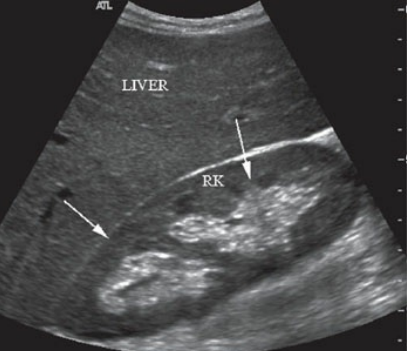
Duplex collecting system. Sagittal image of the right kidney (RK) revealing two distinct renal sinuses (arrows), separated by a band of parenchyma, denoting a duplicated collecting system.