PSY396 Lecture Week 3: Introduction to transcranial magnetic stimulation (TMS)
 Call Kai
 Learn
Learn Practice Test
 Spaced Repetition
 Match
Match Flashcards
 Knowt Play
1/13

There's no tags or description
Looks like no tags are added yet.
Name | Mastery | Learn | Test | Matching | Spaced | Call with Kai | Chat |
|---|
No analytics yet
Send a link to your students to track their progress
14 Terms
What is TMS?
A technique that works through the principle of magnetic field induction
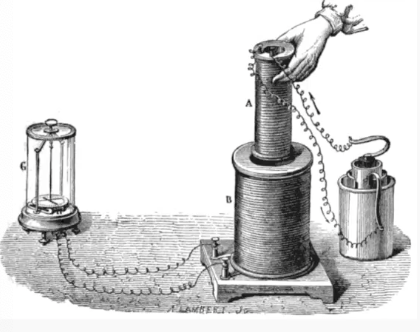
Discovered by British physicist Michael Faraday in the late 1800s
Faraday’s law of induction
Faraday’s law of induction
When coil A (electromagnet) moves through coil B, this creates a change in magnetic field
This induces an electromagnetic field (EMF), which will generate current in a nearby conductor B (observed in G)
Key takeaway: a moving electric current induces a change in the magnetic field, and a change in the magnetic field can induce current in a conductor (like the copper wire here)
How TMS works
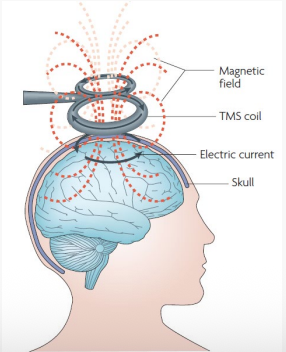
A brief, high current, electric pulse travels through to a handheld coil Induces a magnetic field
Magnetic field passes through scalp
Induces current flow in cortical tissue
Neurons depolarise
Action potentials!
How is TMS used in cog neuro?
1. To investigate the dynamic cortical processes underpinning human behaviour
2. To investigate the causal involvement of cortical regions in human behaviour
3. To induce neuroplasticity (for research and clinical purposes)
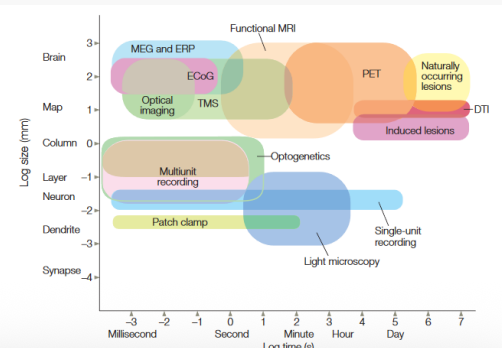
Techniques compared
Investigating dynamic cortical processes
TMS can activate cortical neurons
Which neurons are activated depends on…
Where the coil is
Coil geometry (c.f. Talebinejad and Musallam 2010)
Stimulus intensity
Brain state (i.e., at rest, or engaged in a task) •
When we apply stimulate the cortical neurons before/during/after a task, we can observe the dynamic cortical processes underpinning the task
Excitation
Inhibition
Investigating dynamic cortical processes - Measuring excitation
Deliver single-pulse TMS to scalp
Activates local neurons (excitatory and inhibitory)
Example: primary motor cortex (M1)
Specific M1 regions control specific muscles
Place coil over a region → stimulate at a sufficient intensity → net excitation of corticospinal neurons → signal travels along corticospinal tract toward muscle → produces muscle activity (measured by EMG)
The muscular response to a TMS pulse = motor evoked potential (MEP)
MEP = measure of corticospinal excitability; bigger MEP = more excitability
Investigating dynamic cortical processes - Measuring excitation - Action selection & execution
Go/No-Go task
Tells us about underpinning dynamics of action selection in healthy YAs
Question: Why do we get slower at action selection & execution with age?
Young:
Generally greater excitability
Dip
Gradual increase
Older:
Generally less excitability
No dip
Limited increase
Investigating dynamic cortical processes - Measuring inhibition
Deliver paired-pulse TMS to scalp
Different protocols, common = short-interval intracortical inhibition (SICI)
Selectively targets GABA-A mediated inhibitory circuit by applying two TMS pulses with a short interval
Investigating dynamic cortical processes - Measuring inhibition - How SICI works
→ Apply single-pulse TMS
→ Produces an MEP of a certain size, giving us a measure of corticospinal excitability
→ Apply paired-pulse TMS
→ Single-pulse preceded by weaker pulse
→ Weaker conditioning stimulus selectively activates inhibitory circuit (lower threshold)
→ Stronger test stimulus is applied 2.5-3ms later, while the inhibitory circuits are still active
→ As a result, the response (i.e., MEP) produced by the test stimulus is smaller than when we give the test stimulus alone
→ We compare the size of the conditioned MEP to the unconditioned MEP
→ The greater the suppression of the MEP, the greater the SICI
Investigating dynamic cortical processes - Measuring inhibition - Action selection & execution
Q: Why do we get slower at action selection & execution with age?
Task: Go/No-Go
Young:
Generally greater release of inhibition
No-Go: Inhibition increased
Go: Inhibition reduced
Older:
Generally lower release of inhibition
Time-course of SICI modulation preserved was in healthy aging
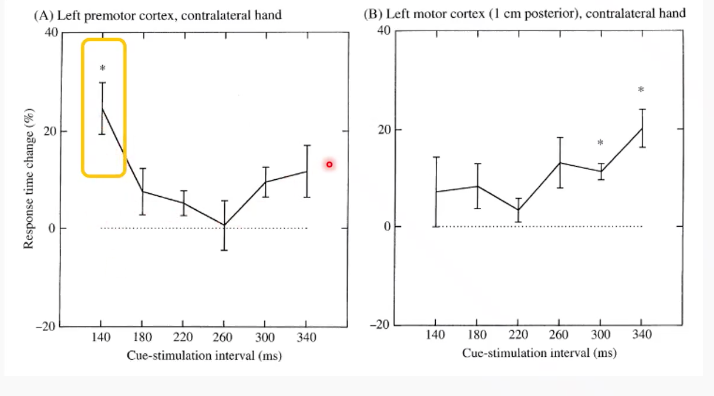
Investigating causal cortical involvement
Schulter et al. 1998 investigated the involvement of different motor regions in movement selection
Task: choice RT
TMS to induce neuroplasticity (for research and clinical purposes)
TMS can induce lasting changes in neuroplasticity through repetition → repetitive TMS (rTMS)
Utilises Hebbian rule
→ ‘When an axon of cell A is near enough to excite a cell B and repeatedly or persistently takes part in firing it, some growth process or metabolic change takes place in one or both cells such that A's efficiency, as one of the cells firing B, is increased’ - Donald Hebb
‘What fires together, wires together’ - Carla Shatz
Many types of rTMS
rTMS can be used to induce neuroplasticity
Different protocols for different purposes
High-frequency rTMS (>1Hz) → upregulates
Low-frequency rTMS (≤1Hz) → downregulates
To induce neuroplasticity (for research and clinical purposes) - Treatment of depression
In depression, a part of the central executive network (DLPFC) is hypoactive
High-frequency rTMS to the DLPFC helps to upregulate this activity & ameliorate depressive symptoms
Treatment response is associated with an increase in BOLD activity
This rTMS protocol was approved by Medicare (2021) as a subsidised treatment
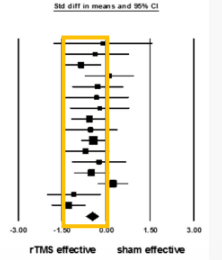
Effect of high-frequency rTMS (>1 Hz) over the left DLPFC (Kedzior et al., 2015) on depression: