Khanacademy MCAT Unit 8: Foundation 3: Organ systems - Neural cells
 Call Kai
 Learn
Learn Practice Test
 Spaced Repetition
 Match
Match Flashcards
 Knowt Play
1/83

There's no tags or description
Looks like no tags are added yet.
Name | Mastery | Learn | Test | Matching | Spaced | Call with Kai | Chat |
|---|
No analytics yet
Send a link to your students to track their progress
84 Terms
Which two catogeries of neural cells are there ?
Neural cells and Glia (glial cells)
Cell name coming from a Greek word for nerve
Neural cells
Cell name coming from a Greek word for glue
Glial cells
Brain and spinal cord are the …
central nervous system
Nerves coming out of brain and spinal cord are the …
peripheral nervous system
Nerves are made up of … and …
neurons and glial cells
Neural cells are derived from …
neural stem cells or neural crest cells
Neural crest cells and neural stem cells arise in the part of the embryo called the …
ectoderm
Neurons and glia in the CNS are derived from
neural stem cells
Neurons and glia in the PNS are derived from
neural crest cells
What is the main part of the cell called (both in neurons and glia)
The soma or the cell body with the nucleus
What are the processes (thin, long extensions) coming out of the neural cells ?
Axons
What is the function of neurons ?
to process and transmit information
What is the function of glia ?
to support the neurons with processing and transmitting information
How many neurons are there ?
Billions
What are the most common glia ? (5)
Astrocytes
Microglia
Ependymal cells
Oligodendrocytes
Schwann cells
What are some less common glial cells ? (3)
Satelite cells
Olyfactory cells
Sheathing cells
What is the cell body of a neuron ?
Soma
What are the short and long processes (neurites) of a cell ?
Short = dendrites
Short or long = axon with axon terminals
What’s the first part of the axon called ?
The axon inital segment or trigger zone
What is the sheath that large axons are wrapped in ?
Myelin sheath
What are the little gaps called between the segments of myelin on an axon ?
Nodes of Ranvier
Where to the axon terminals come close to ? (4)
Target cells (can be other neurons, muscle cells, gland cells or capillaries = haarvaten)
What is the place called where an axon terminal comes close to a target cell ?
A synapse
What is the main difference in potency between a Neural Stem Cell (NSC) and a Neuroblast? (potency = what a cell is capable of becoming)
Neural Stem Cell (NSC) are multipotent: They can differentiate into neurons or glial cells (astrocytes & oligodendrocytes).
Neuroblasts are unipotent/committed: They can only differentiate into neurons.
How does the development of a neuron go ?
**** Neural crest or stem cell to neural blast to neuron with growth cone
What is the defining structural feature of a unipolar neuron?
It has only one single process (axon) extending from the cell body (soma).
When are unipolar neurons present in humans ?
During development (embryo)
What is a bipolar neuron ?
A soma, a dendrite and an axon
What is a multipolar neuron ?
It has a soman, multiple dendrites and an axon
Which type of neuron is the most common in humans ?
Mutlipolar neurons
What is a pseudo-unipolar neuron ?
Soma with one short process that divides into two long processes.
Which are the two processes called in a pseudo-unipolar neuron ?
The pheripheral axon, bringing information in from the periphery and the central axon bringing information into the central nervous system.
Where is the most common place to find pseudounipolar neurons in the human body?
In the Dorsal Root Ganglia (DRG) of the spinal cord (and some cranial nerve ganglia).
What is a cyton ?
It is a soma or a cell body. Cyton is more specific to the neuron. Cyton is also called perikaryon.
What is the resting membrane potential ?
Without input, most neurons have a stable electrical charge difference across their cell membrane, where it's more negative inside the cell membrane and more positive outside the cell membrane.
Neurons receive excitatory or inhibitory input from other cells or from physical stimuli (like odorant molecules in the nose) throught where does this information come from ?
Input information usually comes in through the dendrites. (Although less often, it'll come in through the soma or the axon.)
… are changes to the membrane potential away from the resting potential (which are small in size and brief in duration, and which travel fairly short distances).
Graded potentials
To what is the size and the duration of a graded potential proportional ?
to the size and the duration of the input
Where does summation, or an adding together of all the excitatory and inhibitory graded potentials at any moment in time occur ?
At the trigger zone, the axon initial segment
The summation of graded potentials is how neurons process their information. When will information be fired down the axon ?
If the membrane potential at the trigger zone crosses a value called the threshold potential.
How is the information fired down an axon ? Which change to the membrane potential ?
An action potential
How are action potentials different than graded potentials ?
Action potentials are different than graded potentials because they're usually the same size and duration for any particular neuron, as opposed to the graded potentials, whose size and duration depends on the size and the duration of the inputs.
How does information cross from an axon to a trarget cell ?
By releasing molecules called neurotransmitters that bind to receptors on the target cell
What part of a cell receives the electrical action potential traveling down the axon and converts it into a chemical signal by releasing those neurotransmitters.
The axon terminal
What are the three parts of a synapse ?
1) The Presynaptic Element (the axon terminal)
2) The Synaptic Cleft (a tiny, fluid-filled physical gap between the two cells (usually about 20 nanometers wide).
3) The Postsynaptic Element (The membrane of the receiving cell (usually a dendrite or cell body of the next neuron, or a muscle cell) which contains the receptors that catch the neurotransmitters.)
What’s the name of a pseudounipolar neuron (in the PNS) that brings information from the periphery in toward the central nervous system.
Afferent neuron (meaning it's bringing information into the central nervous system)
What is an other name for an afferent neuron ?
A sensory neuron (information about a stimulus going into the CNS)
What’s the name for the neurons carrying information away from the central nervous system out into the periphery.
Efferent neurons
What are the two types of efferent neurons
1) motor neurons/somatomotor neurons
2) autonomic neurons
Which efferent neuron controls skeletal muscles
Motor neuron / somatomotor neurons
Which efferent neurons control smooth muscle (muscle around blood vessels), cardiac muscle (of heart) and gland cells ?
Autonomic neurons / visceromotor neurons
What are the neurons called that connect other neurons together ?
Interneurons
Which glial cell of the CNS has there name from the greek word star ?
Astrocytes (derived from neural stem cells)
What are the parts of astrocells (3)
1) soma
2) a lot of processes
3) end feet at the end of the processes
Which cell form the scaffold for the entire central nervous system and form the majority of the structure that actually makes up the brain and the spinal cord.
Astrocytes
What are the two functions of astrocytes ? (3)
1) They are the scaffolding/support of the CNS
2) Glial scar: divide and migrate into the area of injury and processes hyportrophate
3) Homeostasis: trying to keep the interstitial fluid (between all the cells) stable and releasing lactate
4) Blood brain barrier
5) Clear out synapses
What is the process called where astrocytes multiply as part of the healing process following CNS injury, where proliferation of astrocytes and their processes results in dense glial scar tissue ?
Gliosis / astrogliosis / (reactive) astrocytosis
Why is it imortant the astrocytes keep the homeostatis of the interstitial fluid ? (2)
1) Neurons can’t function properly if there is an abnormal concentration of potassium ions (K+), so they are taking in or releasing ions
2) Astrocyte convert glycogen into lactate they can release: neurons have very little initial energy and are dependent on a continuous supply of oxygen and glucose
Which part of the astrocyte play a role in the blood brain barier ( preventing large molecules from leaving the blood to enter the central nervous system) ?
The end feet (at the end of the processes) are plastered all over the blood vessels (barrier)
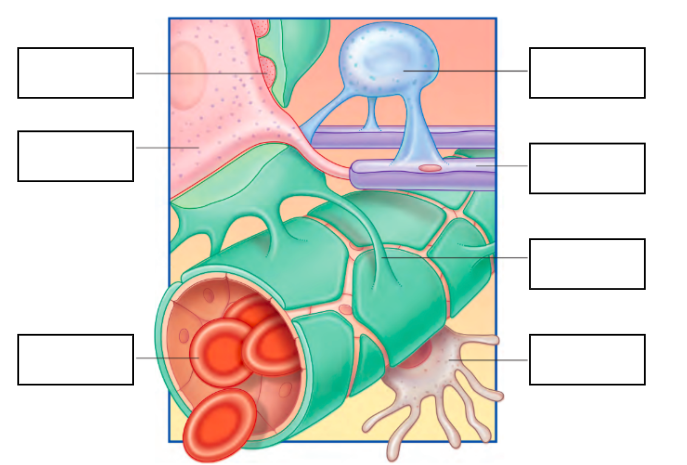
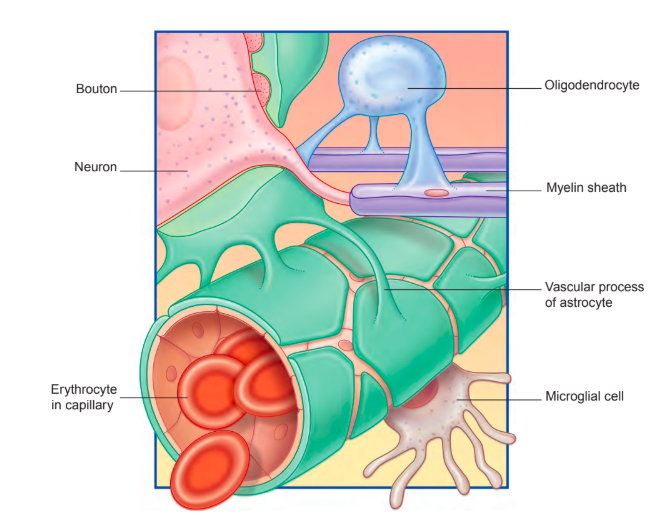
How do astrocyte clear out the molecules that communicate between neurons and their target cell, called neurotransmitters ?
Astrocytes are extending their processes and placing their end-feet all over synapses and they're actually helping to clear out those synapses, resetting the synapse so that it can be used again for communication.
Where do microglia originate from ? (in the embryo)
Mesoderm (microglia probably derived from circulating monocytes from the bone marrow, that then enter the central nervous system)
When do resting microglia convert into active microglia ?
When there is inflamation to the CNS (from injury to the tissue of the CNS or from an infection like a bacteria or a virus)
How do resting microglia convert into active microglia ?
Retract all the long processes
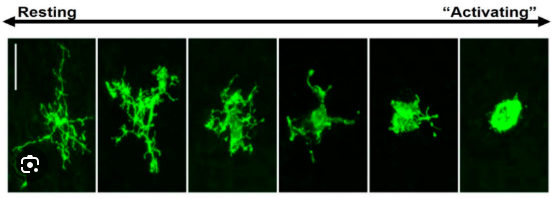
What does an active microglia secrete when it finds a foreign cell (like ROS)
like a bacteria, that can kill these foreign cells.
Cytotoxic
What is it called when microglia will take inside its own cell and break down into smaller pieces anything that's not a normal healthy cell of the central nervous system ?
Phagocytosis
What’s the function called when microglia ate present the debris on its surface for other cells of the immune system (like the lymphocyte) so that these cells can further increase inflammation ?
Antigen presentation
In which two ways does microglia play a role in neuroinflammation (inflammation in the CNS) ?
Promote inflammation and resolve inflammation (links to alzheimers)
Which are the four different types of neuroglial cells that are found in the CNS
1) astrocytes
2) oligodendrocytes
3) microglia
4) ependymal cells
Which cells originate from the neural crest ?
1) Schwann Cells of Peripheral Nerves
2) Spinal Ganglion Cells (Dorsal Root Ganglia)
3) Autonomic Ganglion Cells
4) Melanocytes
Which cells are glial cells of the central nervous system derived from neural stem cells that make up the ependyma ?
Ependymal cells
How are ependymal cells constructed ?
They form a simple (meaning that they're just one layer of cells), cuboidal (shaped like little cubes) epithelium (they're a covering the lining of a cavity).
Which two fluids do the ependymal cells separate ?
The CSF (cerebral spinal fluid) and the IS (interstitial fluid, fluid between the cells).
What increases the surface area of the ependymal cells ? (on the side of the CSF)
Little tiny processes called microvili
Which long processes on ependymal cells help move the CSF around by creating a mechanical wave ?
Cilia
What is one of the funcitons of the ependyamal cells ?
To form a (leaky) barier between the CSF and the IF, so that the movement of cells and molecules is limited between these spaces.
In what way is it medically relevant to have a leaky barrier by the ependymal cells ?
There are areas where we can sample the cerebral spinal fluid and send it to the laboratory and when we analyze the cerebral spinal fluid, we can often get a lot of information about what's happening in the tissue of the brain in the spinal cord (IF)
What’s a function of ependymal cells where capillaries and modified ependymal cells forms the choroid plexus ?
To participate in secretion of the cerebral spinal fluid.