COG PSYCH 3
 Call Kai
 Learn
Learn Practice Test
 Spaced Repetition
 Match
Match Flashcards
 Knowt Play
1/29

There's no tags or description
Looks like no tags are added yet.
Name | Mastery | Learn | Test | Matching | Spaced | Call with Kai | Chat |
|---|
No analytics yet
Send a link to your students to track their progress
30 Terms
Unable to perceive motion
Seeing ‘nothing in between’ location changes
EX) Parked cars vs moving cars
What is Akinetopsia?
Vision is the most dominant sense in humans
There is more brain area devoted to vision than the other senses
If visual inputs conflict with other sensory inputs, visual inputs generally dominate the final perception
EX) Puppet shows, we don’t see the puppet master but since we see the puppets instead, we generally focus on them instead of the puppet master.
Which is the most dominant sense in humans?
Light comes into the cornea → lens → retina
The cornea and lens focus the light on the retina
How does light enter the eyes?
Sensitive to low levels of light
Lower acuity
Does not produce a higher resolution, rods produce lower quality images.
Color-blind
None in the fovea
EX) Shining bright light into our eyes tells our rods that the ‘sun is up’, which is why people are told not to use your phone before sleeping.
What are Rods?
Cannot function in dim light
Higher acuity
Color-sensitive
Mostly in, or near, the fovea; none in the periphery
What are Cones?
Rods and cones do not report directly to the cortex
Photoreceptors → Bipolar Cells → Ganglion Cells
Ganglion cells to the thalamus via the optic nerve
Lateral Geniculate Nucleus (LGN)
After the thalamus, it goes to the occipital lobe
What is the pathway for rods and cones?
Lateral Inhibition is when cells are stimulated, they inhibit the activity of neighboring cells.
Results in edge enhancement
What is lateral inhibition?
The relationship between activity in the nervous system and the stimulus that is somehow represented by this activity
What is Coding?
Single-cell coding in psychology and neuroscience links individual neuron electrical activity to specific mental processes like perception, memory, and language.
Most knowledge of the visual system comes from single-cell recordings
Each cell in the visual cortex has a receptive field (what we can physically see)
There are specific cells that respond to different stimuli in what we physically can see
Neuron firing rate depends on the stimuli presented
What is Single Cell Coding?
In psychology, pattern coding and pattern recognition refer to how the brain sorts information, identifies regularities in data, and groups qualitative research codes into broader themes
What is Pattern Coding?
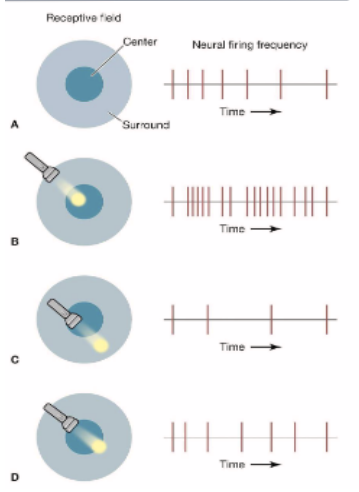
Stimulus is presented in the center of the receptive field leads to faster firing rates
Therefore, stimulus outside of the center leads to slower, below-baseline firing rates
However, a stimulus covering the entire receptive field has the same effect as no stimulus
The less similar a stimulus is to the cell’s ‘preferred’ stimulus, the less often the cell fires.
What are Center-Surrounded Cells (“dot detectors”)?
Orientation (edge detectors)
Angles
Motions and Directions (movement detectors)
Corners
What are other receptor specializations?
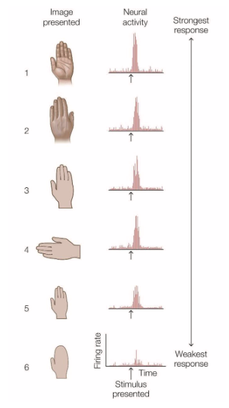
When presented with different images of a hand, there are different neural activity with each image.
Each image was of a hand, but at different qualities, when it decreased in quality, it seemed to have a weaker response.
What is an example of when we code specific targets?
The brain's ability to split a visual scene into multiple components—specifically color, motion, shape, and depth—and analyze them all at the same time
No longer coding with a single neuron at a time, but now a loop between different cortexes
Creates a more complex pattern than the previous ones
What is Parallel Processing in the Visual Syste,?
Visual system is more faster and efficient
EX) Object recognition doesn’t need to wait for movement recognition in order to work.
Has a mutual influence among multiple systems
Resolves contradictory demands
What are the Advantages of Parallel Processing?
However, as a weakness, it tends to be less accurate due to speed being a priority.
What is a weakness of Parallel Processing??
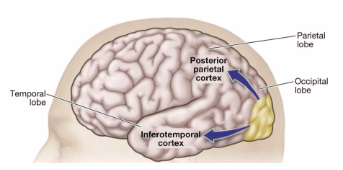
Pathway connecting the occipital lobe and inferotemporal cortex
Aids in identification of visual objects
EX) Recognizing a face, someone you already know
Damage leads to visual agnosia
What is the ‘What’ System?
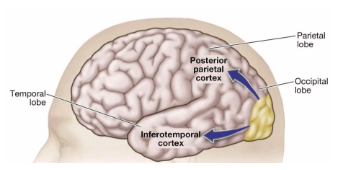
Pathway connecting the occipital lobe and the posterior parietal cortex
Aids in the perception of an object’s location
Damage leads to difficulties reaching for objects
What is the ‘Where’ system?
The task of reuniting elements of a stimulus that were addressed by different systems in different brain regions
EX) How are the ‘What’ and ‘Where’ systems coordinated?
What is the ‘Binding Problem’?
1. Spatial Position
An overlay map of ‘which forms are where’ with a map of ‘which colors are where’, ‘which motions are where,’ etc.
2. Neural Synchrony
Attributes are registered as belonging to the same object if the neurons detecting these attributes fire at the same time (in sync)
3. Attention
With insufficient attention, conjunction errors are common
EX) Less objects = more attention and less room for error. More objects = less attention (overloading) and more room for error.
What elements help with solving the binding problem?
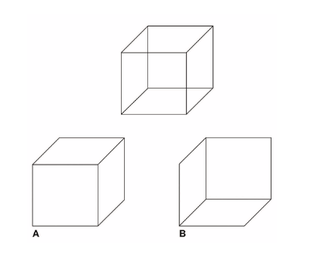
Perception of stimuli goes ‘beyond the information given’
Gestalt Psychologists: the perceptual whole is often different than the sum of its parts
Demonstrated by reversible (or ambiguous) figures
EX) The Necker Cube
What is Form Perception?
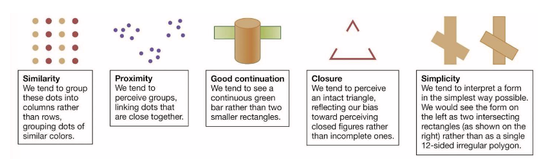
Similarity – tend to group things based on a similar factor.
Proximity - tend to group things based on how close they are with one another
Good Continuation – tend to assume that things continue when blocked by something
Closure – when a figure is incomplete (i.e. a triangle) we can assume what the full figure is
Simplicity – interpreting a form in the most simplest way possible.
What are the Gestalt Principles?
Information gathering
Interpretation
What activities are involved in perception?
We perceive constant object properties (sizes, shapes, etc.) even though sensory information about these attributes change when viewing circumstances change
Brightness Constancy
Our visual ability to perceive objects as having a stable level of brightness, shape, and color
Size Constancy
Where your brain perceives an object as maintaining its actual physical size, regardless of its distance or the size of its image on your retina
Shape Constancy
Correct perception of an object’s shape changes in its shape on the retina
EX) A door opening, you assume that the door hasn’t changed despite it looking different.
What is Perceptual Constancy? What are some examples of it?
An involuntary, automatic mental process to explain how the brain builds complete, three-dimensional visual perceptions from incomplete sensory data.
What is Unconscious Inference?
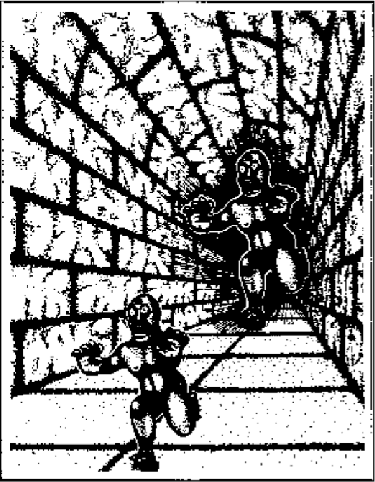
The role of interpretation in perception becomes clear from misinterpretations
EX) Are these two figures the same size? Yes, but the convergence of lines leads to the initial perception that they are NOT the same size.
What are Illusions?
How do people in different countries perceive the world?
Cultures differ in what they pay attention to
Eastern cultures have more emphasis on context than Western cultures
EX) West Asia (Middle-East) cultures don’t tend to focus on eye contact, but when we move more West, then eye contact is more focused
What are the Cultural Differences to visual perception?
We need to know the distance to be successful at size judgements and to interact successfully with the surrounding world
How do we perceive depth?
Binocular Disparity
The difference between each eye’s view of a stimulus
EX) Put thumb out, close left eye and open right eye, and then close right eye and open left eye
Monocular Cues
Depth cues that depend only on what each eyes sees by itself
EX) Lens adjustment
EX) Pictorial cues, including interposition
What are the different ways to percieve depth?
There is some redundancy across different cues
However, different cues become more or less important under different circumstances
EX) Binocular disparity is only informative when objects are relatively close to the viewer
What is the role of redundancy?