WBCs & Platelets | A&P II
 Call Kai
 Learn
Learn Practice Test
 Spaced Repetition
 Match
Match Flashcards
 Knowt Play
1/52

There's no tags or description
Looks like no tags are added yet.
Name | Mastery | Learn | Test | Matching | Spaced | Call with Kai | Chat |
|---|
No analytics yet
Send a link to your students to track their progress
53 Terms
Granule
Membrane-bound structure in a cell
2 types of leukocytes
Granulocytes & agranulocytes
Types of granulocytes
Neutrophil, eosinophil, basophil
Types of agranulocytes
Lymphocyte, monocyte
Types of WBCs in order from most → least common
Neutrophils, lymphocytes, monocytes, eosinophils, basophils
What is DLC (acronym & clinical use)
Differential leukocyte count, provides the percentages of each type of WBC to help understand multiple aspects someone’s immune health
Diapedesis
The process in which WBCs squeeze through blood vessels to enter surrounding tissues
WBCs are capable of ____ movement through the use of ____
Amoeboid; pseudopodia
Positive chemotaxis
Attraction towards chemical stimuli allowing WBCs to respond to infection, injury, etc
Neutrophils are also called:
Polymorphonuclear cells
Neutrophil visual description
Multilobed nucleus, mostly light pink with fine dark blue granules
Which WBC is known as the “first responder”
Neutrophils
Which WBC is the most abundant, making up 50-70% of WBCs?
Neutrophils
What do neutrophils do upon encountering pathogens?
Phagocytosis
What occurs after a neutrophil phagocytoses (engulfs) a pathogen?
Degranulation: the neutrophil release defensins from its granules to destroy the pathogen
What occurs after degranulation in a neutrophil?
It releases prostaglandins and leukotrienes to signal for reinforcements from other WBCs
Once neutrophils have exhausted their function and lived out their 1-2 day lifespan:
They pool with killed bacteria and other debris to form pus

Which of these is a neutrophil?
A
High neutrophil count indicates:
Recent (acute) infection
Eosinophil visual description
Red cytoplasm, coarse granules, bilobed nucleus (earmuff shape)
Eosinophils make up __% of WBCs
2-4%
Eosinophil function:
Defend from parasitic infections and regulate allergic reactions & inflammation
Why can’t eosinophils perform phagocytosis and what is their alternative?
They attack parasites that are too large to engulf, so they release the toxic compounds from their granules onto their targets
Eosinophils temper ____ (effect) to counterbalance _____ (cell)
Inflammation; neutrophils
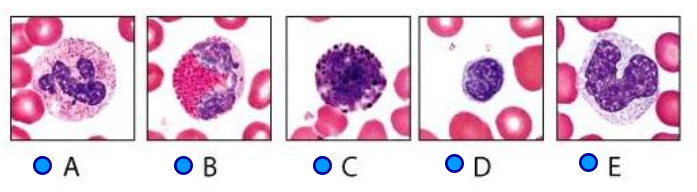
Which one of these is an eosinophil?
B
What is the rarest type of WBC? (<1%)
Basophils
Basophil visual description:
Almost completely dark blue/purple with granules difficult to see
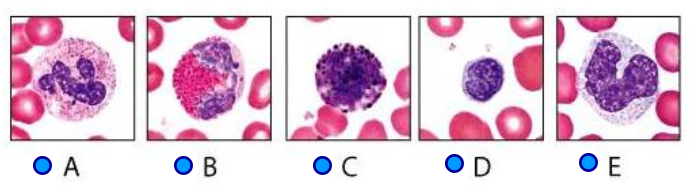
Which one of these is a basophil?
C
Basophil granules contain:
Histamine & heparin
What type of cell are basophils similar to & what is the key difference?
Mast cells: fixed in tissues rather than circulating in blood
How does histamine (released by both basophils and mast cells) affect the blood vessels?
Vasodilation
Heparin is released by basophils and functions to:
prevent blood clotting
What is the second most common type of WBC and what % do they make up?
Lymphocytes; 20-30%
Lymphocytes visual description
Smallest WBC; large spherical nucleus surrounded by thin ring of cytoplasm
What are two of the common types of lymphocytes and where are they produced?
T-cells: thymus
B-cells: bone marrow
Memory lymphocytes are:
Long lived lymphocytes that can remember specific pathogens for your entire life, allowing them to multiply rapidly to defend against it

Which of the following is a lymphocyte?
D
Which WBC is late to respond but stays for a longer period of time to fight an infection?
Monocyte
Monocytes, once they migrate into body tissues, are activated and become:
Macrophages
Which is the largest WBC at ~20 microns?
Monocyte
Monocytes make up ___% of WBCs
2-8%
Monocyte visual description
Largest WBC; kidney bean shaped nucleus
Platelets are also called:
Thrombocytes
Platelets are not true cells but fragments of :
Megakaryocyte
Megakaryocyte
Giant cells in bone marrow with extensions in bloodstream that break off, forming platelets
After platelets circulate for ____ days, they are removed by the ____
9-12; spleen
Typical platelet count range per microliter
150k-500k
Term for production of platelets
Thrombocytopoiesis
Platelets’ primary function is:
Preventing blood loss
What are 3 main ways platelets prevent blood loss?
Releasing factors like ADP, thromboxane, etc
Form platelet plugs to temporarily patch damaged vessel walls
Clot retraction to shrink break in vessel walls
The term for low platelet count (<150k/µL) is ____ and results in ___
Thrombocytopenia: results in excessive bleeding, causing hematoma (bruise) formation
The term for high platelet count (>500k/µL) is ____ and results in ___
Thrombocytosis: excessive clotting, restricting blood flow & oxygen
All blood cells come from this stem cell:
Hemocytoblast