2.5 Biological Membranes
 Call Kai
 Learn
Learn Practice Test
 Spaced Repetition
 Match
Match Flashcards
 Knowt Play
1/46

Earn XP
Description and Tags
OCR A level biology
Name | Mastery | Learn | Test | Matching | Spaced | Call with Kai |
|---|
No analytics yet
Send a link to your students to track their progress
47 Terms
What is a plasma membrane?
a cell surface membrane
What are some of the functions of membranes?
partially permeable
involved in cell signalling
provide attachment sites for enzymes and other molecules involved in metabolism
allow electrical signals to be passed
allow compartmentalisation
Why is it important that membranes allow compartmentalisation?
It allows cellular compartments to have different conditions required for optimum reaction rates, as the membrane acts as a barrier
Explain why phospholipids form a bilayer in plasma membranes
phospholipids have a polar phosphate group head, which is hydrophilic and will face the aqueous solution
the fatty acid tails are non-polar and hydrophobic so will move away from the aqueous solution
as both the tissue fluid and the cytoplasm are aqueous, phospholipids form 2 layers with the hydrophilic tails facing inwards and the hydrophobic phosphate groups facing outwards
Which part of a phospholipid is polar and hydrophilic?
phosphate heads
Which part of a phospholipid is non-polar and hydrophobic?
fatty acid tails
True or false? Phospholipids act as a barrier to most water-soluble substances, such as dissolved glucose and amino acids
True
Why is the structure of the plasma membrane often called the “fluid mosaic model”?
‘fluid’ as the phospholipids are free to move laterally within the layer
‘mosaic’ due to the scattered pattern of intrinsic and extrinsic proteins in the membrane
‘model’ as the agreed structure is based on experimental and chemical evidence
True or false? Proteins (both intrinsic and extrinsic) cannot move through the phospholipid bilayer
false - they can move depending on the number of phospholipids with unsaturated fatty acids in their tails
What is an intrinsic or integral protein?
a protein that is embedded in both layers of the phospholipid bilayer
What is an extrinsic or peripheral protein?
a protein that is present in only one layer of the phospholipid bilayer
How are intrinsic proteins fixed in position in the phospholipid bilayer?
The hydrophobic R-groups in their amino acids interact with the hydrophobic core of the membrane
How are extrinsic proteins held in place?
The hydrophilic R-groups interact with the polar heads of the phospholipids or with intrinsic proteins?
True or false? All extrinsic proteins can move between the layers of the phospholipid bilayer
false - only some can
What type of molecules can diffuse directly through a membrane?
small, non-polar, fat soluble molecules
Give 2 examples of transport proteins?
channel and carrier proteins
What characteristic of molecules means they need a transport protein to transport them through a membrane?
polar
Fill in the blanks and choose the correct words: channel proteins are (p)____ in the membrane that provide a hydrophilic/hydrophobic channel to allow the passive/active of small/large or polar/non-polar molecules through membranes down a ___ ___. Some may be (g)____ to control movement by opening and closing.
pores, hydrophilic, passive, large, polar, concentration gradient, gated
What are carrier proteins?
proteins that change shape to carry molecules across a membrane
True or false? Carrier proteins always require energy
false - some are passive
Are glycoproteins intrinsic or extrinsic proteins?
intrinsic
What are the carbohydrates chains (of varying lengths) that protrude from glycoproteins and glycolipids called?
glycolax
On a diagram, how can you tell the difference between a glycolipid and a glycoprotein?
the glycolax (carbohydrate chain) of a glycoproteins is usually more highly branched
How do glycoproteins help to stabilise the cell membrane?
they form hydrogen bonds with the water molecules surrounding the cell
Give 3 functions of glycoproteins
help stabilise the membrane
involved in cell adhesion (for building cell tissues)
act as cell receptors for cell signalling, neurone transmission, hormones, and drugs
What is the function of glycolipids?
immune recognition - act as cell identity markers for antigens allowing the immune system to recognise its own cells and distinguish them from pathogens, preventing self destruction
receipts for drugs and hormones
What does amphiphilic mean?
a molecule is both hydrophobic and hydrophilic
Is cholesterol an amphiphilic molecule?
yes
How is cholesterol positioned within a membrane?
it is found in small amounts positioned in between the phospholipids with the hydrophilic end interacting with the phospholipid heads and hydrophobic end with tails, pulling them together
Choose the correct word: cholesterol - at a high temperature membranes becomes more/less fluid, so more/less stable, as cholesterol releases/binds/modifies the phospholipids together, so they are packed more loosely/tightly.
less, more, binds, tightly
How does cholesterol affect membrane fluidity at low temperatures?
cholesterol maintains the membranes fluidity by preventing the phospholipid molecules from grouping too closely together.
What are the 2 functions of cholesterol in cell membranes?
regulate fluidity
increase mechanical strength (less likely to burst)
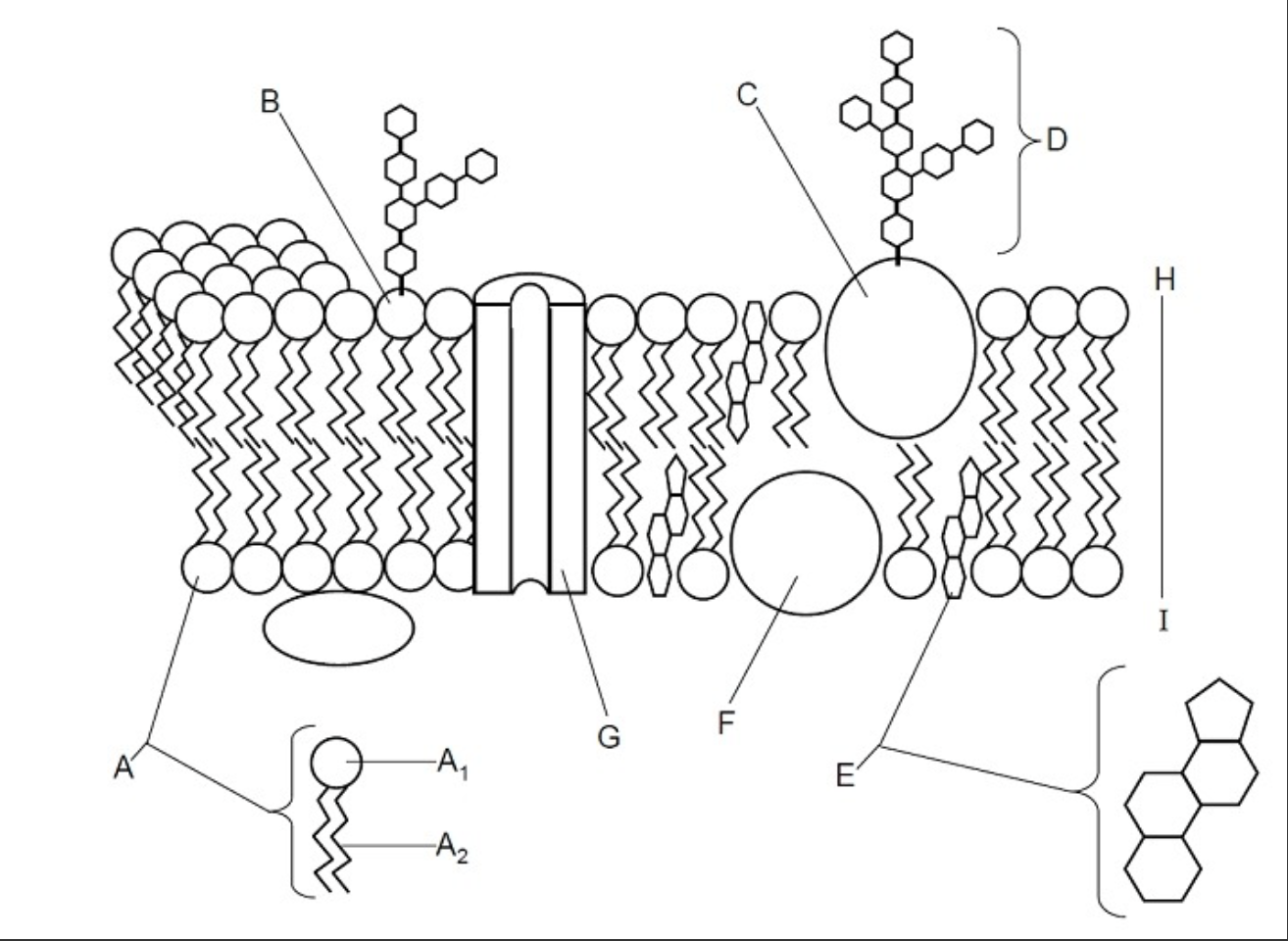
Label parts A, G and F
A - phospholipid head, fatty acid tail, G - intrinsic channel protein, F - extrinsic protein
Label the parts B, C and D
B - glycolipid, C - protein component of glycoprotein, D - carbohydrate chain of glycoprotein
Label Part E
cholesterol
What 2 factors can affect membrane permeability?
temperature and solvents
How does a temperature below 0ºC affect membrane permeability?
the phospholipids don’t move as they have little energy, so they are packed closely together causing the membrane to become rigid increasing permeability
proteins denature increasing permeability
ice crystals may pierce the membrane, making it very permeable when it thaws
How does a temperature between 0-45ºC affect membrane permeability?
phospholipids have increasing kinetic energy so move around more, meaning they are less tightly packed together so permeability increases
How does a temperature above 45ºC affect membrane permeability?
Fill in the blanks: the bilayer starts to ___, ____ permeability. Water inside the cell ___ putting more ___ on the cell surface membrane. Proteins begin to ___, disrupting the membrane (s)___ so it is no longer an effective (b)___ and allows substances pass through freely. This process is (i)___
break down, increasing, expands, pressure, denature, structure, barrier, irreversible
How do organic solvents affect the permeability of the phospholipid bilayer?
they increase the permeability by dissolving the phospholipids in the membrane
Give an example of an organic solvent
alcohols
Even though water is a solvent, why does it benefit the phospholipid bilayer?
it has hydrophilic interactions with the phospholipid heads of the phospholipids which help to keep the membrane intact