CH 6 The behavior of proteins: enzymes
 Call Kai
 Learn
Learn Practice Test
 Spaced Repetition
 Match
Match Flashcards
 Knowt Play
1/47

There's no tags or description
Looks like no tags are added yet.
Name | Mastery | Learn | Test | Matching | Spaced | Call with Kai | Chat |
|---|
No analytics yet
Send a link to your students to track their progress
48 Terms
catalysis
process of increasing the rate of chemical reactions
enzymes
biological catalysts usually globular proteins with self-splicing RNA as the only exception
increase rate of reaction by factor of up to 10²0
standard free energy change (delta G)
the difference between the energies of reactants and products under standard conditions
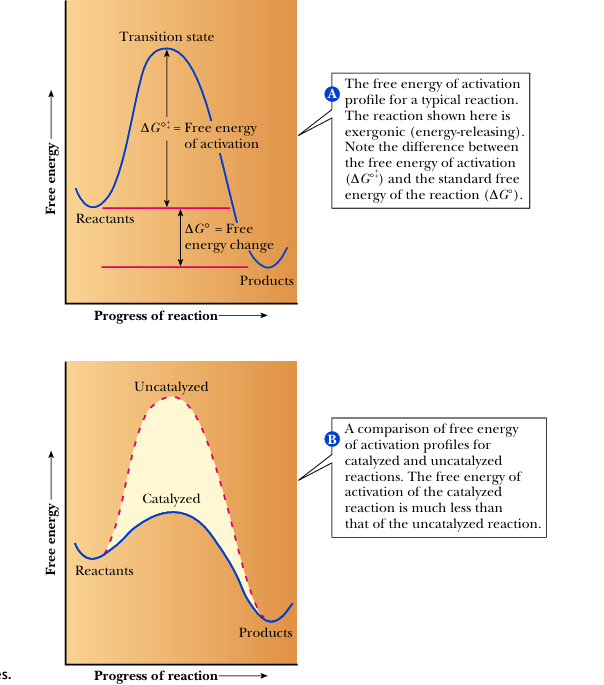
activation energy
energy required to start a reaction
more required for a reaction without a catalyst
fast, greater than
Spontaneous doesn’t = ____ because energy is needed to break stable molecules like glucose to start the reaction but the energy released from reaction ___ energy it took to get started
transition state
the intermediate stage in which old bonds break and new bonds are formed

lower
catalysts ___ activation energy which speeds up reaction b/c it takes less time/energy to reach transition state
increase, increases
rate of reactions speeds up with ____ in temp to a certain point before it denaturing occurs. It ____ energy available to reactants to reach transition state
rate constant (k)
a proportionality constant in the equation that describes the rate of a reaction
sum, exponents
overall rate of a reaction equals the ___ of all the ____
first order
describes a reaction whose rate depends on the first power of the concentration of a single reactant
happens with decay
Ex) A—> P, rate= k[A]^1
second order
describes a reaction whose rate depends on the product of the concentrations of 2 reactants
Ex) A+B—> C+D, rate= k[A]^1[B]^1
zero order
reaction that proceeds at a constant rate, independent of the concertation of reactant
concentrations of the reactants are so high that the enzyme is completely saturated with reactant molecules and rate depends entirely on how fast the enzyme can catalyze the reaction
rate= k[A]^0= k[1]= k
substrate
a reactant in an enzyme- catalyzed reaction
active site
part of an enzyme to which the substrate binds and at which the reaction takes place using highly specific interactions between substrate and side chains of the AAs at the site
lock and key model
the binding of a substrate to an enzyme such that the active site and the substrate exactly match each other in shape
fails to account for protein flexibility
induced fit model
description of substrate binding to an enzyme such taht the conformation of the enzyme changes to accommodate the shape of the substrate
temperature, proximity, and orientation
___, ____, and ____ speeds up a reaction
accounts for protein flexibility to adjust according to substrate
too perfect binding between E and S, to make ES then ES would be at such a low energy that the difference between ES and transition state EX would be very large. This would slow the reaction because such a high activation barrier means fewer ES molecules have enough energy to reach the transition state at any moment and thus product formed more slowly
explain why induced fit model is preferred over lock and key
initial velocity
rate measured immediately after E and S are added

first, zero
most enzymes have a hyperbola that starts with ___ order kinetics and then advances to ___ order kinetics as substrate concentration increases
Vmax
velocity at infinite substrate concentration

Km (Michaelis Constant)
substrate concentration at which the reaction proceeds at one-half its maximum velocity
concentration of substrate where half the enzyme sites are filled/bound
Km is the substrate concentration where half the enzyme is bound. We detect that point by noticing that the reaction is at half of Vmax.
lower this number the higher the affinity (bonding strength)
rate of formation
It means the enzyme–substrate complex (ES) forms faster when there is more enzyme, more substrate, or a larger rate constant k1

rate of breakdown
how fast the ES complex is being used up, either by dissociating or by converting into product.
k-1: dissociation back into E+S
k2: conversion into product releasing E

steady state
the condition in which the concentration of an enzyme-substrate complex remains constant in spite of continuous turnover
the rate of ES formation and breakdown are equal

Km equation

What is the Michaelis- Menten equation
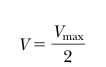
half, equal
In other words, when the rate of the reaction is ____its maximum value, the substrate concentration is ____ to the Michaelis constant

ordered mechanism
enzyme mechanism where the substrates have to bind and release to and from the enzyme in a specific separate order
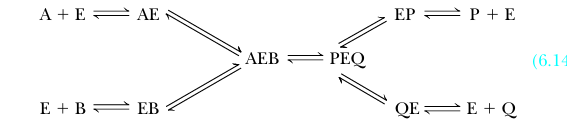
random mechanism
substrate can bind to the enzyme in any order
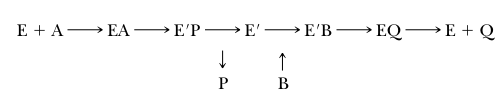
ping-pong mechanism
substrate binds to the enzyme and releases a product before the second substrate binds to the enzyme

Lineweaver- Burk double reciprocal plot
graphical method for analyzing the kinetics of enzyme catalyzed reactions
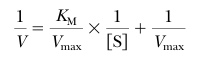
reciprocal, y
Vmax can be found on a Lineweaver plot by taking the ____ of the ___ intercept
reciprocal, x
Km can be found on Lineweaver by taking the ___ of the ____ intercept
rate of ES dissociation is greater than formation of product k-1>k2, then Km= k-1/k1
-large km= weak binding
-small km= strong binding
Km becomes a dissociation constant when
turnover number
number of moles of substrate that react per second per mole of enzyme
Ex)Catalase (kcat)= 4×10^7 meaning one catalase enzyme converts around 40 million H2O2 molecules into H2O and O2 every second

chymotrypsin
proteolytic enzyme that preferentially hydrolyzes amide bonds adjacent to aromatic AA residues

aspartate transcarbamylase (ATCase)
catalyzes on early reaction in pyrimidine biosynthesis
ATCase is an allosteric protein while chymotrypsin is not (similar to myo and hemoglobin)
Why does ATCase have a sigmoidal curve vs a normal parabola like chymotrypsin
inhibitor
a substance that decreases the rates of an enzyme catalyzed reaction
reversible leaves enzyme in its original state after catalyzation while irreversible inhibitors means the enzyme never returns to original state and is no longer active
explain a reversible vs irreversible inhibitor
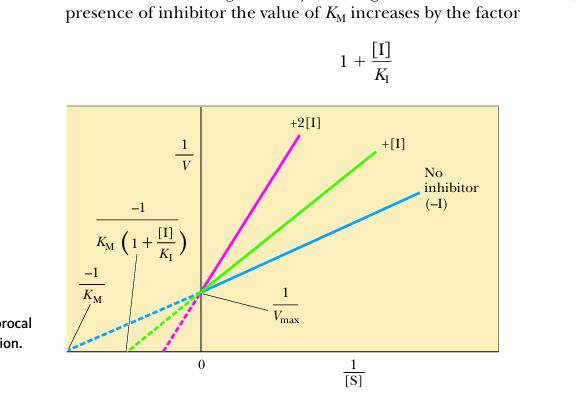
competitive inhibitor
decrease in enzymatic activity caused by binding of a substance analogue to the active site
inhibitor competes with substrate
Vmax unchanged (high S can outcompete allowing E to reach Vmax)
Km increases (inhibitor makes substrate binding harder so more substrate needed to reach have maximal velocity
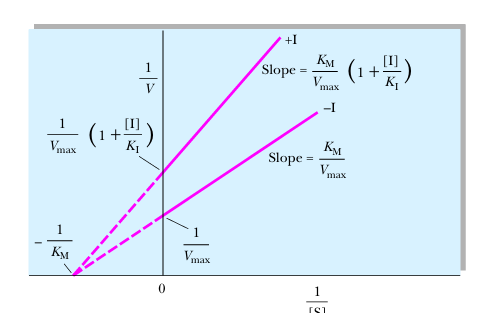
noncompetitive inhibition
form of enzyme inactivation in which a substance binds to a place other than the active site but distorts the active site so that the reaction is inhibited
Vmax decreases (since both S and I can bind there will be enzymes that will never activate due to the inhibitor)
Km stays the same (I doesn’t interfere with bind at the active site Km only a measure of how much substrate it takes to get half the molecules BOUND and catalyzed)
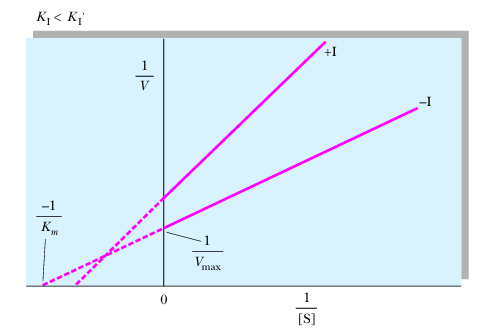
mixed noncompetitive inhibition
decreases Vmax because inhibited enzymes cannot catalyze, and it changes Km because the inhibitor binds E and ES with different affinities, altering substrate binding.
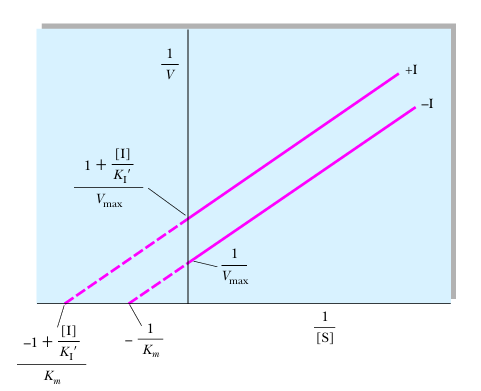
uncompetitive inhibition
type of inhibition where the inhibitor can’t bind to ES but not to free E
Vmax decreases: inhibitor ties up ES complex to be unused so not all of the enzymes will be available to reach total uninhibited vmax
Km decreases: removes some ES so by LeChatelier there must be more made to offset the ES that has been lost (move down concentration gradient)
Irreversible inhibitors
covalent binding of an inhibitor to an enzyme causing permanent inactivation
Vmax decreases: some enzymes are permanently disables means it could never reach the same vmax as an enzyme without an inhibitor
no Km: as more enzymes are deactivated its hard to measure half maximal velocity
suicide substrates
molecules used to bind to an enzyme irreversibly and inactivate it