The Brains Regions, Functions and Connection to the Body
 Call Kai
 Learn
Learn Practice Test
 Spaced Repetition
 Match
Match Flashcards
 Knowt Play
1/34

There's no tags or description
Looks like no tags are added yet.
Name | Mastery | Learn | Test | Matching | Spaced | Call with Kai | Chat |
|---|
No analytics yet
Send a link to your students to track their progress
35 Terms
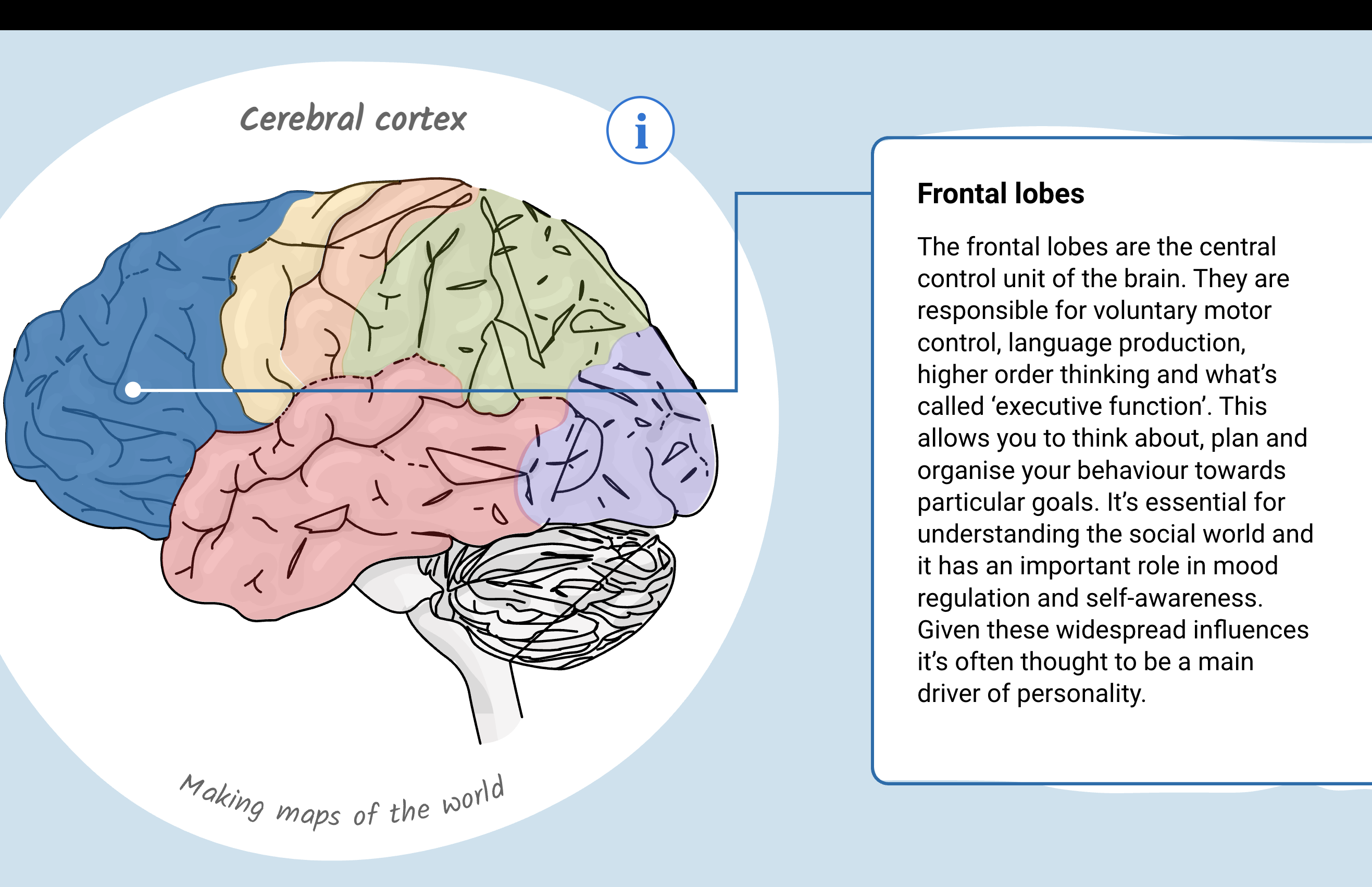
The Frontal Lobes, what is their function?
They are the central control unit of the brain. Planning, decision-making, problem-solving, voluntary movement, attention, working memory and impulse control.
The brain region that controls voluntary movements of the body.
What is the primary motor cortex?
somatosensory cortex
What part of the brain processes touch, pressure, pain, temperature, and body position?
Is to process somatosensory information
What is the function of the parietal lobes?
Processing auditory information, language, memory and aspects of emotion.
What is the function of the temporal lobes?
The somatic nervous system and autonomic nervous system.
What are the main sections of the peripheral nervous system?
Controls voluntary movement and carries sensory information to the CNS.
What is the function of the somatic nervous system?
A neuron that carries signals from the CNS to muscles or glands.
What is an efferent neuron?
A neuron that carries sensory signals from the body to the CNS.
What is an afferent neuron?
The peripheral nervous system (PNS).
What system are afferent and efferent neurons part of?
Heart rate, digestion, breathing, blood pressure and pupil dilation.
What involuntary functions does the autonomic nervous system control?
The autonomic nervous system (ANS), a division of the peripheral nervous system (PNS) that controls involuntary functions.
What nervous system do the sympathetic and parasympathetic systems belong to?
Activates rest-and-digest, reducing heart rate and supporting digestion and recovery.
What does the parasympathetic nervous system do?
The amygdala, hippocampus, hypothalamus, thalamus and cingulate cortex.
What does the limbic system include?
The thalamus.
Which part of the brain relays sensory information to the cerebral cortex?
The Hippocampus
Which part of the brain plays a major role in memory?
The hippocampus encodes memories, while the amygdala adds emotional significance to them.
How do the amygdala and hippocampus work together?
The hypothalamus.
Which part of the brain regulates body temperature, physiological states and motivated behaviours?
It detects changes in the body and signals the autonomic nervous system and endocrine system to produce appropriate responses.
How does the hypothalamus regulate functions?
The midbrain, pons and medulla oblongata.
What areas of the brain are located in the brainstem?
Vital autonomic functions such as breathing, heart rate, blood pressure, digestion and arousal.
What does the medulla control?
Most motor fibres cross to the opposite side of the body in the medulla, so each brain hemisphere controls the opposite side of the body.
What happens to motor neurons as they travel through the medulla?
Cortical arousal, the startle response, eye and facial movements, REM sleep and dreaming.
What functions are associated with the pons?
A rapid, automatic reaction to a sudden or unexpected stimulus, such as a loud noise.
What is the startle response?
Controls movement, visual and auditory reflexes, arousal and attention.
What is the role of the midbrain?
It coordinates movement, balance, posture and motor learning.
What is the function of the cerebellum?
The hindbrain.
What section of the brain is the cerebellum part of?
It integrates sensory information with motor commands to coordinate smooth, accurate movements.
How does the cerebellum help movement?
The cerebellum's contribution to language — sequencing grammar, coordinating speech articulation, and supporting verbal fluency — is a more recently discovered role beyond its traditional function in movement coordination.
What role does the cerebellum play in linguistic abilities?
relays sensory and motor signals between the body and brain, and also controls certain reflexes independently of the brain.
Function of the Spinal Cord?
The corpus callosum.
What brain structure connects the two cerebral hemispheres?
The corpus callosum is made of white matter — bundles of myelinated axons connecting the two hemispheres.
What is the corpus callosum made of?
Yes. It is mainly white matter, whereas many brain regions contain grey matter (neuron cell bodies).
Is the corpus callosum different from other brain structures?
The basal ganglia.
Which brain structure is involved in the initiation and control of movement?
It shows that body parts are mapped to specific areas of the cortex, with more cortical space allocated to sensitive body parts (like lips and hands) than to less sensitive ones (like the torso), regardless of actual body size.
What does somatotopic organization in the primary somatosensory cortex show?