LING 3100B - Lecture 3&4: L2 Acquisition
 Call Kai
 Learn
Learn Practice Test
 Spaced Repetition
 Match
Match Flashcards
 Knowt Play
1/22

There's no tags or description
Looks like no tags are added yet.
Name | Mastery | Learn | Test | Matching | Spaced | Call with Kai | Chat |
|---|
No analytics yet
Send a link to your students to track their progress
23 Terms
Working definition of bilingual
Ability to carry out a conversation with a native speaker or use both languages properly
Kids learning 2 languages may show slight delay in each language compared to kids learning only 1 language (about 3 months). Therefore in they 70s it was discouraged to raise children bilingually since they may be
‘retarded’
Bilingual kids know the _ number of words or even more as monolingual peers.
Same (number of words). But distributed across two languages it seems like they know less.
Bilingual advantage: Parallel Activation (e.g Thierry & Wu, 2007)
When speaking one language the other language is also activated in their brain. Bilinguals must constantly choose the right language to use. Must use cognitive control. Inhibition of the language that doesn’t need to be used. Strong executive attention.
Stoop Task
One of the most famous tests used to study cognitive control: participants see colored words printed in ink. There are two main conditions:
Congruent condition
Incongruent condition
When reading without consideration of the colors of the actual words, we read much faster (inhibiting the colors.)
Attention Network Tas/Flanker Task
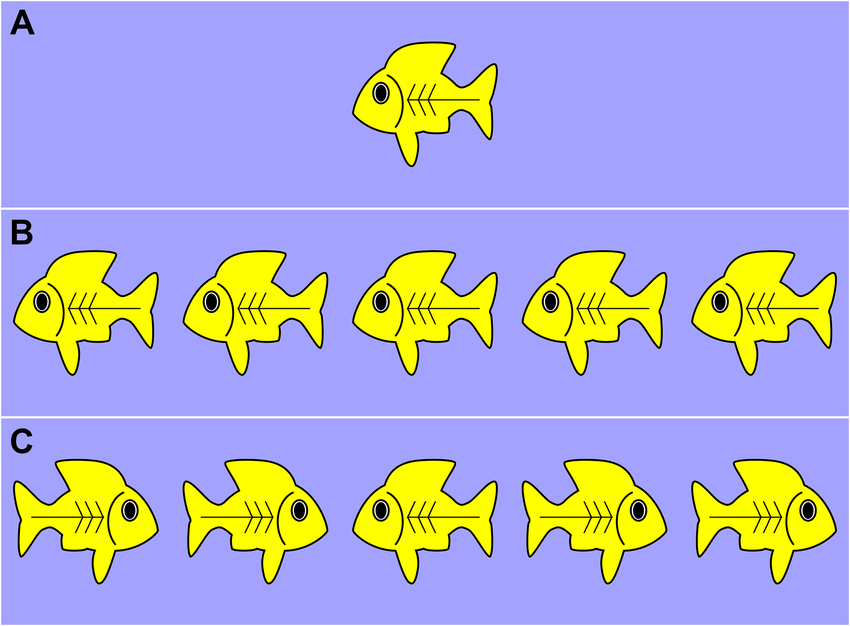
Bilingual speakers can find the target fish much easier (congruent vs incongruent) because bilinguals constantly target the non target language (the “flankers” are the fish that are going against the intended way (which I think is the middle fish.)
Child Directed Speech
In most industrialized societies parents speak to kids far differently than adults, designed to get the child’s attention. Using diminutive words like ‘Look at the doggy! woof!’. Names instead of pronouns “Daddy is putting Jenny to sleep now!'“
But some societies (like Kaluli of Papua New Guinea) parents don’t use child directed speech
Children learn through eavesdropping
IMPORTANT POINT: Children need rich language input, but it doesn’t need to look the same everywhere. Children in Papua New Guinea and the United States both acquire their language pretty easily.
The 30-million word gap
Claim (Betty Hart and Todd Risley, 1995) that kids from higher SES have heard 30 million more words than kids from lower SES by the time school starts.
Exposed to more words→ Leads to lager vocabularies → Better school performance
Heritage Language
A minority language spoken at home or within a family that is different from the dominant language of the wider society.
(Often acquired early in life but incompletely.)
Acquisition vs Learning
Acquisition you pick up a langue subconsciously perhaps without formal studying. Learning is the conscious studying and practicing a language, perhaps with formal study of knowledge/rules.
Explicit knowledge vs Implicit knowledge: children having their own system picked up over time, with little focus on rules (acquisition) vs “how to form a plural”? structural conscious practice in abiding of rules.
Is the first langue the language you know best?
Not necessarily.
Heritage language speaker:
Someone who was exposed to HL through interaction with family members at home while growing up. Someone to whom HL is the home language.
Most often learned their parents language first, before attending school. But once attending school the language of the wider community often becomes the best language (their most dominant/literate language)
Heritage language speakers may experience attrition (degradation) of their heritage language but still have a great advantage in learning/reactivating that language later in life
L1 vs L2 Acquisition Theory: Fundamental Difference Hypothesis
Loss of access of UG after Puberty.
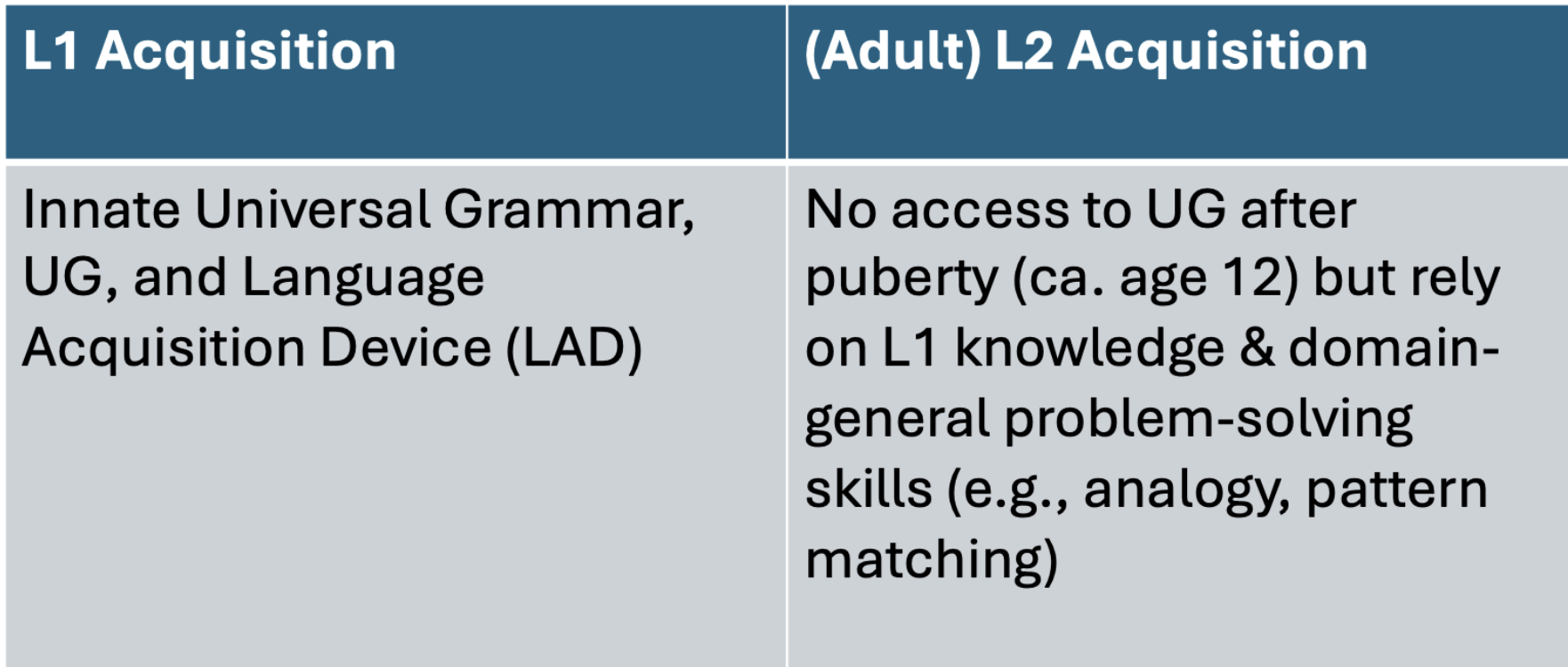
L1 vs L2 Acquisition Theory: Neurolinguistic Perspectives on L2
Adult L2 learners often learn rules but struggle with fluency. Aligns with idea that explicit knowledge doesn’t easily convert to implicit knowledge. L1 acquisition uses implicit knowledge, that implicit knowledge is stored in the procedural knowledge. But adult L2 acquisition uses explicit knowledge, stored in the episodic memory.

L1 vs L2 Acquisition Theory: Emergentism
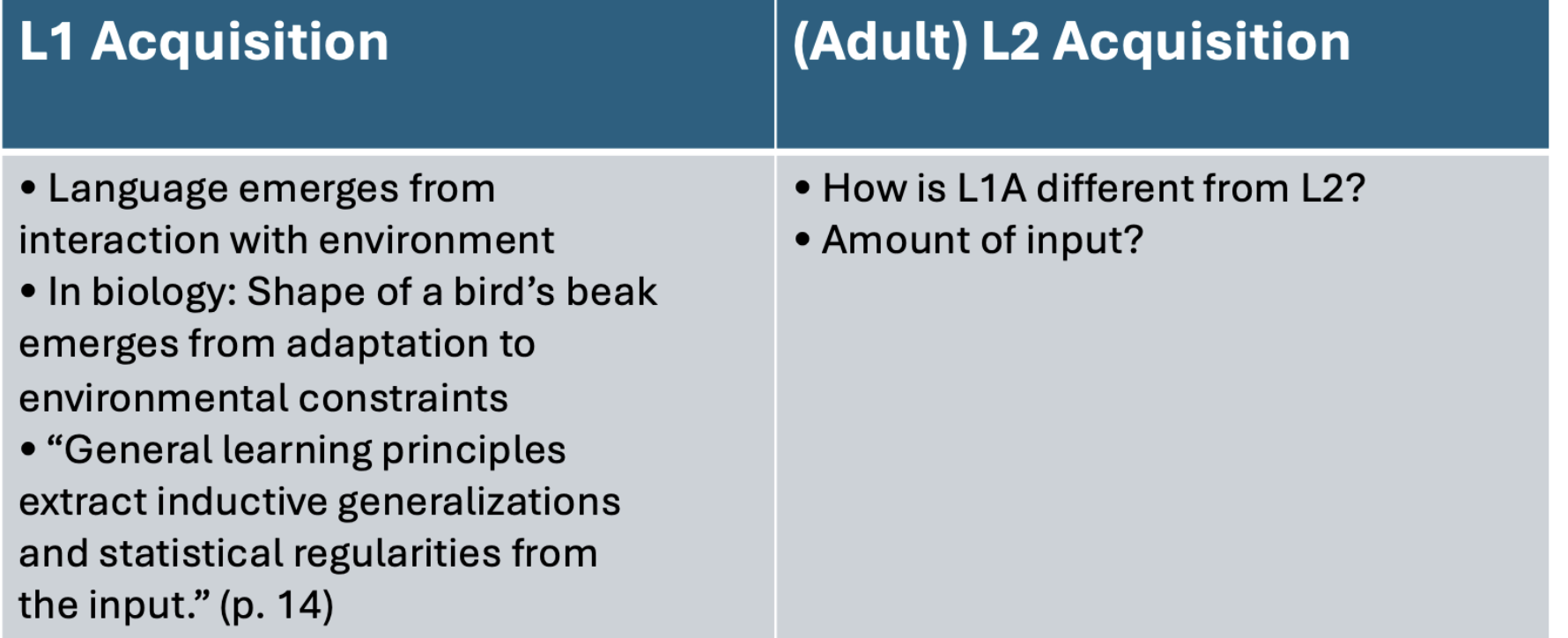
Core Idea: Language is not pre-specified in the mind, but emerges over time in interaction with the environment. This theory often uses analogies from biology.
Interestingly, this theory believes that given high input adult L2 acquisition could in theory reach high levels of fluency.
Linguistic Competence
Ability to internalize a rule to produce the language properly. Even though you can’t explain the English grammar, you have the intuition to build out your sentences in a grammatical way and to recognize when a sentence is not grammatical.
Similarities between L1, L2, HL language acquisition?
Learn a language (starting simple with errors, growing in sophistication over time)
More frequent words/construction learned first
Similar patterns of errors
“Where is she going? the ‘th’ sound is difficult
Comprehension precedes production (can often understand more than what can be said)
Writing is not universal
What do you have to learn to learn a L2?
Articulatory (teeth, tongue..) phonetics (difference between consonants, vowels)
Phonology (must acquire the phonological system, which sound contrasts matter, stress and intonation constraints, syllable structures)
Morphology (how words are formed and structured)
Syntax (how sentences are structured)
Semantics (tied to meaning of a sentence/word)
Vocabulary
Sociolinguistic knowledge (accents, formality, cultural references, social conventions..)
How to study L2 acquisition?
Often dependent variable = language proficiency
Independent variables can be:
Teacher’s self report curriculum or teaching style
L2 learners in “natural experiments” (kids in ESL classes vs not in ESL classes; kids who study abroad or not)
Biographical facts about L2 learners’ lives (how long have they been in this country, what is their profession, have they ever taken courses, etc..?)
How to study L2 acquisition (actual methods):
Corpora of speech or writing produced by L2 learners: what errors do they make?
Lab experiments on l2 learners
Reaction time, eye-tracking, judgments of whether a sentence is grammatical or not
What leads to success in L2 learning?
Not necessarily a lot of linguistic theory, but it helps ot have some linguistic
Less (negative) anxiety on the part of learner
Greater (intrinsic) motivation on the part of the learner
l2 seen as useful, valuable
L2 culture seen as aspirational
Language class (if any) seems as interesting, valuable, doable
Belief that it is valuable to learn (an) L2
The use of immersion for learning L2
For beginner, classroom is not the most useful; for intermediate/advanced student, immersion is the most useful.
Krashen: for a beginner, immersion yields very little comprehensible input at I+1 level. Lerned understands only a few minutes of the entire day, so gets very little I+1 input (can’t learn from just “noise”)
While for intermediate level, much more of the input is comprehensible at I+1 level more comprehensible input leads to more learning (duration of time in the country)
The true mechanism, Crash says is the quantity of comprehensible input at I+1 level
The actual mechanism is that more motivated people seek out. more input at the I+1 level
What does success mean on L2 acquisition?
Being able to communicate meaningfully > perfect pronunciation.
ACTFL (American council on the teaching of foreign languages) standards focused on functioning in personal and professional interactions in the L2 culture
Less focus on pronunciation/accent (as long as it’s comprehensible), more focused on using the language to “do things”
equal focus on production, comprehension
How do you want to weight comprehension, production, accent, perceptible differences form a native speaker, reading writing, “errors” ability to function?