Drug Receptors
 Studied by 0 people
 Call Kai
 Learn
Learn Practice Test
 Spaced Repetition
 Match
Match Flashcards
 Knowt Play
1/49

There's no tags or description
Looks like no tags are added yet.
Name | Mastery | Learn | Test | Matching | Spaced |
|---|
No study sessions yet.
50 Terms
Receptor
component of a cell or organism that interacts with a drug an initiates the chain of events leading to the drug’s observed effect
Receptors largely determine the quantitative relations between ____ or _____ of drug and pharmacological effects
Dose or concentrations
Affinity of drug for receptor determines what
The concentration f drug needed to form significant number of drug receptor complexes, and the total number of the receptors may limit the maximal effect a drug may produce
Receptors are responsible for what
The selectivity of drug action
Receptors ___ the actions of pharmacological agonists and antagonists, and dictate the biological functions to follow
Mediate
Most receptors for clinically relevant drugs are
Proteins
In the past, drug binding was used to ___ or ___ proteins from tissues extracts, and therefore receptors were discovered after the drugs that bind them
Identify; purify receptor
Advances in molecular biology and genomics has changes this and we can identify receptors by ____ on _____
prediction based; structure
Regulatory proteins
Mediate the actions of endogenous chemical signals (ie neurotransmitters)
Enzymes
Biological catalysts for specific biochemical reactions
Enzyme Examples
HMG-CoA reductase, receptor for statins
Transport proteins
Membrane bound receptors that facilitate movement of molecules across cell membranes
Transport Proteins Example
Norepinephrine and serotonin receptors, receptor for antidepressants
Structural proteins
Components of cells that provide structural support
Structural proteins example
Tubulin, receptor for colchicine (pain/inflammation)
Agonist
Substance which initiates a physiological response when combined with a receptor
In both animals or patients the response to drug at low doses ___ in direct ___ to dose
Increases; proporition
As dose increases the response…
Plateaus, meaning no further response can be attained with increasing drug
Agonist vs effect equation
E= (Emax * C)/( C + EC50)
Agonist vs effect relationship resembles the
Law of mass action and suggests that agonist act by binding or occupying, a distinct class of biological molecules with a characteristic affinity for the agonist
Law of mass action
More mass= more reaction action= response
Agonist “occupying” a receptor equation
B= (Bmax*C)/(C+Kd)
B max
The maximum concentration of receptor sites bound by drug at exceedingly high agonist concentration
Kd in the Bmax equation
The drug concentration at which half maximal binding or occupancy is achieved
Dissociation constant
Kd
Kd characterizes
The binding affinity for a given agonist/receptor relationship in a reciprocal fashion
The lower the Kd
The higher the affinity
Coupling
The overall transduction process linking receptor occupancy to response, and is determined by downstream biochemical events that transduce the occupancy into cellular response
Spare receptors concepts
Receptors are spare for a given relationship when a maximal response can be achieved at a concentration of agonist that does not result in occupancy of all available receptors
-Receptors may be spare in number or over abundant relative to the number of downstream mediators
-Maximal activation/response is elicited by activation of relatively few receptors
The Kd for a given agonist receptor interaction determines what fraction (____) of total receptors will be occupied at a given free concentration of agonist, regardless of the receptor amount
B/Bmax
B
Bound receptors
Bmax
Total receptors
C
Concentration of agonists
Anarogonists
Bind to receptors but do not active them, primarily causing reduced effects if agonists (other drugs or endogenous ligands) that normally activate a receptor
Inverse agonist
An antagonists that reduces receptor activity or response below basal levels in the bsence of any agonist
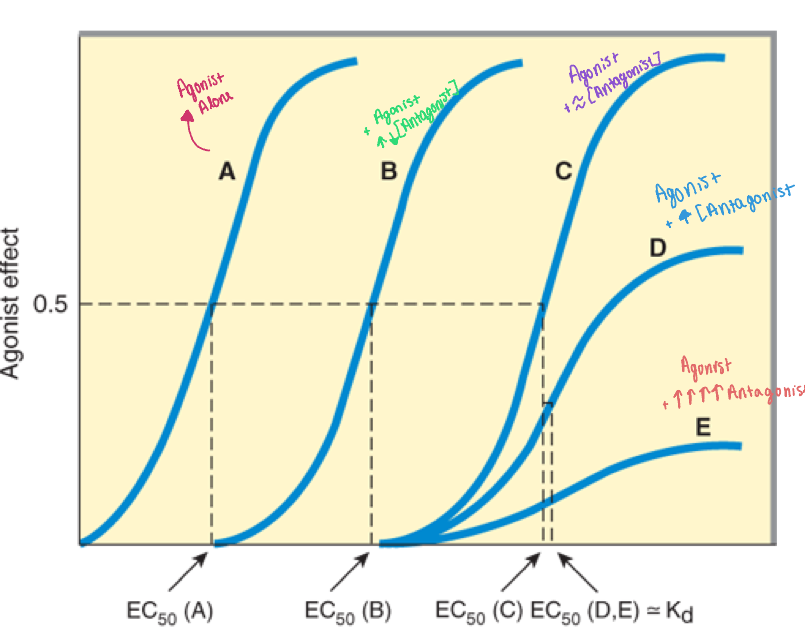
Competitive antagonist
Progressively inhibit agonist response with increasing concentration by competing for binding with agonist. Presence of an antagonist increases the concentration of an agonist need to elicit a given degree of response.
[l]
Antagonist
Inhibitory constant (Ki)
Describes the potency of an inhibitory drug relative to a given agonist receptor interaction.
Lower the Ki
Higher the potency
Degree of inhibition produced by a competitive antagonist depends on
Concentration of antagonist
Clinical responses depend on the concentration of what that is competing for binding at receptors
Agonist
Non-competitive antagonism aka irreversible antagonism
Binding of a receptor in a way that an agonist cannot surmount the inhibitory effect exerted no matter the [agonist] present.
Therapeutically irreversible antagonists may provide a distinct advantage, and sometime disadvantage. Once bound, the duration of action is ___ of its own ___ rate and more in the turnover of the drug receptor
Independent; elimination
Negative all’osteria modulation
Non-competitive binding of an receptor at a site different that the site to which the agonist binds on a given receptor, inhibiting the biological effect in a reversible manner
Positive all’osteria modulation
Same as negative, but elicit a response not inhibition of a response
Partial agonists
Produce a lower respinse at full receptor occupancy based on the max response when all receptors are occupied
Lack of maximal response=
Decreased affinity
Not all mechanisms of antagonism involve _____ of drugs or ligands at a single receptor and some types ___ involve receptors at all
Interactions; do not
Physiologic antagonism
Sometimes endogenous pathways oppose each other and can be skewed in disease. We can modulate one pathway to counteract a disturbance in the other. Are not always easy to predict/manage and responses can vary widely.