DELETE (1) The Self-Care Landscape: Products, Access & Regulation
 Call Kai
 Learn
Learn Practice Test
 Spaced Repetition
 Match
Match Flashcards
 Knowt Play
1/44

There's no tags or description
Looks like no tags are added yet.
Name | Mastery | Learn | Test | Matching | Spaced | Call with Kai | Chat |
|---|
No analytics yet
Send a link to your students to track their progress
45 Terms
What is Self-Care?
SELF-CARE ≠ OTC MEDICATION
Self-care includes:
Prevention + monitoring + non-drug care + devices + medications + professional guidance
Self-Care Continuum - Self-care ranges from patients managing their own health to situations requiring increasing professional/medical involvement.
What Influences Self-Care?
A patient's self-care decisions can be influenced by many people and information sources—not just health professionals.
Why Self-Care Matters
Access
Convenience
Cost
Consumer autonomy
Health care capacity
$1 spent on nonprescription medicines → $7.33 in health-system savings.
Availability ≠
A product being available does NOT mean the patient has meaningful access to appropriate self-care.
What can prevent appropriate self-care?
Social/individual barriers
Easy access to a product ≠
easy access to good information
Availability ≠ Access
Pharmacist role:
Assess → decide if self-care is appropriate → recommend → monitor → refer when needed.
Nonprescription drug
medication that may be used without medical supervision
GRASE
Generally Recognized As Safe and Effective
For nonprescription use, the consumer must be able to:
Self-treat
→ Product is safe/effective when used as labeled.
Self-manage
→ Professional supervision is not required for safe/effective use.
Also:
Low abuse/misuse potential.
Benefits outweigh risks.
Adequate directions for use can be written.
If a product/device is too complicated to explain adequately →
generally not appropriate for nonprescription status.
Nonprescription Use
State vs Federal
States may be stricter than federal requirements for OTC access.
When did nonprescription drug regulation became more developed?
over time—moving toward standards for safety, efficacy, quality, drug classification, and updated OTC regulation.
NDA vs OTC Monograph
NDA = approval of a specific product.
OTC monograph = rulebook/recipe book describing standards for qualifying OTC products.
When can a prescription drug can move to OTC status?
when it can be used safely and effectively without required prescription supervision.
Full vs Partial Switch
Full switch
→ all relevant doses/indications become OTC.
Partial switch
→ only certain doses/indications/durations become OTC.
Examples:
Omeprazole → OTC has limits; Rx may allow longer/higher use.
NSAIDs → some doses/uses OTC; others Rx.
Drug Facts label should be:
Likely to be read + likely to be understood
OTC recommendation should follow:
OTC label → correct use + dose + duration
EXAM ALERT: Professor said you will probably be asked to interpret a Drug Facts label.
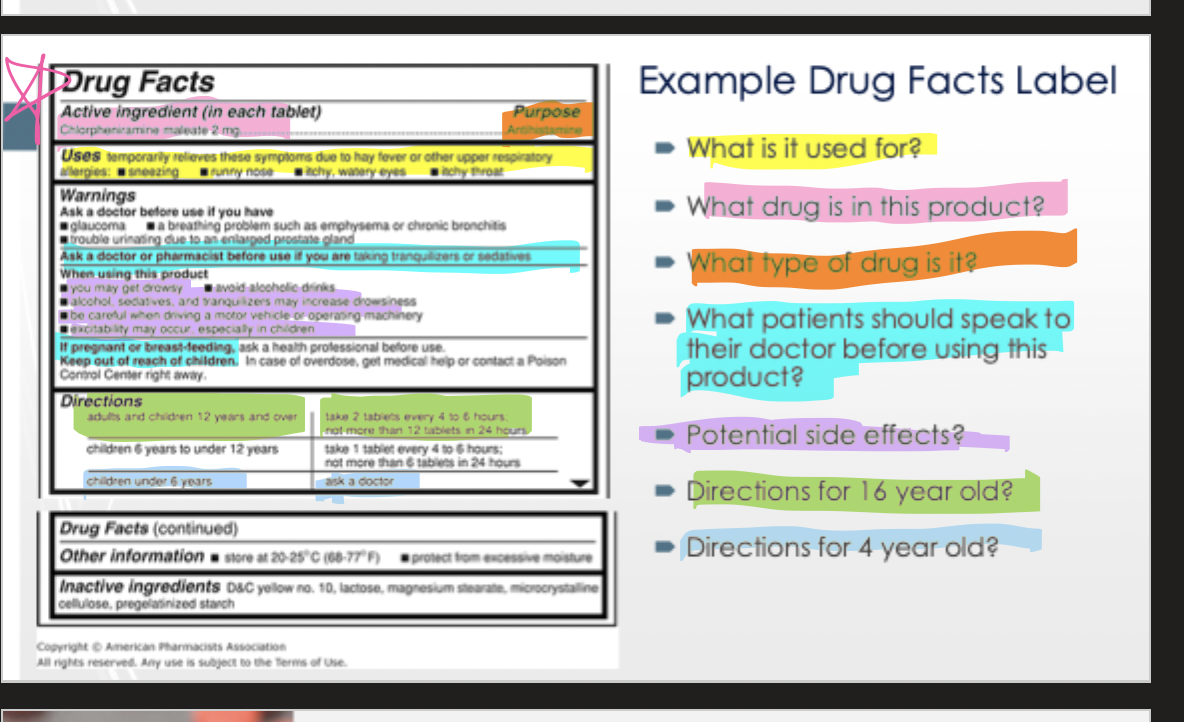
⚠ DO NOT MEMORIZE THE EXACT LIST OF SECTIONS
Professor explicitly said she would not ask you to memorize which specific pieces are required.
🔴 KNOW HOW TO FIND/USE:
Active ingredient
→ generic drug.
Purpose
→ type/class of drug.
Uses
→ indications.
Warnings
→ patients/circumstances requiring caution.
Directions
→ OTC dosing.
Inactive ingredients
→ check for dyes/allergies/sensitivities.
Expiration Dates
OTC products generally require an expiration date.
After a product expires, the main concern is that it may not work as well or uncertain efficacy, rather than suddenly becoming harmful.
Some products may be exempt from an expiration date requirement if they meet certain stability/dosage criteria.
Month/year expiration →
product is good through the END of that month
Example:
5/18 → good through end of May → expired beginning June 1
Tamper-Resistant vs Tamper-Evident
Tamper-resistant → makes access harder.
Tamper-evident → makes tampering noticeable.
Packaging
OTC products commonly have regulated packaging that helps protect consumers and identify possible tampering.
If tamper-evident packaging is missing/disrupted →
product should be returned.
Child-resistant packaging requirements also exist for…
nonprescription products
Adulterated vs Misbranded
Adulterated
Problem with the product itself → may make it harmful
Examples:
Filthy/putrid/decomposed substance.
Harmful container.
Unsanitary manufacturing/storage.
Misbranded
Problem with labeling/presentation
Examples:
False/misleading labeling.
Required information missing.
Deceptive container.
Recalls - types?
Class I = most severe health problems/death
Class II = temporary/slighter risk
Class III = unlikely harm but regulatory problem
Recalls - Seller/pharmacist:
Know recalled products.
Stop selling/dispensing.
Contact customers when necessary.
The more serious the recall, the more likely the pharmacy may need to actively contact previous purchasers.
Brand name ≠
active ingredient
A brand family may contain different:
Strengths
Formulations/Ingredient combinations
Therapeutic products
Same/similar brand name →
wrong product selected
solution - Pay attention to active ingredients.
Nonprescription Advertising
Nonprescription drug advertising is regulated and claims should be truthful/forthright.
Restricted-Access Products
De Facto “Third Class”
The U.S. has an unofficial group of products that are nonprescription but have restricted/behind-the-counter access.
Other examples:
Dextromethorphan → may have state-specific age restrictions.
Some states give pharmacists prescriptive authority for specific drugs.
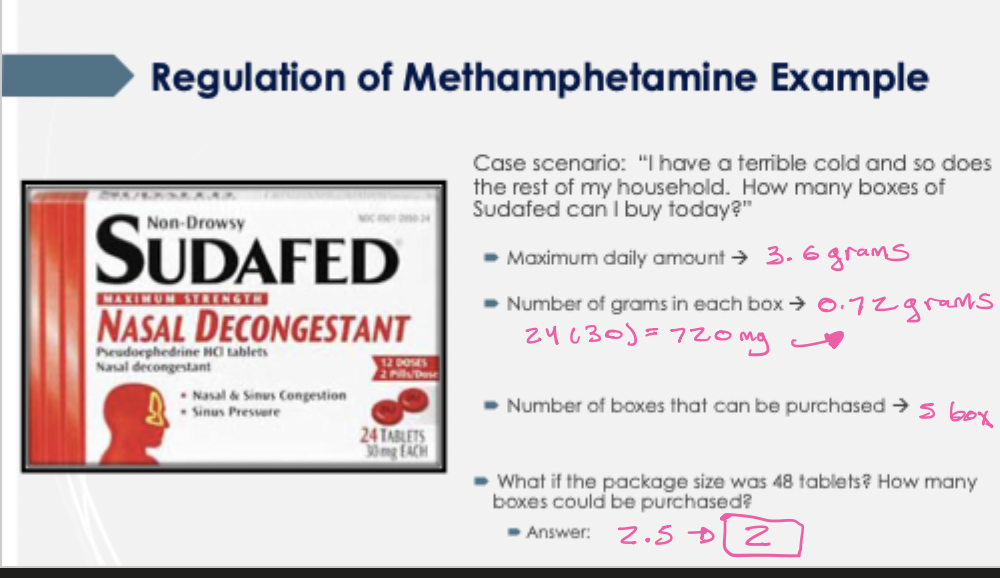
Pseudoephedrine
requirements
3.6 g/day
9 g/30 days
A logbook requirement exists.
Dietary supplements regulation?
Dietary supplements are regulated differently from OTC/Rx drugs, and FDA has less regulatory authority over them.
Drug-Cosmetic Products
Drug-intended use + cosmetic-intended use
Drug-Cosmetic Products - example
Examples:
Anti-dandruff shampoo
Toothpaste
Drug-Cosmetic Products - Why important?
Different labeling requirements
🔴 KNOW
Standard Drug Facts inactive ingredients
→ generally alphabetical
Cosmetic ingredient lists
→ may be listed by weight
Therefore:
Do not assume the whole ingredient list is alphabetical.
Example:
Patient avoiding a dye → scan the entire ingredient list.
Nonprescription Product Liability
OTC recommendation → stay within OTC labeling
Pharmacists may face malpractice/negligence when inaccurate advice harms a patient.
Nonprescription Product Liability = Potential liability:
Recommending OTC use outside the label.
Recommending a different therapy instead of prescribed therapy.
Failing to remove expired products.
Failing to remove recalled products.
Whiting v. Rite Aid
This case was used to reinforce that pharmacists should follow OTC label warnings and stay within labeled recommendations.
Follow OTC labeling →
safer recommendation + less liability risk.