Phys Unit 2 - Muscle Physiology
 Call Kai
 Learn
Learn Practice Test
 Spaced Repetition
 Match
Match Flashcards
 Knowt Play
1/58

There's no tags or description
Looks like no tags are added yet.
Name | Mastery | Learn | Test | Matching | Spaced | Call with Kai | Chat |
|---|
No analytics yet
Send a link to your students to track their progress
59 Terms
Muscle cells are capable of converting chemical energy to:
Mechanical energy
What are the three types of muscle tissue?
Skeletal, smooth, and cardiac muscle.
Muscle maintains length but produces internal tension
Isometric Contraction
Muscle changes in length with no change in tension
Isotonic Contraction
Muscle shortens
Concentric Isotonic Contraction
Muscle Lengthens
eccentric isotonic contraction
Type of muscle that is striated, voluntary, multinucleate, has parallel fibers
Skeletal muscle
Type of muscle that is striated, involuntary, has branching cells, is uninucleate, has intercalated discs, and is myogenic
Cardiac muscle
Type of muscle that is fat in the middle with tapered ends, uninucleate, non-striated, involuntary, and can be either myogenic or multiunit
Smooth muscle
First phase of muscle contraction
Excitation
second phase of muscle contraction
excitation-contraction coupling
third phase of muscle contraction
contraction
fourth phase of muscle contraction
relaxation
Staircase phenomenon with high stimulation
Treppe
No time to return to baseline between twitches (20-40 stim/sec)
Incomplete tetanus
No time to relax at all between stimuli (40-50 stim/sec)
Complete tetanus
Decreased ability of a fiber to produce tension despite continued stimulation
Fatigue
Produces greatest force when muscle contracts
Optimum resting length
A state of partial contraction maintained by the nervous system
muscle tone
Multi motor unit recruitment
spatial summation
AP triggered in the same muscle fiber consecutively, may lead to tetany
Temporal Summation
Initial sarcomere length = overly contracted
weak contraction
A form of spastic paralysis caused by toxin of Clostridium tetani
Tetanus (lock jaw)
Muscle is limp and cannot contract
Flaccid paralysis
Food poisoning caused by neuromuscular toxin of Clostridium botulinum
Botulism
Where calcium is stored in muscles
terminal cisternae
if too stretched before stimulated
a weak contraction results
stiffness in muscles after death, Actin-myosin cross-bridging can't be broken in absence of ATP
rigor mortis
Autoimmune disease in which antibodies attack neuromuscular junctions and bind ACh receptors together in clusters
myasthenia gravis
Group of hereditary diseases in which skeletal muscles degenerate and weaken, and are replaced with fat and fibrous scar tissue
Muscular dystrophy
Type of MD occurring in males
Duchenne muscular dystrophy
Type of MD that affects facial and shoulder muscles more than pelvic muscles (occurs in both sexes equally)
Facioscapulohumeral MD
Type of MD that affects shoulder, arm, and pelvic muscles
Limb-girdle dystrophy
Reflex testing function of corticospinal tract
Babinski reflex
"Jerk" reflex (as when falling asleep in class)
Myotaxic (stretch) reflex
nerve endings that respond to duration of stretch stimulus
secondary afferent fibers
Proprioceptors embedded in collagen fibers on tendons
Golgi Tendon Organ (GTO)
Stretch receptor inside of muscle that sends info to the cerebellum
muscle spindle
Starts at ventral horn, responds to tension; keeps muscle spindle fibers taut and responsive even when muscle shortens
Gamma motor neuron
nerve endings that respond to onset of stretch stimulus
primary afferent fibers
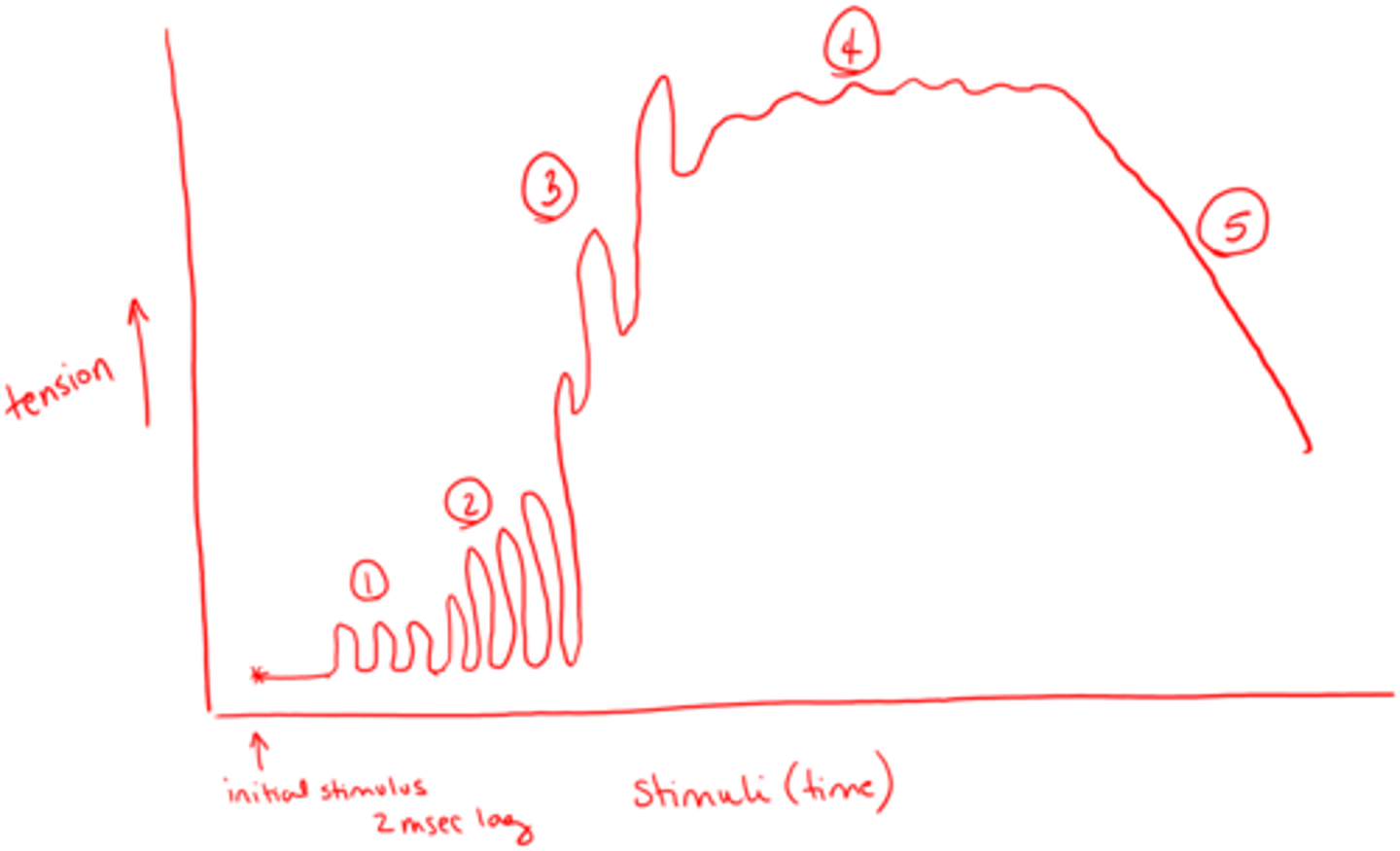
Number 1 on the diagram
Normal contraction
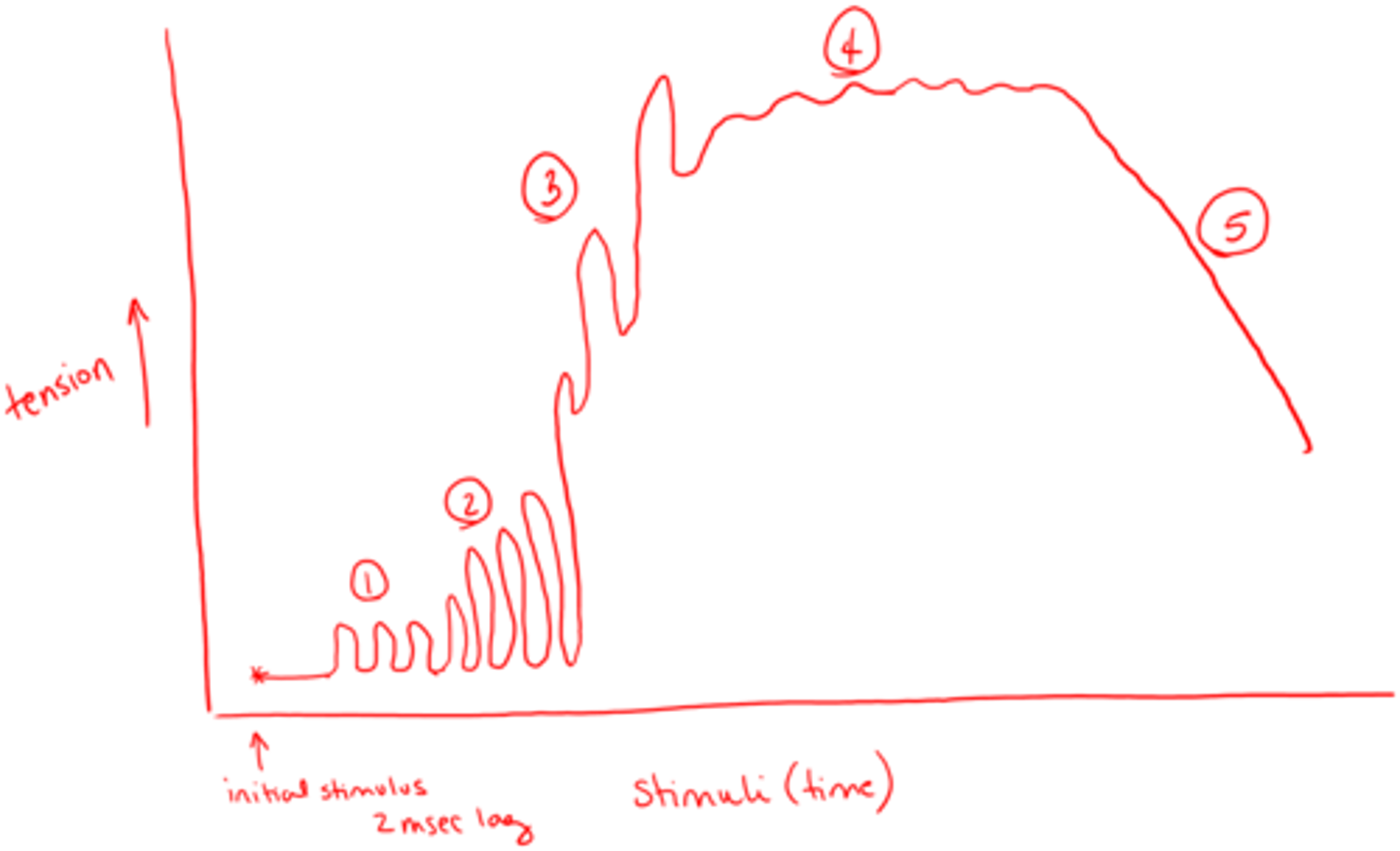
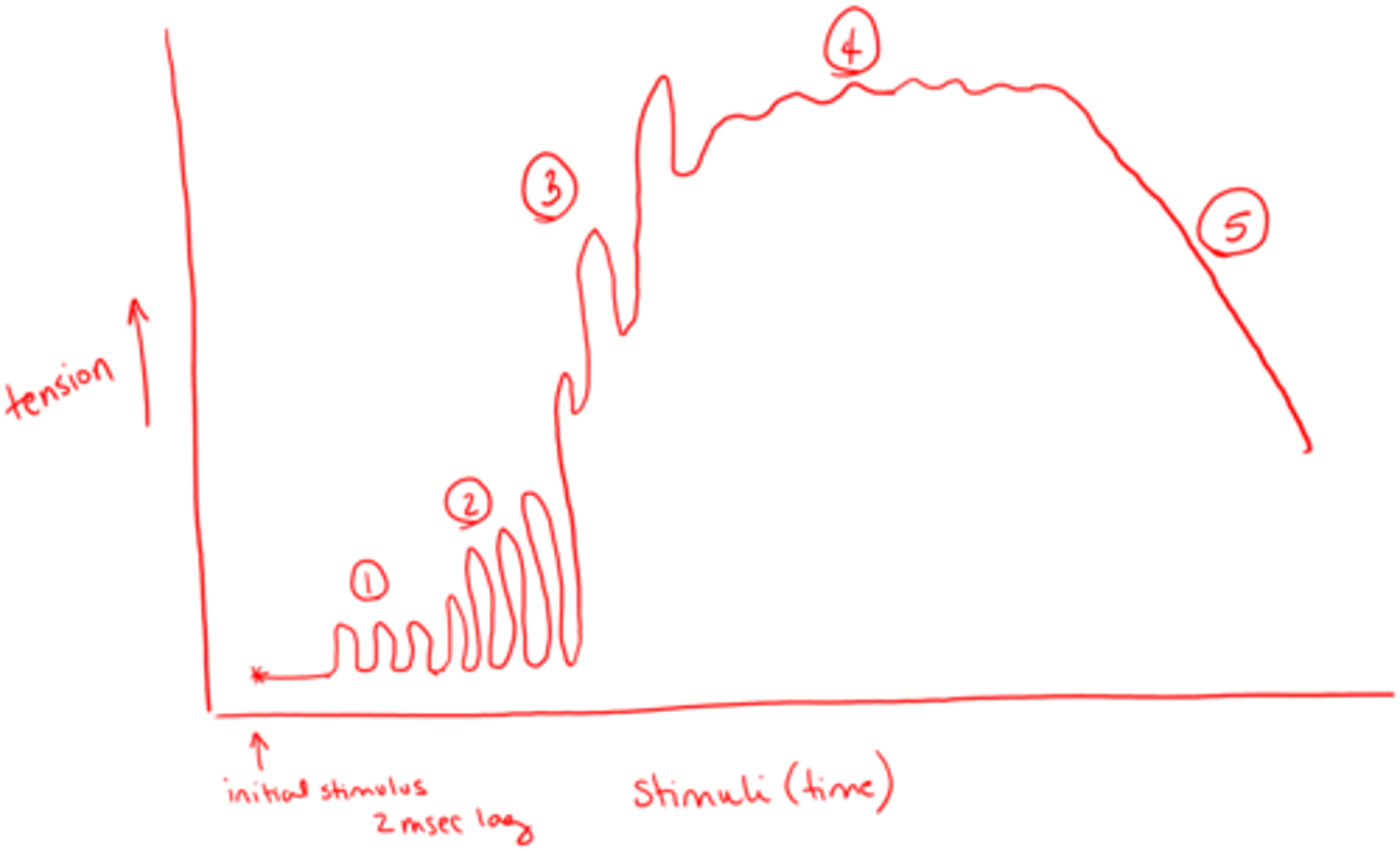
Number 2 on the diagram
Treppe
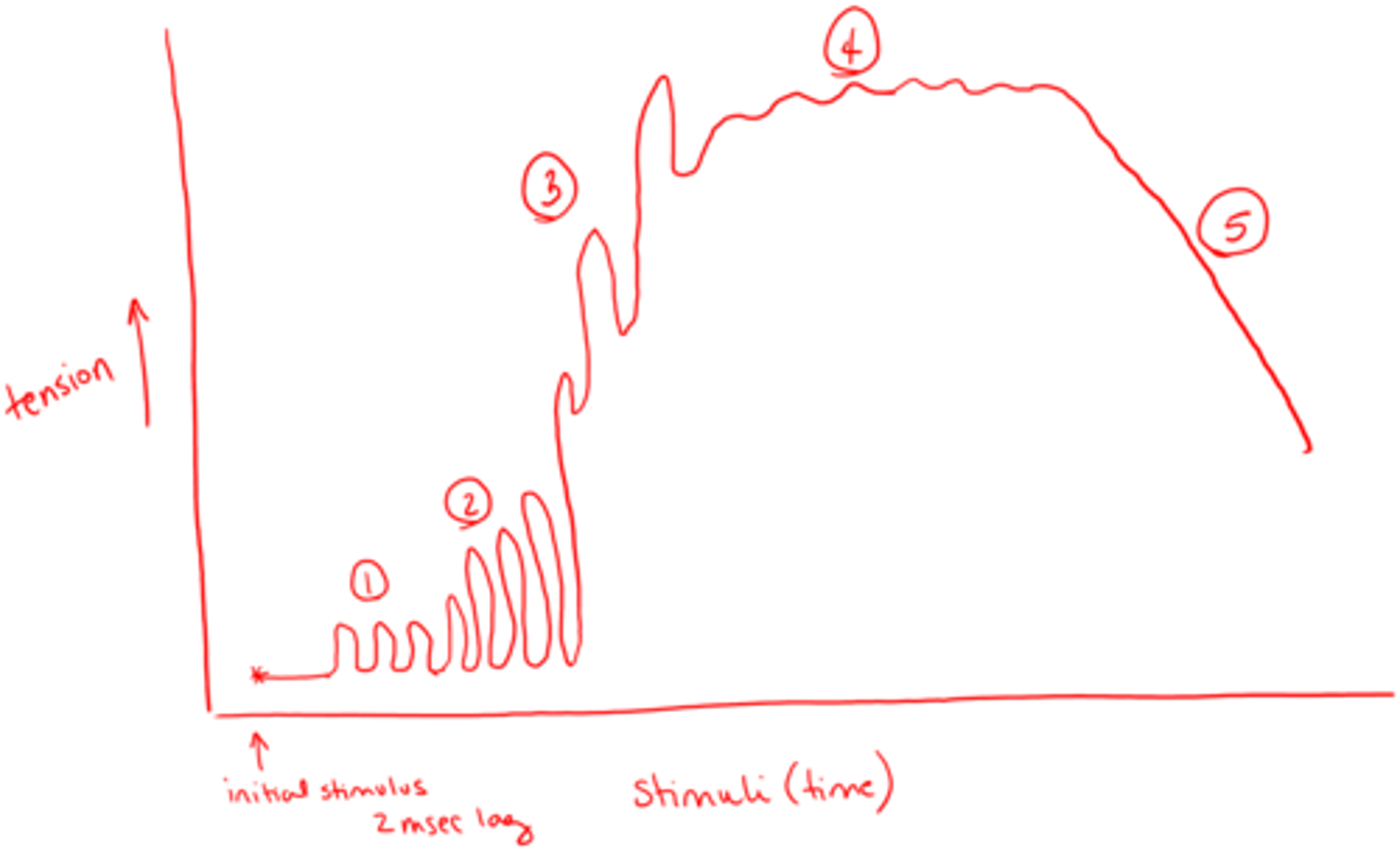
Number 3 on the diagram
Incomplete tetany
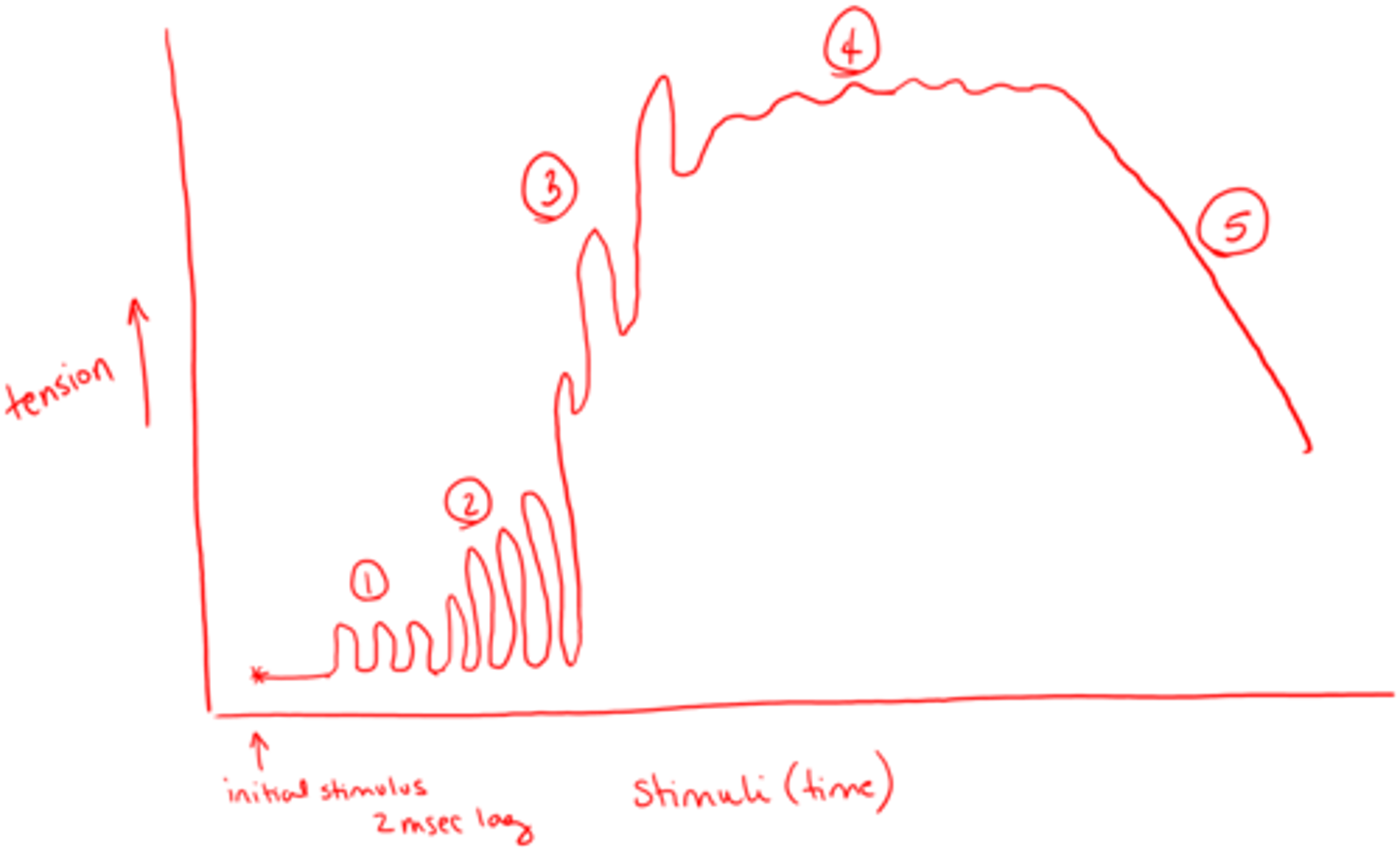
Number 4 on the diagram
complete tetany
Number 5 on the diagram
Fatigue
Contractile protein
myosin
Filament that blocks actin-binding site
Tropomyosin
Calcium-binding protein
Troponin (Tn)
Protein that links actin in outermost myofilaments to transmembrane proteins and fibrous endomysium
Dystrophin
Functional contractile unit of a muscle fiber
Sarcomere
One neuron and all the muscle fibers it innervates
motor unit
What are the only two electrically excitable cell types in the human body?
Nervous system and muscle cells
The amount of tension generated by a muscle + the force of contraction
Length-tension relationship
Type of twitch fiber that fatigues slowly, uses aerobic respiration, and is red in color
Slow twitch (Type I/Slow Oxidative)
Type of twitch fiber that fatigues slowly, contracts quickly, and is good for long periods of strenuous exercise
Fast Twitch - Oxidative
Type of twitch fiber that fatigues and contracts quickly, good for short periods of strenuous activity
Fast Twitch - Glycolytic
Type of muscle metabolism using creatine phosphate
Direct phosphorylation
Type of muscle metabolism with high ATP yield, CO2 and H2O byproducts
Oxidative phosphorylation
Type of muscle metabolism that has low ATP yield, lactic acid byproduct
Anaerobic fermentation (glycolysis)