2. Earth Processes
 Call Kai
 Learn
Learn Practice Test
 Spaced Repetition
 Match
Match Flashcards
 Knowt Play
1/15

There's no tags or description
Looks like no tags are added yet.
Name | Mastery | Learn | Test | Matching | Spaced | Call with Kai | Chat |
|---|
No analytics yet
Send a link to your students to track their progress
16 Terms
What factors determine climate of a location?
- Elevation
- Proximity to equator
- Vegetation
- Proximity to ocean
- Human activity (farming, industry, urban landscape)
- Pollution
- Tilt of the Earth

Rain Shadows
- Warm, wet air rises on one side of the mountain
- Warm air cools, condenses, and precipitates on that side
- Dry air moves down the other side of the mountain, causing it to be dryer with less vegetation

Albedo Effect
A measure of how much of the Sun's energy is reflected off an object.
- Snow and Ice reflects more radiation
- Dark asphalt reflects very little radiation (Urban heat island)
Melting ice reveals more dark rock that absorbs more heat and accelerates melting.

Uneven heating of earth's surface
The 23.5-degree tilt drives seasons, air circulation patterns, and precipitation patterns.
- More intense at the equator

Wind circulation patterns
1. The sun heats moist air at the equator
2. Warm wet air rises, condenses, and precipitates
3. Cool, dry air is pushed 30 degrees north and south
4. Dry air sinks as it warms and becomes wetter
The Earth's rotation affects wind direction
Polar cell: around the poles
Ferrel cells: distribute cool air from poles and warm air from the equator
Hadley Cell: around the equator
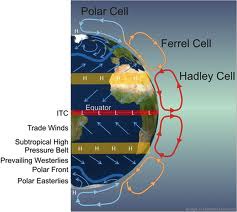
Intertropical Convergence Zone (ITCZ)
The area where the two Hadley cells converge and cause large amounts of precipitation.
- Causes seasonal rainfall
- Moves with the tilt of the Earth, following the sun's position

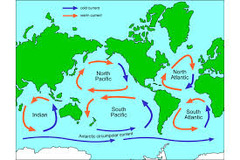
Ocean circulation pattern (Gyres)
Northern hemisphere: Clockwise
Southern hemisphere: Counterclockwise
- Affected by temperature and salinity
Upwelling zones
Areas of ocean where winds blow warm surface water away from a land mass. This allows colder, deeper, and nutrient-rich water to replace it.

El Niño events
Caused by variations in trade winds due to changes in air pressure
Normal years: Winds push warm water away from South America ; Dry, cold conditions.
El Niño years: changes in air pressure weakens or reverses winds; Warm water pushed to S.American coasts (Less upwelling)
La Niña years: Warm water is pushed away from S.America like normal years, but stronger

Great Salt Lake (1982-1983)
El Niño years caused high rainfall that diluted the salt in the lake.
- Water became habitable for insects
- Water became uninhabitable for the brine shrimp
- Phytoplankton thrived
Conditions returned to normal after El Niño.
Which atmospheric circulation cell brings warm air from the subtropics and cold air from the poles to temperate latitudes?
a. Ferrel cell
b. Humboldt cell
c. Hadley cell
d. Polar cell
a. Ferrel cell
These cells are in between polar and hadley cells
Urban areas tend to be hotter than rural or polar areas. Which of the following contributes to this difference?
a. The tilt of the Earth's axis
b. Proximity to water
c. Albedo effect
d. Serotiny
c. Albedo effect
Albedos is a measure of how much sun energy is reflected. Urban areas have dark roads that absorb more heat and reflect less.
Which of the following is caused by the constant tilt of the Earth's axis?
a. The seasons
b. Uneven heating of the Earth
c. Variation of day-time length at the poles
d. All of the above
d. All of the above
For mountain ranges that are subjected to prevailing winds, why is the climate drier on the leeward side (downwind, or side furthest from ocean)?
a. Deserts create dry conditions on the leeward side of mountain ranges.
b. The sun illuminates the leeward side of mountain ranges at a more direct angle, converting to heat energy, which evaporates most of the water present.
c. Pushed by the prevailing winds on the windward side, air is forced to rise, cool, condense, and drop its precipitation, leaving drier air to descend the leeward side.
d. Air masses pushed by the prevailing winds are stopped by mountain ranges and the moisture is used up in the stagnant air masses on the leeward side.
c. Pushed by the prevailing winds on the windward side, air is forced to rise, cool, condense, and drop its precipitation, leaving drier air to descend the leeward side.
What process causes the El Nino Southern Oscillation Events?
a. Drought conditions in South America
b. Weak prevailing winds in the northern hemisphere
c. Higher temperatures over the Pacific Ocean
d. Weak prevailing winds from the southern hemisphere
d. Weak prevailing winds from the southern hemisphere
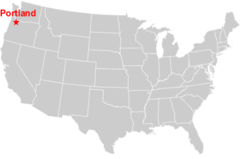
The cities of Portland, Oregon and Minneapolis, Minnesota are at about the same latitude, but Minneapolis has much hotter summers and much colder winters than Portland. Why?
The ocean near Portland moderates the temperature.