Ch.13 Genetics and Sexual Reproduction: Chromosomes, Meiosis, and Genetic Variation
 Studied by 1 person
 Call Kai
 Learn
Learn Practice Test
 Spaced Repetition
 Match
Match Flashcards
 Knowt Play
1/40

There's no tags or description
Looks like no tags are added yet.
Name | Mastery | Learn | Test | Matching | Spaced | Call with Kai |
|---|
No analytics yet
Send a link to your students to track their progress
41 Terms
What is the transmission of traits from one generation to the next called?
Inheritance or heredity
What are genes made up of?
Segments of DNA
How are genes passed to the next generation?
Via reproductive cells called gametes (sperm and eggs)
What is the total number of chromosomes in human somatic cells?
46 chromosomes
What is the specific position of a gene on a chromosome called?
Locus
What is a clone in the context of asexual reproduction?
An individual or group of genetically identical individuals from the same parent
What is the difference between diploid and haploid cells?
Diploid cells have two sets of chromosomes (2n), while haploid cells have one set (n)
What is a zygote?
The fertilized egg that has one set of chromosomes from each parent
What is a karyotype?
An ordered display of the pairs of chromosomes from a cell
What are homologous chromosomes?
Chromosomes in a homologous pair that have the same length, centromere position, and carry genes for the same characters
What are the sex chromosomes in humans?
X and Y chromosomes
What is the haploid number of chromosomes for humans?
23 chromosomes (n = 23)
What occurs during prophase I of meiosis?
Each chromosome pairs with its homolog and crossing over occurs
What is crossing over?
The exchange of genetic material between nonsister chromatids during prophase I
What happens during anaphase I of meiosis?
Homologous chromosomes separate and move toward opposite poles
What is the result of meiosis I?
Two haploid daughter cells with duplicated chromosomes
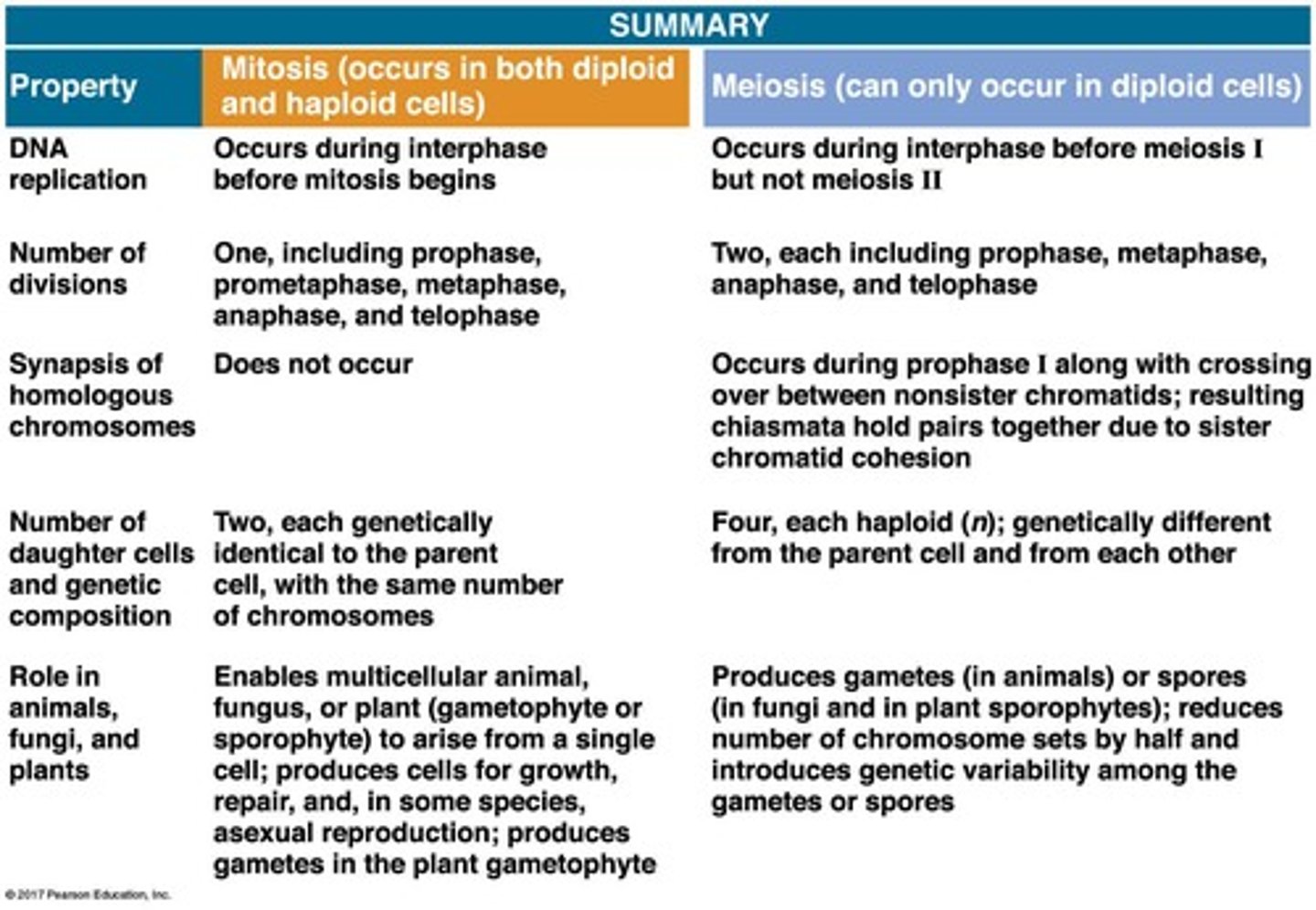
What is the main difference between meiosis and mitosis?
Meiosis reduces chromosome sets from diploid to haploid, producing four genetically distinct cells, while mitosis produces two identical cells
What is the role of the spindle apparatus in meiosis?
To help separate chromosomes during cell division
What occurs during telophase II of meiosis?
Nuclei form, and chromosomes begin to decondense, resulting in four haploid daughter cells
What is sister chromatid cohesion?
The close association of sister chromatids along their lengths before separation
What is the significance of the synaptonemal complex during meiosis?
It holds homologous chromosomes together tightly during synapsis
What is the outcome of fertilization?
The formation of a diploid zygote from the fusion of gametes
What is the diploid number for humans?
46 chromosomes (2n = 46)
What happens during cytokinesis in meiosis?
The cytoplasm divides, resulting in separate daughter cells
What are the phases of meiosis II?
Prophase II, Metaphase II, Anaphase II, Telophase II and Cytokinesis
What is the role of gametes in sexual reproduction?
Gametes are the only haploid cells produced by meiosis and fuse to form a diploid zygote
What is unique about meiosis compared to mitosis?
Meiosis includes crossing over, homologous chromosome pairing, and results in four genetically distinct cells
What occurs during synapsis in prophase I of meiosis?
Homologous chromosomes physically connect and exchange genetic information.
What happens to homologous pairs during metaphase I?
They align at the metaphase plate.
What is separated during anaphase I?
Homologous chromosomes are separated.
How does sister chromatid cohesion function in meiosis I?
Sister chromatids stay together through meiosis I, with cohesins cleaved along chromosome arms in anaphase I.
What is the role of mutations in genetic diversity?
Mutations are the original source of genetic diversity, creating different versions of genes called alleles.
What are the three mechanisms that contribute to genetic variation?
Independent assortment of chromosomes, crossing over, and random fertilization.
What is independent assortment of chromosomes?
Homologous pairs of chromosomes orient randomly at metaphase I, sorting maternal and paternal homologs independently.
How many combinations of chromosomes are possible in humans due to independent assortment?
More than 8 million (2^23) possible combinations.
What does crossing over produce?
Recombinant chromosomes that combine DNA inherited from each parent.
How many crossover events typically occur per chromosome in humans?
An average of one to three crossover events.
What is the significance of random fertilization in genetic variation?
It allows any sperm to fuse with any ovum, leading to about 70 trillion possible diploid combinations.
What is the evolutionary significance of genetic variation within populations?
Natural selection favors genetic variations that are advantageous in the environment.
How do asexually reproducing organisms like bdelloid rotifers increase genetic diversity?
By incorporating foreign DNA from the environment.
What is the result of sexual reproduction in terms of genetic identity?
Each zygote has a unique genetic identity due to the combination of genetic material from two parents.
 Note
Note  Flashcards (276)