Benchmark Review
0.0(0)
Studied by 21 people Call Kai
 Learn
Learn Practice Test
 Spaced Repetition
 Match
Match Flashcards
Card Sorting
1/27

Earn XP
Description and Tags
Last updated 2:40 PM on 2/28/23
Name | Mastery | Learn | Test | Matching | Spaced | Call with Kai | Chat |
|---|
No analytics yet
Send a link to your students to track their progress
28 Terms
1
New cards
Colonial Regions Characteristics
New England-Puritan, economy based on trade, cold rocky solid
Middle - diverse, good relationship with Native Americans, staple crops
Southern-Plantation cash crops, relied on slave labor
\
Middle - diverse, good relationship with Native Americans, staple crops
Southern-Plantation cash crops, relied on slave labor
\
2
New cards
Salutary Neglect
Britain’s unofficial policy, to relax the enforcement of strict regulations, particularly trade laws, imposed on the American colonies late in the seventeenth and early in the eighteenth centuries.
3
New cards
William Penn and Pennsylvania
William Penn was a Quaker who founded Pennsylvania, a refuge for other Quakers. Establish a diverse colony and had a good relationship with Native Americans
4
New cards
First Great Awakening
a revival of religious feeling and belief in the American colonies that began in the 1730s, inspired the American Revolution
5
New cards
Mayflower Compact
1620 - The first agreement for self-government in America. It was signed by the 41 men on the Mayflower and set up a government for the Plymouth colony.
6
New cards
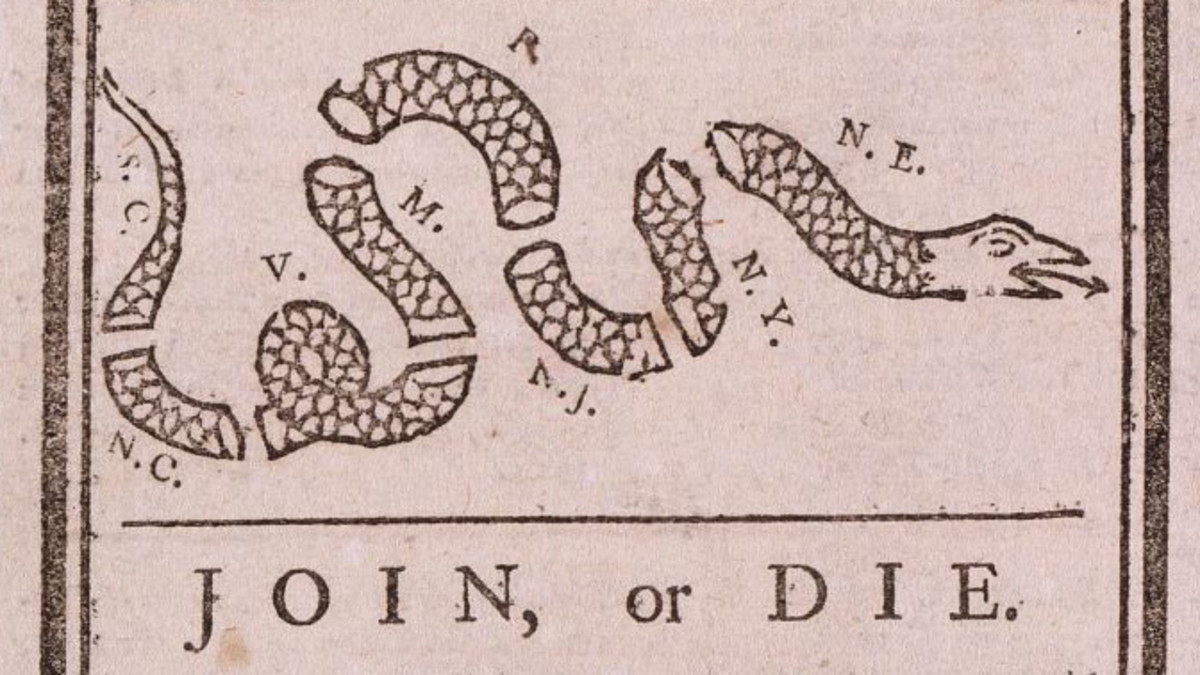
Join or Die Cartoon
Created by Ben Franklin to try to unite the colonies towards fighting the French. This is later used in the American Revolution.
7
New cards
Examples of Self Government in the Colonies
1. House of Burgesses
2. Mayflower Compact
3. Fundamental Orders of Connecticut
4. Town Meetings
5. Colonial Charters
8
New cards
French & Indian War
(1754-1763) War fought in the colonies between the English and the French for possession of the Ohio Valley area. The English won and the colonists were not treated as equals
9
New cards
Battle of Saratoga
Turning point of the American Revolution. It was very important because it convinced the French to give the U.S. military support. It lifted American spirits, ended the British threat in New England by taking control of the Hudson River, and, most importantly, showed the French that the Americans had the potential to beat their enemy, Great Britain.
10
New cards
Right of Revolution (Locke)
if natural rights are being violated people can replace their government
11
New cards
Bill of Rights
Individual Rights that protect citizens from the government
12
New cards
No Taxation without Representation
reflected the colonists’ belief that they should not be taxed because they had no direct representatives in Parliament
13
New cards
Articles of Confederation
A weak constitution that governed America during the Revolutionary War, exposed by Shays Rebellion
14
New cards
Enlightenment Ideas
All human beings are born free and equal with a right to life liberty and property. It is the duty of the government to protect the natural rights of its citizens. These thinkers were primarily interested in changing the relationship between the people and their government. Government’s decisions should be based on laws of nature and reason and that their powers should be separated
15
New cards
Whiskey Rebellion
Farmers in Pennsylvania rebelled against Hamilton’s excise tax on whiskey. In October, 1794, the army, led by Washington, put down the rebellion. The incident showed that the new government under the Constitution could react swiftly and effectively to such a problem, in contrast to the inability of the government under the Articles of Confederation to deal with Shay’s Rebellion.
16
New cards
Hamilton/Jefferson debate
The fighting between these two people, in George Washington’s cabinet, may have influenced his view of political parties.
17
New cards
Marbury v. Madison
This case establishes the Supreme Court’s power of Judicial Review
18
New cards
War of 1812 Causes
1812-1815
\*British impressment of American sailors
\*The United States suspected the British of encouraging Native American rebellion
“War Hawk” Congressional leaders, such as Henry Clay and John Calhoun, pressed for intervention
\*American frontiersmen wanted more free land, as the West was held by Native Americans and the British
\*War Hawks also wanted to annex Canada and Florida
\*Despite the Embargo Act and Non-Intercourse Act, hostilities could not be cooled
\*Eventually, the United States sided with France against Britain
\*British impressment of American sailors
\*The United States suspected the British of encouraging Native American rebellion
“War Hawk” Congressional leaders, such as Henry Clay and John Calhoun, pressed for intervention
\*American frontiersmen wanted more free land, as the West was held by Native Americans and the British
\*War Hawks also wanted to annex Canada and Florida
\*Despite the Embargo Act and Non-Intercourse Act, hostilities could not be cooled
\*Eventually, the United States sided with France against Britain
19
New cards
Louisiana Purchase
1803 purchase of the territory from France. Made by Jefferson, this doubled the size of the US. Somewhat contradicted his idea of the role of government
20
New cards
division of North & South
caused by a changing economy, Antebellum reform movements, debate over slavery
21
New cards
Virginia Plan
“Large state” proposal for the new constitution, calling for proportional representation in both houses of a bicameral Congress. The plan favored larger states and thus prompted smaller states to come back with their own plan for apportioning representation.
22
New cards
New Jersey Plan
The proposal at the Constitutional Convention that called for equal representation of each state in Congress regardless of the state’s population.
23
New cards
Alien & Sedition Acts
passed by Federalists, signed by President Adams; increased waiting period for an immigrant to become a citizen from 5 to 14 years, empowered president to arrest and deport dangerous aliens, & made it illegal to publish defamatory statements about the federal government or its officials.
24
New cards
Roger Williams & Anne Hutchinson
These two people started settlements that joined to become the Rhode Island Colony.
25
New cards
Weaknesses of the Articles of Confederatoin
One vote for each State, regardless of size. Congress powerless to lay and collect taxes or duties. Congress powerless to regulate foreign and interstate commerce. No executive to enforce acts of Congress. No national court system. Amendment only with consent of all States. A 9/13 majority required to pass laws. Articles only a “firm league of friendship.”
26
New cards
Declaration of Independence
Written by Thomas Jefferson; influenced by the Enlightenment philosophers of his day.
*Provisions:*
*Part 1* - Explains the necessity of independence for the preservation of basic laws and rights.
*Part 2* - Lists a series of “abuses and usurpations” by the king and his government; Jefferson claimed that this treatment violated the social contract the British monarch had with the his colonies, thereby justifying the actions his American subjects felt compelled to take.
*Part 3* - Ends with what is tantamount to a formal declaration of war.
*Provisions:*
*Part 1* - Explains the necessity of independence for the preservation of basic laws and rights.
*Part 2* - Lists a series of “abuses and usurpations” by the king and his government; Jefferson claimed that this treatment violated the social contract the British monarch had with the his colonies, thereby justifying the actions his American subjects felt compelled to take.
*Part 3* - Ends with what is tantamount to a formal declaration of war.
27
New cards
Manifest Destiny
1800s belief that Americans had the right to spread across the continent.
28
New cards
Gibbons v. Ogden
The Supreme Court upheld broad congressional power to regulate interstate commerce. The Court’s broad interpretation of the Constitution’s commerce clause paved the way for later rulings upholding expansive federal powers.