Biology - Cell Membranes
 Studied by 1 person
 Call Kai
 Learn
Learn Practice Test
 Spaced Repetition
 Match
Match Flashcards
 Knowt Play
1/50

Earn XP
Description and Tags
Cell membranes test on 11/12/25
Name | Mastery | Learn | Test | Matching | Spaced |
|---|
No study sessions yet.
51 Terms
What is a cell membrane also called?
Plasma membrane or surface membrane
What are the modes of transport?
Modes of transport include passive transport, which does not require energy (e.g., diffusion, osmosis), active transport, which requires energy to move substances against their concentration gradient, and there are also bulk transport methods like endocytosis and exocytosis that involve the movement of large particles.
What is diffusion?
Diffusion is the movement of molecules or ions from a region of high concentration of ions to a region of low concentration, until equilibrium.
Molecules move down a concentration gradient.
A membrane is not needed, but if present, non-polar molecules move through the phospholipids but polar molecules move through the hydrophilic protein channels.
What are the factors affecting rate of diffusion?
Concentration gradient, Temperature, Size of the molecule, Distance, Surface area, Pores in membrane, and Lipid solubility.
How does the concentration gradient affect the rate of diffusion?
the steeper the gradient, the faster the rate
How does temperature affect the rate of diffusion and why?
The higher the temperature, the faster the rate, due to thermal energy being transferred to kinetic energy, which means the particles move more and faster.
How does the size of the molecule affect the rate of diffusion?
The smaller the size, the faster the rate, because smaller molecules tend to have higher kinetic energy than larger molecules as they have a smaller mass. Also smaller molecules can fit easier through the cell membrane pores, while larger molecules will collide.
How does lipid solubility affect the rate of diffusion?
lipid soluble substances diffuse faster than non lipid soluble substances, as the substance simply dissolves in the phospholipid bilayer and then diffuses across it. Lipid-soluble substances are able to cross the plasma membrane at significant rates, allowing them to enter or leave the cell more readily. In contrast, water-soluble substances encounter greater resistance due to their hydrophilic nature and cannot easily dissolve in the lipid bilayer.
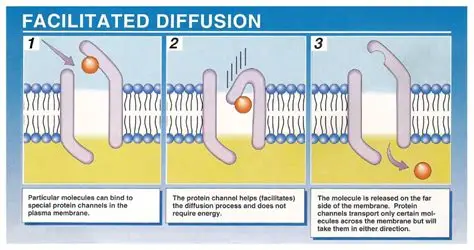
What is facilitated diffusion
Facilitated diffusion is a type of passive transport that uses integral membrane proteins to move polar, charged, or large molecules across the plasma membrane down their concentration gradient. It does not require metabolic energy because substances move from an area of higher concentration to an area of lower concentration, similar to simple diffusion. Examples include the movement of glucose and amino acids into cells.
OR
Carrier molecules in the membrane temporarily bind with the molecules enabling passage through protein channels in the membrane, moving molecules from high concentration to low concentration.
Facilitated diffusion is faster than simple diffusion.
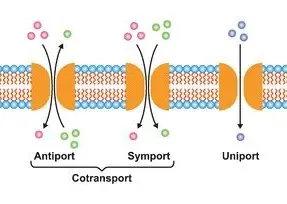
What is cotransport?
This is a type of facilitated diffusion when two substances are simultaneously transported across a membrane by a carrier protein. e.g. in kidneys glucose and sodium and transported together in the same direction.
What is osmosis?
The movement of water molecules from higher water potential to lower water potential across a selectively permeable membrane until equal. Water moves down the water potential gradient. The closer Ψ is to 0, the more water is available to move.
What is water potential? What is solute and pressure potential?
Water potential (Ψ) (psi) is the force acting on the water molecules in a solution. It is the potential for water to move out of a solution/system by osmosis. Measured in kPa. Water potential of pure water = 0kPa.
Add a solute and the water potential will decrease and become negative because there are fewer free molecules available to move.
Ψs = solute potential - this is the effect of solutes lowering the Ψ or the pressure due to the solute concentration - always a negative value as it is a pulling force.
Plant cell wall prevents the cell from bursting, therefore water can enter the cell by osmosis only until the pressure exerted by the wall prevents further entry.
Ψp = pressure potential - The pressure exerted by the rigid cell wall that limits further water uptake. This is always a positive value as it is a pushing force.
What is the net movement between a water solution and a sugar solution which both have the same number of water molecules?
Some of the water molecules on the sugar solution will be attached to sugar molecules, and will not be free to move. Therefore, because there are more freely moving water molecules in the water solution, they move through the pores of the membranes to the sugar solution.
What is the overall equation for water relationships in a plant cell?
Water potential = Solute potential + Pressure potential
Water enters plant cells by osmosis - why don’t they burst?
Because there is pressure exerted by the cell wall back on the water, limiting further water uptake.
Suggest why amoeba living in fresh water do not burst even though water enters by osmosis.
Because they have contractile vacuoles so they can release the water so they don’t burst. (They don’t have a cell wall to exert pressure back)
In a fully turgid cell, what is the water potential?
0 - solute and pressure potential are equal and opposite
What is the protoplasm of a cell?
The living content of a cell
What is incipient plasmolysis?
The point at which the cell membrane just pulls away from the cell wall. Incipient plasmolysis is judged when 50% of the cells are showing signs of plasmolysis or when there is no change in mass.
At incipient plasmolysis, water potential = solute potential as pressure potential = 0 as there is no pressure from the cell wall.
What is a hypotonic solution?
It has a lower solute concentration and a higher water potential
What is a hypertonic solution?
It has a higher solute concentration and lower water potential
What is an isotonic solution?
It has the same solute concentration and same water potential.
What is the equation for water potential for osmosis in animal cells?
water potential = solute potential as animal cells do not have a cell wall so there is no pressure potential. So if there is too much water, there is nothing to stop it from bursting
What is active transport?
Moves substances against the concentration gradient, from an area of low concentration to high concentration. It uses energy in the form of ATP produced by respiration. Cells which carry out active transport are likely to need mitochondria and oxygen.
Carrier proteins in the membrane bind with the molecule or ion and assist their passage through the membrane. Binding occurs on one side only - so transport is in one direction only. e.g. sodium is pumped out of a resting neurone although their concentration is much higher outside. They are exchanged for potassium which is pumped in.
Active transport will not take place in the presence of a respiratory inhibitor such as cyanide as it stops the production of ATP.
If question says pump, it means use of active transport.
What would a graph look like for lipid diffusion?
It would have a linear line/relationship
What would a graph look like for lfacilitated diffusion?
Curved relationship with a maximum rate due to the rate being limited by the number of transport proteins
What would a graph look like for active transport?
The rate of active transport increases with concentration gradient. There is a high rate even when there is no concentration difference across the membrane. Active transport stops if cellular respiration stops, since there is no energy.
The Na+ K+ Pump
This transport protein is present in the cell membrane of all animal cells
Most abundant and important of all membrane pumps
This pump is an ATPase (enzyme), which means that the enzyme derives its energy from the hydrolysis of ATP
The function of Na/K ATPase is to set up the electrochemical gradient of the membrane
Pumps Na out of the cell and pumping K into the cell
The net effect is to create
a chemical potential consisting of two concentration gradients for Na and for K
electrical potential because three positive charges are pumped out while two positive charges are pumped in
A negative potential inside the cell is thus created
What is bulk transport?
Large molecules or particles sometimes need to be transported across cell surface membranes
Achieved via endocytosis and exocytosis
What is exocytosis?
Release of substances from cell as vesicles
Enclosed either by RER or Golgi body/apparatus
e.g. proteins, polysaccharides, hormone, neurotransmittes.
What is endocytosis?
Substances taken into the cell
Solid/liquid engulfed by cell membrane
Pinocytosis (cell drinking) - small materials and vesicles e.g. protein molecule
Phagocytosis (cell eating) - large materials e.g. White Blood Cells ingesting bacteria
In a change in mass against concentration of a solution graph, where would the solution be hypotonic?
Usually at the beginning of the graph, where there is an increase in change in mass as the cells are increasing in mass as water moves in via osmosis. (the cell is turgid).
when cell is turgid, at the very beginning of the graph water potential = 0 as solute and pressure potential are equal and opposite
In a change in mass against concentration of a solution graph, where would the solution be hypertonic?
Usually past the isotonic point to the end of the graph, where change in mass is negative as water is moving out via osmosis.
In a change in mass against concentration of a solution graph, where would the solution be isotonic?
When the graph line crosses the x-axis (where the concentration should be) the solution would be isotonic at that concentration as there is no change in mass and it equals to 0. This is where incipient plasmolysis occurs and water potential = solute potential as pressure potential is 0.
What does plasmolysed mean and when is the cell plasmolysed?
It means the cell has shrunk/is shrinking. The cell is plasmolysed at the very end of the graph past when the change in mass is at its least and it has increased a little.
What do cell membranes usually appear like under a microscope?
Under a electron microscope it appears as a double line with a distance across the lines as 7-9nm
What are cell membranes made of?
The main component of cell membranes are phospholipids.
They have hydrophilic heads and hydrophobic tails.
They arrange themselves as a bilayer with heads towards the inside and outside and tails in the centre.
What is in between the phospholipids?
Protein molecules.
Some are partly embedded (extrinsic) either on the outside or on the inside - and can be used for cell recognition as enzymes, for cell adhesion.
Some extend completely across it (intrinsic) and can be used for transport through the membrane. Some are used as Carrier proteins for specific molecules. Some form protein channels for transport.
What is the fluid mozeic model?
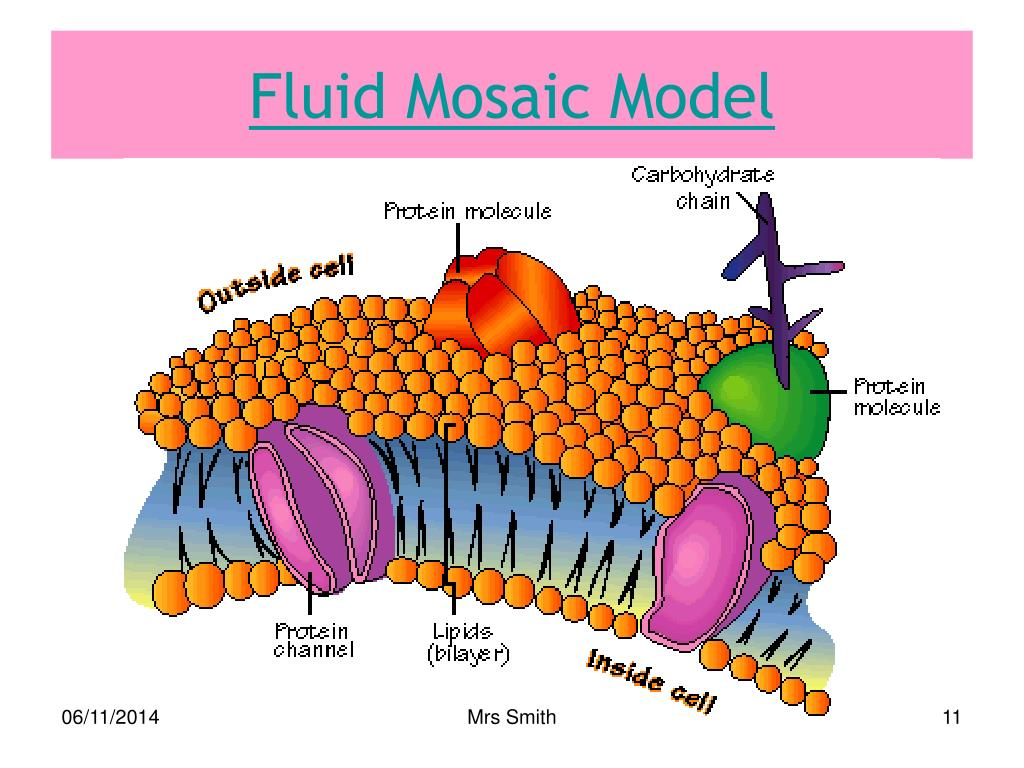
fluid mosaic model drawing
has polar, hydrophilic amino acids (heads) in contact with water outside the membrane
non-polar hydrophobic tails in contact with the fatty acid chains inside the membrane
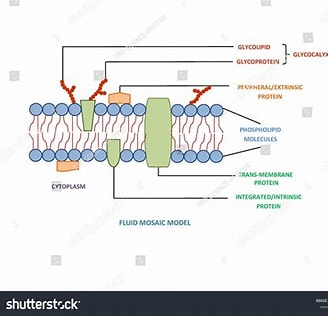
What are glycoproteins?
The extracellular surface of some proteins (glycoproteins) can be glycosylated (i.e. have a carbohydrate chain attached) forming a Glycocalyx.
Some phospholipids (glycolipids) also have a glycocalyx. They are used for cell recognition e.g. antigens on RBCS.
The phospholipids and proteins are free to move with respect to each other, so our model of the arrangement is known as the fluid mosaic model.
Animal cell membranes also have cholesterol, a steroid, which helps to bind the phospholipids together.
What are the functions of plasma membranes?
Regulating uptake of nutrients
Regulating secretion of chemicals
Cell recognition (using glycolipids or glycoproteins)
Separating the inside of the cell from the outside
Separating one cell from another cell
What does hydrophilic mean?
refers to the property of a molecule that means it associates readily with water and is therefore water soluble
can lipid soluble (hydrophobic) substance pass through the cell membrane?
Lipid soluble (hydrophobic) substances e.g. steroids and glycerol pass through the membrane easily and quickly as they can move through the phospholipid bilayer
can water soluble (hydrophilic) substance pass through the cell membrane?
e.g. glucose, amino acids, ions, move more slowly as they must use the protein channels, passing through water filled pores
plasma membranes are selectively permeable to water and some solutes
What can effect permeability of cell membranes?
Factors such as heat and organic solvents e.g. ethanol can affect the permeability of cell membranes
Heat increases the permeability of the membrane as it increases KE of the phospholipid, causing them to move more and makes the membrane more fluid.
Organic solvents increase the permeability of the membrane as it dissolved the lipids in the cells phospholipid bilayer. It disrupts its structure and makes it more fluid and permeable.
What are artificial lipid bilayers?
They lack the proteins present in all cell membranes, and are used to investigate the rate of transport of various molecules.
Investigation diffusion as the lack of proteins means there is no facilitated diffusion and no active transport.
What does the permeability of the protein depend on?
The size of the molecule - the smaller the molecule the more soluble it is in oil, the more rapidly it will diffuse across the bilayer.
Solubility of the molecule in oil (fat) - the more soluble it is in oil, the more hydrophobic or non polar that molecule is
So, small non-polar molecules readily dissolve in lipid bilayers and rapidly diffuse across them as well as uncharged polar molecules if they are small enough.
Large, uncharged polar molecules hardly permeate the bilayer and need proteins to help them pass through.
All charged molecules, even small ones, are not readily dissolvable in lipid bilayers.
some examples for hydrophobic molecules, small uncharged polar molecules, large uncharged polar molecules, ions
can pass through
hydrophobic - Oxygen and Nitrogen
small uncharged polar - H2O, CO2, urea, glycerol
cant pass through (impermeable)
large uncharged polar - glucose and sucrose
ions - Na+ K+ Cl- Ca2+ Mg2+ HCO3-
specific membrane proteins are responsible for transferring large uncharged molecules and ions across cell membranes.
What factors affect cell membrane permeability?
heat, ethanol, pH
A temperature exceeding the optimum and pH levels beyond the normal range can denature the membranes proteins. Ethanol dissolves the lipid components of the membrane.
This all makes the membrane far more permeable acting as if it full of holes.
go revise all the cell membranes questions on teams and in ur folder
lol and write them here when ur done and do the same with all other flashcard sets.