ID 2202 Test 1 - The Industrial Revolution
 Call Kai
 Learn
Learn Practice Test
 Spaced Repetition
 Match
Match Flashcards
 Knowt Play
1/76

There's no tags or description
Looks like no tags are added yet.
Name | Mastery | Learn | Test | Matching | Spaced | Call with Kai | Chat |
|---|
No analytics yet
Send a link to your students to track their progress
77 Terms
The Great Exhibition
-1851 in Great Britain;
-sponsored by monarchy;
-6-month run and 6-million+ attended, 15,000 exhibitors; Second Industrial Revolution
*to show the works of industry to all the nations*
First Industrial Revolution
-1760-1840;
-began in Britain and within few decades spread to Europe and USA;
-transition from agrarian, handicraft production in cottages to one dominated by machine manufacturing;
-increasing use of *steam power* and *development of machine tools*;
-change from wood/bio-fuels to *coal*;
Second Industrial Revolution
-1840-1870;
-evolution of *steam engine into steam-powered systems: boats, ships, railways*
-*large scale manufacture of machine tools* and *factories*
-”The Great Exhibition”

Crystal Palace, 1851, industrial
Joseph Paxton

Crystal Palace, 1851
-Industrial Revolution
-Joseph Paxton
-Greenhouse-inspired design; symmetrical balance;
introduce as much glass as possible.
-*cast-iron and glass
iron girder superstructure and glass skin
large efficient greenhouse
skeleton of cast-iron columns supporting the girders
-floors were wooden for structure
-in his sketch, the palace is symmetrically balanced.
-modular system
very specific configuration
-with prefabricated parts*
modules were already constructed and were assembled on site.
-built around a live tree
-can see all the natural aspects outside because of the windows, connecting the inside to nature
1,851 feet long (same year)
height 108 feet interior
24 ft modules
4,500 tons of iron
-guttering
hollow pillars used as drain pipes and guttering (functional)
condensation on roofline that would be drained
-glazing
-based the size of the modules based on the size of the glass
-took 8 months adn only 5 million dollars to make
helped economy and visited by non-Brits like Charles Darwin, Charlotte Bronte, Charles Dickens, Lewis Carrol, George Eliot
-eventually destroyed by fire in November 1936
Fire in an office that spread throughout the wooden floor
over 100,000 people watched
Iron girders ended up warping because of the high heat
“End of an age“
Glazing
-affixing glass
-used special trolleys to assist with putting up the glass
George Jennings
penny toilets, 1851, industrial
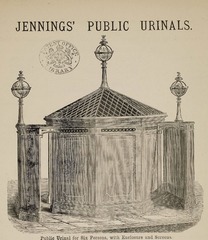
Retiring Rooms and Penny toilets, Crystal Palace, 1851
-Industrial Revolution
-George Jennings
-"Retiring Rooms": where people went to have tea
public restrooms, enclosure around 4 sides
-toilets next to these rooms
-If you were a male, you could pay a penny an duse the toilet
-827,280 paid a penny, industrial design
Glass fountain at Great Exhibition 1851
-Industrial Revolution
-Follett Osler
-”World’s first glass fountain”
-making use of the properties and qualities of glass
-appropriate for crystal palace made of all glass
Machine Hall, Great Exhibition 1851
-Industrial Revolution
-upper roofline for ventilation of machines;
-display machines in action
-
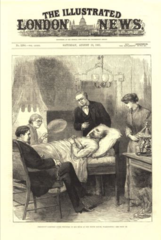
"Illustrated London News"
Newspaper printed inside Crystal Palace's Machine Hall;
5,000 copies an hour churned for public
Hibbert, Platt, Sons
Great Exhibition 1851, Machine Hall;
Cotton machines for demonstrating cotton spinning process of being opened, carded, doubled, spun, warped, and woven
Department of United States
Section of Crystal Palace for American exhibits during Great Exhibition 1851;
plastered larger model of American eagle;
draped banner of "Old Glory"
model of suspension truss bridge of Nathaniel Rider;
pipe organ
Cyrus McCormick
1831, Virginia; reaper with revolving reel for bundling;
July 24, 1851 beat English farm in contest;
Won First Prize Gold Medal!! in British Great Exhibition and reported in Illustrated London News--got more interested in tools from industrial rev, Dept of USA

Samuel Colt
Colt Navy and Dragoon Revolver;
200 guns "commemorative edition" to give away and get people interested;
parts interchangeable--efficiency of industrial rev manufacturing, Dept of USA

Department of Great Britian
displayed British works with Victorian furniture
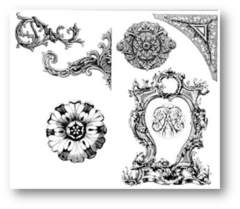
Victorian Design
Queen Victoria
"domestic life important"
"Beauty is paramount"
"*ornament* necessary"
focus on Beauty, domesticity, ornament
individual handcrafted and craftsman employed--not very functional, mainly display
-usually carved wood
-STAINED dark colors to hide wooden inconsistencies
-"curves within curves" symmetrically placed and repeated

Victorian Pattern Book
show pics used as guides or patterns
wood carvers, jewelers, painters, etc would often repeat same patterns but different materials--consistencies across different products
Cooke and Wheatstone
telegraph, 1850s, Victorian
Dept. of British
"*curves within curves*"
individually handcrafted,
focus on Beauty

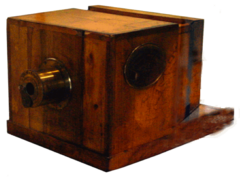
Daguerre Camera
camera 1851, Dept of British, Industrial Rev
"machine"
encased within simple box
no ornament
Sheffield Company
Victorian design,
sterling silver scissors,
*curves within curves*, 1851

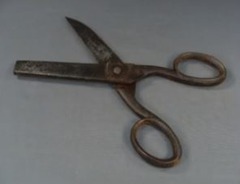
cast iron scissors
Great Exhibition 1851, industrial rev, functional and machine fabricated+assembly line
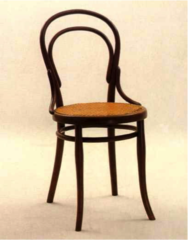
Thonet Brothers
bentwood chairs at Great Exhibition 1850s, awarded bronze medal
industrial design
*steam-forming machine to soften and bend wood around molds*--"gentle curve"
assembled on assembly line--only six parts
functional
Chair #14
Victorian vs Industrial
*Victorian*: Beauty, ornament, decorative, domestic life, individually crafted
*industrial*: machine-made, mass produced, functional
Machines at Great Exhibition brought simplicity and something "new" and more useful than Victorian designs
Thomas Shearer
Desk, 1851, functional with lots of drawers, swing outs, etc.
Arts and Crafts movement, individual BUT focus on function

Universal Exposition 1889
Paris exposition (1889), Hall of Machines (similar to Crystal Palace from 1851 Great Exhibition
origin of World's Fair and celebrate centennial of French Revolution (1789 storming of Bastille)
32 million visitors;
*official entrance was Eiffel Tower*
not important but: Palace of Industry 1855
Gustave Eiffel
Ran engineering firm for *Eiffel Tower*
Eiffel Tower
entrance to Universal Exposition
two senior engineers (Maurice Koechlin+Emile Nougier)--called it "Pylon of Honor" with 4 girders
Stephen Sauvestre--added arches to base for safety and stronger foundation
*composed of iron in towering lattice pattern*--transparent to give human-made in natural context
72 names of French scientists, engineers, math peeps: celebrated INDUSTRIAL BABEYYY
hydraulic elevator
1889; first installed on Eiffel Tower;
traction lift with water pressure;
open so public can see/display transparency
Hall of Machines
1889; industrial, iron superstructure and glass (similar to Crystal Palace)--also modular system with open interior but larger
British Arts and Crafts Movement
William Morris, "stick" furniture, wallpaper designs, 1880s
American Arts and Crafts Movement
Gustav Stickley, furniture, 1902-1908, *Transcendentalism* influence
William Morris
Arts and Crafts *British*, attended 1889 Universal Exhibition in Paris;
"*democratizing design*"--"art should be by the people and for the people" (middle class)
*"stick" furniture*, wallpaper, 1880s
Morris and Company-"employed textiles dyers and weavers and wood carving workshops"
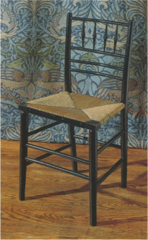
"stick" furniture
dowels of wood put together, handcrafted
*simple lines* (horizontal and vertical)--avoid curves
*absence of ornament*--too time consuming
*focus on function*: easy to get out, lightweight, armrests, smooth surface
-Arts and Crafts
wallpaper designs
Arts and Crafts 1880s; had books similar to Victorian pattern books;
taken from nature
"*nature domesticated*" or "*nature idealized*" instead of imitation--not chaotic and uniform, *geometrically configured* (ovals, cylinders, etc), all facing parallel to surface plane, repetitively placed pos/neg rhythms,
"*decorative colors*" (few colors) instead of descriptive (i.e. many shades of green)
Victorian chairs vs. British Arts and Crafts Chairs
*Victorian*: ornate, decorative focus 1850s
*British Arts and Crafts*: simplistic, function focus 1880s
*both*: individually crafted
Gustav Stickley
American Arts and Crafts "Craftsman movement" 1902-1908, furniture maker and architect, publish The Craftsman magazine to get interested in style, influenced by Transcendentalism
simple (but not sticks), handcrafted (no machines or nails, only *wooden pegs and grooves*)
preferred American wood (tiger oak) and *ammonia fumed* wood instead of painted to maintain natural texture *Truth to Materials*--natural look is beauty *"Mission Style" influence*
"open floor plan, local materials, built-in furniture", log cabin idea, put Woodworker's compass burnt in with Als Ik Khan--means "to the best of my ability", Log Cabin Idea
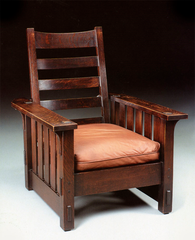
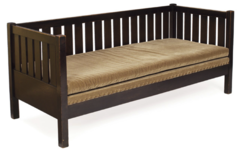
Gustav Stickley sofa
just pics bb
Gustave Stickley table
just pics bb

Transcendentalism
only in USA, "*return to nature*", harmony with nature
Ralph Waldo Emerson;
*Henry David Thoreau*- Walden "a reflection upon simple living in natural"--lived in simple shack by pond, interested in idea of survival
"*natural materials from natural environment*"
"*materials not tampered with or disguised*"
"furniture fits environmental concern"
"so functional that simplicity focuses on user and harmony with nature"
Craftsman Catalog
Stickley's magazine series/books with designs and DIY and more about Craftsman movement
Arts and Crafts traits from industrial/Victorian
*from Industrial*: simple, focus on function
*from Victorian*: handcrafted
French Art Noveau
translates "new art"--completely new, breaking from past, 1890-1900
Siegfried "Samuel" Bing, Dec. 1895, Paris, and his gallery Maison de (L'Art Noveau shop*
Maison entrace: bundles of sunflowers removed from nature--turned into ornament (conforming position, repeated arrangement/balanced)
*"abstracted natural forms"*
*"nature as dynamic*"--different angles, blossoming, etc

"abstracted natural forms"
"geometrically idealized" (circles, ovals, etc.--*rational nature*) = natural idealized (**similar** to Arts&Crafts),
*symmetrical*,
*harmonically repetitive" --duplicate pattern, i.e. flowers at different angles but same amount of blooming
Art Noveau vs. Arts and Crafts
*Art Noveau*: geometrical idealized, nature as DYNAMIC
*Arts and Crafts*: idealized nature, but controlled and NOT DYNAMIC
Eugene Gaillard
Art Noveau; buffet 1895;
ornamental patterns abstracted from natural forms (vines as cylinder)--*geometricizied*
*nature as dynamic*: growing, coiling, climbing vines
*harmonically repetitive*: duplicating pattern, domesticated nature

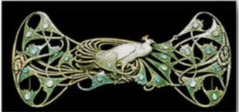
Rene Lalique
1900, Art Noveau, jewelry designer (metal, glass, gems), initially sold at Bing's Noveau shop;
inspiration from plants but also insects, birds, other animals *dynamically in motion*
peacock pin: geometrically idealized (ovals repeated), symmetric/harmonically repetitive, nature as dynamic
Louis Comfort Tiffany
lamps (1895-1906) and vases (1895-1903), Art Noveau, American artist/designer
stained glass in windows and lamps, supplied Bing with lamps and vases
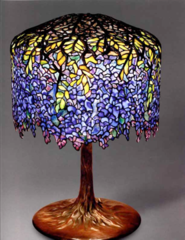
Wisteria Lamp
1895, Tiffany, Art Noveau
geometrically idealized, three patterns of elaves (bisect, trisect, solid)
three color combos
rhythmically placed (symmetrical)
dynamic with overlapping leaves etc but still controlled

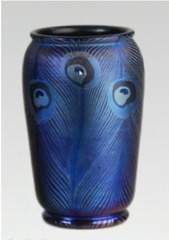
Peacock vase 1895
Tiffany, Art Noveau, feathers geometrically idealized as ovals and concentric
Zinnia lamp 1906
Tiffany, Art Noveau, more dynamism than prior lamps,
*dynamism*: dynamic nature with growing upward, roots, flexible, overlapping--shift from just geometrical to *more emphasis dynamic*

peacock vase 1903
Tiffany, Art Noveau, more dynamic than 1895 peacock vase, not just geometrical idealization but MORE DYNAMISM

Serbian Silverware
1900, Bing's catalog for sale, Art Noveau
functional design appropriates natural world, but very dynamic nature (a bit less geometrical idealized/enforced order)
Universal Exposition of 1900
world's fair held in Paris, celebrate achievements of past century and accelerate into the next, Art Noveau very present,
many people: planned public transportation (Paris metro), tickets to attend, escalators and moving sidewalk
corresponded to Olympic Games--even medals there Noveau influence
wtf Campbell Soup got gold medal (so did escalator)
Eiffel Tower lit with dynamic lights but bc more industrial, not much focus and NOT the entrance this time
Rene Binet
Universal Exposition,1900;
Art Noveau
*Place de la Concorde* (entrance gate):
geometricized vines, flowers

Grand Palais
Universal Exposition, 1900;
Art Noveau;
sculpture display;
similiar to Crystal Palace to bring more light in buttttt
geometricized vines, flowers, leaves, seashell natural forms
Petit Palais
Universal Expositon, 1900;
Art Noveau
Gallery of Flying/Electric Machines--industrial rev design moving into integration with nature
embedded natural forms geometricized (flower stalk)
Celestial Globe
Universal Exposition 1900;
Art Noveau,
150 ft diameter, interior 110 ft
"sun, stars, planets, and comets reproduced show by electricity"--lighting in the sky
still focused on dynamic nature (trees along sides) but integrated in technology
Pavilion Bleu Restaurant
Universal Exposition 1900;
Art Noveau
plant stalks growing upward, dynamic in ornamental patterns

Bing Pavilion
Universal Expositon 1900;
Art Noveau
Bing displayed 6 model rooms simulating living environments--emphasized principle of *creating ambience*
sitting room, Georges de Feure
Georges de Feure
Universal Expositon 1900;
Art Noveau,
furniture displayed in Bing Pavilion, nature abstracted and geometrical idealization (vine growing upward and budding--dynamic)

Eugene Grasset
1897, pattern book for Art Noveau Style
*Plants and their Application to Ornament*
provides different ways of representing nature--both if more earlier Noveau--geomtrical idealization--or later Noveau focus on dynamic

School of Nancy
city Nancy in France; Art Noveau--but slightly diff
Louis Majorelle--major spokesman
Louis Majorelle cabinet
1900, French Art Noveau, School of Nancy, dynamic vines
*modeled in clay* for ornamental pattern prototype before wood carving--organic patterns+pinched looking dynamic coils/curls, stretched

Louis Majorelle chair
1900, Art Noveau, School of Nancy,
*modeled in clay*
!!*mix different materials*: wood, metal, glass combined
i.e. wood represents stalks growing dynamically up and out
bronze for plant's flower buds and roots
*metamorphosis*--stalk change to bud to flower AND wood fuses into bronze

School of Nancy Process
ornament modeled in clay (pinch, expand, contracting look): growing plant
*vitalism* !!!!!!
use of *different materials*: *fusion* of plant's dynamic life sequence
Louis Majorelle desk
1900, Art Noveau;
abstracted natural patterns: stalk, buds, flower, roots
fusion of materials and metamorphosis of natural process

Hector Guimard
Paris architect, Art Noveau, designed private residences (Castel Beranger) and Metro stations for Paris 1900
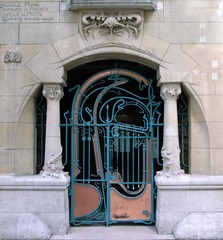
Castel Beranger
Paris, 1897, Art Noveau, private residence by Hector Guimard
posts at entrance drew on nature, abstracted natural patterns (vines, leaves, buds) dynamically (coiling)
different materials: metal, clay tile, mixing structural and decorative elements (i.e. metal tree post)
metro stations Paris
Art Noveau by Hector Guimard
(1)1903, lamp post--plant growing upward with glass lightbulb as bud (mix material) and other natural forms in metal frame i.e. flower blossom
(2) in pic, 1905, seashell pattern, dynamic branching upward
theme: underground built by man/mechanized, upper is natural world, Noveau gates as mediator between two worlds--gates are nature domesticated

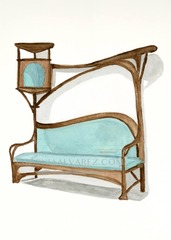
Hector Guimard bench
1898, Art Noveau, stalk growing upward and going across, kinda more abstract/less able to tell what plant than other Noveau people
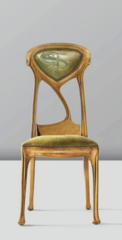
Hector Guimard chair
1900, Art Noveau, stalk growing upward and going across, kinda more abstract/less able to tell what plant than other Noveau people
Charles Darwin
"Origin of the Species" 1859 and "Descent of Man" 1871 influenced Art Noveau
*Evolutionism*: the response
*Adaptation*: refinement
*Natural Selection*/*Metamorphosis*: alteration within life
Evolutionism
Noveau influence, *the response*--focus on dynamism as response
Adaptation
Noveau influence, *the refine*--focus on *harmony* and *rational nature*
Metamorphosis
Noveau influence, *the alteration*, use of *different materials*:
dynamism: nature always in motion
metamorphosis: stalk into bud into blossom
*fusion* of materials: wood supports bronze
Arts and Crafts vs. Art Nouveau
*Arts and Crafts*: 1880-1910, return to Nature, domesticated nature, idealized nature
*Art Noveau*: 1890-1900 ornament derived from Nature, nature as *dynamic*--scientific theory influence