BPK 340 - Module 8
 Call Kai
 Learn
Learn Practice Test
 Spaced Repetition
 Match
Match Flashcards
 Knowt Play
1/48

There's no tags or description
Looks like no tags are added yet.
Name | Mastery | Learn | Test | Matching | Spaced | Call with Kai | Chat |
|---|
No analytics yet
Send a link to your students to track their progress
49 Terms
What is health literacy
the ability of individuals to find, understand, evaluate, and use health information to make informed decisions about their health and health care
Capacity of an individual to obtain, interpret, and understand basic health info and services in ways that are health enhancing
Health education
Planned opportunities for people to learn about health in order to make changes in their behaviour
Involves knowledge translation
Historically limited to “dos and don’ts” and focused on communicable diseases
Health communication
A process that bridges the gap between health info and health practices
It motivates the person to take info and do something with it to keep themselves healthier by avoiding actions that are harmful and by forming ahbits that are beneficial
Without communication, there is no _____ _____
health promotion
Communication is the heart of ______
prevention
Meaning-centered communication
Sharing info in a way that helps people understand why it matters to them, not just what it says
intentional
purposeful
aware of the sender and the receivers context
You want to the reciever to ascribe a particular meaning to what we are saying
Communicating in a way that helps people grasp why it matters to them personally, fostering engagement, motivation and meaningful behaviour change
Barriers to health communication
Disinterest in science
Distrust in scientific community
Bias of individual
Health literacy level
Health education exposure
Social marketing for health
Using marketing strategies and techniques to encourage healthy behaviours and improve public health
Incoporate principles of marketing
Treat behaviour change as a product to:
generate discussion
promote info, attitudes, values, and behaviours
help create a climate conductive to social and behavioural change
have target gorup voluntarily adopt the behaviour change
Examples of social marketing in the past
Abolishing slavery
Getting women teh vote
Title 9 in NVAA for womens sport
Prohibitng alcohol
5 steps of social marketing
Market segmentation
Target marketing
Consumer research
Mass media
Tracking of results (“outcome measures”)
Social marketing benchmark criteria (6)
Behavioural change
Formative research i.e what is unique about a specific group
Segmentation: dividing general target audience into smaller homogenous segments based on shared characteristics
Marking mix: 4Ps: product, price, place, and promotion
Exchange between the consumers and the program developer based on the consumers wants and needs
Competition
Downstream social marketing
Focus: targets individuals and their behaviours
Goal: encourage behaviour change at the personal level
Examples: anti-smoking - helping quit through apps, patches, motivational messages
*from the health promotion organization to the “consumer” of the message
Upstream social marketing
Focus: Targets broader social, environmental, or policy-level factors that influence behaviour
Goal: create systemic changes that make healthy behaviours easier or more accessible
Examples: policies that ban smoking in public, implementing urban planning
*from the health promotion organization to industry or government, attempts to change “environment” (politcal, social, legal, physical, public policy)
Give an example of a downstream and upstream campaign for the goal of getting impaired drivers off the road
Downstream: awareness and education
Upstream: changing policies around impaired driving
Health marketing
Involves creating, communicating, and delivering health information and interventions using customer-centered and science-based strategies to protect and promote the health of diverse populations
How does health marketing go beyond communication
Looks at where people are accessing message, their barriers and supports and the costs/benefits to the person of adopting the particular health practices
Looks at ‘whole landscape of what is going to take to change behaviour’
Market research is crucial for effective health promotion by:
Providing insights into target audiences, understanding their needs, and tailoring health interventions to maximize impact
It helps identify barriers to behaviour change and optimize messaging and delivery strategies for successful health campaigns
Four P’s of marketing
Product: behaviour change, or something that helps with behaviour change
Price: what the person has to invest to change (money or effort)
Place: where the behaviour occurs
Promotion: communication strategy
In order for a product, service or message to be effectively marketed:
It must be tailored to the customer needs, priced realistically, distributed through convenient channels and actively promoted to customers
How are health consumers different from other types of consumers
Because healthcare service, product, or behaviour might be necessary but not something they actually want
Examples of marketing and exchange between traiditonal marketing and health promotion
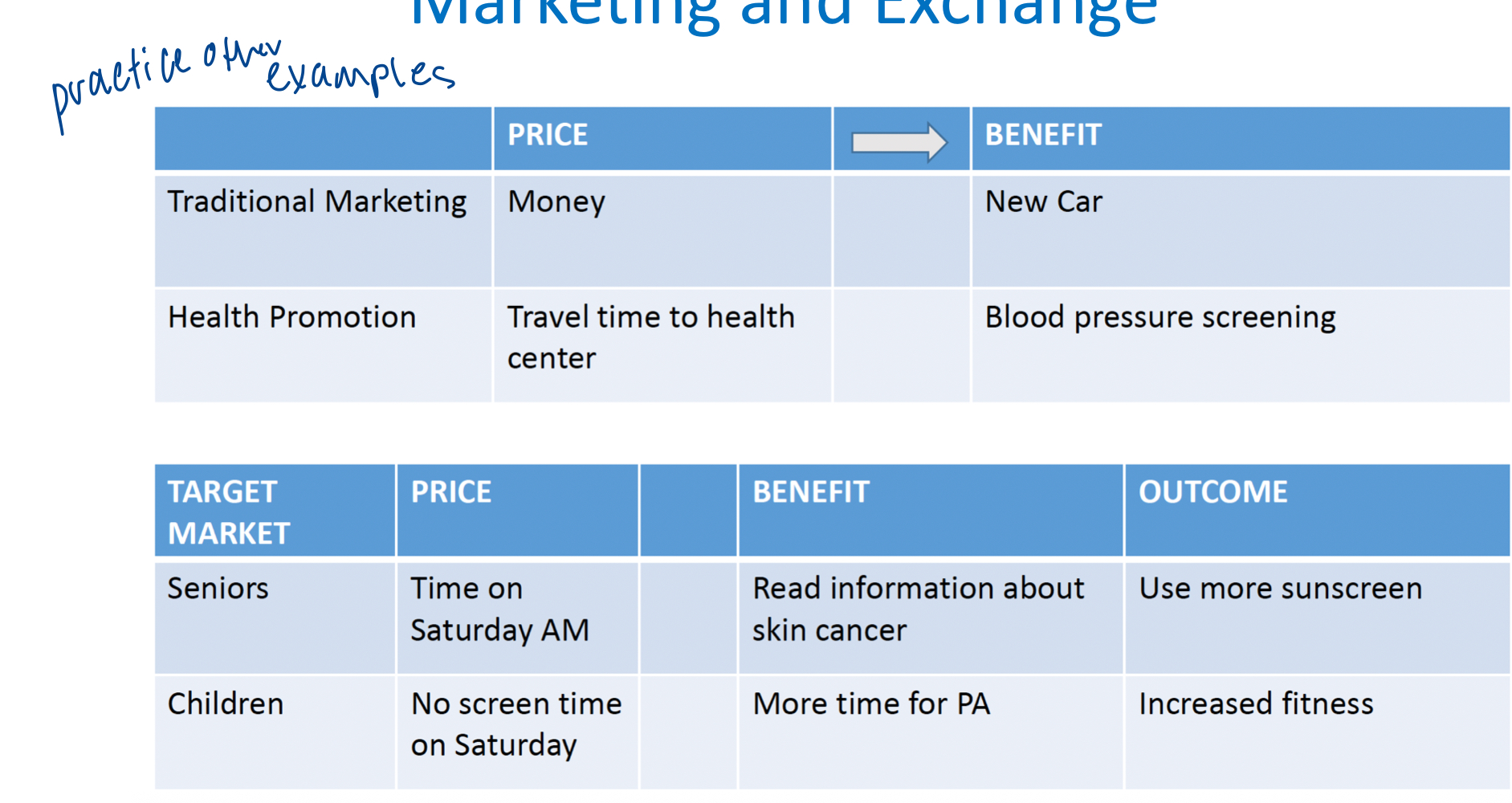
Additional 4 P’s of social marketing
Publics: different groups of people who will be affected by this health promotion
Partnerships
Policy: government and corporations
Purse strings: amount of money available to launch initiatives
Competition
Consider your competition
Competing for target markets time, commitment, and money
Consider other programs out there
Competing for funding, partners, stakeholders, etc
Communication channel analysis
Identify the best way to communicate with the target audience and know about their preferred sources of communication
Examples of sources of communication
Mass media: radio, websites, social media
People
Personal communication
Public events
Printed Materials
Pilot testing
Branding
Brand image
Tagline
Logo
Personality
Stats of people who use health and fitness apps in Canada as of March 2023
Yes: 28%
No: 68%
How many people see mental health as important as physical? What type of promotions are used to facilitate this?
85% of people in 19 different ocuntries
Well-being apps can be an affordable and accessible option
Digital health tech trends
2023 global market size for prescribed health apps is estimated at USD 4.2 billion and projected growth of 12.5 billion by 2032
Attributed to many facotrs, including increasing smartphone penetration, growing prevalence of chronic diseases, and heightened focus on personalized healthcare
Chronic disease management, medication management, specific conditions, lifestyle management apps
Facts about health promotion apps
Many already own and use them
Most use APPs for games and social networking
Does not require face-to-face contact, making it potentially less expensive
Follow at own pace
Can be scaled-up within a population
Can reach people in their own environment where the beahviours happen
Some tech can monitor and provide feedback, but not very authentic
Minimal social interaction
2/3rds only use it oncce
Adherence drops under 50% in 1-2 weeks
Wearable medical products and online medical techniques
Revolutionizing patient monitoring and health management. These devices, ranging from fitness trackers to advanced medical wearables, enable continuous health monitoring, personalized care, and data-driven treatment approaches
Broadened beyond traditional large-scale machinery to include everday items like wathces, that are capable of gathering vital medical data
50% of ppl attended virtual medical appointment
Cybersecurity developments
Becoming more critical as healthcare uses mroe digital tools
Over 50% worry about security risks and 40% have concerns about smartwatches and fitness trackers
Therefore strong cybersecurity is needed to maintain patient trust
Digital health promotion evidence
Not definitive, appears to be positive effects but tech should not be considered a panacea
Many studies have small sample sizes with short follow-up periods/ Studies often evaluate efficacy but not effectiveness
Target market
specific group of people who are similar in: demographics, behaviours, preferences, and/or needs
Choosing and understanding and/or working with your target audience is vital to appropriate health communication, education, literacy and marketing
3 steps in choosing a target audience
clearly define your audience, demographics, values, behaviours, barriers
segment them, demographically, socioeconomically, geographically, by health status
analyze the market, media use, leisure activities, language spoken, values
Market segmentation
A market segment is a relatively homogenous yet distinct group of people
Several ways to:
geographic
demographic
psychographic
behaviour/current status
activities and lifestyle
etc.
Demographic segments
Socioeconomic status
Age
Gender
Income
Family life cycle (eg. new mom)
Education
Psychographic segments
Psychographic: the study and classification of people according to their attitudes, aspirations, and other psychological criteria, especially in market research
Social status, lifestyle, personality traits, activities/interests/opinions, and values/attitudes
Values
Principles, convictions and internal beliefs that people adopt and follow in their daily activities
Beliefs, thoughts&feelings, behaviour
*Hard to change, can’t impose your values on theirs
Behaviour/current status segmentation
Habits
barriers
triggers
current status
status of change
Activites/lifestyle segmentation
How do they spend their money
Where do they socialize
what engages them most
what do they read, watch, or listen to
how do they socialize (i.e during exercise?)
How is market segmentation used
Used to identify target audiences: tailor messages differently to different market segments → segments respond to campaign elements differently
Analyzing each segment of the market may involve:
focus groups, surverys, literature review, consulting with marketing resources for that group
Things to consider:
preferred media
how they communicate with each other
languages spoken, including slang and dialects
beleifs, attitudes, opinions about the sepcific health beahviour
overall values
Dont guess!!
Stages in constructing segmentation
Identify potential target audiences (incidence, severity, surveillence)
What do you already know about these groups
reports, reviews
knowledge, attitudes, perception of risk, beliefs, trust in authroities, locus of control
demographics and social demographics
preferred info channels
use of services
Determine if new data is required
Decide what analysis is feasible with the data available
Question the validity and utility of segments
manageable number? 3-8
clearly defined matching defined interventions
large enough to be economically feasible
likeliness to change
TARPARE, identifying target audiences
T: total # of people in segment
AR: at risk
P: persuadability
A: accessibility
R: resources required
E: equity, i.e is there anything we need to consider for equal opportunity
How have social media platforms become powerful tools in health communication
Engages audience with dynamic, interactive content
Connects individuals, health professionals and organizations
Support education, awareness and health interventions
Fosters community building and peer support
Benefits of social media
Allows us to target a large audience in a short time
Sharing info, thoughts and ideas
Social support
Interactive
Targeted
Social media best practices
Clear and well-defined objectives, research and behaviour change theories
Research, understanding of target audience
Use of behaviour changes theories as a guide
Using social marketing techniques
Branding
most appropriate channel for target group
Allow free access
Creative content (adverts, videos, new links, widgets, etc)
Engagement and action-focused content
Compliment with mobile itnerventions
Persuasion
Ethos: using moral character
pathos: appleaing to emotion
Logos: appealing to logic
All three strategies can be appropriate at different times