Optics MST2
 Call Kai
 Learn
Learn Practice Test
 Spaced Repetition
 Match
Match Flashcards
 Knowt Play
1/132

There's no tags or description
Looks like no tags are added yet.
Name | Mastery | Learn | Test | Matching | Spaced | Call with Kai | Chat |
|---|
No analytics yet
Send a link to your students to track their progress
133 Terms
5 steps in the optical design process
1. Specification - what is the object you want to take an image from? What is the brief?
2. Thin lens design – as a first approximation
3. Aberration reduction - choose material & shapes
4. Thicken the lenses
5. Set manufacturing tolerances
what kind of info is included in the specification
Transverse mag
Throw
aperture stop at the lens
numerical aperture in image space
field size
Gaussian optics
powers
length
position of conjugate planes
magnifications
pupils
FOV
image quality and aberration
resolving power
all the different kinds of aberrations
ergonomical factors
environmental factors
7 design steps
Calculate thin lens powers & separations
Choose aperture stop (position & size)
Choose field of view
Trace paraxial marginal ray & paraxial pupil ray - determines how wide our lens needs to be
Determine aperture radii for each surface radius (p) = |h| + |h bar| (for condition of no vignetting)
Check the product |pF| for each surface (p = radius) - needs to be less than 1 i think
Check field of view values T for
vignetting just beginning and
vignetting just becoming complete
Magnification equations (4) and lens equation
Magnification equations
M = - Fe/Fo (negative)
M = - fo/fe (negative)
M = l’/l
M = entrance pupil diameter/exit pupil diameter
Transverse magnification equation
M = (nl’)/(n’l)
M = nu/n’u’
lens equation
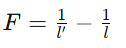
F = 1/l’ - 1/l
Single lens system - from specification to design
determine l and l’ through magnification equation and throw (will need to rearrange)
M = l’ / l
throw (d between image and object) = l’ - l (remember l should usually be negative otherwise we will have a virtual image)
Calculate thin lens power, using the lens equation
F = 1/l’ - 1/l
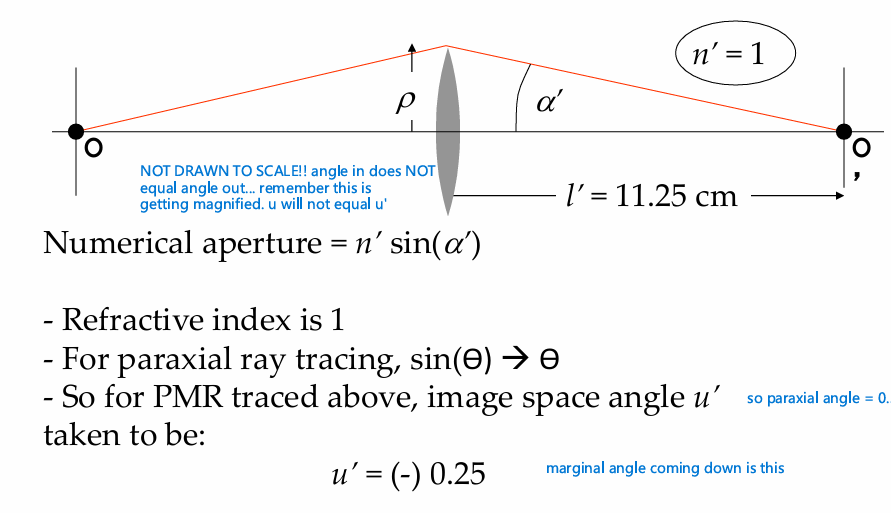
Determine object space angle through the numerical aperture numerical aperture = n’sin(u’)
find the object space angle u with the transverse magnification
M = (nu / n’u’)
Trace the PMR to find height at lens
PMR = determined image height at lens
PMR = determines image plane - on axis object, top of AS
PPR = determines image height - off axis object, middle of AS
trace PPR to find image height
PPR to find image height
goes thru centre without angle change. (same angle on both sides)
draw triangle and calc.
Find aperture radius (p) row
p = h + h(hat) (for no vignetting)
Confirm that the aperture radius can be made
product = pF
Ray tracing steps
ACTUALLY, JUST FOLLOW THE TRIANGLES ITS CHILL
opening equation h = -ul
paraxial refraction equation: n’u’ - nu = -hF
paraxial transfer equation: h’ = h + u’d
closing equation: h=-u’l’
calculation for product (to check that the aperture radius can be made)
product = pF
rowF - needs to be in METERS
aperture radius x power
>1 is NOT POSSIBLE - lens will be too thick
what does numerical aperture determine - don’t worry i don’t think
can trace back numerical aperture to get PMR (on axis ray)
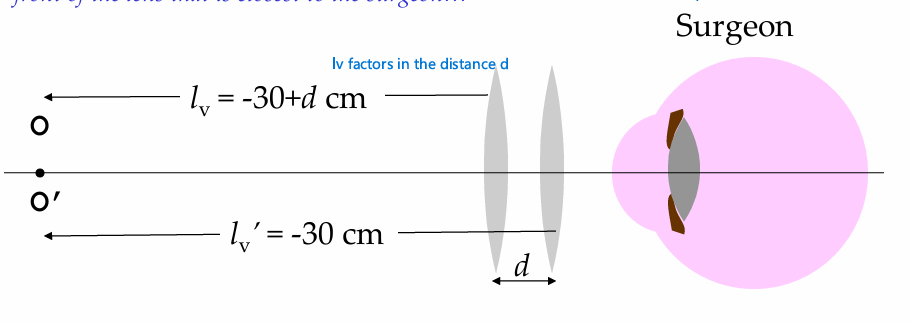
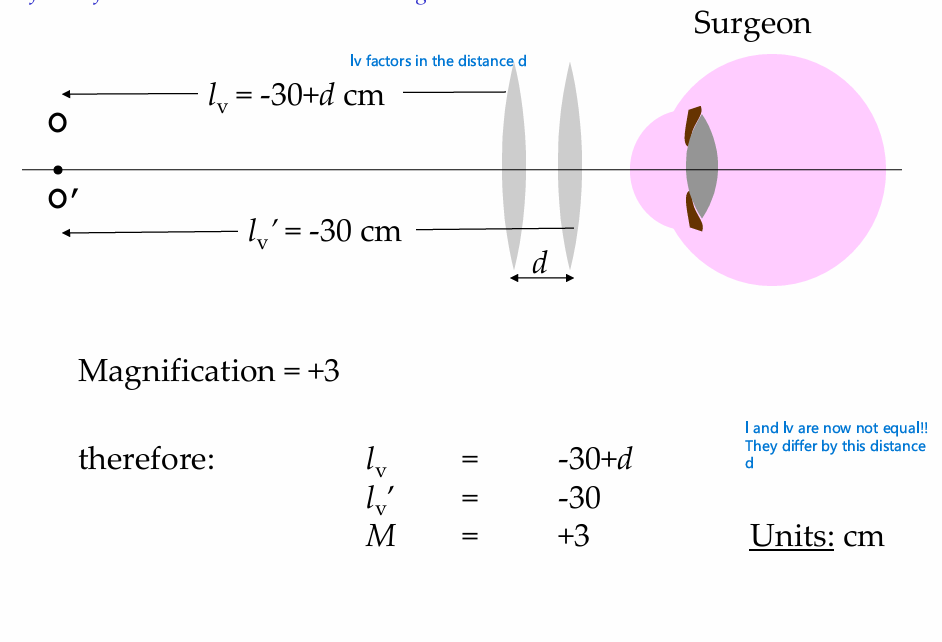
what problems can a 2 lens system solve? Example - surgeon
if we require the object and the image to be in the same spot, can’t use one lens, because then the lens would have to be on the object.
2 lens can solve this problem and magnify
if you put the 2 lenses closer together, you will need MORE AND MORE power differences between the two lensees!!! (rlly pos and rlly neg for example)
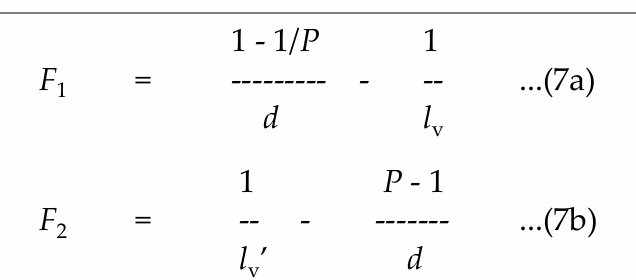
2 lens power equation (2 thin lens system)
F1 generally from object side I think
F2 from image
P = h1/h2 = Mlv/lv’
(magnification x object distance) / image distance
height 1/height 2 of lens i think…
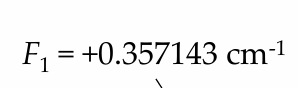
what is this in DIOPTERS
+35D
2 lens system. From specification to
Get mag
get image distance
get object distance
from lens closest to eye
solve for P (Mlv/lv’)
Find F1 and F2 (from new equations)
set aperture stop size + position
set Field of view size
step 6 and 7 enable us to:
Trace PMR + PPR
Determine diameters of each lens
describe what a telephoto lens does.
a 2 lens replacement for a long focal length objective lens to shorten an optical system
similar to Galilean telescope, but instead of columnated rays coming out, it forms a real image.
what negative lens does is make the rays less strongly convergent (but they are still convergent!)
A telephoto pair uses a strong positive lens followed by a negative lens to behave like a long focal length lens, but with a shorter physical length.
aka the equivalent power of the telephoto lens system is the same of the single lens its replacing
what is the problem with having 2 conjugate planes (ex. retina and pupil imaged to the clinican)
patient’s retina is imaged to the clinician
patient’s pupil should also be imaged to the clinician’s pupil
When only one pair of conjugate planes is specified, lens separation (d) can be chosen freely. But once a second pair of planes is also specified, d is no longer free.
what ray tells you HEIGHT AT LENS and which ray tells you IMAGE HEIGHT
HEIGHT AT LENS = PMR
IMAGE HEIGHT = PPR
GOT UP TO SLIDE 53 on thin lens design
🙂
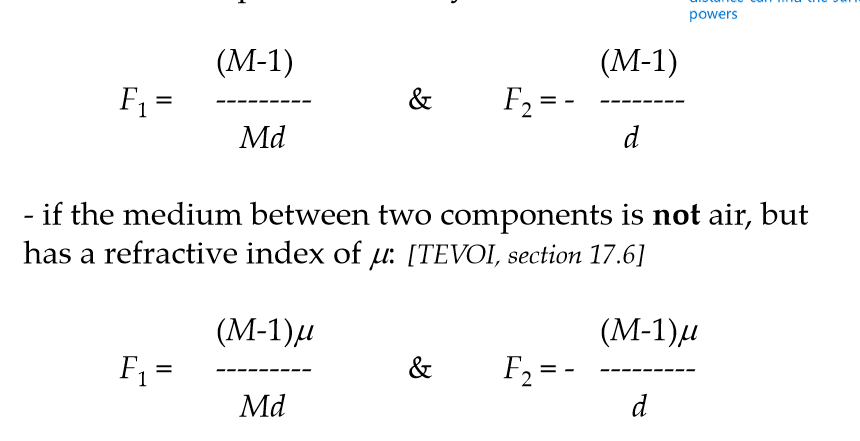
Equations for telescopes with what kind of lenses are identical?? WHY?
two thin lenses
one thick lens
Why?
because F1 and F2 for thin lens = thin lens powers
because F1 and F2 for thick lenses = surface powers
THE equation is the same but because the medium between the components are NOT air then you have to multiply by the refractive index
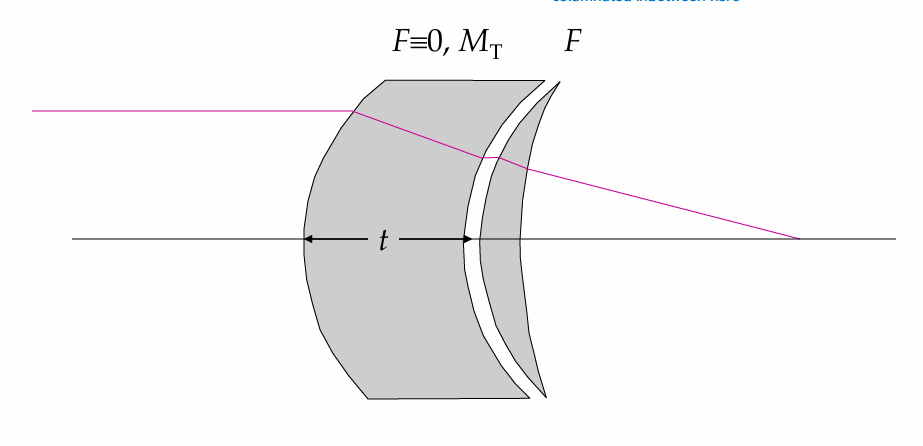
What determines the lens diameter?
the steepest radius of curvature. In keplarian telescopes the F is too high and curvature is too small - not possible to make.
Only possible to make a Galilean telescope with one thick lens.
General telescope trends (M, d, + vs -)
If thickness d increases, required surface powers decrease.
If magnification M increases, required surface powers increase.
The sign of M matters a lot.
Positive M gives a Galilean-style system and is usually more practical.
Negative M gives a Keplerian-style system and often requires very high powers.
Simple version:
To make the curvatures less extreme, make the lens thicker.
To get more magnification, you need stronger curvatures.
what is spectacle magnification? what application?
spectacle magnification: size of sharp (corrected) image / size of blurred (uncorrected) image
aniseikonia = different retinal image sizes between the L and R eyes which cause perceptual effects.
Problem with a normal thin lens (glasses) for someone with aniseikonia?
SM = 1 / (1 − hₑF) - for a single thin lens system
Where:
SM = spectacle magnification
hₑ = distance from the eye’s entrance pupil to the lens/back principal plane***
F = lens power
How can we control magnification?
There are only two obvious options:
Change F
But that is the patient’s prescription, so you generally cannot change it.Change hₑ
You can adjust vertex distance somewhat with frame fit, or use contact lenses.
Key point:
With a thin lens, there is limited ability to control magnification independently of prescription.
How to solve magnification problem with Px with aniseikonia?
Can change the magnification without changing the F (prescription), by putting an afocal thick lens (telescope) immediately in front
another magnification equation here but i don’t think (i hope) we don’t need to know
just know that the equation for mag is in terms of equivalent power F but spectacles are measured from the back vertex.
BUT this is ok cause we are not changing the F so its all freaking good. back vertex power remains unchanged . Can use back vertex power in the equation😛
example of a 3 lens system
Keplarian telescope with a field lens!
field lens placed at intermediate image plane to steer the beam into the eyelens and through the exit pupil
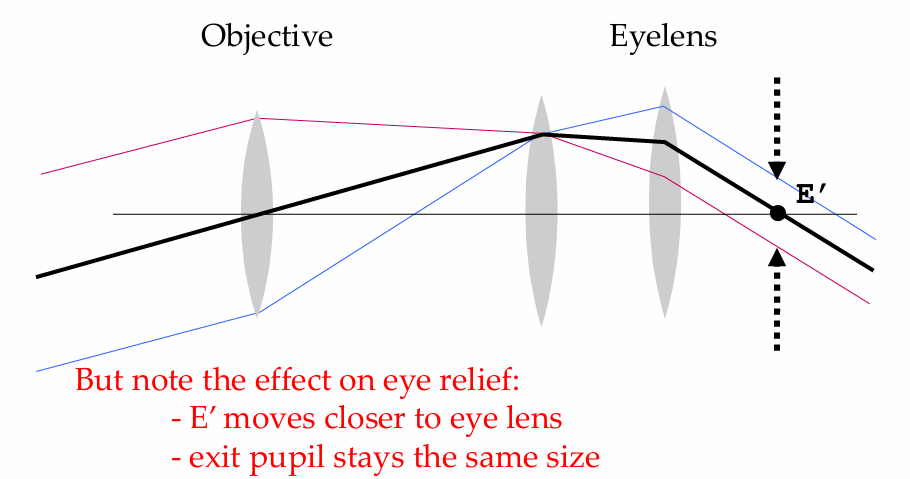
what is the effect on eye relief when a field lens is placed in the intermediate image plane?
exit pupil moves closer to the eye lens
AND stays the same size
Why might we split single components in a multiple lens system?
to ease the condition pF
splitting one lens into two equal lenses means:
power is halved in each
therefore pF is halved
aberrations
more power in a single lens = more aberration.
splitting = reduces dis 🙂
achromatic doublets
if we’re working over multiple wavelengths, we want them to all be in focus together.
multiple lenses reduces this difference.
what is the condition/product??? (pF)
How big a specific lens has to be to fit all the rays through. To find this you have to trace the PMR and PPR to find the aperture radius….
remember: p = h + hbar
a condition or product of more than 1 is NOT possible
for a multi-lens system, would have to check for each lens separately. THE WORST/HIGHEST value is of concern!
what does the telephoto ratio tell you?
how much you’ve shortened the optical system by adding telephoto lens
physical length/effective focal length
smaller = more compact
what is the difference between incandescent and luminescent light sources? Give examples:
Incandescence: visible light is emitted from objects if they have a high enough temp
examples (about 1500C)
sun, flames (some), tungsten filament lamp
Luminescence: Light produced by non-thermal processes, such as electrical, chemical, or light-driven (photo) excitation.
LED, laser, neon tube etc. not hot.
what is a black body?
an ideal or perfect incandescent source. Must be a perfect absorber (aka black).
Actual objects are not perfect (even if black). may absorb a high % but may be reflecting parts of the spectrum that we can’t see (ex. soot about 98% black)
What are the names of the properties of the perfect black body radiator? (3 laws)
Wien’s displacement law
TELLS you where the peak is
The peak wavelength decreases with increasing temperature (see pic)
hotter = emit radiation at smaller wavelengths (shift toward blue)
Planck’s law
Predicts the whole curve as temp increases. Curve changes shape
Stefan-Boltzman law
This law says total radiation emitted varies with the fourth power of temperature:
aka if temp increases, emitted power increases a lot
What is colour temperature? (exam q)
Real sources emit less radiation than an ideal black body sources at the same temperature (because they’re not perfect absorbers!! THey are grey)
Colour temperature means
what temperature would a black body need to be to produce the observed output spectrum (colour)
This is NOT the actual temperature of the object, it ONLY describes the shape of the spectrum
example: A torch or screen might have a colour temperature of 6000 K, but it is obviously not physically 6000 K.
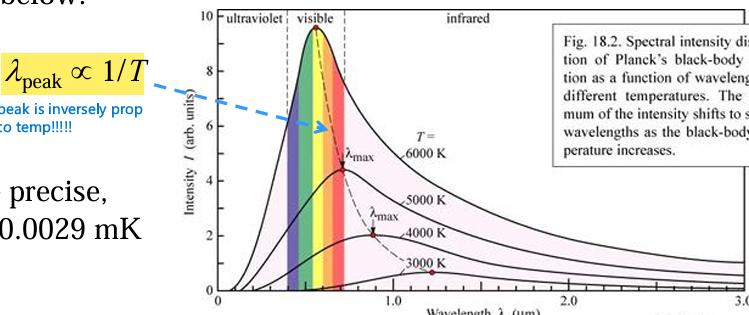
what would an object with a lower colour temperature vs higher colour temperature appear?
Lower colour temps: warmer/redder
candle, tungsten bulb, warm indoor light
Higher colour temps: cooler, bluer
common examples of luminescence. How are they different and how are they similar?
Electro-luminescence
Photo-luminescence: Fluorescence and phosphorescence
Chemi-luminescence
different in how the ‘excited state’ gets generated, but the relaxation process is generally the same
how does electroluminescence work? (what is the extra step for fluorescent tubes?) - exam q
Electroluminescence means light caused by electrical activity.
Electrical energy excites electrons to higher energy state (collides w gas atoms)
when it drops it emits a photon with wavelength λ = hc / ΔE
the energy CHANGE determines the wavelength of the photon
larger energy change = shorter wavelength, more energetic light
so blue violet light is more energetic than red light (UV is even more)
λ = hc / ΔE = hc / ΔE
example; gas discharge tubes, gas lasers, solid-state sources
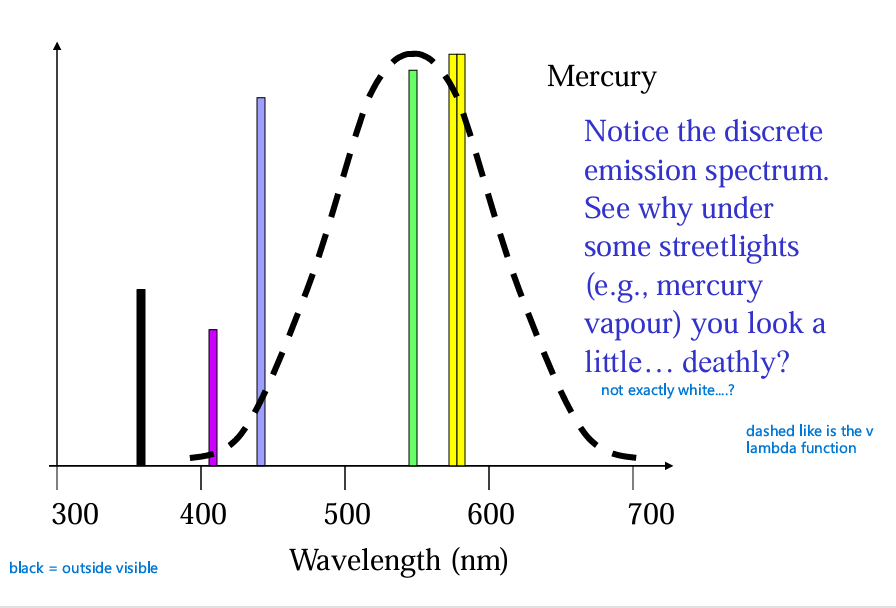
fluorescent tubes do this but also have a phosphor coating… They use mercury and get so excited that UV light is emitted (not visible, highly excited). BUT fluorescent tubes have a phosphor coating which emits visible light. this is photoluminescence.
what is a discrete emission spectrum? example:
discrete emission spectrum.
That means it does not emit a smooth rainbow of wavelengths. It emits strong lines at specific wavelengths
discrete energy transitions
Laser produce light by 2 types of processes. What are these, what is it called, and how it work? EXAM
electroluminescence and photoluminescence
Stimulated emission: Electrical energy starts the excitation, but photons then stimulate further photon emission.
pump energy into laser
electrons move to higher NRG states and excite atoms
atoms spontaneously emit photons
mirrors reflect photons back and forth
photon catalyse electron transitions, more atoms excited
emitted photons match the stimulating photon
chain reaction builds up
one mirror is transparent, so laser beams out
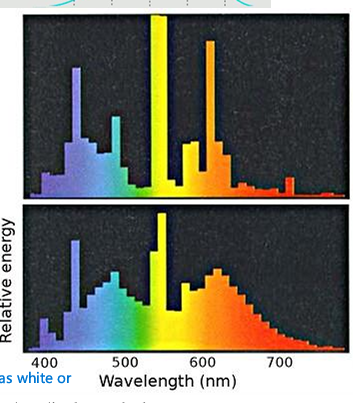
Electroluminescence + photoluminescence - fluorescent tube: which one of these is a more efficient light source?
TOP. Discrete = more efficient
lower curve = lower light output. but filling out whole spectrum.
trade off: The bottom will look whiter and may be nicer but less efficient
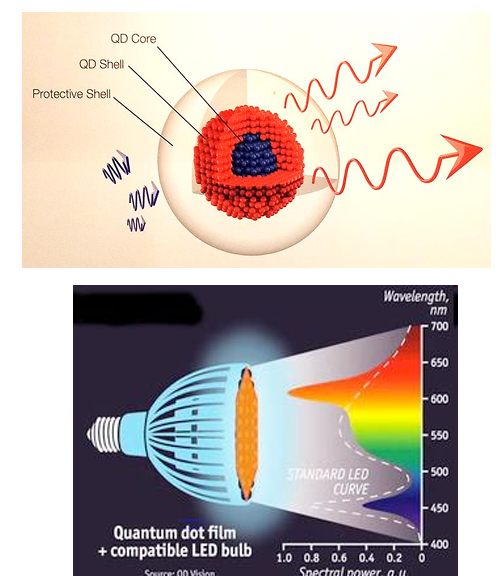
Fluorescence/Photoluminescence: what can quantum dots do?
Main idea:
short wavelength light goes in
longer wavelength light comes out
emitted wavelength depends on dot size
** Combined with phosphors, any spectrum shape can be achieved
very efficient
what is Chemiluminescence
chemiluminescence: a chemical reaction creates an excited product, and when it relaxes back down, it emits light. The decay from an excited state is the same as for other types of luminescence.
light is emitted in the same physical way. However, getting to the excited state happens chemically
example: bioluminescence (glow worms, fireflies)
fluorescent vs bioluminescent animal
bio-luminescent: animal generates light via a chemical reeaction (chemi-luminescent)
fluorescent: animal absorbs light and re-emits at a longer wavelength (photo-luminescent)
glow fish illuminated with a UV light, fish absorb this and emit longer wavelength red light 🙂
what is scattering?
when light (electromagnetic radiation) interacts with matter, energy is taken from the incident wave and some of that energy is re-emitted, often in different directions. WILL oscillate with it if it can….
energy can be dissipated as heat (prob don’t need to know this)
What does polarisation describe?
The direction in which the electric field of a light wave oscillates.
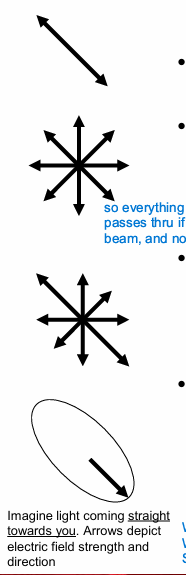
4 types of polarized light states, and what do they describe, and give examples - WILL BE EXAM QUESTION
Plane/linear polarized light
Light where the electric field oscillates in one fixed direction or plane.
Unpolarised/randomly polarized light
light where the electric field direction varies randomly over time, so there is no single preferred polarisation direction.
ex. blackbody (sun)
partially polarized light
A mixture of unpolarised light and light with a bias toward one polarisation direction.
ex. gas discharge lamps.
elliptically polarized light (can be circular)
Light where the electric field vector rotates so its endpoint traces a circle as the wave travels.
What are three ways light can become polarised?
Filtering, reflection, and small particle scattering.
Polarisation by filtering: What is the difference between extinction axis and transmission axis?
The extinction axis is the absorbed direction; the transmission axis is the direction that passes through.
top = absorbed (extinction)
bottom = transmitted
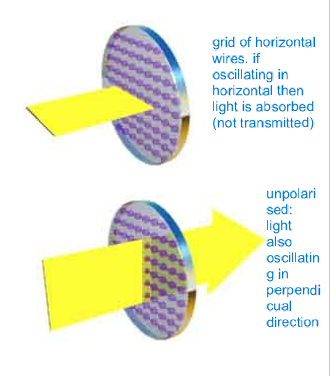
Polarisation by filtering: If the strands in a polarising filter are horizontal, what polarisation passes through?
Vertically polarised light passes through.
How much unpolarised light passes through a perfect polariser?
50%.
can determine how much light gets thru with Malus’s Law
equation involving the angle between the polariser axes
What happens when two polarisers are crossed at 90°?
Complete extinction; ideally no light passes through.
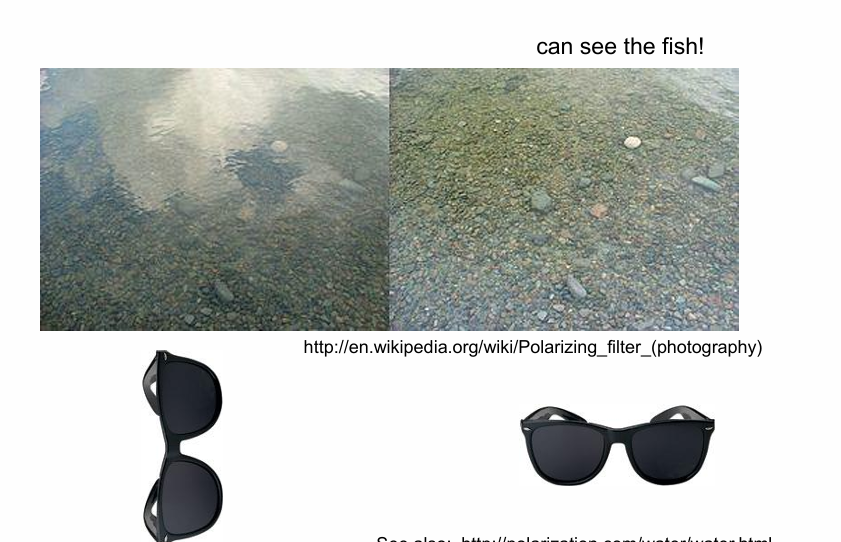
How do polarizing sunglasses work?
Sunglasses designed to absorb horizontally polarized light
This matters because glare from horizontal surfaces, such as water or wet roads, is often mainly horizontally polarised.
How can polarisation be used in stereopsis tests?
Different polarised images are shown to each eye, creating binocular disparity that can be fused into depth.
What did polarisation help reveal about light?
Light is a TRANSVERSE wave, meaning its oscillations are perpendicular to its direction of travel. (can travel in all directions) idk
before noticing the calcite crystal, it was thought that light was a LONGITUDINAL wave (aka oscillations traveling in the same direction as travel)
What type of surface commonly produces polarised reflected light?
Dielectric/non-conducting surfaces, such as water, glass, paper, and wet roads.
What is Brewster’s angle?
he angle of incidence where the reflected and refracted rays are 90° apart and reflected p-polarised light is zero.
KNOW that at Brewster’s angle, reflected light becomes STRONGLY POLARISED
tan θB = nt / ni
p-polarised light
Electric field vibrates in the page/screen plane.
s-polarised light
Electric field vibrates out of the page/screen plane.
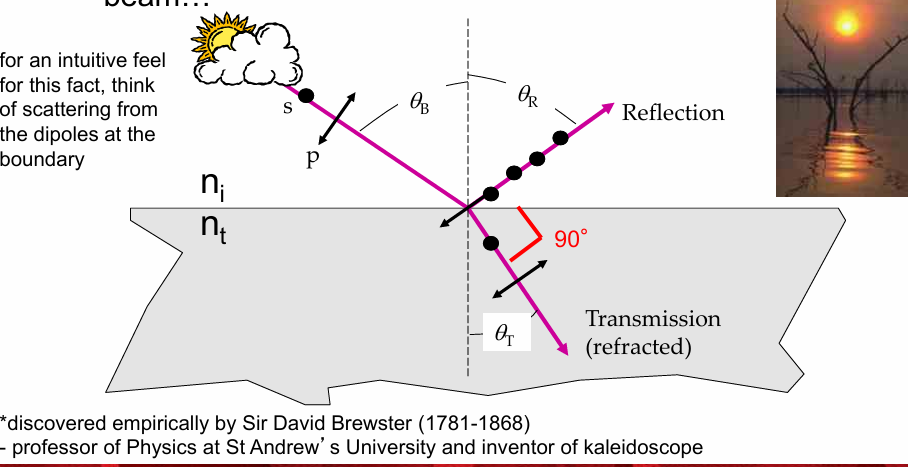
Why is glare from water often horizontally polarised? why can sunglasses reduce this glare?
Reflection near Brewster’s angle from a horizontal surface produces reflected light dominated by horizontal polarisation.
They reduce reflected glare from the water surface, allowing more transmitted light from below the surface to be seen.
sun is vertical and high…. we want a horizontal filter to block out
what are the 2 types of scattering?
Rayleigh scattering
Mie scattering
What is Rayleigh scattering?
Scattering by particles much smaller than the wavelength of light, such as oxygen and nitrogen molecules.
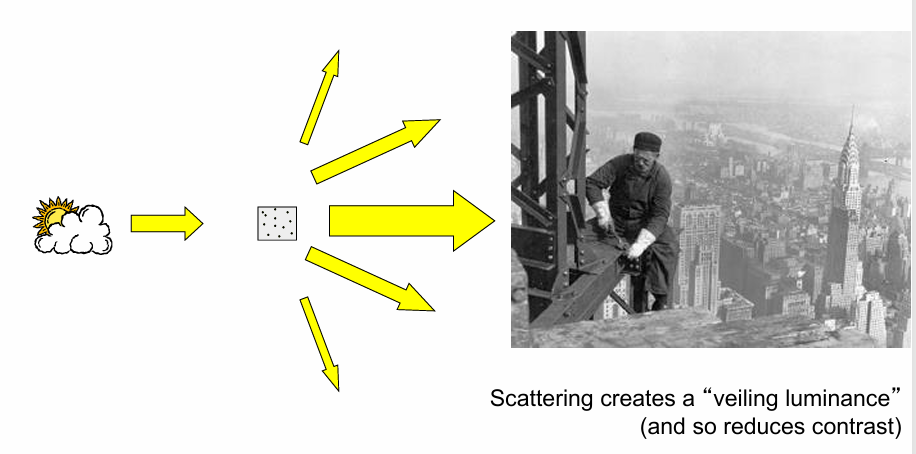
What is Mie scattering?
Scattering by larger particles, such as dust or water droplets.
creates veiling luminance (overlays an imate and reduces contrast)
What is the key wavelength relationship in Rayleigh scattering? EXAM Q FOR SHO
Rayleigh scattering is proportional to 1/λ⁴.
This means shorter wavelengths scatter much more strongly than longer wavelengths.
blue light scatters more!
Why is Earth’s sky blue?
Small atmospheric molecules Rayleigh-scatter short wavelengths, especially blue, much more strongly than long wavelengths.
Why are sunsets red/orange?
At low sun angles, light travels through more atmosphere, so short wavelengths are scattered out of the direct beam, leaving more red/orange light.
How does Mie scattering differ from Rayleigh scattering?
Mie scattering is caused by larger particles, is less wavelength-dependent, and is more forward-directed.
bigger particles than wavelength of light, scattering affects equal wavelengths across the visible spectrum (achromatic)
Why is Mars’ sky not blue like Earth’s?
Mars’ atmosphere is dominated by dust particles causing Mie scattering, plus absorption of shorter wavelengths by dust, giving a yellowish/reddish sky.
note: If the dust did not absorb any sunlight, the Martian sky would appear whitish, since all wavelengths would be scattered to similar degree
What are aberrations?
Aberrations cause the rays in a beam to depart from their ideal (i.e. paraxial) paths
What are the five main monochromatic aberrations? - be prepared to draw each of these on the final exam!
Spherical aberration
coma
(oblique) astigmatism
field curvature
distortion.
What is the difference between monochromatic and chromatic aberrations?
Monochromatic aberrations occur even with one wavelength; chromatic aberrations depend on wavelength differences in polychromatic light.
Which monochromatic aberration can occur for both on-axis and off-axis object points?
Only spherical aberration.
everything else is only for off-axis object points
Which monochromatic aberrations occur only for off-axis object points?
Coma
(oblique) astigmatism - (for spherical surfaces)
field curvature
distortion.
everything but spherical aberration
Which monochromatic aberrations do not give point-to-point imagery?
Spherical aberration, coma, and oblique astigmatism.
everything but field curvature and distortion
Which monochromatic aberrations still give point-to-point imagery? where do they not give point-to-point imagery?
Field curvature - but NOT in the paraxial image plane
Distortion, but NOT in paraxial position
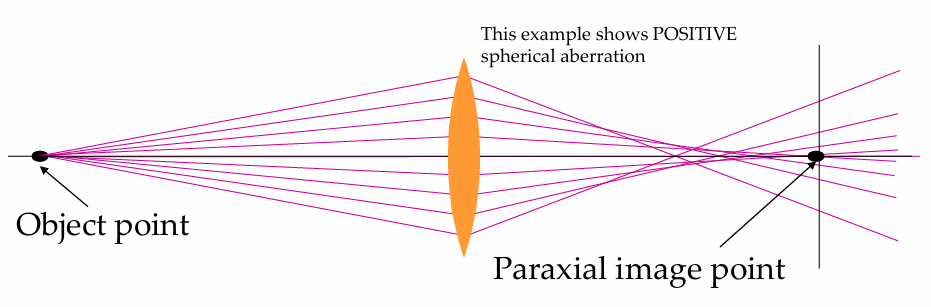
What is spherical aberration?
An aberration where rays from one object point focus at different positions depending on ray height, producing blur rather than one point image.
Higher ray = further from paraxial image point X
I think with positive lens, higher ray = closer to lens, and opposite for negative (but confirm)
form concentric rings
Does spherical aberration require spherical surfaces?
No. It can occur even with a plane glass plate if rays at different angles are refracted differently.
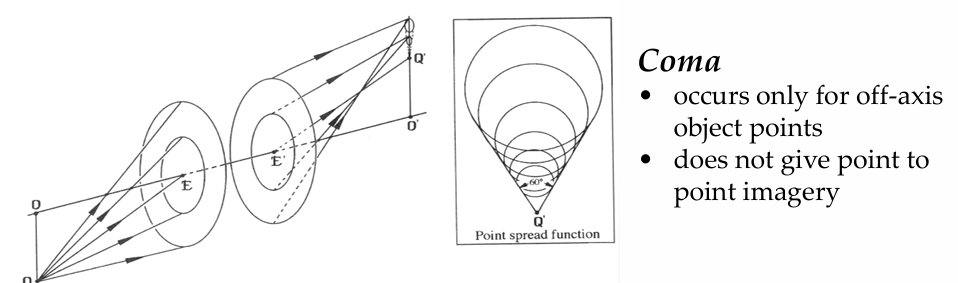
What is coma aberration?
An off-axis aberration where a point image becomes cone/comet-shaped because ray cones form non-concentric circles in the image plane.
main difference = spherical aberrations are concentric (look more like a bullseye)
What is oblique astigmatism? What are the two line foci called? DRAW
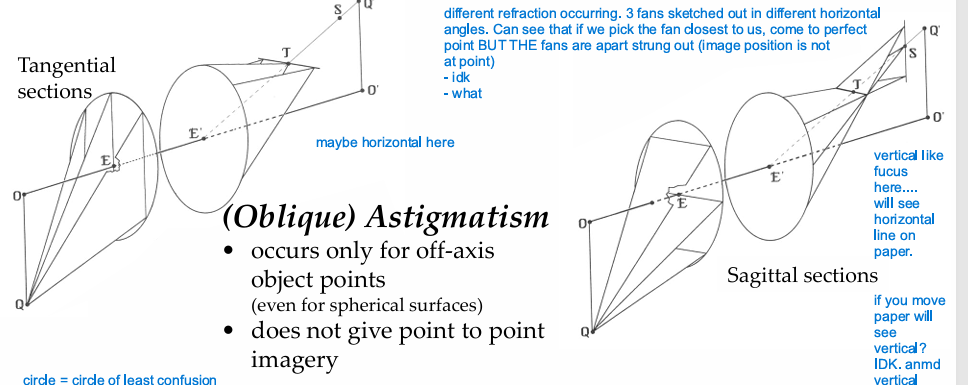
An off-axis aberration where tangential and sagittal ray fans focus at different positions, producing two perpendicular line foci rather than one point.
The beam can be thought of as two perpendicular sets of ray fans:
tangential fans
sagittal fans
These focus at different positions:
tangential focus = T
sagittal focus = S
Between the two line foci is the circle of least confusion, where blur is more circular/even.
not to be confused with clinical astigmatism
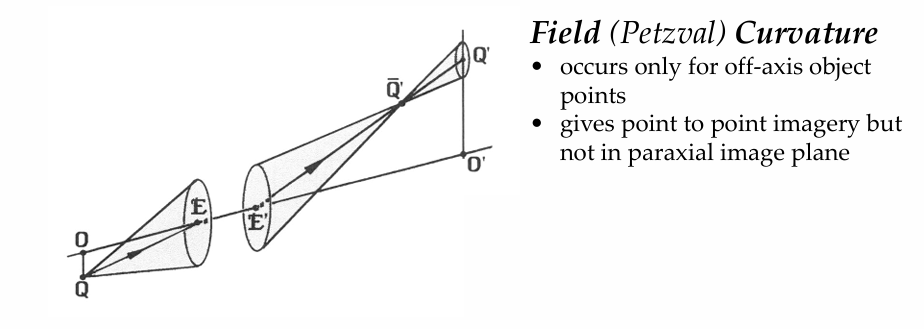
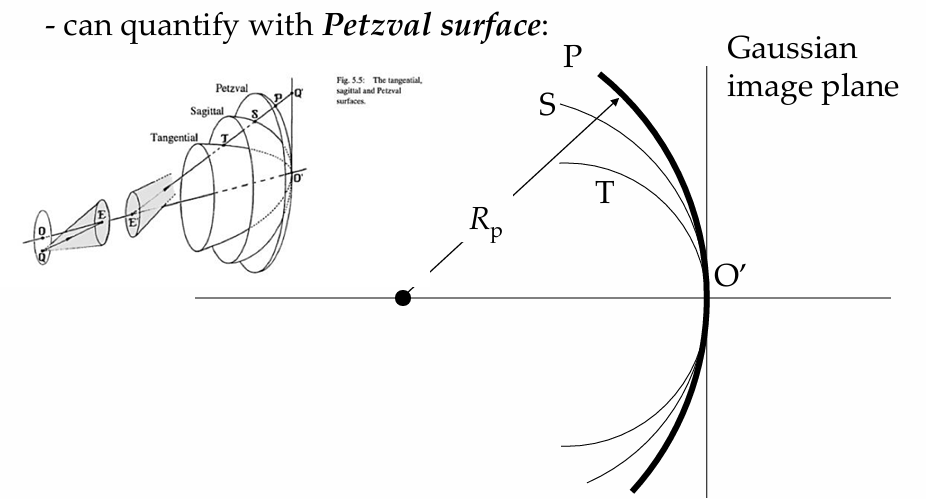
What is field curvature? What is the curved image surface called?
It gives point-to-point imagery, but the point image is not located in the flat paraxial image plane.
Instead, the sharp image points lie on a curved surface called the Petzval surface.
So if you had a flat sensor or flat image plane, off-axis points may appear blurred because their best focus is actually in front of or behind that flat plane.
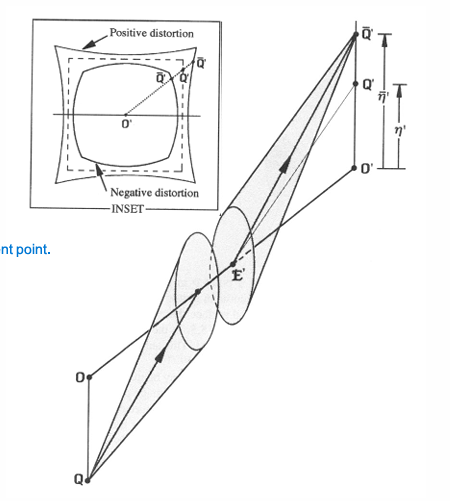
What is distortion (aberration). What are the 2 types.
It gives point-to-point imagery, and the point is in the paraxial image plane, but it is not at the expected paraxial position.
(so it converges in the image plane but strikes at a different point (Qbar’ not Q’)
So the image is sharp, but spatially warped.
positive distortion = pincushion
negative distortion = barrel (square ish)
Why do we need to quantify aberration levels
When we design/assess optical system, we need to know how to: • determine which aberrations are present, and at what levels • minimize aberrations to below minimum values tolerable
What are four common ways to quantify ray aberrations?
Transverse aberration
longitudinal aberration
angular aberration
wave aberration.
these are all based on paths of individual rays
focus on transverse and longitudinal!
Longitudinal vs transverse aberrations:
know how to sketch (esp for meridonal ray) - there is another flashcard on this
longitudinal
displacement along the optical axis
transverse
displacement along the image plane?
What is a meridional ray? - draw longitudinal vs transverse aberration for meridional rays
A ray that intersects the optical axis.
Picture: showing longitudinal vs. transverse aberrations for meridional rays.
Longitudinal = [O’G]
Transverse = [O’H]
![<p>A ray that intersects the optical axis.</p><p></p><p>Picture: showing <strong>longitudinal </strong>vs. <strong>transverse aberrations </strong>for <strong>meridional rays. </strong></p><ul><li><p><strong>Longitudinal = [O’G] </strong></p></li><li><p><strong>Transverse = [O’H] </strong></p></li></ul><p></p><p></p>](https://assets.knowt.com/user-attachments/3747beb5-9736-4cc1-81d4-635bf0072ed4.png)
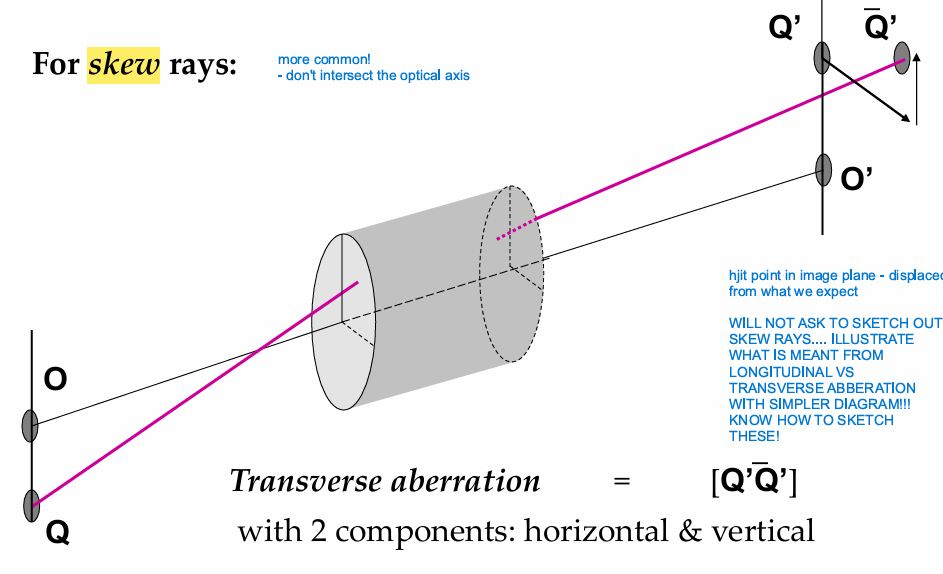
What is a skew ray?
Skew rays are rays that do not intersect the optical axis or the central ray of the beam.
more common
what is a skew ray? What aberrations can a skew ray be split into
skew rays: rays that do not intersect the optical axis or the central ray of the beam
THERE is not longitudinal aberrations for skew ray (because not on the optical axis)
HOWEVER, the transverse aberrations can be split into 2 components
HORIXONTAL (x-axis)
VERTICAL
will not be asked to sketch skew ray but prob understand the two components
What is an angular aberration?
Angular aberration measures the angular difference between where a ray actually travels and where it should have travelled.
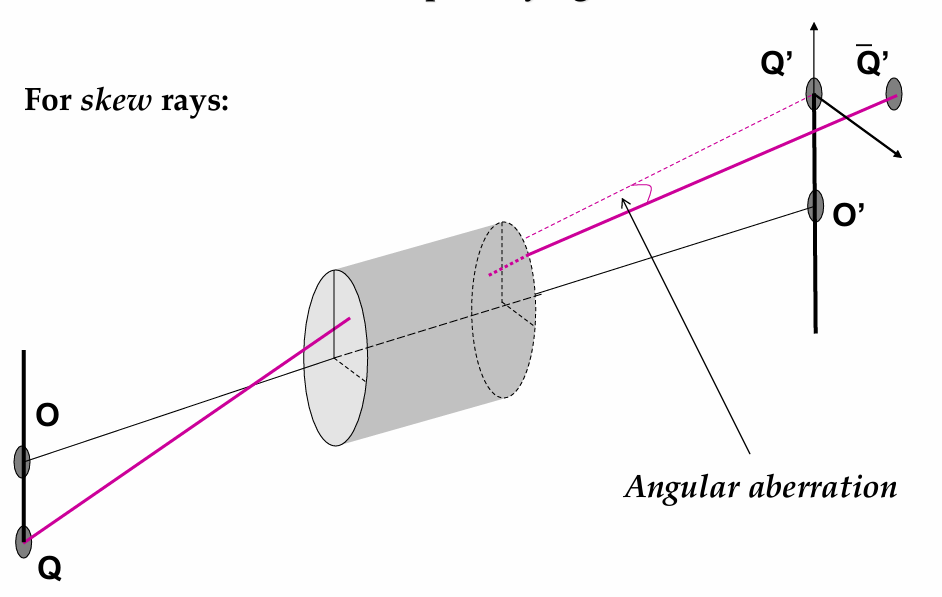
When is angular aberration especially useful?
In afocal systems, where errors are naturally described by angles rather than positions in a finite image plane.
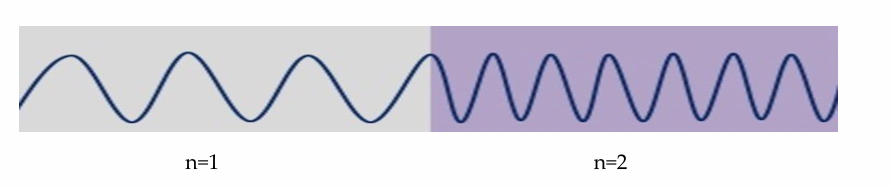
What is optical path length?
Optical path length is physical distance multiplied by refractive index:
OPL = n × distance
important concept to understand how long a wave has travelled from an optical perspective. aka: how many wavelengths has it gone through?
think fermats principle…. if we double the refractive index, we will double the cycles - ray travels at HALF the speed 🙂
What is wave/path length aberration? What is it dependent on?
A difference in optical path length (OPL) between an actual ray/wavefront and the ideal reference.
how much extra optical path did the ray have to travel?
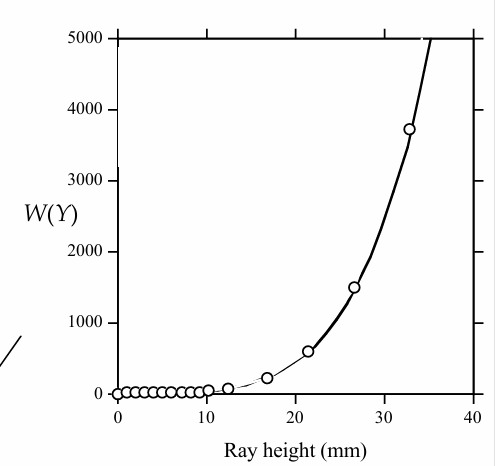
dependence on: ray height (Y) at the pupil plane
measuring the wave aberration W(y) in terms of optical path length - how many cycles has it gone?
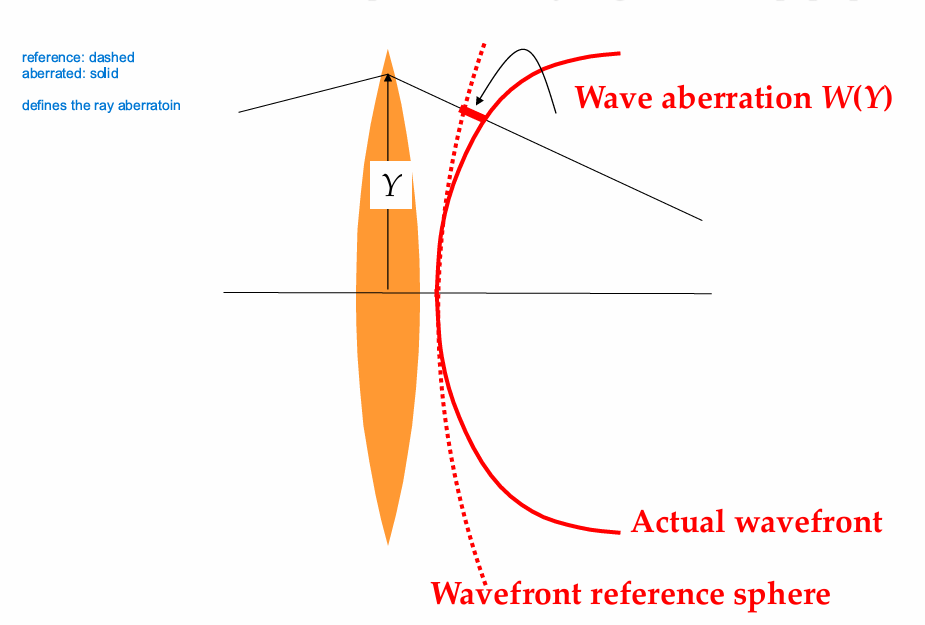
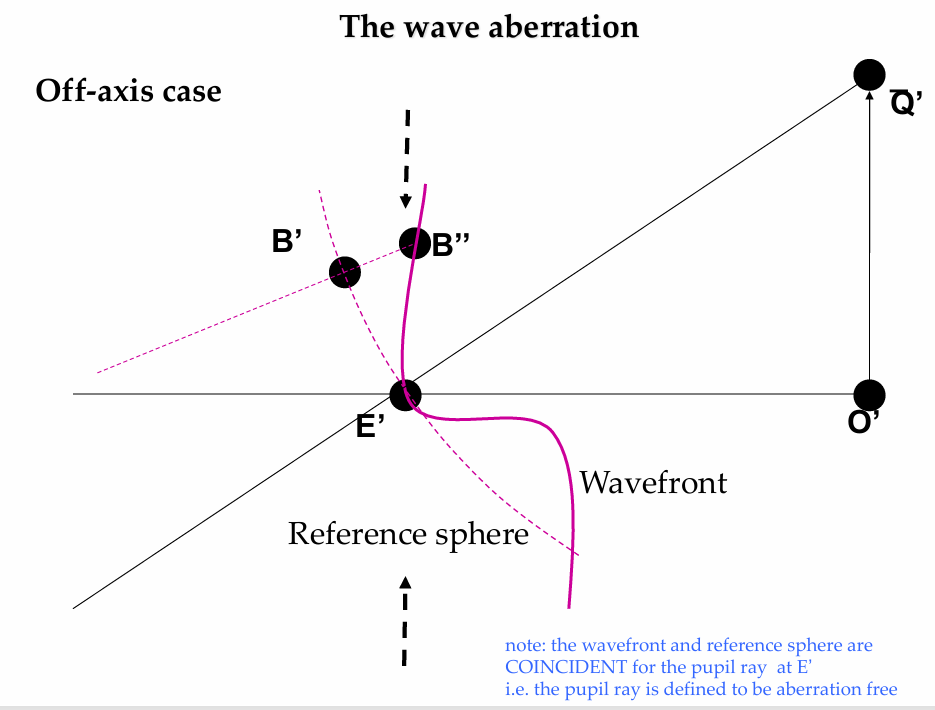
In wave aberration, what is the reference sphere?
The ideal wavefront shape that would focus perfectly at the ideal image point.
dashed line = reference sphere
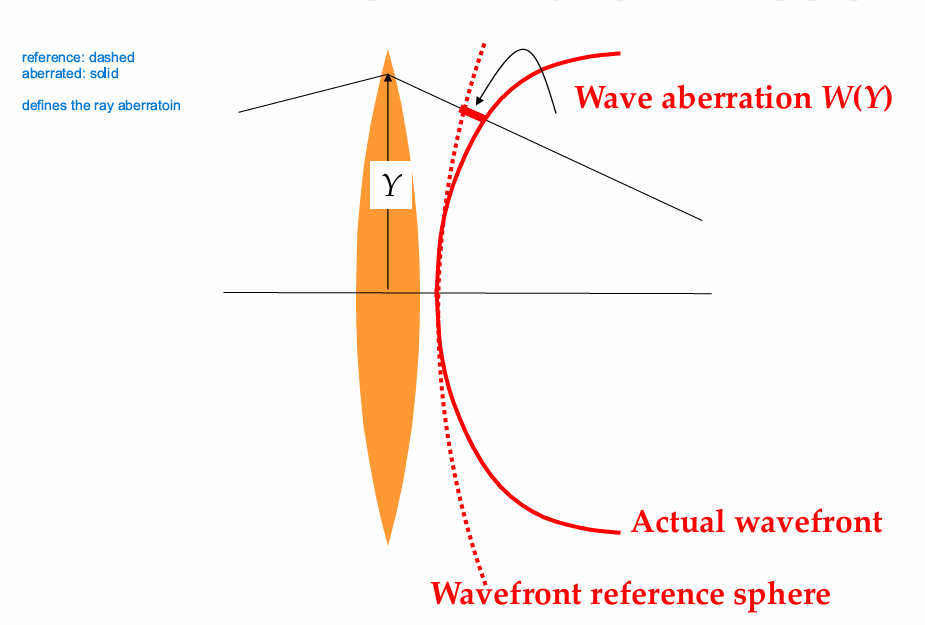
For spherical aberration, what happens as ray height increases?
Wave aberration increases strongly; peripheral rays are usually more aberrated.
In the off-axis wave aberration setup, which ray is defined as aberration-free?
PUPIL RAY
this passes thru the middle of the lens… I think this is why but legit not sure
Factors affecting wave aberrations
aperture stop diameter.
larger aperture stop means more peripheral rays pass thru
peripheral rays are usually more aberrated
does not impact distortion
distance off axis
further = more aberrations
impacts all except spherical aberration. spherical is impacted the MOST by aperture stop diameter (power of 4)
just understand the trends tho
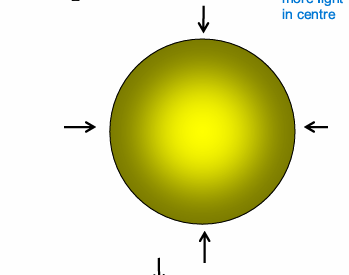
What is the point spread function?
The light distribution in the image of a point source.
How can spherical aberration be quantified using PSF? What does it depend on?
By the width/size of the PSF, which depends on
bigger pupil diameter = wider point - more light in centre
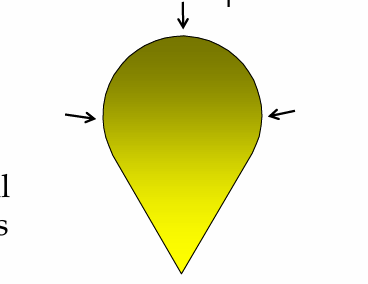
how can coma aberration be quantified using PSF? what does this depend on?
quantify by width or length
depends on aperture stop diameter and distance off-axis
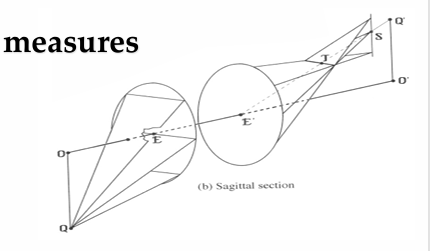
What is the interval of Sturm? What aberration does it measure and what does it depend on?
The separation between the sagittal and tangential line foci in astigmatism aberration
depends on distance off-axis but NOT pupil diameter - but AS still does impact blur…. prob not important
expressed in Dioptres
How can field curvature be quantified?
By using the Petzval surface and measuring how far the curved best-focus surface lies from the Gaussian/paraxial image plane.
Effect of Aperture Stop size. How does it incluence aberrations? What aberrations aren’t impacted
increasing aperture stop size does not change the aberration of a specific ray but it allows more peripheral rays to pass thru
since peripheral rays are usually more aberrated, the PSF typically becomes larger.
SO increase aberrations except for:
distortion
transverse chromatic aberration (don’t know this one yet)
aka bigger pupil = increase aberration
Effect of distance of an off-axis object point (field position)
Moving the object point off-axis changes ray paths for all rays!!!!
Moving further off-axis affects each aberration except:
spherical aberration (influenced by aperture stop size)
longitudinal chromatic aberration
The magnitude of change depends on the aberration
Which monochromatic aberration is not mainly affected by moving off-axis?
Spherical aberration.
What are 5 factors affecting the level of aberrations?
Aperture stop diameter
Field position - distance of off-axis object point
lens shape (including surface asphericity)
position of conjugate points?
aperture stop position
Keplarian v Galilean telescope: objective lens, eye lens, image orientation, intermediate image, aperture stop,
Keplerian
positive OL
positive EL
inverted image
real intermediate image
AS generally the objective lens
Galilean
Positive OL
Negative EL
Upright image
no intermediate image (negative lens intercepts rays before they create int im)
no intrinsic AS… pupil is AS
aka AS is the exit pupil (so NO eye relief…….)
define vignetting
the blocking of rays by a surface other than the aperture stop or field stop
define aperture stop
element that limits width of beam from on-axis object point