Physiology: Chapter 4
0.0(0)
Studied by 11 people Call Kai
 Learn
Learn Practice Test
 Spaced Repetition
 Match
Match Flashcards
 Knowt Play
Card Sorting
1/30

Earn XP
Description and Tags
Last updated 5:29 PM on 12/6/24
Name | Mastery | Learn | Test | Matching | Spaced | Call with Kai | Chat |
|---|
No analytics yet
Send a link to your students to track their progress
31 Terms
1
New cards
Define Chemical Reaction
Breaking of bonds in reactant molecules and making new chemical bonds to form the product molecule
2
New cards
what are the 2 parts to a chemical reaction?
reactant and product
3
New cards
what is are reactants
The chemicals in which the molecular bond is breaking
4
New cards
what are products
the substance that is created when the new bonds form from reactants
5
New cards
How can you identify a reversible reactant?
By double arrows in the chemical reaction or bolded/bigger letters on one side than the other
6
New cards
what is the 'Law of Mass Action'
the greater amount of reactants will cause a faster production on products and vice versa
7
New cards
What is an Enzyme
a biological catalyst that lowers activation energy to speed up the rate of chemical reaction
8
New cards
what is activation energy
the amount of energy that causes a reaction to proceed
9
New cards
what type of organic molecules are enzymes?
protein
10
New cards
what do enzyme names usually end with?
'ase' [ex. amylase, kinase, hydrolase]
11
New cards
what is a substrate?
a reactant molecule
12
New cards
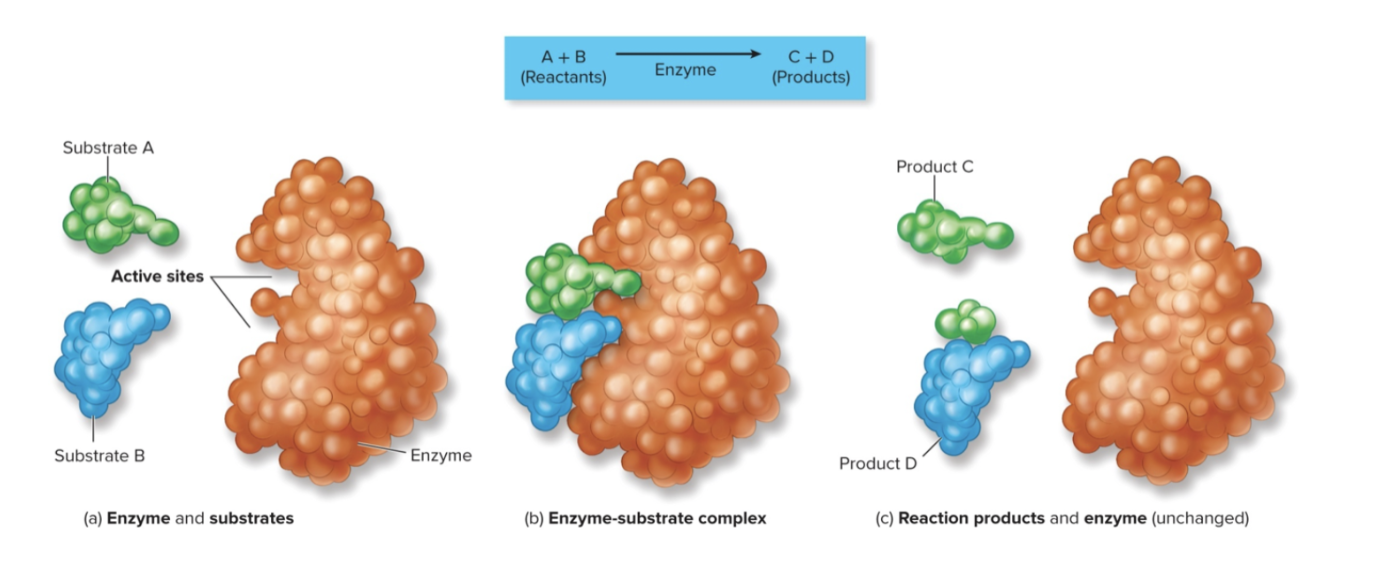
what model do enzymes resemble
'lock and key' model
13
New cards
How does the enzymatic process work?
enzymes use binding sites to bring substrates together, thus accelerating the reaction
14
New cards
What does ATP stand for?
Adenosine TriPhosphate
15
New cards
What is ATP?
It is the universal energy carrier of the cell.
16
New cards
how many phosphate groups can you find in ATP?
Three. [TRI-phosphate]
17
New cards
What is ADP
an essential organic compound that is essential for the flow of energy
18
New cards
How many phosphate groups are in ADP
2. [DI-phosphate]
19
New cards
How is ATP formed?
When ADP is combined with one inorganic phosphate, creating the 'di' to 'tri'
20
New cards
What do enzymes do ?
lower activation energy to speed up chemical reaction
21
New cards
What are the three metabolic pathways for ATP
Glycolysis, Tricarboxylic Acid Cycle, Oxidative phosphorylation
22
New cards
What does Glycolysis mean?
"sweet breakdown" or "splititng sugars
[glyco = sweet, lysis= breakdown]
[glyco = sweet, lysis= breakdown]
23
New cards
What happens in Glycolysis
glucose splits into pyruvate, which then helps aid the production of ATP
24
New cards
What is energy production?
the synthesis of ATP
25
New cards
What is Tricarbocylic Acid Cycle also called?
Krebs Cycle or Citric Acid Cycle
26
New cards
What happens in the Citric Acid Cycle?
Guanosine Triphospahte (GTP) is produced which donated a phosphate group to ADP in order to create ATP
27
New cards
What happens in the Oxidative Phosphorylation
coupling of electron-transport system with phosphorylation of ADP to produce ATP
28
New cards
What is oxidation
When an electron loses an election [think O.I.L 'Oxidation Is Loss'
29
New cards
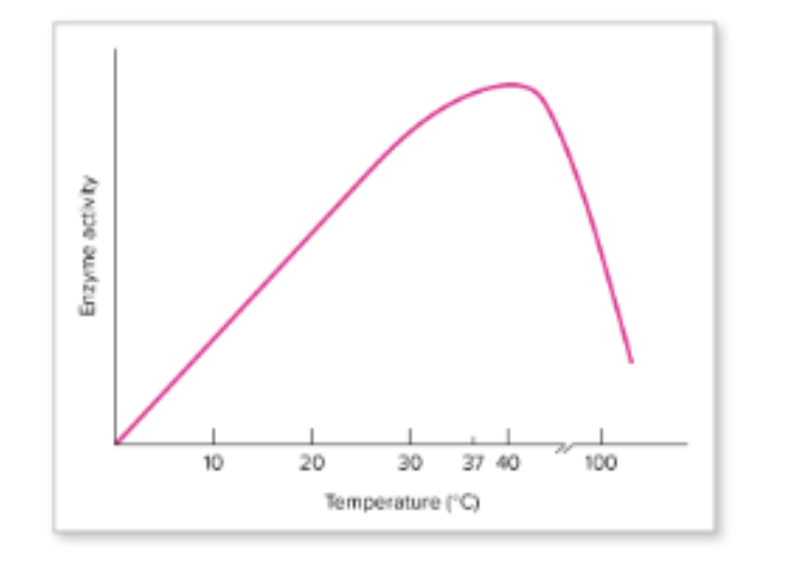
How to temperature and Enzymes relate?
in increase in temperature causes an increase speed in enzyme activity.
30
New cards
At what temperature does enzymic activity start to slow
a few degrees after 37.0°C
31
New cards
what is the most optimal temperature of Enzymic activity
a steady 37.0°C