23 - Blood types. Physiological and clinical importance. The ABO and Rh blood type system. Analytical methods. Principles of blood transfusion.
 Call Kai
 Learn
Learn Practice Test
 Spaced Repetition
 Match
Match Flashcards
 Knowt Play
1/8

There's no tags or description
Looks like no tags are added yet.
Name | Mastery | Learn | Test | Matching | Spaced | Call with Kai | Chat |
|---|
No analytics yet
Send a link to your students to track their progress
9 Terms
section
how is blood classified in transfusion and why is it important to do this
blood types
universal recipient
universal donor
Rh system
Rh incompatability
laboratory procedures to determine blood type - test sera
principles of blood transfusion
how is blood classified in transfusion and why is it important to do this
blood classified, according to the presence or absence of antigens (cell markers) found on red blood cells and in the plasma that allow your body to recognize blood as its own.
If another blood type is introduced, your immune system recognizes it as foreign and attacks it, sometimes resulting in life-threatening, transfusion reactions.
blood types
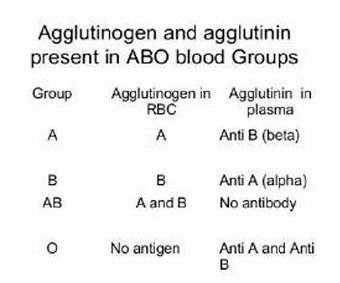
Group A – has only the A antigen on red cells (and B antibody in the plasma)
Group B – has only the B antigen on red cells (and A antibody in the plasma)
Group AB – has both A and B antigens on red cells (no antibody in the plasma)
Group O – has neither A nor B antigens on red cells (but both A and B antibody are in the plasma)
AB to O only plasma can be given
universal recipient
Universal recipients: people with type AB blood as they can receive any of the ABO types.
universal donor
Universal donor: people with type O blood as their blood can be given to any of the ABO types.
Rh system
third antigen called the Rh factor, Rh factor includes RhD, RhC and RhE antigens which is coded for either 2 RhD genes or 2 RhCE genes.
D+ individuals have RhD and Rh C and RhE.
D- individuals do not have RhD.
…………………………………………………………………………………..
In general, Rh negative blood is given to Rh-negative patients, and Rh positive blood or Rh negative blood may be given to Rh positive patients.
Universal red cell donor: has Type O negative blood type.
Universal plasma donor: has Type AB blood type.
Rh incompatability
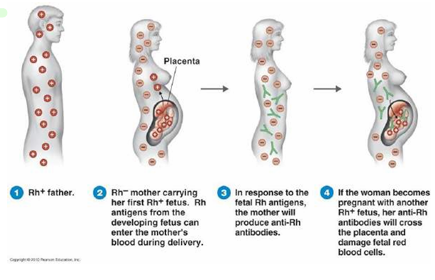
When is there a problem?
If the mother is Rh-negative and the baby is Rh-positive (inherited from the father), the mother’s immune system may see the baby's red blood cells as "foreign."
What happens then?
The mother's body may make antibodies against the baby's red blood cells.
This usually doesn’t happen in the first pregnancy but can happen in later pregnancies if she has been "sensitized" (exposed to Rh-positive blood earlier).
Effect on the baby:
The antibodies can cross the placenta and destroy the baby's red blood cells.
laboratory procedures to determine blood type - test sera
antibodies in sera react with antigens in blood
Drop the antisera On a labeled slide (or multiple wells), place:
Anti-A serum in the “A” spot
Anti-B serum in the “B” spot
(Optional) Control serum “O” spot
Add patient blood Add a small drop of the person’s blood to each of the sera drops.
Mix and wait Gently mix each pair with separate applicator sticks. Wait about 2–5 minutes.
Observe for agglutination Agglutination (clumping) means the antigen is present on the red blood cells.
Agglutination with Anti-A
Agglutination with Anti-B
Interpretation
Yes
No
Blood type A
No
Yes
Blood type B
Yes
Yes
Blood type AB
No
No
Blood type O
principles of blood transfusion
Fundamental principle of blood transfusion: recipient’s plasma does not agglutinate donor’s RBC.
………………………………………………………………………………
Determination of the blood types of D (donor) and R (recipient).
Direct cross matching:
1st stage: serum of R + blood D → no agglutination
2nd stage: serum of D + blood of R → no agglutination
Biological test: monitoring the occurrence of the following symptoms: chills, headache, shivering, yellowing of the skin, waist pain.