CMS100 - Week 2 Illness Scripts
 Call Kai
 Learn
Learn Practice Test
 Spaced Repetition
 Match
Match Flashcards
 Knowt Play
1/8

There's no tags or description
Looks like no tags are added yet.
Name | Mastery | Learn | Test | Matching | Spaced | Call with Kai | Chat |
|---|
No analytics yet
Send a link to your students to track their progress
9 Terms
what are disease illness scripts? and what are their components?
representation of a condition in the mind of a practitioner
vary between practitioners
include: epidemiology, time course, clinical presentation (signs & symptoms), and mechanism/pathophysiology
what falls under the epidemiology?
demographics such as age, sex, race/ethnicity, socioeconomic status
risk factors including pre-existing conditions
exposures like travel, occupation, hobbies, sexual activity, drugs, meds, pets, etc.
what falls under time course?
duration - hyper acute, acute, subacute, chronic
persistence/pattern - constant (stable, progressive), episodic (waxing and waning, intermittent)
what falls under clinical presentation?
most important signs and symptoms
can use “classic” presentation but note that these can be misleading
what do we see in high quality illness scripts?
use medical terms and categories
will change overtime with experience and research
can compare and contrast multiple illness scripts
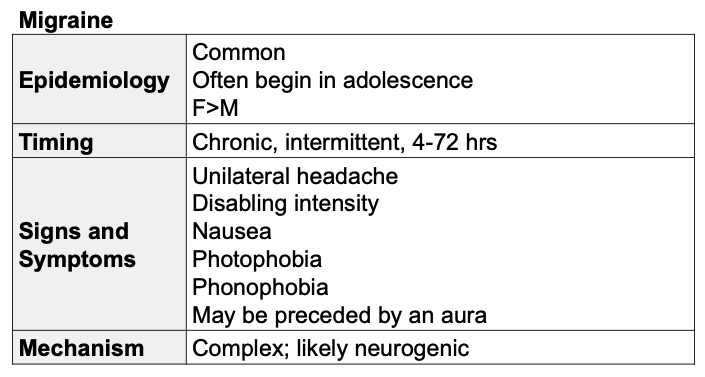
what do comparative illness script tables look like? what are they useful for?
disease illness scripts in adjacent columns or rows
focus on the most relevant info, not every cell needs to be filled
typically compare 2/3 diseases
useful to focus on what is important
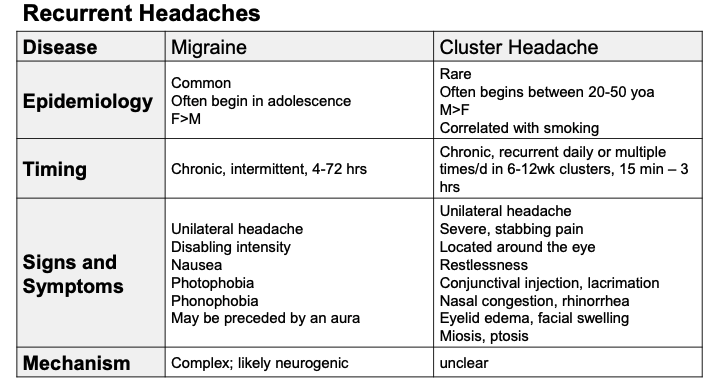
how do you create problem lists and process lists?
create a problem list - include everything that the case study/patient says verbatim
then, create a processed problem list - emphasize the most important evidence and de-emphasize les valuable evidence
finalize the problem representation in a way that it can be compared with disease illness scripts
what are patient illness scripts, what is included in them?
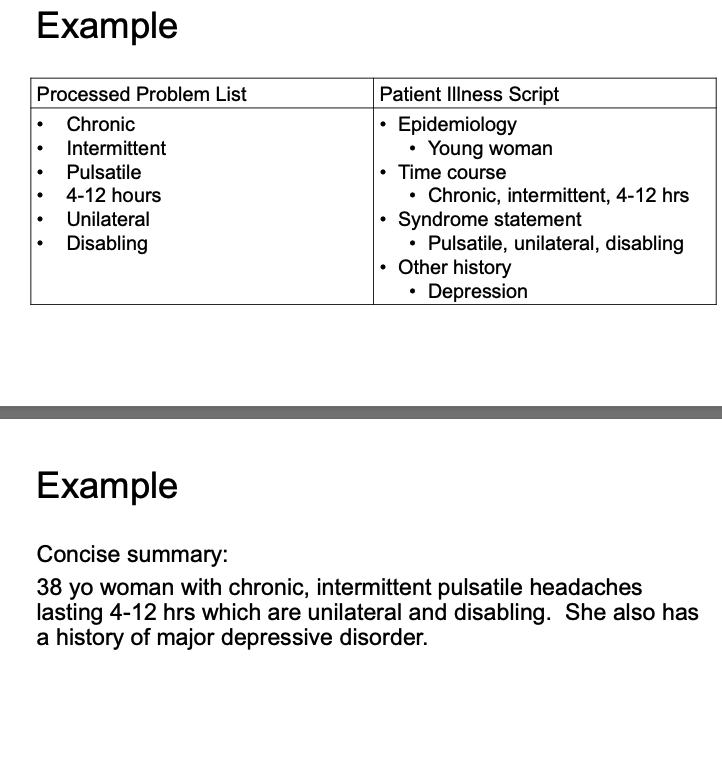
Concise summary of patient’s concern
Used to match presentation to illness scripts
Includes:
Epidemiology
Time course
Clinical presentation
Key signs + symptoms
Forms a syndrome statement
Excludes irrelevant info
Relevant PMH only
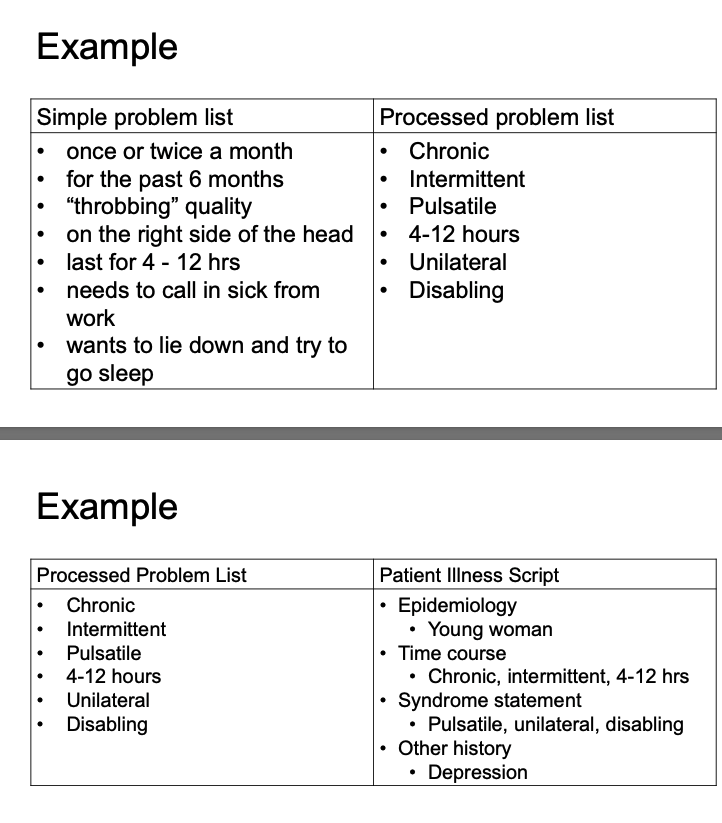
what is a concise summary statement?
Brief, synthesized description of case
Created after problem list, processed problem list, illness script
Includes:
Key demographics
Clinical features (signs + sx)
Time course/pattern
Severity & impact
Only relevant PMH
Purpose:
Supports clinical reasoning
Aids diagnostic matching