U2 AOS 1 - Metalang + Other stuff
 Call Kai
 Learn
Learn Practice Test
 Spaced Repetition
 Match
Match Flashcards
 Knowt Play
1/49

There's no tags or description
Looks like no tags are added yet.
Name | Mastery | Learn | Test | Matching | Spaced | Call with Kai | Chat |
|---|
No analytics yet
Send a link to your students to track their progress
50 Terms
The Great Vowel Shift
A change in the pronunciation of English that took place at the end of the Middle Ages: most long vowels were raised and those vowels already at the top of the mouth became diphthongs.
Morphological word formation processes
Processes of constructing words through the use of morphemes
BACCA BASIC - Blending, Affixation, Compounding, Conversion of word class, Abbreviation, Backformation, Acronym, Shortening, Intialism, Contraction
Blending (Morphological word formation process)
Blending parts of words together or a whole word together
E.g: glitterati (glitter + literati), modem (modulator + demodulator), kidult (kid + adult). Puns are often created thu blending; modern animal puns such as ‘koalafications’ and ‘hawkward’, brunch
Affixation (Morphological word formation process)
The process of adding an afix (suffix, prefix, infix)
E.g: government (with the suffix ‘-ment’)
Modern tech - neologisms such as ‘YouTuber’ and ‘podcaster’ have become commonplace
Compounding (Morphological word formation process)
The process of taking two whole words in their entirety to create a word that carries meaning of both. Compounds → stem + free morpheme functioning as derivational affix
E.g: Swimsuit, football, bookcase, keyboard
Conversion of Word Class (Morphological word formation process)
Using words in different parts of speech with no affixation
E.g: eyeball (as a verb), ‘to email’, laze
Abbreviation (Morphological word formation process)
Pronouncing shorter words or string of letters → can be context specific graphemes, numbers, alphabet as well
E.g: St. (street/saint), Gr8, 4G, VCAA (‘V’ said as a letter, the rest pronounced as 'car’)
Be careful to distinguish from initialism
Backformation (Morphological word formation process)
Refers to taiking away what was thought to be affixes → difficult to spot without knowing when both entered E.L
E.g: televise, typewriter (a backformation from ‘typewriter)
Acronym (Morphological word formation process)
Taking the first letter of a string of words; pronounced as a word
E.g: Scub, laser, ANZAC, lol, taser,
Shortening (Morphological word formation process)
Cutting the word down (→ efficiency, easier to spell)
E.g: pram (pramulator), noob (newbie), all caps (‘caps’ → a shortening of ‘capitals’). bro
Initialism (Morphological word formation process)
Taking the first letter of a string of words pronounced as individual letters
E.g: VCE, RSVP, Q&A
Contraction (Morphological word formation process)
Apostrophe represents omitted letters, as it mimics speech it may be considered (→ mimics closer to spoken language, informal)
She’s (she is/she has), It’s (from ‘it’ and ‘is’), couldn’t’ve (from ‘could’, ‘not’ and ‘have’)
Lexical word formation processes (BNCN)
Processes of bringing new words into the language
Borrowing (e.g. sushi from Japanese), Commonisation (typically occurs when a popular brand name is applied to all similar items, e.g. vaseline, poloriod), Nominalisation, Neologisms, Taboo & Euphemisms
Other: obsolescence, arhaism
Borrowing (Lexical word formation process)
A word taken from another language and adapted into English
Also sometimes foreign concepts are better dealt with in their original language.
Commonisation (Lexical word formation process)
Forming a common noun from a proper noun
E.g: Panadol, tablets, google, Velcro, Gladwrap
Nominalisation (Lexical word formation process?)
Forming a noun from an existing verb or adjective
E.g: (ai): decide → decision, recover → recovery
Technological advancements → ‘typing’, ‘streaming’, ‘likes’
Neologism (neo - new, logos - word)
A new word in the lexicon, having been introduced to the language or being repurposed existing lexeme or lexemes
Archaism
A term or phrase that exists within specific contexts e.g. idioms) but has otherwise dropped out of the language
Obsolescence
A term or phrase becoming obsolete: no longer used as part of the language
Semantic broadening
The process of a word denoting additional referents (the thing that a word or phrase refers to or stands for) - I.e. gaining additional meaning/s
E.g: handle,
Semantic narrowing
The process of a word denoting fewer referents (a reduction in the breadth of its meaning).
Semantic shift
The process of a word changing what it denotes to something different
Elevation
The process of a wrod’s connotation becoming more positive
Deterioration
The process of a wrod’s connotation becoming more negative
Semantic denotation, changing connotation
Changes to the meanings of words that affect their connotations. Over time, such changes can also shift the denotation.
Taboo language
Terms or language use socially prescribed as improper or unacceptable, including the use of dysphemism (substituting a harsh or offensive expression for a more acceptable one - opposite of euphemism).
Prescriptivism
Focuses on correctness of language and its use and aims to preserve perceived standards or impose ideas about how the language ‘should’ be
Prescriptivists believed language was declining, becoming less proper causing confusion, distances younger generations from older texts, encourages ‘lazy’ or irregular language use, reducs mutual intelligibility between dialects, creates divisions between generations of speakers
Descriptivism
Gives an objective account of actual observed patterns and use of a language
Adds to our expression, enriches the lang for use by giving more option. Natural part of living languages → allows for language change
Can alleviate discriminatry or otherwise problematic embedding elements of language (euphemisms and dysphemism’ )
Problems in codification - Caxton’s printing press
Caxton's printing press spread the Mercian dialect of English around Britain from 1476, long before the establishment of agreed rules for English grammar and spelling. The priority for compositors (who assembled the metal type for printing) was to ensure that each of the lines filled the width of the page, to create a consistent appearance and make buyers feel that they were getting their money's worth. Handwritten books included small diagrams, pictures or elongated letters to fill the pages but this was not an option for the printing process, as compositors were limited to using letters. It was not uncommon for compositors to add or remove letters to make the text fit better on the page, meaning that a particular word might have multiple different spellings in the same book.
With no standard record of English spellings to refer to, other factors also played a part in determining spellings in Caxton's publications. Terms pertaining to the law and the Church often had Latin origins, so sometimes printers decided on spelling based on where they thought letters should appear to mark this etymology, rather than accurately reflecting the word's orthography. For instance, a 'b' was added to 'debt' to connect better with the Latin lexeme debitum, despite the 'b' having been dropped in Middle English, when it was commonly spelt 'dette'
Silent letters + double letters → difficult for those learning English due to spelling inconsistencies
Dutch workers including filler letter, ‘e’ at the end of words
Problems in codification - Bullokar’s pamphlet
Bullokar's Pamphlet for grammar was published in 1586 and drew heavily on the tradition of Latin grammar books, seeking to impose onto English the grammatical patterns and structures of the now-dead language. Bullokar felt that this would make English more regular in its form and add greater legitimacy to the language by likening it to a language of such high prestige. Likening English to Latin would also make it easier for foreigners to learn, as Latin was common to most of Europe in the sixteenth century. This was a sound theory in terms of his aim of making English more accessible and easily taught, for English and non-English speakers alike.
Latin terms that Bullokar used to describe the elements of English grammar are still used today, such as 'verb' from the Latin word verbum. Bullokar also applied to English the Latin grammar system of classifying verb tenses (past, present and future) into different aspects (how an action or state extends over time), which gave English the forms of simple, progressive, perfect progressive and perfect.
Rather than simply noting how to mark possession, he also advised how the language should be changed. For example, Bullokar stated that a singular possessive noun should be marked with '-is' so that it would not be confused with the plural marker for nominative case nouns, '-es'. In this way, the Middle English phrase 'Jacobes bookes' (Jacob's books) would be written as 'Jacobis bookes' to indicate to whom the books belong. This application of Latin grammar patterns to English was typical of the time and was done to invent etymological links between Latin and English, despite English being a Germanic language.
Problems in codification - Dr Johnson’s Dictionary
Dr Samuel Johnson's work in the mid-1700s established the style used by dictionaries for centuries to come. Although his A dictionary of the English language was not the first dictionary, nor the most comprehensive, it clearly articulated definitions, classifications, etymologies, pronunciations and usage, recording the shape of English at the time. Major criticisms of his dictionary come from his attempts to guess at etymologies, his personal biases influencing his definitions, and the limitations of his own lexical knowledge (he wrote his dictionary with only the aid of six transcribers). There were errors such as 'pastern' being defined as the incorrect part of a horse's leg, which, according to Boswell's biography, Johnson explained to a lady as 'ignorance, madam, pure ignorance.
Johnson is also thought to have included words that were not real, to protect his copyright. This practice continues today, the idea being that these quirks will identify plagiarists who illegitimately reproduce the work. In 1943, Webster's new twentieth century dictionary of the English language contained the lexeme 'jungftak', and the 2001 edition of The new Oxford American dictionary included 'esquivalience' specifically to trap such copyright infringers. Unfortunately, Johnson did not record which words in his dictionary he invented for this purpose, meaning that these made-up lexical entries were permanently codified into English and became accepted.
His sexist, classist and racist views hindered his definitions, due to these biases affecting his own understanding of the words. His humour is also apparent in some definitions, such as his dig at his patrons. The limitations of his knowledge also meant that terms like ‘trolmydames’ received no definition, and countless others could have been inaccurate as they are based on his own guesses.
Ignored borrowings in E.L
Problems of spelling
Spelling is incredibly inconsistent, demonstrated by words that rhyme with each other, despite different letter combinations representing the same set of phonemes
dough know, true few, choose lose, heard bridge, nose flows
Words may have the same form or same ending orthographically, but have different phonological realisations
lead lead, thorough through cough, wound wound, tear rear (to) row (to) bow
As English has become more standardissed, some prescriptivists thought that spelling should be made more consistent by basing it on etymologies
Phonological Changes

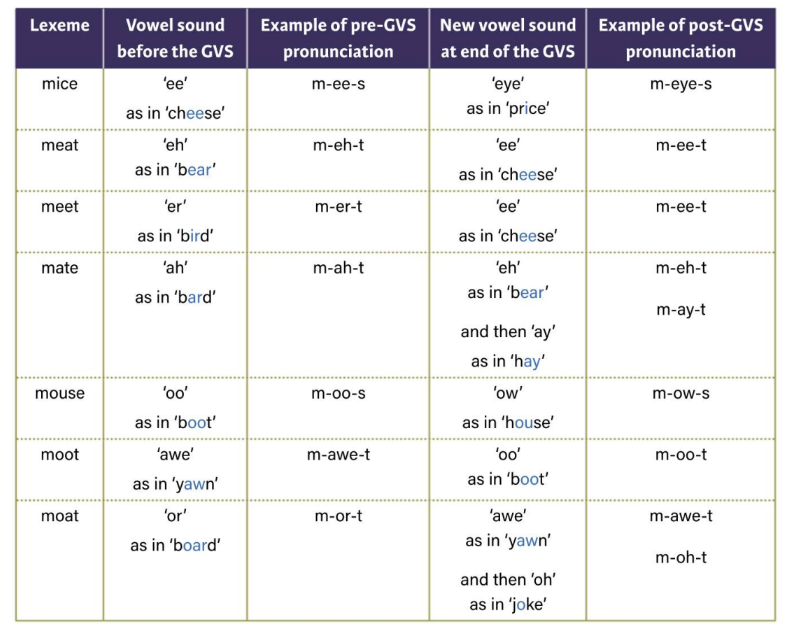
The Great Vowel Shift
The Great Vowel Shift (GVS) was a major upheaval of the pronunciation of long vowels (vowels that are held proportionately longer than other vowels, such as the 'oo' sound in 'moon') in English, taking place between 1400 and 1700 CE. The seven long vowels of English each moved up one position in the mouth, with the highest vowels then moving into diphthongs (when one vowel phoneme glides onto another in the production of a syllable; e.g. the 'oi' sound in 'coin'). See the following table for an outline of how the vowels started and how they changed during the GVS. Modern English words have been used to give you a sense of the sound of the vowels.
Reasons for changes
The Black Death ravaged the population of Euorpe which caused a mass migration to bigger cities such as London which lead to the missing of dialects from across the British isles may have created the shift
During the Hundred Years War against France, in Britain therewas a desire to move away from French-sounding vowels and borrowings; adopting different vowels helped to demonstrate this anti-French sentiment
Outside of this time of war, the wealthier middle class may have hyper-corrected their speech to sound more similar to French
GVS is one of the reasons why some modern English spellings don’t seem to match their pronunciations
Detrimental impact of timing of GVS to English spelling: The GVS took place while English spelling was being codified, so irregularities and inconsistencies were written into the rules of English spelling
Morphological changes
While they have been retained in many of the Indo-European languages, English has been steadily loosing inflectional morphemes since the Middle English Period when English went from being a synthetic to an analytic language
consequently, the function of words and the role of word order become more prominentin definiong the grammatical roles of lexems
Derivational morphemes were important during this shift → provided an opportunity for the creation of neologisms through morphological processes
Expository Esay - Body Paragraph Structure
Topic sentence
Elaboration - define key terms + what does this mean?
Linguist concept (metalang) → word formation semantic (BNCN maybe BACCA BASIC)
Examples + Analysis
Linguist concept (contemporary examples, linguist)
Linking sentence → needs to link back to T.S. and back to essay question to avoid wandering off topic
OR
Topic sentence
Point
Example
Analysis
Concluding Statment
Note: Analsysis for examples can be merged together
e.g
Point
Example
Point
Example
Analysis
Silent letters + double letters being common problems for those learning English and its connections with Caxton’s Printing Press
Use of spellings to fill pages to ensure customers got their money’s wroth
Same words with multiple different spellings in one print
Silent letters preserving meaning (Why is there a ‘B’ in Doubt Gina Cook) etymology
184 - lexical changes
Digital Inventions
1993 - Microsoft introduction of autocorrect to enable accuracy in formal writing by using suggested orthography of the author. Limitations: decreased accuracy + efficiency for informal writing or if program doesn’t recognise the lexicon
1980s - Internet for military + academics
1990s - Internet spread to public → shorthand character limitations, acronyms + initialisms
Standardisation
Takes away diversity and variation
Process of Language Change
Slow predicted change or rapid (bc of incursions)
Incursions speed it up
Limitations of dictionaries
Lacks IPA Pronunciation
Lacks social interaction (context)
No regional dialects
Etymology
Abbreviations
Syntax
Spoken discourse
Time to produce (doesn’t allow for the evolution of language)
No one version of correct English → too many variables
DvorakKeyboard
Noah Webster
Z in analyze remove u in colour
Influence of French on English.
Upper class - more elite
Key event: Battle of Hasntings William the Conquorer
Many, about 10000 French lexemes entered English language at this time (particularly in court life: just, lute, bounty, law: tort, ecit, religion Tabernacle, government + administration)
Old English vs Old norman synonym pairs there is an elevation to there French lexems
Impact of 1066 Norman Conquest
Drivers for lexical changed
Lexems may be invented, repurposed or lost due to: movement between domains, innovation rquriing new lexemes, and/or societal changes
Movement between domains: ‘wireless’ → transmission of radio signals without the use of wires to accessing the modern internet without wired connection, ‘switching off’, ‘taking something offline’
Societal changes: ‘mankind’, ‘policeman’ or ‘chairman’ that were once used to refer to people of all generders to now being phased out + replaced with gener-netural terms eg. ‘human kind’, ‘police officer’ and ‘chairperson’
Reasons for word loss (lexical change)
Lexems lost over time in English due to
Obsolescence (brigadine (a type of armour that protected the torso)
Brevity
Taboo (Homonyms or near=homonyms of toboo terms lost from English to avoid potentially offendingg others, e.g. traditional English word for ‘rabbit’ was ‘coney’ rhyming with ‘honey’ but is similar to a vulgar Engish slang and so the euphemistic mispronunciation ‘bunny’ was created)
Unknown reasons (vellity - the wish to do SMTH but not strong enough to to make u act on it ppl related yet if tell out in 1920s, overmorrw - day after tmrw, ‘brabble’ (argue loudly, ‘groaks (watches sm eat food in the hope they will share it))) these lexemes have strong application for the modern world but died out of popular usage
Archaism (kith (in the expression 'kith and kin', meaning 'friends and relatives'))
pg 188 do the develop ur understanding 9.7