Lab Safety Review
 Call Kai
 Learn
Learn Practice Test
 Spaced Repetition
 Match
Match Flashcards
 Knowt Play
1/29

Earn XP
Description and Tags
Name | Mastery | Learn | Test | Matching | Spaced | Call with Kai | Chat |
|---|
No analytics yet
Send a link to your students to track their progress
30 Terms
Which of the following requires laboratories to establish a chemical hygiene plan?
A) CAP (College of American Pathologists)
B) ACS (American Clinical Society)
C) OSHA (Occupational Safety and Health Act
D) CLIA (Clinical Laboratory Improvements Act
C) OSHA (Occupational Safety and Health Act
One of the elements of a written laboratory chemical hygiene plan is to
A) Require employees who handle chemicals to have annual medical evaluations
B) Prohibit the use of carcinogens
C) Designate a laboratory chemical hygiene officer
D) Perform chemical monitoring every 6 months for OSHA regulated substances
C) Designate a laboratory chemical hygiene officer
The purpose of the OSHA Hazardous Communication, General Industry Standard, 29 CFR, Subpart Z, 1910.1200 is to require employers to establish a program ensuring personnel are provided with information regarding the workplace dangers of:
A) Bloodborne Pathogens
B) Environmental Hazards
C) General Safety Hazards
D) Hazardous Chemicals
D) Hazardous Chemicals
An example of an engineering control is
A) A biological safety cabinet
B) A procedural mask
C) Googles
D) A lab coat
A) A biological safety cabinet
Infection rate is highest for laboratory professionals exposed to blood and body fluids containing
A) Hepatitis A
B) Hepatitis B
C) CMV
D) HIV
B) Hepatitis B
Regulated medical waste refers to
A) Chemical waste
B) Infectious waste
C) Radioactive waste
D) All waste from healthcare facilities
B) Infectious waste
Use of “Standard” (Universal) precautions minimizes exposure to
A) Blood borne pathogens
B) Chemical hazards
C) Radiation hazards
D) Environmental hazards
A) Blood borne pathogens
Which disinfectant inactivates HIV and HBV?
A) Alcohol
B) Iodine
C) Phenol
D) Sodium hypochlorite
D) Sodium hypochlorite
What is the single most effective method to prevent nosocomial spread of infection?
A) Wear mask, gown and gloves
B) Require infectious patients to mask
C) Wear an N95 respirator mask
D) Perform frequent and appropriate hand hygiene
D) Perform frequent and appropriate hand hygiene
What is the most likely mode of transmission for blood borne pathogens in laboratory acquired infections?
A) Parenteral inoculation of blood
B) Contact with intact skin
C) Airborne transmission
D) Fecal-oral transmission
A) Parenteral inoculation of blood
Compressed gas cylinder should
A) Be stored with flammable materials
B) Be transported by rolling or dragging
C) Have safety covers removed when pressure regulators are unattached
D) Be secured upright to the wall or other stable source
D) Be secured upright to the wall or other stable source
All laboratory instruments should
A) Have repairs conducted while connected to facility wiring
B) Be grounded or double insulated
C) Have safety checks performed initially and then every 6 months
D) Be connected to multiple outlet adapters
B) Grounded or double insulated
For fire safety and prevention
A) Fire drills should be announced and practiced in advance
B) Hallways and corridors should be clear and free of obstruction at all times
C) Only one exit is necessary in laboratories that contain an explosion hazard
D) Hazard evaluations only need to be done prior to initiation of clinical operations
B) Hallways and corridors should be clear and free of obstruction at all times
The first step to using a fire extinguisher is
A) Sweep the flow of the hose from side to side
B) Pull the pin
C) Squeeze the top handle of lever
D) Aim the hose at the base of the fire
B) Pull the pin
A fire occurs in the laboratory. The first course of action is to
A) Evacuate the entire area
B) Pull the fire alarm box
C) Remove persons from immediate danger
D) Contain the fire by closing the doors
C) Remove persons from immediate danger
An electrical equipment fire breaks out in the laboratory. Personnel have been removed from immediate danger; the alarm has been activated. What is the next action to be taken?
A) Evacuate the facility
B) Contain the fire by closing the doors
C) Extinguish fire with type A extinguisher
D) Lock all windows and doors in the immediate area
B) Contain the fire by closing the doors
Class A fires involve
A) Grease and oil
B) Xylene and alcohol
C) Paper, wood, and plastics
D) Electrical Equipment
C) Paper, wood, and plastics
A technologist splashed a corrosive chemical in his/her eyes. To prevent permanent injury, the first action should be to
A) Bandage the eyes and seek immediate emergency medical assistance
B) Flush eyes with a chemical of opposite pH to neutralize the injury
C) Use the eyewash station to flush eyes with water for 15 minutes
D) Seek immediate emergency medical assistance
C) Use the eyewash station to flush eyes with water for 15 minutes
What chemical is a potential carcinogen?
A) Potassium chloride
B) Formaldehyde
C) Mercury
D) Picric Acid
B) Formaldehyde
A chemical that causes immediate visible destruction or irreversible alterations of human tissue at the contact site is best classified as
A) Carcinogenic
B) Toxic
C) Ignitable
D) Corrosive
D) Corrosive
Labels on shipped chemicals from manufacturers, importers or distributors are required to include information on
A) Physical properties of chemical
B) Accident instructions
C) Appropriate hazard warnings
D) Exposure limits
C) Appropriate hazard warnings
A technologist spilled 10 gallons of formaldehyde on the floor. After determining the chemical poses a significant health hazard, the first action step would be to
A) Notify emergency assistnace
B) Control the spill with appropriate absorbent material
C) Evacuate the area
D) Don appropriate personal protective equipment
C) Evacuate the area
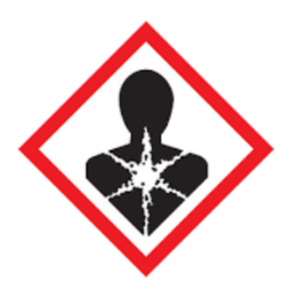
The following symbol indicates which of the following hazards
A) Flammable
B) Electrical
C) Skin Corrosion
D) Carcinogen
D) Carcinogen
A technician is asked to clean out the chemical reagent storeroom and discard any reagents not used in the past 5 years. How should the technician proceed?
A) Discard chemicals into biohazard containers where they will later by autoclaved
B) Pour reagents down the drain, followed by flushing of water
C) Consult SDS sheets for proper disposal
D) Pack all chemicals for incineration
C) Consult SDS sheets for proper disposal
Using a common labeling system for hazardous material identification such as HMIS or NFPA, the top red quadrant represents which hazard?
A) Reactivity
B) Special reactivity
C) Health
D) Flammability
D) Flammability
If the HMIS or NFPA hazardous material identification system has a number 1 in the left blue quadrant, it represents a
A) High health hazard
B) Low health hazard
C) High reactive hazard
D) Low reactive hazard
B) Low health hazard
The HMIS or NFPA hazardous material identification system rating for a slightly toxic chemical would be
A) 1 in the yellow quadrant
B) 4 in the blue quadrant
C) 1 in the blue quadrant
D) 4 in the yellow quadrant
C) 1 in the blue quadrant
When hazardous chemicals are transferred from the original appropriately labeled container(s) to a secondary container for immediate use by the person performing the transfer, it:
A) Must be labeled with an emergency response phone number(s)
B) Must be labeled with the identity or contents of the hazardous chemical(s)
C) Must be labeled with hazard warnings related to the effect on involved target organs
D) Does not require labeling
D) Does not require labeling

What type of identification system does this symbol represent?
A) Transmission-based precautions
B) Physical environment hazards
C) Chemical hazardous materials
D) Radiation hazards
C) Chemical hazardous materials
What is the difference in the number scale between the GHS and NFPA/HMIS?
A) The GHS has a primary scale and the NFPA/HMIS have a secondary scale
B) GHS uses colors to dictate severity and NFPA/HMIS use pictograms
C) The GHS ranks 1=severe and 4=low, while the NFPA/HMIS ranks 0=low to 4=severe
D) There is no difference
C) The GHS ranks 1=severe and 4=low, while the NFPA/HMIS ranks 0=low to 4=severe