BLOOD (Schistosoma spp.) Flukes
 Call Kai
 Learn
Learn Practice Test
 Spaced Repetition
 Match
Match Flashcards
 Knowt Play
1/23

There's no tags or description
Looks like no tags are added yet.
Name | Mastery | Learn | Test | Matching | Spaced | Call with Kai | Chat |
|---|
No analytics yet
Send a link to your students to track their progress
24 Terms
How are BLOOD flukes different from all kinds of flukes?
They are not hermaphroditic
Male and female forms
Females live INSIDE of males
Eggs are UNOPERCULATED
Cylindrical shape
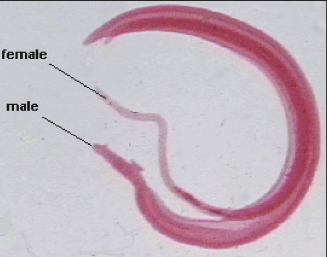
What does the adult form of the Schistosoma spp. look like?
FEMALE living INSIDE of the MALE
What are the 3 primary Schistosoma species?
Schistosoma mansoni
Schistosoma haematobium
Schistosoma japonicum
What are the geographical distributions of the different Schistosoma species?
Schistosoma mansoni
Africa, South America, W Indies, and Puerto Rico
Schistosoma japonicum
Far East (Japan)
Schistosoma haematobium
East Africa & Middle East
How are the Schistosoma spp. TRANSMITTED?
CERCARIAE PENETRATION OF SKIN
Contaminated water entering via skin
Where are the adults of Schistosoma japonicum & mansoni found?
VEINS of the INTESTINE
Where are the adults of Schistosoma haematobium found?
VEINS of BLADDER
What clinical infections does Schistosoma spp. cause?
Schistosomiasis
What are the symptoms associated with Schistosoma spp. infections?
Infecting cercariae - SWIMMER’S ITCH, dermatitis
Larval migration - Urticaria, fever, and malaise
Egg production/migration - cause of ACUTE DAMAGE
What are the symptoms seen with Schistosoma mansoni?
Stool with BLOOD & MUCUS
What are the symptoms seen with Schistosoma japonicum?
Stool with mucus and blood, KATAYAMA fever
What are the symptoms seen with Schistosoma haematobium?
hematuria (BLOOD IN PEE), dysuria (PAIN WHEN PEE)
URINE RETENTION, UTIs
What is seen in chronic Schistosomiasis?
Granuloma formation
Vein scarring
Hepatomegaly
Splenomegaly
What is the INFECTIVE stage of Schistosoma spp.?
Cercaria
What is the DIAGNOSTIC stage of Schistosoma spp.?
EGGS
Which specimen is used to diagnose Schistosoma japonicum and Schistosoma mansoni?
STOOL
Which specimen is used to diagnose Schistosoma haematobium?
URINE
What are the characteristics of Schistosoma mansoni EGG stage?
Yellowish OVAL egg
115um-175um
LATERAL SPINE
LOOKS LIKE A MESSAGE BOX
REMEMBER they do NOT have an OPERCULUM

What are the characteristics of Schistosoma haematobium EGG stage?
TERMINAL SPINE, spine at the end of the oval
110um-170um
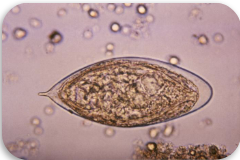
What are the characteristics of Schistosoma japonicum EGG stage?
SMALL CURVEDDDD rudimentary spine
60-95um
