NEURO2020 WEEK 7
 Call Kai
 Learn
Learn Practice Test
 Spaced Repetition
 Match
Match Flashcards
 Knowt Play
1/26

There's no tags or description
Looks like no tags are added yet.
Name | Mastery | Learn | Test | Matching | Spaced | Call with Kai | Chat |
|---|
No analytics yet
Send a link to your students to track their progress
27 Terms
PERCEPTION
Determine what is 'out there'
Decide on best/most appropriate behaviour
Approach food / avoid danger / navigate path / interact with mater
Survival depends on speed and accuracy with which an organism can evaluate external events and properly react to them.
MULTISENSORY PERCEPTION
Objects and events in the world generate information in multiple ways, enhancing our ability to perceive and understand our environment, enabling us to interact better with our surroundings.
Light
Sound
Mechanical
Chemical
MULTISENSORY BENEFITS/WORKINGS
Different modalities can substitute when individually compromised
Different fields of operation (touch/smell/taste for close up, vision/hearing for distance)
Each modality tends to be best suited to a particular task (visual – spatial, auditory – temporal)
Resolves ambiguities (boost signal to noise)
Combine information from multiple cues to improve stimulus detection and discrimination
REDUNDANT TARGET EFFECTS
Speeded response to either audio (A), visual (V), or audio-visual (AV) target.
Auditory and visual reaction time on its own, was longer than audio-visual together.
Responses of redundant signals are too fast to be explained as the faster of two responses to individual signals (statistical facilitation)
Assume that signals jointly contribute to process of producing response (MSI – neural coactivation)
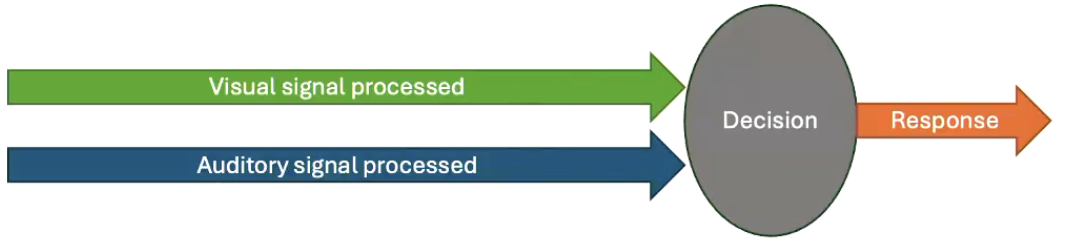
REDUNDANT TARGET EFFECTS - STATISTICAL FACILITATION (independent processing)
Both elements of the auditory/visual stimulus are processed along independent channels
One that reaches output stage first, triggers the response
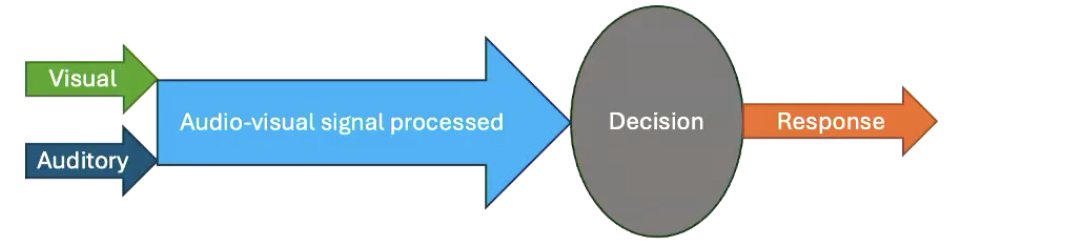
REDUNDANT TARGET EFFECTS - NEURAL COACTIVATION (integrated signals)
Both components of a redundant signal influence response on a single trial
Activation from different channels combine in satisfying a single criterion for response initiation – activation builds up over time until some criterion is reached
Activation builds faster when provided by two sources versus one
FACTORS INFLUENCING MULTISENSORY INTEGRATION
Ability to dissociate between stimuli from different sources and single source
Temporal coincidence (bottom-up)
Spatial coincidence (bottom-up)
Temporal patterning (bottom-up)
Cross-modal correspondence (objective)
Stored knowledge (subjective)
Recent experience/context/expectation/attention (subjective)
MULTIMODAL BRAIN AREAS - COLLICULUS
Superior Colliculus
Integrating auditory and visual info
orienting to stimuli
Produces motor actions guided by sensory stimuli
Programming eye movement
Inputs = retina, cortex, inferior colliculus, spinal cord
Outputs = motor control of eyes, ears, head
Superficial layers are visual, deeper layers are multi-sensory
Inferior Colliculus
Organising auditory information
MULTIMODAL BRAIN AREAS - SUPERIOR TEMPORAL SULCUS
Perception of language
Integrate visual and auditory information
Weights information on quality of each
Audio-visual speech perception (McGurk effect)
MULTISENSORY ENHANCEMENT
Multisensory neurons response to appropriate multisensory stimuli exceeds the response to individual uni-sensory inputs
Get suppression of inappropriate stimuli
MULTISENSORY ENHANCEMENT RULES
Spatial rule
MS stimuli must occur at the same region of space
Two stimuli in same receptive field of MS cell
Temporal rule
MS stimuli must reach the MS cell at the same time
Maximal response when no time delay
Principle of inverse effectiveness
Enhancement is greater for weak stimuli than for strong stimuli
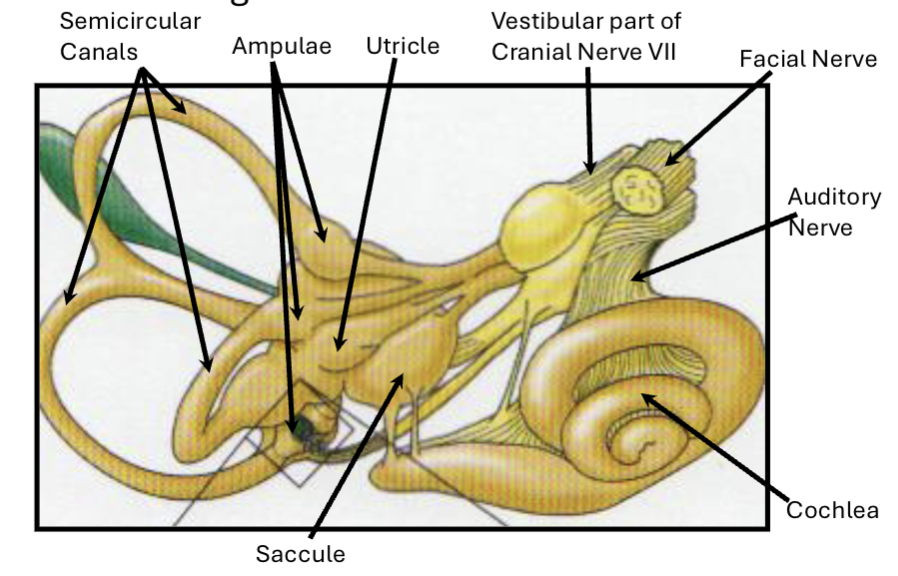
VESTIBULAR SYSTEM
Cochlea
3 semicircular canals
Ampullae
Utricle & saccule (otoliths)
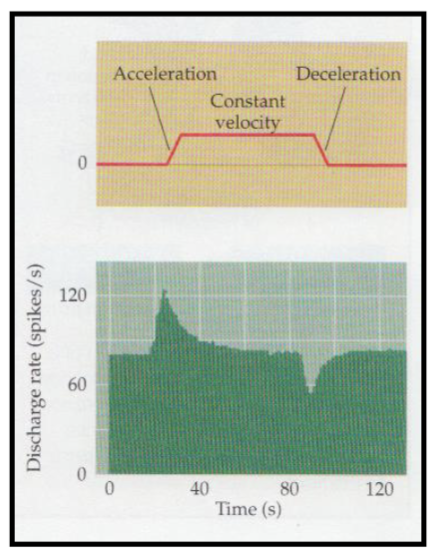
RESPONSE OF NERVE FROM SEMICIRCULAR CANAL
Hair cells have baseline firing rate at rest
When head rotates in one direction, activity spikes, activity decreases/stops in other direction.
Bidirectional deviation from baseline encodes direction of rotation
Fluid eventually catches up with rotation and signal is transient
Reflects acceleration not constant motion
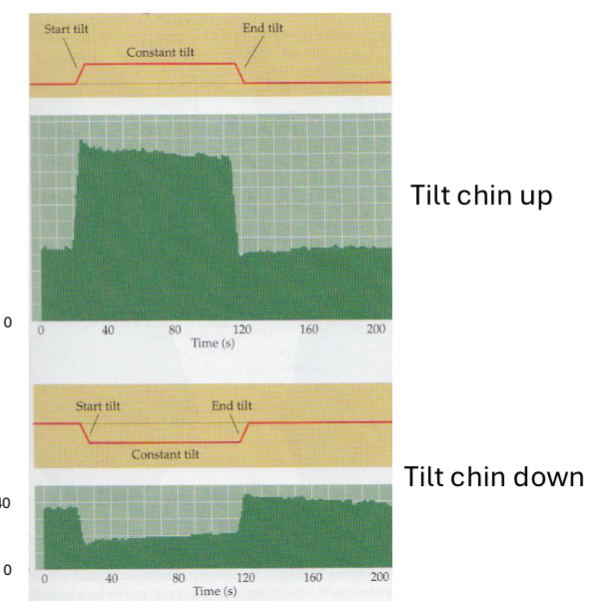
RESPONSE OF OTOLITHS
Sensitive to linear acceleration & orientation relative to gravity
Tilting chin up causes spike in activity, tilting down causes decrease
Allows brain to infer head orientation
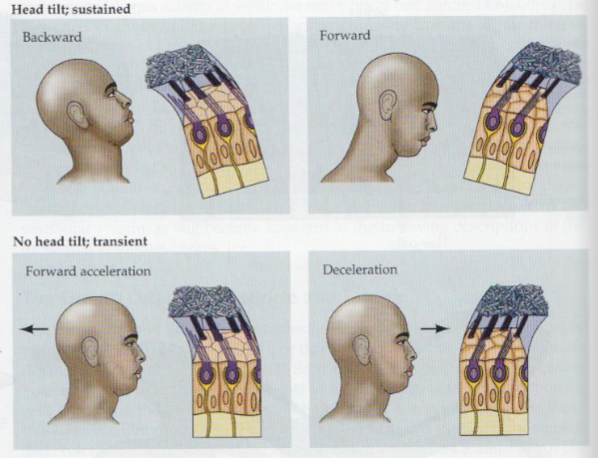
OTOLITH LIMITATIONS
Same otolith signal can be produced by forward acceleration and backward tilt
Signal ambiguous without visual input
VESTIBULO-OCCULAR REFLEX (VOR)
Wiring between vestibular system and eye muscles that produce compensatory eye movement every time the head moves
Reflex arc (left head turn)
Left horizontal semicircular canal detects rotation
Sends excitatory signal to lateral rectus of right eye (to pull it right)
Complementary signal sent to medial rectus of left eye
The two eyes move together to the right, compensating for the leftward head turn
MULTISENSORY CONFLICT
When two modalities provide differing spatial/temporal information, vision will override the other.
SPATIAL VENTRILOQUISM EFFECT
Visual + auditory info conflict spatially but match temporally and semantically
The brain assumes vision is correct and shifts the perceived location of the sound
small disparity of audio and visual target leads to almost complete overlap in perceived location
COLAVITA VISUAL DOMINANCE EFFECT
When presented with audio-visual stimuli, they underreport the auditory stimuli in the audio-visual target
frequently only respond to visual modality when presented with both
vision and audio can be characterised as competing for attention, and the brain will favour vision
MCGURK EFFECT
Conflicting visual and audio information produces a different sound from original audio stimulus
OUTCOMES OF MCGURK EFFECT (FOR AUDIO BA, VISUAL DA)
FUSION - vision + sound fuse into new percept (ga)
COMBINATION - vision + sound combined but seperate (bada, daba)
VISUAL DOMINANCE - visual stimulus dominates percept (da)
AUDITORY DOMINANCE - audio stimulus dominates percept (ba)
MORE MCGURK EFFECT Fusion
spatial + temporal coincidence of lips + sound source = stronger fusion effect
fusion due to long-term effects of observing speech from mouths
both information is relevant, so fusion makes the best match
RELIABILITY DOMINANCE
When two multisensory signals conflict, the brain will favour the more accurate/reliable one.
therefore, vision dominates because it is reliable and degrading the audio stimulus (using ambiguous consanants) makes it more reliable
IT IS NOT ABOUT VISUAL DOMINANCE BUT RELIABILITY DOMINANCE
SOUND INDUCED FLASH ILLUSION
When visual flashes paired with beep, the number of beeps will alter the perceived number of visual flashes.
presence of 2+ beeps creates illusion of multiple visual flashes, but not linearly
shows there is a limit
TEMPORAL VS SPATIAL
Vision has better spatial/object detail acuity, while audition has better timing acuity.
eyes to visual cortex = 70ms
ears to auditory cortex = 30ms
TEMPORAL VENTRILOQUISM EFFECT
Auditory stimuli can shift the perception of a visual stimulus closer to it in time.
REACTION TIMES ARE FASTER WHEN TWO SENSORY SIGNALS ARE PRESENTED TOGETHER INSTEAD OF ONE:
Redundant target effects