History of the Atom
 Call Kai
 Learn
Learn Practice Test
 Spaced Repetition
 Match
Match Flashcards
 Knowt Play
1/57

There's no tags or description
Looks like no tags are added yet.
Name | Mastery | Learn | Test | Matching | Spaced | Call with Kai | Chat |
|---|
No analytics yet
Send a link to your students to track their progress
58 Terms
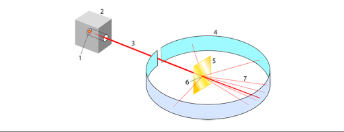
Which scientist used this apperatus?
Ernest Rutherford
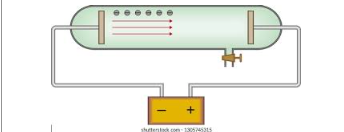
Which scientist used this apperatus?
JJ Thomson
Which of the following choices correctly characterizes the Nuclear (Rutherford's) atomic model?
There are two subatomic particles (the electron and the proton), and these particles are each localized in a specific region (protons in the nucleus, and electrons scattered around the nucleus randomly).
Which of the following choices correctly characterizes the Plum Pudding (Thomson's) atomic model?
There is one subatomic particle (the electron), and these particles are spaced randomly in a positive region.
What does it mean if most of the alpha particles passed directly through the gold foil?
Most of the atom is empty space
What does it mean if some of the alpha particles rebounded backwards
The atom has a dense postive nucleus
What does it mean if the particle beam bent away from the negative magnetic pole?
The particle beam must have a negative charge
Used the Gold-Foil experiment to determine that each atom has a dense, positively-charged nucleus in its center
Rutherford
Gathered evidence for the existence of atoms, and believed the atom to look like a solid sphere.
Dalton
Identified a neutral particle of roughly the same size as the proton in the nucleus of the atom
Chadwick
Used light emission spectra to determine that electrons are likely found in fixed/defined energy levels around the nucleus. Believed that electrons orbited the nucleus on these energy levels just as the planets orbit the sun.
Bohr
Identified the first subatomic particle, the negatively charged electron
Thomson
Which of the following correctly characterizes Dalton's atomic model?
Atoms can be combined, separated, and rearranged during chemical reactions
Which of the following correctly characterizes Rutherford's groundbreaking experiment?
The gold foil experiment led directly to the discovery of the atomic nucleus

Who made the solid sphere model in 1803?
John Dalton
The first thing that Dalton proposed was
all matter is made up small solid spheres
The second thing that Dalton proposed was
Atoms cannot be broken down into smaller parts
The third thing that Dalton proposed was
all of the atoms of a specific element are exactly alike

What was Thomson’s apperatus/ expeirment of the atom?
The Cathode ray tube
What is Thomson’s first inference?
There are subatomic particles within atoms that have a negative charge (electrons)
What is Thomson’s second inference?
Electrons are randomly spaced throughout the atom
What is Thomson’s third inference?
The atom itself is a postively charged sphere
Thomson’s model name is “Plum Pudding Model” because…
Positively charged “pudding”
Negatively charged “raisins” (electrons)
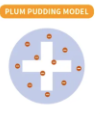
Who made the Plum Pudding Model in 1904?
Thompson
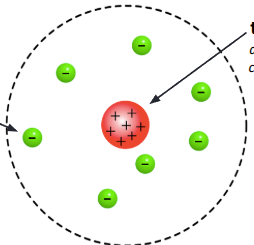
Wo made the nuclear model in 1911?
Ernest Rutherford

Who made the planetary model in 1913?
Niels Bohr
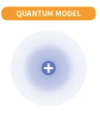
Who made the Quantum model in 1926?
Erwin Schrodinger
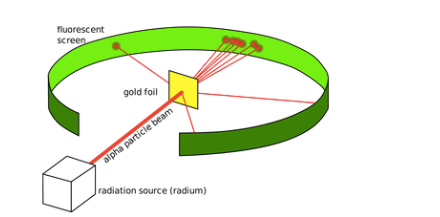
What was Ernest Rutherfords apperatus/expeirment of the atom?
Gold Foil Experiment
Shot “alpha particles” (positively charged particles) through a thin gold foil sheet surrounded by a detection screen

This is Neils Bohr’s model of the atom, what does this show us?
Bohr observed specific wavelengths (colors) of light when electricity was applied to a hydrogen gas tube.
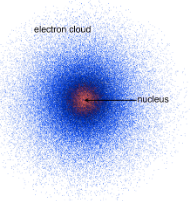
This is Erwin Schrodinger’s Model of the Atom, what does it show us?
Electrons in probability regions (orbitals) around the nucleus
Schrodinger used mathematical functions to determine the arrangement of electrons around the nucleus
Who made the atomic emissions spectrum?
Bohr
Who discovered the neutron?
Chadwick
What is Dalton’s model’s name?
The soild sphere model
Where did Dalton think protons were located?
The whole atom is one big proton
Where did Dalton think was the location of electrons?
There is no electrons.
What was Daltons experiment?
Bilards ball model- Came up with 5 postulates about atoms:
Atoms are the smallest, indivisible pieces of matter.
All atoms of the same element are identical.
Atoms of different elements are always different.
Atoms combine in whole-number ratios to form compounds (no half atoms in a compound)
Chemical reactions involve the rearrangement of atoms.
What is Thomson model name?
Plum Pudding model
Where did Thompson think protons where located?
Whole atom is one proton
Where did Thompson think electrons were loacted?
Random spaced throughout the protons
What was Thomsons experiment?
CATHODE RAY TUBE
Particles in cathode tube attracted to positive (+) magnet
THEREFORE Particles must be negative → found electrons
What was Rutherfords model name?
The nuclear model
Where did Rutherford think protons were located
In the nucleus
Where did Rutherford think electrons were located
Randomly scatered throughout the atom
What was Rutherfords experiment?
GOLD FOIL EXPERIMENT
Positive Alpha particles shot through gold foil
99% of particles didn’t hit anything
THEREFORE atom is mostly empty space
Some particles were repelled
Positive nucleus repelled by positive alpha particles
What is Bohr model name
The Bohr model
Where did Bohr think protons were?
In the nucleus bohr
Where did Bohr think electrons were?
Organised in energy levels
What was Bohr’s experiment
Light Emission Spectra
Atoms emit light only at certain wavelengths / energies
Energy corresponds to a specific distance from nucleus
What was Schrodingers model name?
The quantum mechanical model
Where did Schrodinger think protons were?
In the nucleus
Where did Schrodinger think electrons were?
In probablity regions (orbitals) around the nucleus
What was Schrodingers experiment?
Math- he is smarter than we are
Plum Pudding Model-Thomson
Discovered electrons
Can be removed from atom
Protons unknown
Nuclear Model-Rutherford
Discovered Dense Positive Nucleus
Discovered Atom is mostly empty space
Planetary Model-Bohr
Discovered electron orbits
Electrons can only be in certain spots
Quantum Mechanical Model-Schrodinger
Discovered electron cloud
Shells, Subshells, orbitals, and spins
What is a isotope?
An isotope is an atom of the same element with the same number of protons but a different number of neutrons.
Why does the periodic table list the atomic mass as instead of a whole number?
The atomic mass is a weighted average of all naturally occurring isotopes of that element based on their abudence.