eco test 2
 Call Kai
 Learn
Learn Practice Test
 Spaced Repetition
 Match
Match Flashcards
 Knowt Play
1/66

There's no tags or description
Looks like no tags are added yet.
Name | Mastery | Learn | Test | Matching | Spaced | Call with Kai | Chat |
|---|
No analytics yet
Send a link to your students to track their progress
67 Terms
Microeconomics
the study of how individuals and firms manage resources
Macroeconomics
the study of the economy as a whole and how policy-makers manage the growth and behavior of the overall country
Gross National Product (GNP)
the sum of the market calues of all final goods and services produced by a country’s businesses within a given period of time
Consumption
spending on goods and services by private individuals and households
Investment
spending on productive inputs such as factories, machinery, or inventories
Inventory
the stock of goods that a company produces now but does not sell immediately
Government Purchases
spending on goods and services by all levels of government
net exports (NX)
exports minus imports; the value of goods and services produced domestically and consumed abroad minus the value of goods and services produced abroad and consumed domestically
real GDP
GDP calculation in which goods and services are valued at constant prices
nominal GDP
GDP calculation in which goods and services are valued at current prices
GDP deflator
a measure of the overall change in prices in an economy, using the ratio between real and nominal GDP
GDP per capita
a country’s GDP divided by its population
recession
a period of significant economic decline
depression
a particularly severe or extended recession
Green GDP
an alternative measure of GDP that subtracts the environmental costs of production from the positive outputs normally counted in GDP
market basket
a list of specific goods and services in fixed quantities
price index
a measure showing how much the cost of a market basket has risen or fallen relative to the cost in a base time period or location
Consumer Price Index (CPI)
a measure that tracks changes in the cost of a basket of goods and services purchased by a typical U.S. household
Inflation rate
the size of the change in the overall price level; the percent change in a price index such as the CPI from year to year
headline inflation
measure of inflation that measures price changes for all of the goods in the market basket of the average urban consumer
core inflation
measure of inflation that measures price changes minus food and energy costs, which are traditionally volatile
indexing
the practice of automatically increasing payments in proportion to the cost of living
purchasing power parity (PPP)
the theory that purchasing power in different countries should be the same when stated in a common currency
PPP-adjustment
recalculating economic statistics to account for differences in price levels across countries
unemployment
situation in which someone wants to work but cannot find a job in the current market
labor force
people who are in the working-age population and are either employed or unemployed; people who are currently working or who are actively trying to find a job
unemployment rate
the number of unemployed people divided by the number of people in the labor force
labor-force participation rate
the number of people in the labor force divided by the working-age population
discouraged workers
people who have looked for work in the past year but have given up looking because of the condition of the labor market
underemployed
workers who are either working less than they would like to or are working in jobs below their skill level
labor demand curve
a graph showing the relationship between the total quantity of labor demanded by all the firms in the economy and the wage rate
labor supply curve
a graph showing the relationship between the total labor supplied in the economy and the wage rate
natural rate of unemployment
the normal level of unemployment that persists in an economy in the long run
frictional unemployment
unemployment caused by workers who are changing location, job, or career
structural unemployment
unemployment that results from a mismatch between the skills workers can offer and the skills in demand
real-wage/classical unemployment
unemployment that results from wages being higher than the market-clearing level
labor unions
groups of employees who join together to bargain with their employer(s) over salaries and work conditions
efficiency wages
wages that are deliberately set above the market rate to increase productivity
unemployment insurance
money paid by the government to people who are unemployed
productivity
output produced per worker
physical capital
the stock of equipment and structures that allow for the production of goods and services
human capital
the set of skills, knowledge, experience, and talent that determine the productivity of workers
convergence theory
the theory that countries that start out poor will initially grow faster than rich ones but will eventually converge to the same growth rate
investment trade-off
a reduction in current consumption to pay for investment in capital intended to increase future production
domestic savings
savings for capital investment that come from within a country; equal to domestic income minus consumption spending
foreign direct investment (FDI)
investment that occurs when a firm runs part of its operation abroad or owns all or part of another company abroad
Equation of GDP
Consumption + Investment + Government Purchases + Net Exports
Equation to calculate Net Exports
Exports - Imports
Equation for National Income
Wages + Interest + Rent + Profits
Equation for Value-Added (Production) Approach
Value of Output (Sales) - Value of Intermediate Goods
Equation for GDP Deflator
(nominal GDP/ Real GDP) x 100
Equation for Inflation Rate
(Deflator year 2 - Deflator year 1/ Deflator year 1) x 100 OR
[(CPI year 2 - CPI year 1) / CPI year 1] x 100
Equation for GDP Growth Rate
(GDP in Year 2 - GDP in Year 1/ GDP in Year 1) x 100
Equation for Nominal GDP
Price in Current Year x Quanity in Current Year
Equation for Real GDP per Capita
Real GDP / Total population
Equation for Consumer Price Index (CPI)
(Cost of base-year basket in desired-year prices / Cost of base-year basket in based-year prices) x 100
Equation of Real Value year Y
Nominal value year Y x ( CPI year Y / CPI year X)
Equation for PPP-adjusted GDP
Nominal dollars country A x (1 / 1 - Price level adjustment country A)
Equation for Labor Force
Employed + Unemployed
Equation for Unemployment Rate
(Number of Employed / Labor Force) x 100
Equation for Labor-Forced Particpation Rate
(Labor Force / Working-age population) x 100
Equation for Real GDP per capita Growth Rate
Nominal GDP growth rate - Inflation Rate - Population Growth Rate
Equation for GDP per capita in any year
GDP year A = GDP year B x (1 + Growth Rate)^ (year A - year B)
Equation for Rule of 70
Years until income doubles = 70 / Annual Growth Rate
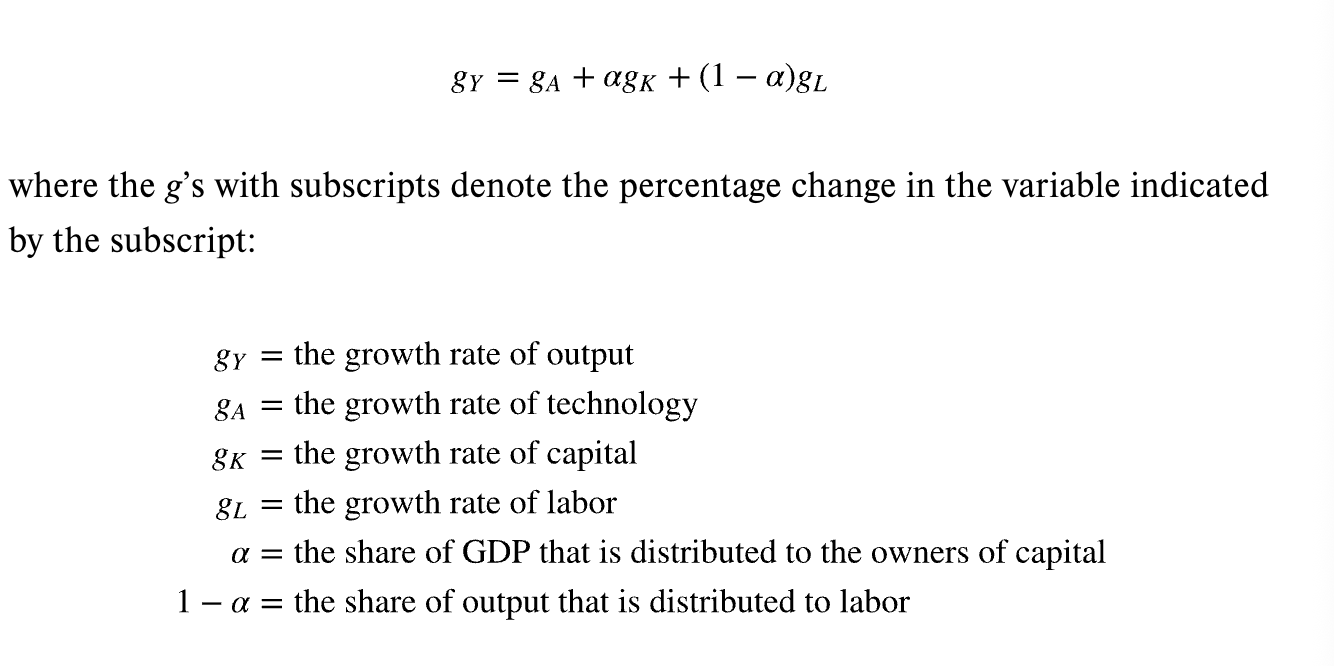
Equation for Growth-Accounting