Advanced Molecular Cell Biology - Lecture 15
 Call Kai
 Learn
Learn Practice Test
 Spaced Repetition
 Match
Match Flashcards
 Knowt Play
1/45

There's no tags or description
Looks like no tags are added yet.
Name | Mastery | Learn | Test | Matching | Spaced | Call with Kai | Chat |
|---|
No analytics yet
Send a link to your students to track their progress
46 Terms
Cell polarity generates a wide variety of forms (i.e. shapes and sizes), allowing?
a diverse array of functions
give examples of different types of polarity:
migrating fibroblast
vesicles moving along a microtubule network
yeast cell forming hyphae, the proteins important for hyphae formation moving to a new environment, like relocation to the tip of the hyphae to sample and push through the environment
planar cell polarity (in hair cells in hearing or wings in drosophila), the way different cells are organised to allow different behaviours; this is dependent on different protein concentrations in different parts of the cell
the ___________ is key to cell polarity
cytoskeleton
why is the cytoskeleton important in cell polarity?
Actin cortex, microtubules, and intermediate filaments maintain the polarised state of the cell. They form a meshwork of the cytoskeleton beneath the plasma membrane, to which the actin is attached and allow movement; microtubules allow movement of vesicles forwards and backwards in the cell
what can help us visualise apical,m basolateral domains and junctional complexes?
immunofluorescence
in mammalian epithelial cells what do tight junctions do?
Block movement through the epithelial layer (they are located above the adherence complexes)
What does adherence junction allow?
allow adherence proteins to stick tightly together in the process of adhesion
cell polarity requires organisation of proteins at the plasma membrane and?
inside cells
regions of the cell have distinct ________ compositions, this allows different capabilities, __________ and functions
protein, morphologies
why is polarity important is animals?
asymmetric cell division
tissue patterning
directional transport
polarised growth
directional movement
why is polarity important in plants:
asymmetric cell division
tissue patterning
directional transport
polarised growth
environmental responses
What did Whitman find in 1878 that contributed to studies of polarity in development and early cell fate determination and laid the foundations of modern developmental genetics and biology?
distinct cytoplasmic domains and differentially partitioned to leech descendants and that these differences were reflected in different cell lineages
What did Conklin find in 1905 that contributed to studies of polarity in development and early cell fate determination, and that laid the foundations of modern developmental genetics and biology?
Identified 5 different cytoplasm types in the ascidian oocyte that were differentially inherited to determine tissue types
what are the 2 main routes to generate diversity?
intrinsic and extrinsic
describe intrinsic polarity:
Polar mother cells divide → daughters inherit different components
via localised determinants or an asymmetric division plane
describe extrinsic polarity:
daughters are equal at ‘birth’ but → exposure to different environmental signals
Signals can come from other cells or between daughter cells
what are model organisms to study cell fate?
C.elegans and drosophila
C.elegans has how many founder cells that give rise to all the different tissues via asymmetric cell division?
6
P0 gives rise to?
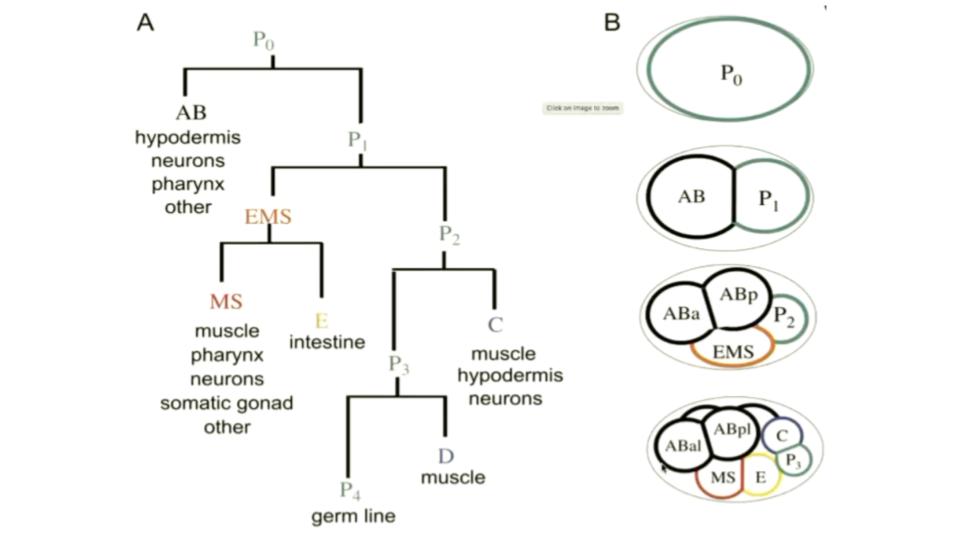
What is a key player in asymmetric division, and what did the discovery of this gene lead to?
par genes (partitioning defective)
In mutants, the size and fate difference between the daughter cells AB and P1 are less pronounced and in extreme cases the 2 are identical
The par genes encode the Par proteins Par1-6, and the seventh member of the group is atypical protein kinase C (aPKC).
Only Par2 is not conserved in other metazoans (multicellular animals)
Symmetry at P0 is broken when?
following fertilisation
what defines the posterior pole and the axis of polarity of the embryo?
sperm entry point
What does sperm deliver to the embryo?
a microtubule organizing centre (MTOC)
how is polarity established in the embryo?
There is antagonism which prevents certain Par proteins from accumulating at the anterior or posterior pole; this is mediated by phosphorylation, as one of the proteins is a kinase (therefore, cell division causes very different daughter cells)
describe the hierarchy of events in the establishment of polarity:
microtubules recruit Par1 and Par2 to the posterior cortex
antagonises anterior Par proteins, which accumulate at the anterior cortical domain
distinct localisations of the Par proteins. Par3/Par6/aPKC localise to the anterior cortex; Par1 and Par2 are at the posterior cortex and Par5 maintains the boundary
phosphorylation is key in the feedback loops that allow the poles to be defined
interactions between microtubules and the cortex result in pulling forces which act on the mitotic spindle, which causes the spindle to be displaced toward the posterior end
redistribution of the Par proteins and cell fate determinants requires a directional and actin-myosin-based process
in epithelial cells, where do we find specific Par complexes which maintain polarity in an adult epithelial cell?
apical and basolateral domains as well as junctional contacts
Why is maintaining epithelial sheets important?
so the epithelium faces the environment, so pathogens can’t penetrate into the body
When tissues need to change shape, i.e. the basolateral domain is extended, what happens to the size of the apical domain?
reduces
define EMT
When epithelial cells migrate out of the epithelium and migrate to become more mesenchymal (important in neural tube formation)
regulation of endocytosis and exocytosis is key for?
membrane polarity (i.e. if material is delivered to the apical instead of basolateral domain it will be re-endocytosed and retargeted to the correct domain)
Why are cadherins important for the maintenance of the epithelium?
They are adhesive molecules which hold the cells together. In mammalian cells, they are often found along basolateral connections between cells
Par proteins form the core of a cell polarity network in many animals and in many developmental contexts. The ________ of the network is one of mutual _________ with the establishment of opposing and ___________ membrane domains that define a cell’s axis of polarity. The network was first identified in _________.
output, antagonism, complementary, C. elegans
_____________ transport of glucose is an example of the need for cell polarity
transcellular
How many asymmetrically distributed transporters do you need to transport glucose across the stomach lining?
3
how does glucose travel against it’s concentration gradient into the cell?
via the glucose sodium symporter
how does glucose leave an area of high glucose and enter the bloodstream?
through a carrier, passive transport, in the membrane
How is excess sodium removed from the epithelial cell to ensure the gradient is maintained?
by the sodium-potassium ATPase pumping sodium out of the cell
how is polarity established in cells?
Vesicle trafficking contributes to the establishment of polarity
Delivery of material to the correct domain in the process of secretion
endocytosis and recycling
why is polarity required in bacteria?
for plasmid segregation
what are plasmids?
Extra DNA separates from circular DNA, they code for antibiotic resistance, virulence factors or metabolic advantages
how does plasmid segragation work?
recruitment of the cytoskeleton for plasmids to be segregated into daughter cells
Cytoskeletal protein ParM, an actin cytoskeleton-related protein to mammalian actin, can assemble into a long fibre. This pushes the plasmids to either end of the cell and ensures that the cells have the required components
apical ______ cell polarity is essential for functional epithelia. Maintenance of cell polarity is highly _______. Interference with membrane traffic disrupts _______.
basal, dynamic, polarity
majority of human cancers are?
epithelial in origin
loss of polarity leads to?
malignancy
cell polarity is lost in?
advanced tumours, particularly with invasive and malignant properties
The amoTL family of proteins is a scaffolding protein with binding domains for ZO-1 and other junctional proteins. They interact with actin and are postulated to integrate apical polarity, junctional formation and the actin cytoskeleton. Why is there a loss of polarity when Amotl2 is overexpressed?
High levels of AmotL2 cause Par3 and Crb3 proteins to be in the wrong subcellular location