Audiology (SHS 450)
 Call Kai
 Learn
Learn Practice Test
 Spaced Repetition
 Match
Match Flashcards
 Knowt Play
1/132

There's no tags or description
Looks like no tags are added yet.
Name | Mastery | Learn | Test | Matching | Spaced | Call with Kai | Chat |
|---|
No analytics yet
Send a link to your students to track their progress
133 Terms
How many people have hearing loss worldwide?
360 million (5.3%) persons in the world have debilitating hearing loss
How many Americans have hearing loss?
Nearly 50 million (14.6%) Americans experience hearing loss
How many children born each year in the U.S. have hearing loss?
2-3 of every 1000 children (0.3%) in America are born with hearing loss in one or both ears
What is the definition of audiology?
The study of:
The function of the hearing and balance mechanisms
Assessment of hearing and balance
Hearing disorders
(Re)habilitation of individuals with hearing loss and balance disorders
Tinnitus affects how many Americans?
Around 68 million Americans, or 20%
Those with even mild hearing loss are twice as likely to develop what condition?
Dementia
Untreated hearing loss is associated with what 4 things?
Depression and isolation
Decreased work performance
Increased risk of falls
Dementia
What 2 things are outside audiologists’ scopes of practice?
Prescribing medication
Perform surgeries (cochlear implants)
What does an audiologist assistant do?
Performs audiologic and related tasks under the supervision/direction of an audiologist
What 5 things are within audiologists’ scopes of practice?
Diagnostics and treatment for hearing, balance, and other disorders
Early hearing detection and intervention
Educational audiology
Counseling
Hearing conservation and preservation
What does a hearing instrument specialist/dealer do?
Evaluates hearing and dispenses hearing aids (only in individuals 18+)
What does an otolaryngologist (ENT) do?
Provides medical treatment for disorders of ear, nose, and throat
Requires medical degree and 5-year residency
What does an otologist/neurotologist do?
Specializes in treatment of ear disease, hearing loss, and balance disorders
Requires 2-year fellowship after becoming otolaryngologist
What are the 2 academic requirements needed in order to become an audiologist?
Undergraduate degree in SHS
Doctor of Audiology (Au.D.) is entry-level degree
3-4 year clinical doctorate
How many audiologists are there in the U.S.?
Approximately 16,000
What is the difference between audiology licensure and audiology certification?
Licensure is legally required to practice, certification (ASHA, ABA) is not
What 3 divisions make up the peripheral auditory system?
Outer Ear
Middle Ear
Inner Ear
What 2 structures comprise the outer ear?
The pinna
The ear canal
What 2 structures comprise the middle ear?
The tympanic membrane
The ossicles
What 2 structures comprise the inner ear?
The cochlea
The balance organs
True or false: Each division of the peripheral auditory system (outer, middle, inner) amplifies incoming sound.
True
What are the two mechanisms of sound transmission?
Air conduction
Bone conduction
Which ossicle bone is attached to the tympanic membrane?
(A portion of) the malleus
Which ossicle bone is attached to the oval window of the cochlea?
The stapes
The middle ear transduces ____ vibration into ____ vibration
air, fluid
The inner ear transduces _____ vibration into _____ release
fluid, neurotransmitter
Why is it important to have sensory input from two ears?
Having two sensory inputs is crucial for localization and hearing in background noise
The conductive mechanism applies to which 2 divisions of the ear?
Outer
Middle
The sensorineural mechanism applies to which 2 divisions of the ear?
Inner
Auditory nerve (neural)
What is air conduction?
Vibrations traveling through air are transmitted to outer ear, middle ear, inner ear, and auditory nerve
Air conduction involves the conductive mechanism and the sensorineural mechanism
What is bone conduction?
Vibrations are transmitted through bone to stimulate the inner ear and auditory nerve
Bone conduction only involves the sensorineural mechanism
The conductive mechanism is bypassed
Conductive hearing loss originates in which divisions of the ear?
Outer and middle
Sensorineural hearing loss originates in which divisions of the ear?
Inner and/or auditory nerve
How are AC and BC affected by normal hearing?
They are both transmitted efficiently.
How are AC and BC affected by conductive hearing loss?
AC is not efficient. BC is transmitted normally.
How are AC and BC affected by conductive hearing loss?
Both AC and BC are affected (at the level of the inner ear and/or auditory nerve)
What are the possible causes of conductive hearing loss?
cerumen impaction
tympanic membrane perforation
atresia
“a congenital condition where a body passage, tube, or valve is closed, missing, or improperly formed”
microtia
condition where a baby's outer ear does not fully develop
What are the possible causes of sensorineural hearing loss?
hair cell damage
noise-induced hearing loss
acoustic neuroma
slow-growing, noncancerous (benign) tumor that develops on the main nerve leading from the inner ear to the brain
How are AC and BC affected by mixed hearing loss?
AC is diminished at the levels of:
the outer ear and/or middle ear
Inner ear and/or auditory nerve
BC is diminished only at the level of the inner ear and/or auditory nerve
BC is transmitted more efficiently than AC

This audiogram demonstrates ___________.
Normal hearing

This audiogram demonstrates _____________.
Conductive hearing loss

This audiogram demonstrates _____________.
Sensorineural hearing loss
What question does the Weber Test answer?
Does the patient have hearing loss in one ear?
How does the Weber Test procedure work?
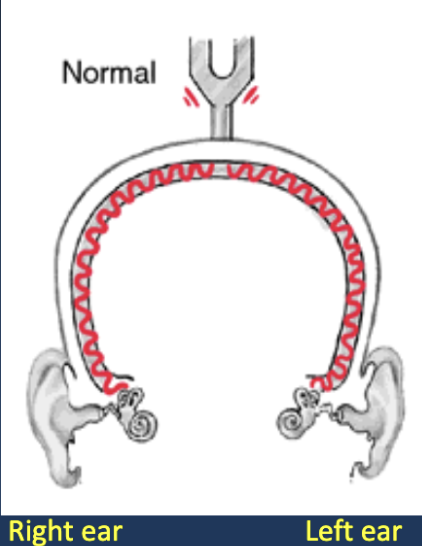
The audiologist strikes a tuning fork and places the stem on the midline
This allows the patient to hear the sound through bone conduction
The audiologist will ask the patient in which ear they hear the sound
Left, right, or middle
What is the Stenger Principle?
(Weber Test) If a tone reaches both ears with different loudness, it is only perceived in the ear receiving the louder tone
During the Weber Test, a patient reports hearing the sound in the middle. What does this suggest?
No unilateral hearing loss
Caveat: This could mean either normal hearing or bilateral sensorineural hearing loss
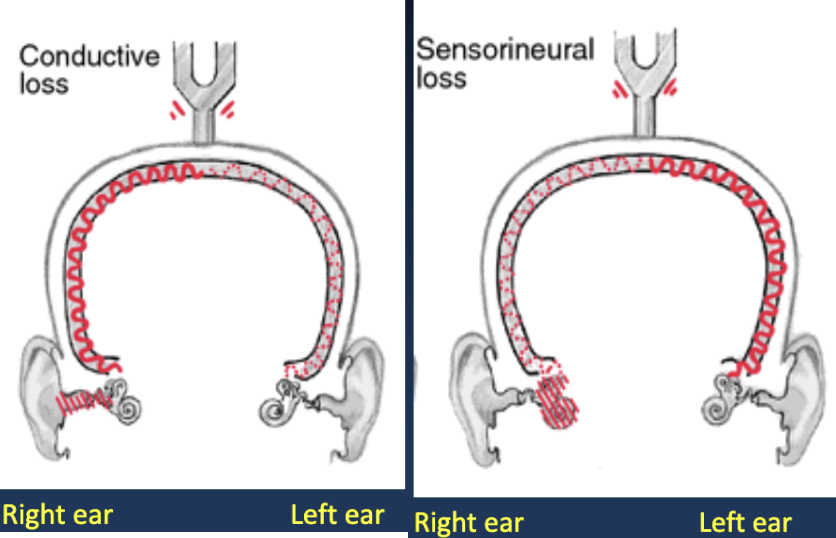
During the Weber Test, a patient reports hearing the sound in the right ear. What does this suggest?
Option 1: Suggests unilateral conductive hearing loss in the right ear
Conductive hearing loss increases the amplitude of bone-conducted sound reaching the cochlea
Option 2: Suggests unilateral sensorineural hearing loss in the left ear
The sound reaching the ear with sensorineural hearing loss will be perceived as softer than the other ear
Further testing will be needed to determine the type of hearing loss
During the Weber Test, a patient reports not being able to hear the sound at all. What does this suggest?
The result is inconclusive
Potential reasons:
Bilateral sensorineural hearing loss
Background noise
Improper technique
Retesting is needed
What questions can the Rinne Test answer?
Does this patient have conductive hearing loss? Which ear does it affect?
What 2 positions of the tuning fork does the Rinne Test involve?
Strike the fork and place tines by pinna to test air conduction
Strike the fork and place stem on mastoid to test bone conduction
Patient will answer which option was louder
What does the outcome (AC > BC) on the Rinne Test suggest?
Suggests no conductive hearing loss in that ear
Sound is normally transmitted more efficiently by air conduction than by bone conduction
Outer ear and middle ear amplify sound
Bone conduction bypasses the outer and middle ear
Caveat: Patients with sensorineural hearing loss will also hear sound louder by air conduction
The conductive mechanism is normal in sensorineural hearing loss
What does the outcome (BC > AC) on the Rinne Test suggest?
Suggests conductive hearing loss in that ear
Conductive hearing loss reduces the intensity of air-conducted sound reaching that cochlea
What does the outcome (BC = AC) or sound not heard on the Rinne Test suggest?
Result is inconclusive
Potential causes:
Substantial sensorineural hearing loss
Background noise
Improper technique
A patient’s Weber Test lateralizes to the right ear. The Rinne Test for the right ear produces the result (BC > AC). What can you conclude?
Patient has a conductive hearing loss in the right ear
You conduct the Weber Test and your patient hears the sound in the middle. Your patient may have what? (Hint: 3 possibilities)
Bilateral normal hearing
Bilateral conductive hearing loss
Bilateral sensorineural hearing loss
What information can be gained from case histories?
Patient’s concerns and reason for visit
Characteristics of hearing loss
Duration, ear affected, previous evaluation/treatment
Patient’s communication abilities
Medical issues related to hearing
Preventable risk factors (e.g., noise exposure)
What are factors associated with conductive hearing loss?
Otalgia (ear pain)
Otorrhea (ear drainage)
Aural fullness
Injury to ears
History of ear infection
History of ear surgery
What are factors associated with sensorineural hearing loss?
Advanced age
History of noise exposure
History of ototoxic medication
Family history of hearing loss
Tinnitus
What is a possible contraindication to cerumen removal?
The patient takes blood-thinning medication.
What are some red flags warranting referral to an ENT?
Sudden or rapidly progressing hearing loss
Unilateral or asymmetric hearing loss
Unilateral tinnitus
Vertigo (sensation of room spinning)
Otalgia (ear pain)
Otorrhea (ear drainage)
Aural fullness
Blood, discharge, or foreign body in ear canal
Why does a patient with sensorineural hearing loss have an AC > BC result on the Rinne test?
The outer and middle ear still amplify incoming sound in sensorineural hearing loss.
A patient’s Weber test lateralizes to the left ear. Rinne testing shows AC > BC in both ears. Which interpretation is most consistent with the combined results?
Sensorineural hearing loss in the right ear
What is otoscopy?
Visual inspection of the pinna and surrounding area, ear canal, and tympanic membrane
What is proper otoscopic technique?
One hand pulls up and back on the pinna to straighten ear canal
Other hand holds otoscope like a pencil
Use other fingers to brace against patient’s head
If patient moves, otoscope will move with them
What does an otoscopic evaluation help to determine?
Need for cerumen removal
Potential etiology of hearing loss
Etiology: the study of the causes or origins of a disease, condition, or other phenomena
Need for referral to physician
Contraindications to procedures
Appropriate size of eartips to use

What is this part of the pinna called?
The crus of the helix
Degree of hearing loss is defined as what?
The amount of hearing loss
Configuration of hearing loss is defined as what?
How hearing loss changes across frequencies
What is the difference between diagnostic and screening?
Diagnostic:
Determine degree, configuration, and type of hearing loss
Broad range of frequencies
Find threshold
Air conduction and bone conduction
Screening:
Determines if the individual requires further evaluation or not
Limited range of frequencies
One intensity
Air conduction only
What does a diagnostic do?
It determines if hearing loss is present or not.
What is an audiometer?
Device that produces sound and presents it through headphones or speakers
User can control:
Frequency
Amplitude (intensity)
Transducer (device that produces sound)
Ear (left, right, both)
Type of stimuli (e.g., tones, speech, noise)
How should the patient be seated in relation to the audiologist?
At a 90 degree angle
What are the 4 types of transducers used in audiology?
Insert earphones
Supra-aural headphones
Bone oscillators
Sound field speakers
What are the advantages and disadvantages of using insert earphones?
Advantages:
Foam eartips attenuate external noise more than supra-aural earphones
Disadvantages:
Cannot be used with certain contraindications (cerumen buildup, otorrhea, etc.)
What is an audiogram?
A plot of hearing sensitivity across frequencies
x-axis = frequency (Hz)
y-axis = amplitude (dB HL)
How do you condition a patient to the hearing screening task?
Present a 1000 Hz tone at 40 dB HL
Make sure they respond twice before proceeding to screening
What tones are tested during a hearing screening?
Screen at 1000 Hz, 2000 Hz, and 4000 Hz in both ears
Present each tone at 20 dB HL
Present each tone and wait for a response
At each frequency, present between 2 - 4 times
If they respond at least 2 times, mark that frequency as pass
If they do not respond at least 2 times, mark that frequency as refer
Why should you present a tone for 1-2 seconds?
Less than 1 second affects ability to detect sound
More than 2 seconds increases chance of false positive (patient responds even though they didn’t hear anything)
True or false: There is only one way for a patient to pass a hearing screening.
True. They must be able to hear all the presented tones.
True or false: There is only one way for a patient to refer a hearing screening.
False. There are multiple ways a patient can receive a refer result (hearing the tone in one ear but not the other, etc.)
When viewing an audiogram threshold, if you look further down the graph (up in dB HL), the sounds for the patient are ________
Audible
How do you define audiometric threshold in the clinic?
Present tone (for 1-2 seconds) and see if patient responds (e.g., raises hand)
If they respond, decrease intensity by 10 dB (“down 10”)
If they do not respond, increase intensity by 5 dB (“up 5”)
Start with an initial descending run at 30 dB HL
After the initial descent, begin ascending runs
Threshold is 5 dB HL (lowest intensity the patient responded to for at least 2 / 3 ascending runs)
True or false: an audiogram is part of a hearing screening.
False. An audiogram is part of a hearing diagnostic.
After conditioning your patient, you present a 20 dB HL tone at 1000 Hz in the right ear. The patient raises his hand. What is an appropriate next step?
Present a 1000 Hz tone at 20 dB HL again in the right ear
You are screening a kindergartner. She responded to all tones except for 1000 Hz in the left ear. What is an appropriate next step?
Mark the overall results as “refer” since she did not respond to all tones
True or false: An intensity of 0 dB HL means you cannot hear the sound.
False. 0 dB HL is the threshold of the average normal-hearing young adult.
What is the hearing range for normal hearing?
-10 dB HL to 25 dB HL
What is the hearing range for mild hearing loss?
26 to 40 dB HL
What is the hearing range for moderate hearing loss?
41 to 55 dB HL
What is the hearing range for moderately severe hearing loss?
56 to 70 dB HL
What is the hearing range for severe hearing loss?
71 to 90 dB HL
What is the hearing range for profound hearing loss?
>90 dB HL
What is an audiometric threshold?
The lowest intensities the patient can hear across the speech frequency range (must respond to it in at least 2 out of 3 ascending runs)
How do you calculate the pure-tone average (PTA)?
Compute the average of air-conduction thresholds at 500, 1000, and 2000 Hz
What is the impact on communication for someone who has mild hearing loss?
They would have difficulty hearing and understanding quiet/soft conversations, especially situations with a lot of background noise
What is the impact on communication for someone who has moderate hearing loss?
They would have difficulty understanding speech. Higher volume levels would be required for hearing the TV and radio
What is the impact on communication for someone who has severe hearing loss?
Speech has to be louder than normal. Group conversations are difficult
What is the impact on communication for someone who has severe-to-profound hearing loss?
They would have difficulties with speech; comprehension becomes impossible without amplification
What is the impact on communication for someone who has profound hearing loss?
Amplified speech or devices are still difficult or impossible to hear and understand

What is this symbol on an audiogram?
Left air conduction unmasked