Lab 3: Describing Evolutionary History
 Call Kai
 Learn
Learn Practice Test
 Spaced Repetition
 Match
Match Flashcards
 Knowt Play
1/54

There's no tags or description
Looks like no tags are added yet.
Name | Mastery | Learn | Test | Matching | Spaced | Call with Kai | Chat |
|---|
No analytics yet
Send a link to your students to track their progress
55 Terms
Carolus Linnaeus
Who developed a classification system to catalog all of life? The Linnaean classification identifies eight hierarchical levels; Domain, Kingdom, Phylum or Division, Class, Order, Family, Genus, Species

Taxonomy
Science of giving unique and meaningful names to all of the species on Earth and organizing those names in a meaningful way that all scientists can use
Systematics
Science of naming & identifying evolutionary or phylogenetic relationships among species
What are the eight major levels of classification?
Domain, Kingdom, Phylum or Division, Class, Order, Family, Genus, Species

What are the three domains of life?
Bacteria, Archaea, Eukarya

prokaryotes
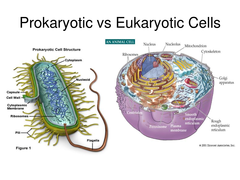
Organisms in the domains Bacteria and Archaea; mostly unicellular, single-celled organisms that have neither a distinct nucleus with a membrane, nor other specialized membrane-bound organelles. Not a clade.

Eukaryote
Organisms in the domain Eukarya; cells with a true nucleus
Bacteria
Domain of mostly heterotrophic cells. Does include the cyanobacteria which are autotrophic.

heterotrophic
cannot obtain energy from non-living forms and must eat other organisms to obtain energy
autotrophic
can convert energy from non-living forms into biologically useful energy from light (photosynthesis) or inorganic chemicals (chemosynthesis).
photosynthesis
a process by which organisms use sunlight to synthesize foods (energy) from carbon dioxide and water
Archaea
one of three Domains of life. Heterotrophic or autotrophic.
Eukarya
one of three Domains of life. Cells have a true nucleus. Has four supergroups including the Unikonta of which animals are a member.
Which two Domains' members are all prokaryotic?
Bacteria & Archaea
Which Domain is divided into four "supergroups"?
Eukarya is divided into Unikonta (animals, fungi and others), Archaeplastida (land plants and others), Excavata and SAR clade.
extremophiles
Archaea that survive extreme conditions
thermophiles
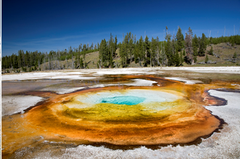
Archaea that survive in extreme temperatures such as hot springs. One of the hot springs of Yellowstone National Park is depicted.
halophiles
Archaea that survive in high salt conditions such as high salinity lakes. Picture is a high salt lake in California (I think).

Kingdom Protista (protists)
highly diverse single-celled organism of the old kingdom Protista. Grouped together because they are NOT plants, animals or fungi.
Kingdom Plantae
Land plants or Embryophytes. Autotrophic. Cells walls have cellulose.

Kingdom Fungi
Mushrooms, yeasts, other fungi. Heterotrophic. Many are decomposers. Cell walls have chitin.

Kingdom Animalia
Animals. Heterotrophic. Cells do not have cell walls.

Name the Four Traditional Kingdoms
Protists, Plants, Fungi, and Animals
binomial nomenclature
Formal system by which scientists give each species a unique scientific name. Each name has 2 parts (bi means 2).

common name of a species
vernacular name of an organism. Can sometimes be confusing or inaccurate in scientific community. For example, green frog.
scientific name of a species
binomial name given to a particular species. Comprised on a Genus name and specific epithet.

How do you hand-write a scientific name?
Underline both genus and specific epithet.
What are the two parts of a scientific name?
Genus and specific epithet.
What are some rules for naming species?
Genus = always capitalized, species = never capitalized Example: Homo sapiens. Name is always set off by type font.
phylogenetic tree
branching diagram showing the evolutionary relationships among various species (a phylogeny) based upon similarities and differences in their inherited traits

phylogeny
Same as a phylogenetic tree. A diagram showing the pattern of ancestry and descent.

shared-derived character
characters that are newly evolved and shared with members of a group. Same as synapomorphy. Hair is the shared derived character for the clade of the mammals (cat and kangaroo).

synapomorphy
characteristics present in an ancestral species & shared exclusively by its evolutionary descendants. Same as shared derived characters.
homologous characters
Characters that are the same or similar because they were inherited from a common ancestor. Note the yellow finger tips (phalanges) are homologous in all of the animals, even though they have different forms.

clade
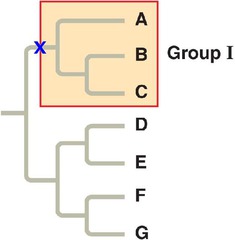
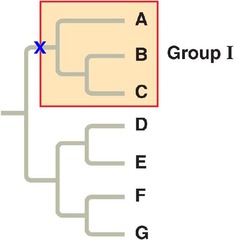
an ancestor and ALL of its decedents. Group 1 is a clade.
part of a tree: tip
represent the extant (living) species on a phylogenetic tree. The very ends or tips of branches.

part of a tree: branch
depict relationships among the tips of the phylogenetic tree

part of a tree: node
branching points. They identify a recent common ancestor that is extinct. Usually bifurcations or splitting into 2 parts.

common ancestor
an ancestor that two or more descendants have in common
polytomy
when the pattern of relationships in a phylogenetic tree is not clear and multiple branches are derived from one node. A branch splitting into three or more branches.

basal node
Node with the most ancestral lineage in the phylogeny. Number 1 in the picture.

part of a tree: root
represents the ancestral lineage

outgroup
more distantly related group of organisms that serves as a reference group when determining the evolutionary relationships of the ingroup.
sister taxa, sister species
The two closest relatives on the tree are called sister taxa. For example, wolves are the sister taxon to dogs. Chimpanzees are sister to humans.

What is the dental formula for humans
2-1-2-3 2 incisors, 1 canine, 2 premolars, 3 molars

Which teeth are used to determine the dental formula?
One fourth of your teeth, for example one side of your upper jaw.
diagnostic character
character that is unique to a species
Of what value is a key such as a key to mammal skulls?
You can determine the identity of a skull if it is unknown (for example, you found one in the woods).
What biological process is a key based on?
Evolution! It is because closely related organisms share similar phenotypic characteristic, but also have diagnostic or unique traits, that we can use a key.
What kind of characters are problematic if you are trying to create a phylogeny?
Characters that change a lot, for example height in humans. Or characters that are based largely on environment such as height in plants.
derived characters
Characters that occur more recently in time (compared to a specified node). More recent organisms inherited the characters. For example, hair was derived within the group mammals and was derived after the lineage to the lizard.

ancestral characters
Characters that occur older in time or closer to the root of a tree (comped to a specified node). Characters were present before the arrival of the specified node. For example, having four feet (tetrapod) is ancestral to mammals. In this picture hair evolved as an ancestral state in mammals and was lot in whales.

How is a clade identified on a phylogenetic tree?
It includes the node identifying the ancestor and all of the nodes and tips of the tree derived or descended from that ancestor.
shared derived character
An evolutionary novelty that is unique to a particular clade. Hair is a shared- derived character to the mammals (cat and kangaroo).

Clade
Group 1 is a clade. It has the ancestor and all the descendants (A, B, C)