Veterinary Influenza (Week 1, Mod 9)
 Studied by 0 people
 Call with Kai
 Learn
Learn Practice Test
 Spaced Repetition
 Match
Match Flashcards
 Knowt Play
1/17

There's no tags or description
Looks like no tags are added yet.
Name | Mastery | Learn | Test | Matching | Spaced | Call with Kai |
|---|
No study sessions yet.
18 Terms
What is the difference between an “enzootic” disease and an “epizootic” disease?
Enzootic means a disease is constantly present in an animal population at a low, predictable level
Epizootic is a sudden, widespread outbreak affecting a large proportion of animals, similar to an "epidemic".
Interspecies infection
Describe the general characteristics of Swine Flu… how long does it last? Symptoms?
Seasonal, explosive outbreaks in fall and winter.
Clinical disease lasts ~7 days
high fever
runny nose
lethargy
“goose honk” cough
reduced appetite!!!
Few animals develop pneumonia
High morbidity (~100%).
Low mortality
Describe the general characteristics of Equine Flu… how long does it last? Symptoms?
Enzootic in most countries
Clinical disease lasts ~5-10 days
fever
dry hacking cough
conjunctivitis
runny nose
muscular soreness
Few animals develop pneumonia
High morbidity in unvaccinated herds (~100%).
Low mortality (except for foals)
Donkeys SEVERELY affected
Describe the general characteristics of Canine Flu… how long does it last? Symptoms?
Enzootic in Asia (UK is free of disease)
Clinical disease variable: hyperacute (severe), 10-14 days (mild)
fever
runny nose
rarely pneumonia
Could be fatal in adult animals
Variable morbidity (home dogs vs kennel dogs).
Variable mortality
Describe the general characteristics of Bovine Flu… how long does it last? Symptoms?
Virus affects the MAMMARY GLANDS
Transmission possibly associated with milking equipment and/or human handling while milking
Recently emerged in USA
Clinical signs
low appetite
reduced milk production
abnormal appearance of milk (thickened, discolored).
Lactating cows most affected
Abortions?
No morbidity data available yet. Associated with cattle movement.
Low mortality
High levels of virus in milk (destroyed by pasteurization)
Diagnosis
PCR (milk)
Describe the general characteristics of Avian Flu (poultry)… how long does it last? Symptoms?
Enzootic in wild birds
Epizootic in poultry; infected BY wild birds
Clinical signs variable, two different possibilities:
Low pathogenicity influenza
Subclinical or mild respiratory disease
Anorexia
Lethargy
Decreased egg production
Ruffled feathers
High pathogenicity influenza
High mortality (sudden death)
Cessation of egg laying
Respiratory distress
Diarrhea, cyanosis, edema of the head.
Describe the general characteristics of Avian Flu (wild birds)… how long does it last? Symptoms?
MAINLY affects the GI tract if its a low pathogenicity infection… virus is then shed through feces
Low pathogenicity viruses cause mild or no disease. They infect the GI tract and transmit via faecal-oral route.
High pathogenicity viruses cause outbreaks and epizootics. They can affect the resp tract too.
Clinical signs variable (difficult to assess in wild birds)
High mortality
Swollen heads
Respiratory distress
Neurological signs
How does animal influenza impact pig production? (3 things…)
Weight loss
Poor growth
Can lose up to 12 pounds of body weight over a three to four-week period.
How does animal influenza impact poultry production? (4 things…)
Culling and compensation (HPAI)
Decline in egg production
Trading restriction
Infrastructural costs (biosafety)
How does influenza spread in general?
Either:
Direct contact
Indirect contact (fomites)
Aerosol transmission
Describe the structure of the influenza virus particle… what kind of genome do they have?
The influenza viruses are:
Pleomorphic (spherical and filamentous forms)
Are very sensitive to the environment; cannot withstand many chemicals or cleaners
negative strand RNA viruses
have a segmented genome (8 segments specifically), encapsidated into ribonucleoprotein complexes (RNPs)
form enveloped virions
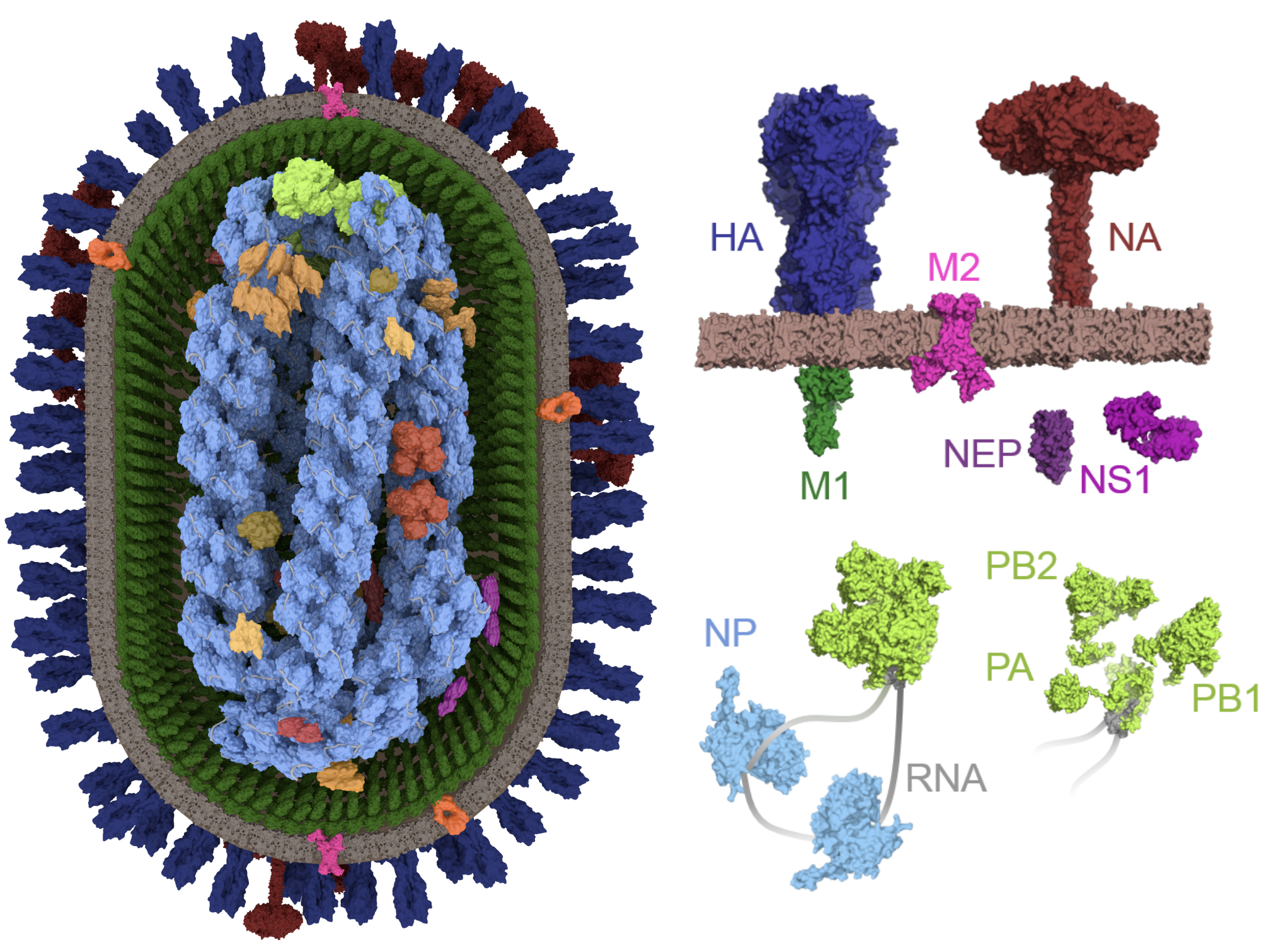
What are the two main surface proteins that can be found on the surface of influenza virions?
Hemagglutinin (HA)
Neuraminidase (NA)
What do we use to classify different influenza A viruses into subtypes? (ex: H1N1, H3N2, etc.)
The surface glycoproteins found on virion envelopes, hemagglutinin (HA) and neuraminidase (NA)
Classified based on what TYPE of HA or NA there is
HA → 1, 2, 3… 19
NA → 1, 2, 3… 11
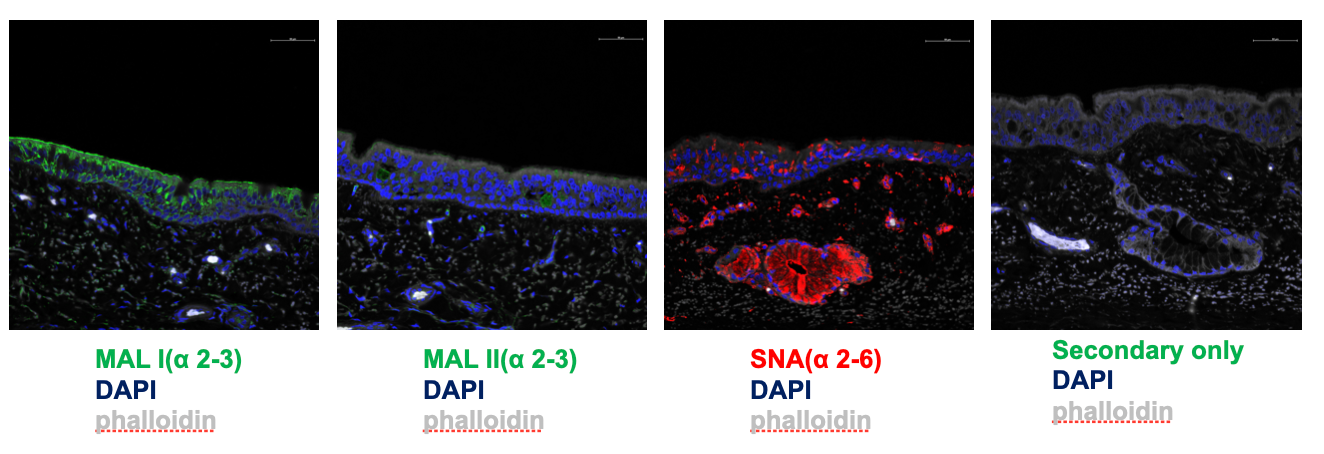
What is the main determinant of whether or not a virus will infect a certain species?
Hemagglutinin (HA)
Mediates virus attachment and entry based on whether or not that specific HA can bind to specific sialic acids (alpha 2,3 or alpha 2,6) found on the surface of that mammal’s cells
Determines the virus’ host range
What are the 2 different ways to diagnostically confirm an influenza virus infection? What are 3 things you need to consider for each method?
Virus detection and antibody detection
Virus detection:
Sample type: think about virus tropism.
What are you detecting to confirm virus presence? Think about virus structure.
When are you collecting your samples? Think about the duration of infection.
Antibody detection:
When is serology informative?
If virus is exotic.
If there is no vaccination with antigenically similar strains.
If you could detect a raise in Ab levels.
What is your antibody target?
Conserved proteins
Subtype-specific proteins (HA/NA)
Which animals are you sampling?
Because of the genomic structure of influenza viruses, what exactly do they need to replicate their genome that mammals don’t have? What does this inevitably lead to?
They need RNA-dependent RNA polymerases to copy their genomes
The virus itself has these
BUT these enzymes lack proofreading ability… this means that during replication, mutations are introduced that CANNOT be corrected
Means that the virus evolves
What are the 2 ways influenza viruses can evolve?
1) Mutation - discussed previously
2) Reassortment - when two different viruses infect the same cell… replication of both genomes leads to mixed genomic sequences, resulting in different kinds of viruses all together (see image)
Is usually what leads to pandemics

What animal is the MAIN CARRIER for influenza viruses?
WILD BIRDS