Reactivity
 Call Kai
 Learn
Learn Practice Test
 Spaced Repetition
 Match
Match Flashcards
 Knowt Play
1/11

Earn XP
Description and Tags
Name | Mastery | Learn | Test | Matching | Spaced | Call with Kai | Chat |
|---|
No analytics yet
Send a link to your students to track their progress
12 Terms
What is the difference between heat and temperature?
Temperature is a measurement of the average kinetic energy of particles in an object. Heat is a flow of energy from an object at a higher temperature to an object at a lower temperature
Law of Conservation of Energy
The total energy of an isolated system remains constant
Enthalpy (Heat content)
The total chemical energy inside a substance
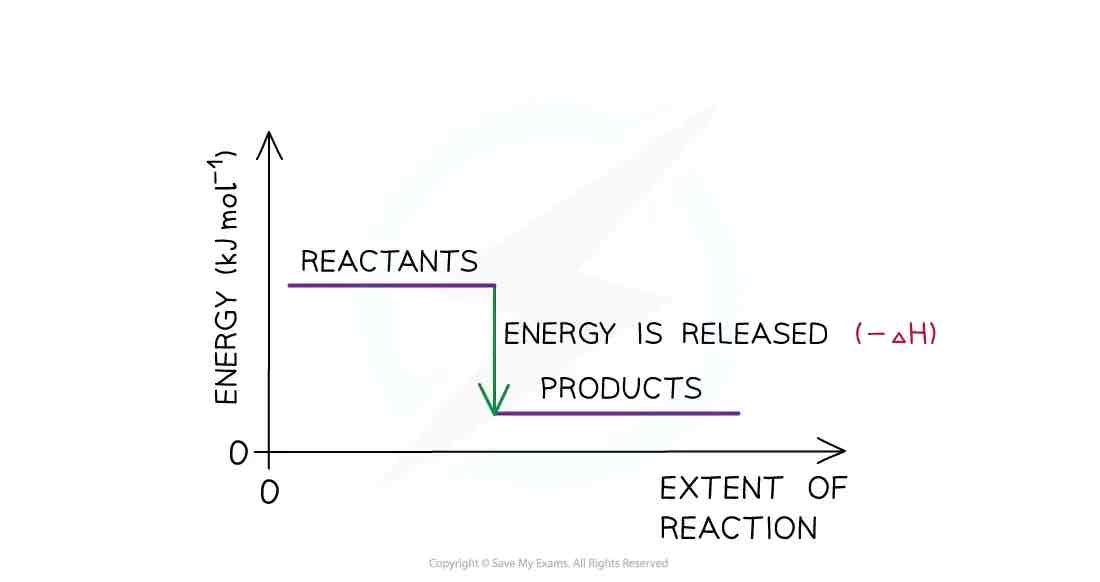
Exothermic Reaction
When the products have less enthalpy than the reactants.
ΔH is negative.
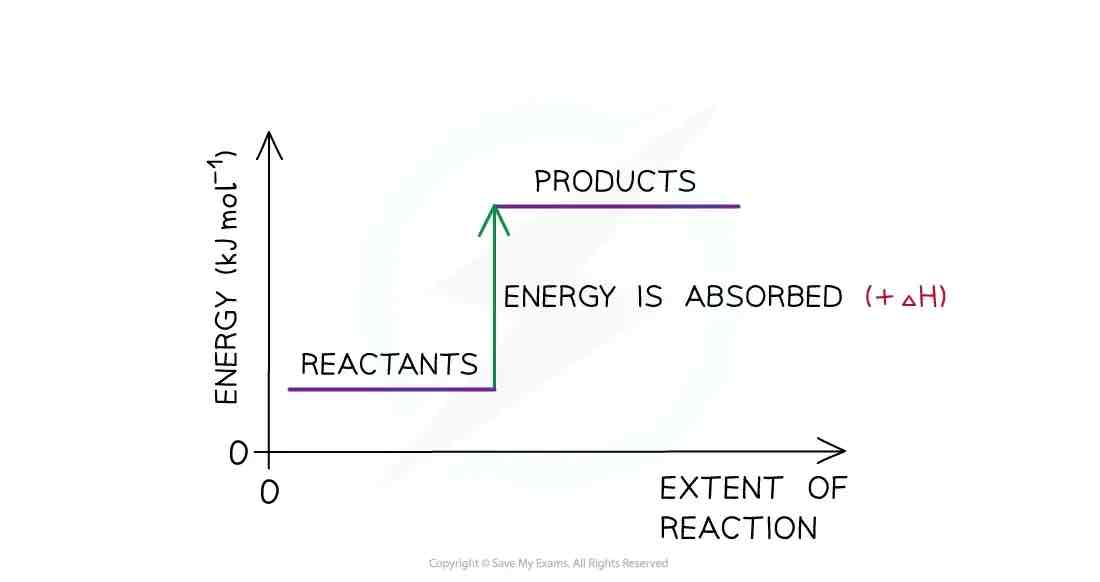
Endothermic Reaction
The products have more enthalpy than the reactants
ΔH is positive.
The transition state
A stage during the reaction at which chemical bonds are partially broken and formed. The transition state is very unstable - it can’t be isolated and is higher in energy than the reactants and products.
The activation energy (Ea)
The energy needed to reach the transition state.
The minimum amount of energy needed for reactant molecules to have a successful collision and start the reaction
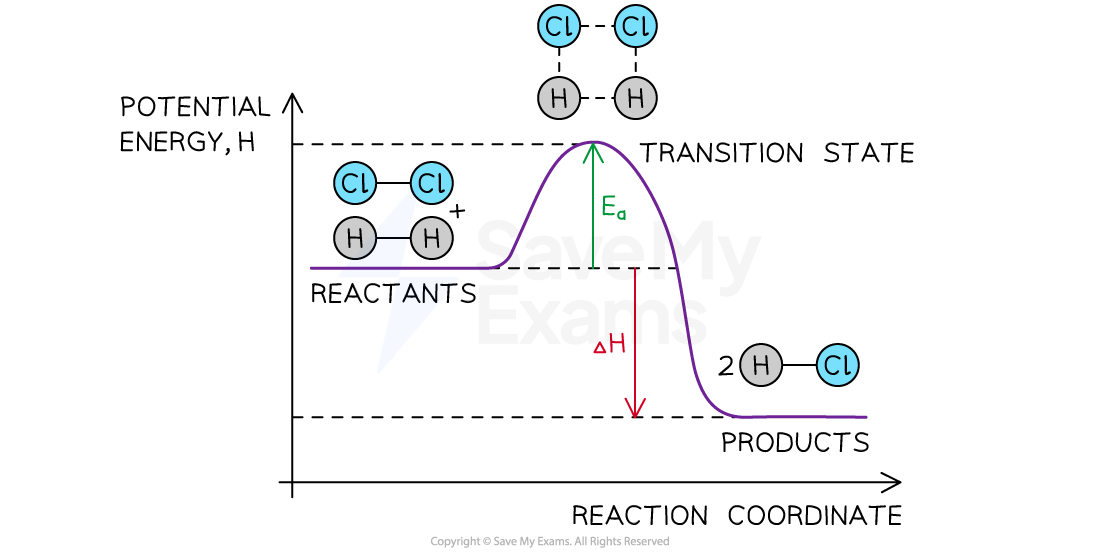
Which reaction has a lower activation energy, why?
Since the reactants are higher in energy than the products in exothermic reactions, thus they are closer in energy to the transition state. Hence, exothermic reactions have a lower activation energy compared to endothermic reactions.
What is the relationship between temperature and kinetic energy of particle?
The temperature of a substance is directly proportional to the average kinetic energy of the substance particles
Most combustion reactions are exothermic; how does the bonding in N2 explain the fact that its combustion is endothermic?
One factor is that the 2 nitrogen atoms in N2 are held very closely together via a triple bond. That takes a lot of energy to break. Reforming those bonds with oxygen restores some of that energy, but not enough to put the entire reaction into energy excess. Hence the reaction is called endothermic.
What conditions does the standard enthalpy change measured under?
a pressure of 100 kPa
Concentration of 1 mol/dm³
All substances in their standard states
298 K (Temperature)
The specific heat capacity
The heat needed to increase the temperature of a unit mass of a substance by 1 K.
heat added (q) = mass (m) x specific heat capacity x temperature change (ΔT)