chp. 3: energy, catalysis, and biosynthesis
 Call Kai
 Learn
Learn Practice Test
 Spaced Repetition
 Match
Match Flashcards
 Knowt Play
1/75

There's no tags or description
Looks like no tags are added yet.
Name | Mastery | Learn | Test | Matching | Spaced | Call with Kai | Chat |
|---|
No analytics yet
Send a link to your students to track their progress
76 Terms
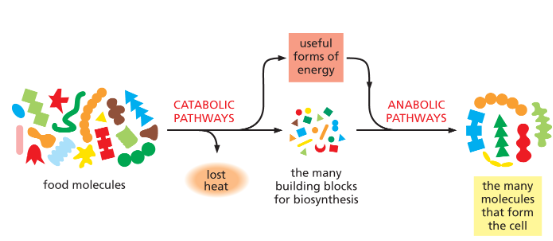
catabolism
BREAK down molecules = RELEASE ENERGY
increases disorder/spontaneous (-G)
energy can be released as heat too
OXIDATION!
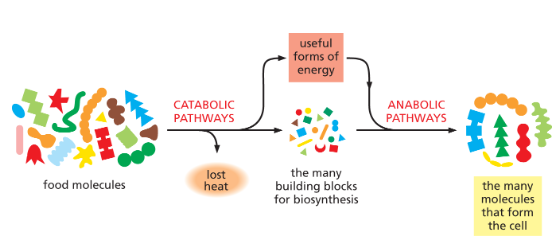
anabolism
BUILD larger molecules = REQUIRE input of energy
cause more order so they decrease the disorder/entropy of a system (+G)
REDUCTION!
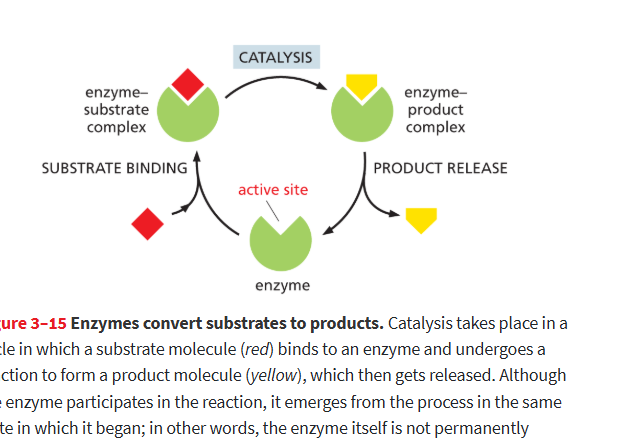
enzymes
catalyzes or accelerates reactions molecules can undergo, lowers activ. energy
highly specific/selective
remain unchanged after helping in a rxn
metabolism
The sum total of the chemical reactions that take place in the cells of a living organism.
catalysis controls metabolism

2nd law of thermodynamics
the total entropy (disorder) of an isolated system can only increase over time or stay the same for reversible processes
- transfer of energy releases heat, heat results in an increase in disorder
systems will change spontaneously toward those arrangements that have the greatest probability
entropy
Thermodynamic quantity that measures the degree of disorder in a system.
systems will change spontaneously toward arrangements with greater entropy.
how does heat relate to entropy?
Heat is energy in its most disordered form!
- heat energy produced by metabolic reactions is quickly dispersed into the cell’s surroundings. This dispersed energy increases the intensity of the thermal motions of molecules, thereby increasing the entropy of the cell’s environment
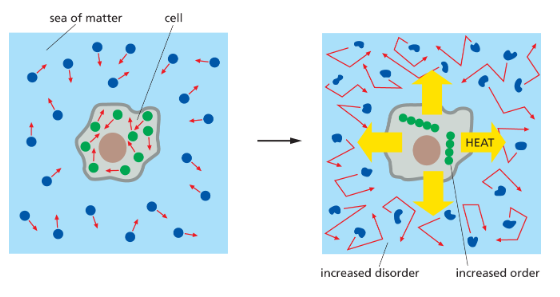
how do cells follow the 2nd law of thermodynamics?
A cell has to release enough heat so that any order it creates inside itself is balanced by more disorder in its surroundings. - In other words, even though the cell becomes more organized, the total disorder of the cell plus its environment still increases. Because of this, the overall entropy of the universe goes up, and the second law is satisfied.
1st law of thermodynamics
energy cannot be created or destroyed, but it can be converted from one form to another
(ex: converting sunlight energy into chemical bonds)
Although the chemical reactions that power such energy conversions can change how much energy is present in one form or another, the first law tells us that the total amount of energy in the universe must always be the same.
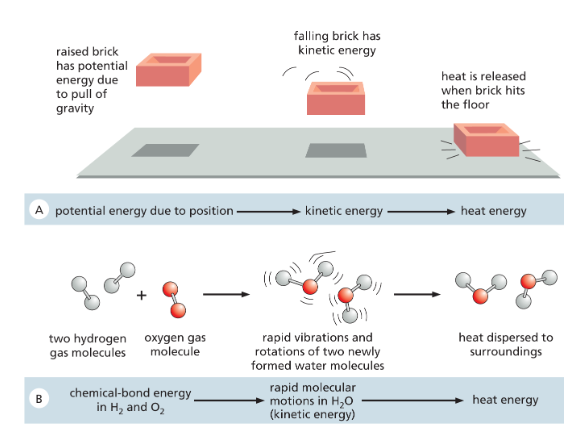
when is heat energy beneficial?
A cell only benefits from the heat it makes if it is directly connected to the processes that keep the cell organized. Unlike a fire, a cell uses its energy to build and maintain order instead of just wasting it.
energy coupling
how does all energy come from the sun?
plants = obtain energy directly from sun to make sugars, 02, organic molecules
animals = eat plants or other animals, but they also got energy from sun so all energy is from sun. release CO2 and H20
photosynthesis
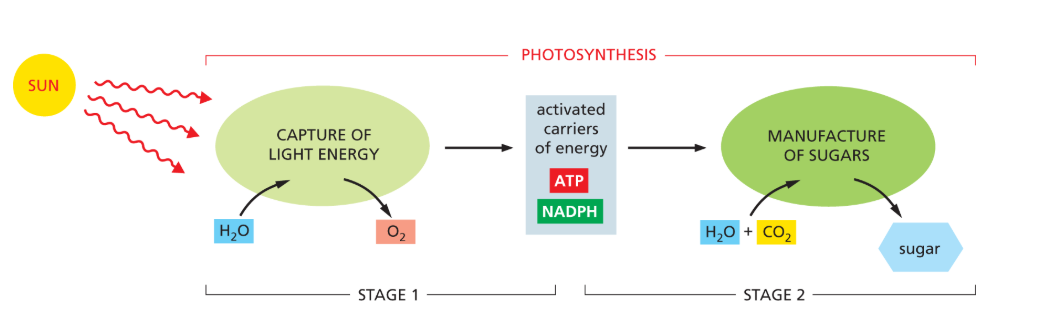
plants, algae, and some bacteria use the energy from sunlight to drive the synthesis of organic molecules, sugars and O2 from CO2 and water
synthesize monomers like fatty acids, a.a, sugar, and nucleotides
what are the 2 main stages in photosynthesis?
1) sunlight is captured and turned into chemical energy stored in special molecules called activated carriers (ATP/NADPH). Oxygen is generated during this stage when water is split.
2) carbon-fixation: that stored energy in activated carriers is used to turn carbon dioxide (CO₂) into sugars.
Overall, photosynthesis uses CO₂ and water to make sugars and oxygen.
autotrophs
organisms that make their own food (usually using sunlight or chemical energy).
Example: plants.
heterotrophs
organisms that cannot make their own food and must eat other organisms for energy.
Example: animals.
what happens in cell respiration?
cells harvest the energy stored in food molecules, accompanied by uptake of O2 and release of CO2.
sugars + O2 —> CO2 + H2O
this happens through the oxidation of organic molecules
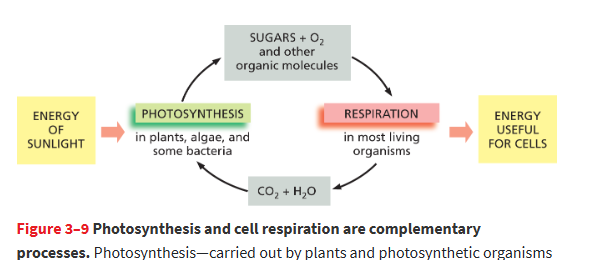
why is cellular respiration
Sugar + O₂ → CO₂ + H₂O + energy (more stable)
- Carbon and hydrogen are more stable when they are in CO₂ and H₂O.
- When sugar is gradually oxidized into these more stable molecules, energy is released.
The cell captures that released energy to make ATP instead of letting it escape as just heat.
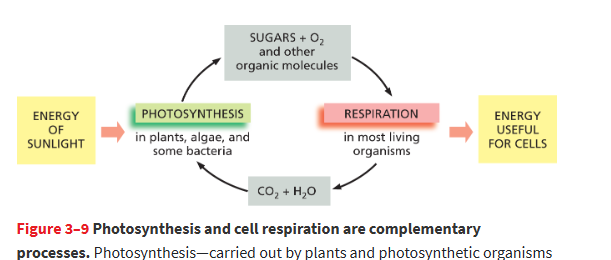
what happens to the oxygen released by photosynthesis?
it is consumed by organisms for the oxidative breakdown of organic molecules
the cell uses oxygen to slowly break down food molecules (like sugars, fats, or proteins) to release energy.
oxidation-reduction rxns
chemical reactions where electrons are transferred between molecules.
Oxidation = a molecule loses electrons
Reduction = a molecule gains electrons
They always happen together: when one molecule loses electrons, another gains them.
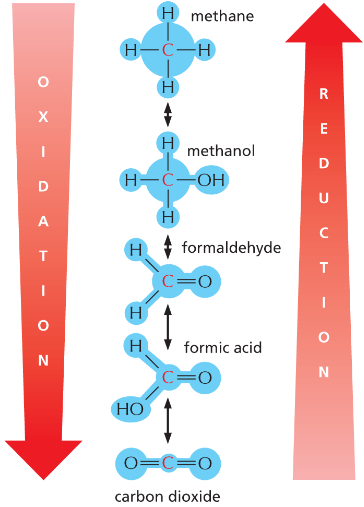
oxidation
removal of an electron (CATABOLIC)
occurs through the addition of an oxygen, or removal of an H
energetically FAVORABLE! = releases energy
always coupled w/ reduction!
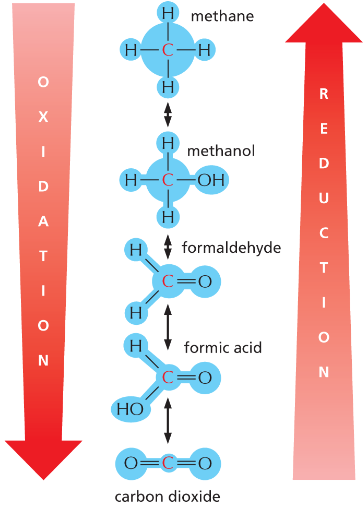
reduction
gaining of electrons (ANABOLIC)
can occur through the addition of an H or the removal of an Oxygen
energetically UNFAVORABLE = requires energy
always coupled w/ oxidation!
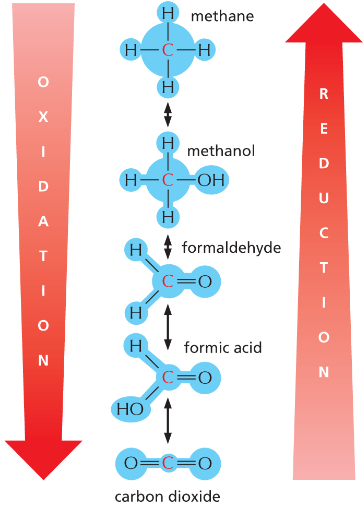
oxidation-redox still occurs w/ partial shifts of electrons
When carbon bonds to a more electronegative atom (like oxygen, chlorine, or sulfur), the electrons are pulled closer to that atom. The carbon loses some electron density, gets a slight positive charge (δ+), and is oxidized.
When carbon is bonded to hydrogen, it holds more electron density than usual, gets a slight negative charge (δ–), and is reduced.
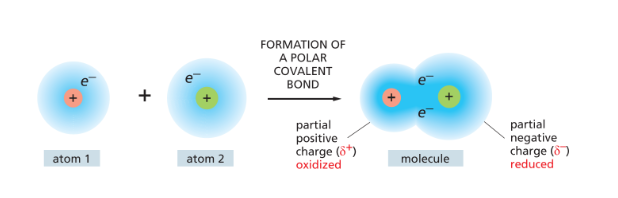
hydrogenation
ARE REDUCTIONS! the addition of more H
an increase in the # of C-H bonds indicates a reduction
dehydrogenation
ARE OXIDATIONS! The loss of H
a decrease in the # of C-H bonds indicates an oxidation
cellular respiration is predominantly….
oxidation
Glucose (C₆H₁₂O₆) is oxidized to CO₂ — it loses electrons. Oxygen is reduced to water (O₂ gains electrons). Energy is released.
Cellular respiration is catabolic: it breaks down complex molecules (glucose) into simpler ones (CO₂ and H₂O), releasing energy.
photosynthesis is predominantly…
reduction
CO₂ is reduced to glucose — it gains electrons (mostly from H in water). Energy from sunlight is used to drive this process.
Photosynthesis is anabolic: it builds complex molecules (glucose) from simpler ones (CO₂ and H₂O) using energy from sunlight.
is photosynthesis anabolic or catabolic?
anabolic: it builds complex molecules (glucose) from simpler ones (CO₂ and H₂O) using energy from sunlight.
is cellular respiration anabolic or catabolic?
catabolic: it breaks down complex molecules (glucose) into simpler ones (CO₂ and H₂O), releasing energy.
free energy (G)
the energy that can be harnessed to do work or drive chemical rxns
the greater the free energy change = the greater amt of disorder created in universe
which way do chemical rxns occur?
only in the direction that leads to a loss (-G) of free energy “downhill” aka energetically favorable
activation energy
The energy that must be acquired by a molecule to undergo a chemical reaction.
even energetically favorable rxns require activation energy to get them started
almost all r positive!
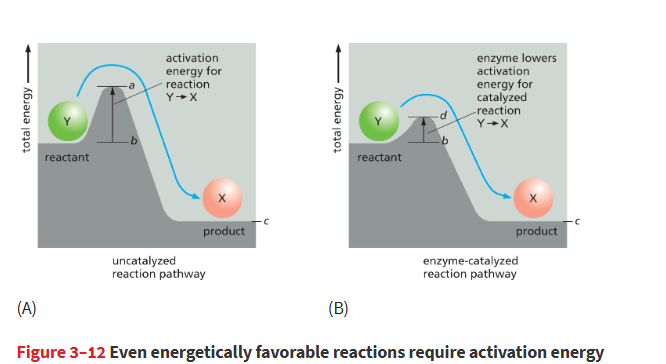
how do enzymes effect activation energy?
they reduce activation energy to increase the rate of spontaneous rxns
enzyme doesn’t change delta G (free energy diff btwn product and reactant)!
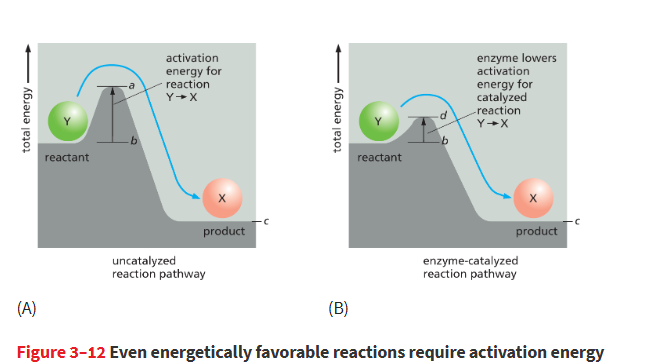
how does substrate binding in enzymes work?
Each enzyme binds tightly to one or two molecules, called substrates, and holds them in a way that greatly reduces the activation energy needed to facilitate a specific chemical reaction
catalyst
a substance that can lower the activation energy of a rxn
accelerates a chemical reaction by lowering its activation energy; (enzymes perform this role in cells.)
how do catalysts work?
boost the rate of chemical reactions (and lower activ. energy) because they allow a much larger proportion of the random collisions with surrounding molecules to kick the substrates over the energy barrier
free-energy change (delta G)
the difference in free energy between reactant and product molecules. A large negative value of ΔG indicates that the reaction has a strong tendency to occur/spontaneous
the amt of disorder created in the universe when a rxn involving these molec. takes place
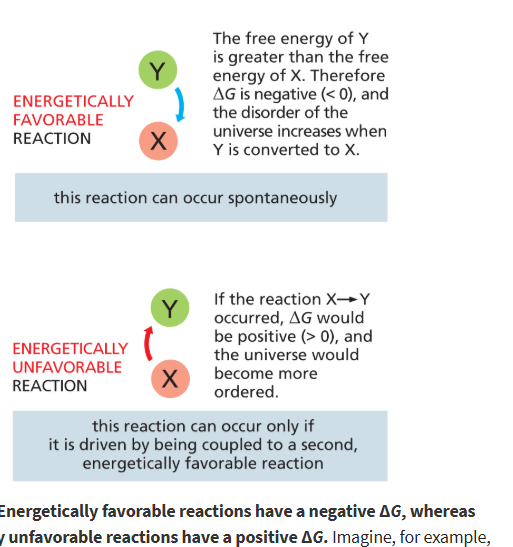
negative delta G
energetically favorable/spontaneous rxns!
create disorder by decreasing the free energy of a system
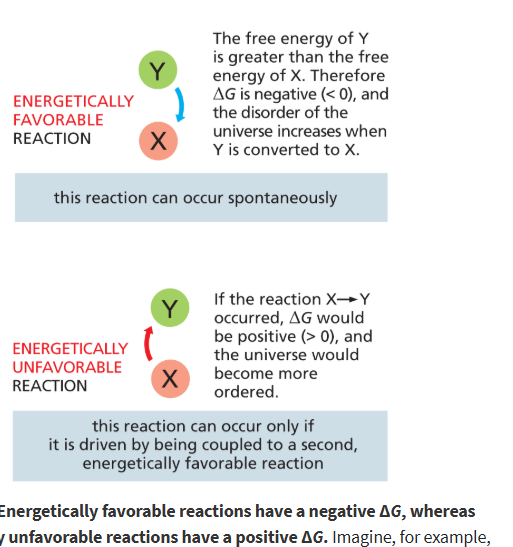
positive delta G
energetically unfavorable! create order in the universe
need input of energy and need to be coupled to an energy releasing rxn
equilibrium
State in which the forward and reverse rates of a chemical reaction are equal so that no net chemical change occurs.
delta G= 0
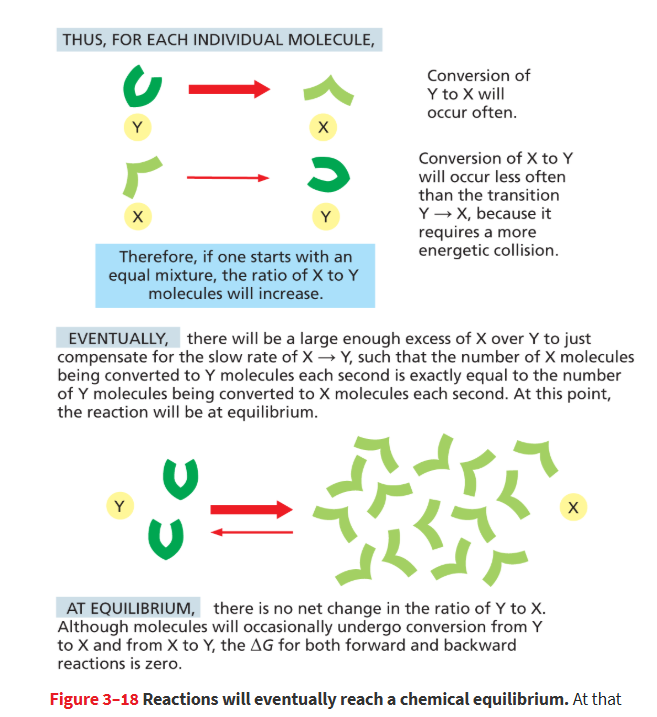
the direction a rxn proceeds depends on?
the energy stored in each indiv. molecule
the concentrations of the molecules in the rxn mixture
standard free energy change
The free-energy change measured at a defined concentration, temperature, and pressure
this is INDEPENDENT of concentration, depends only on intrinisic characters of molecules based on ideal conditions
The Equilibrium Constant Is Directly Proportional to ΔG°
equilibrium constant (k)
For a reversible chemical reaction, the ratio of substrate to product when the rates of the forward and reverse reactions are equal.
how rxns cause disorder
1) changes in bond energy of the reacting molecules can cause heat to be released, which disorders the environment around the cell
2) the rxn can decrease the amt. of order in the cell by breaking apart a long chain of molecules or by disrupting an interaction that prevents bond rotations
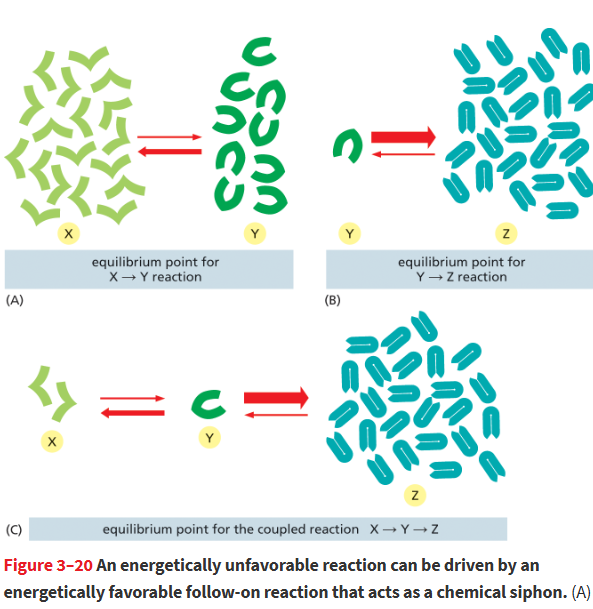
for sequential rxns, changes in free energy are additive
The unfavorable reaction, X ⟶ Y, will not occur spontaneously. However, it can be driven by the favorable reaction Y ⟶ Z, provided that the second reaction follows the first. That’s because the overall free-energy change for the two reactions is equal to the sum of the free-energy changes for each individual reaction.
rxn coupling
diffusion
Process by which molecules and small particles move from one location to another by random, thermally driven motion.
enzyme catalyzed rxns depend on rapid molecular collisions
the substrate is the one that finds the enzyme cuz it moves faster and collides more
what allows enzymes to bind specific molecules?
NONCOVALENT INTERACTIONS!
substrate stays bound to the enzyme through weak noncovalent interactions like hydrogen bonds which keeps them bound long enough for rxn to occur
If the substrate doesn’t fit well, it won’t stay attached, so the enzyme only works on the right molecules.
The Equilibrium Constant Reflects the Strength of Noncovalent Binding Interactions
Weak (noncovalent) interactions let molecules like enzymes, proteins, and DNA stick together in cells.
Molecules bind when it lowers their energy. The equilibrium constant (K) shows how strong the binding is: bigger K = stronger binding.
activated carrier
A small molecule that stores energy or chemical groups in a form that can be donated to many different metabolic reactions.
contain 1+ energy rich covalent bonds
Examples: ATP, acetyl CoA, and NADH/NADPH
they store energy as a readily transferable chemical group or as trasnferable high energy electrons
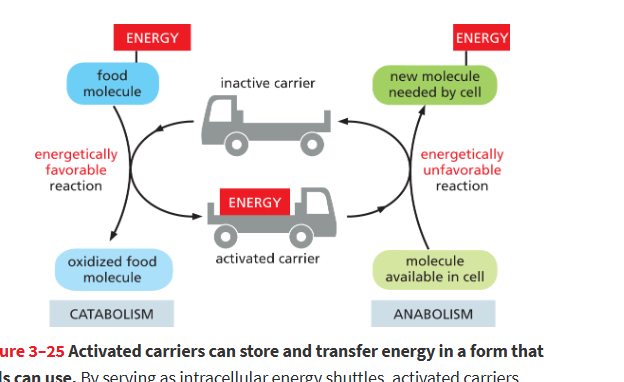
coupled rxn
Linked pair of chemical reactions in which free energy released by one reaction serves to drive the other reaction.
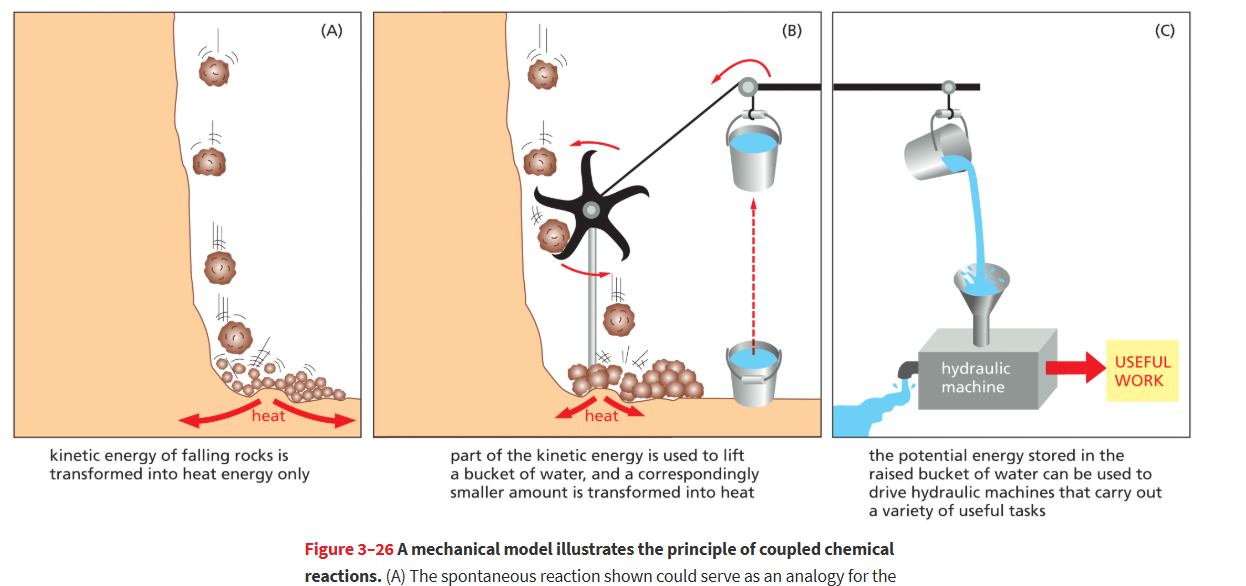
The Formation of an Activated Carrier Is Coupled to an Energetically Favorable Reaction
enzymes couple an energetically favorable reaction, such as the oxidation of food molecules, to an energetically unfavorable reaction, such as the generation of activated carriers
forming activated carriers needs energy (unfavorable)
what is the most widely used activated carrier?
ATP
it is a convenient store of energy to drive chemical rxns
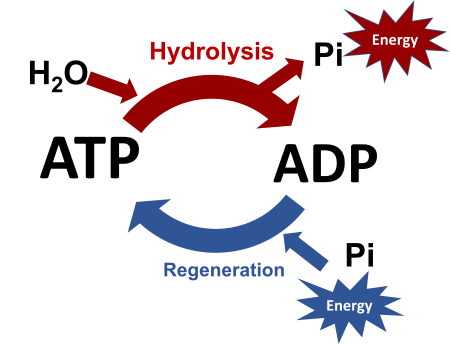
ATP is synthesized in an unfavorable phosphorylation rxn where a P is added to ADP.
When energy is needed, ATP will give up a phosphate through a favorable hydrolysis to go back to ADP and a phosphate
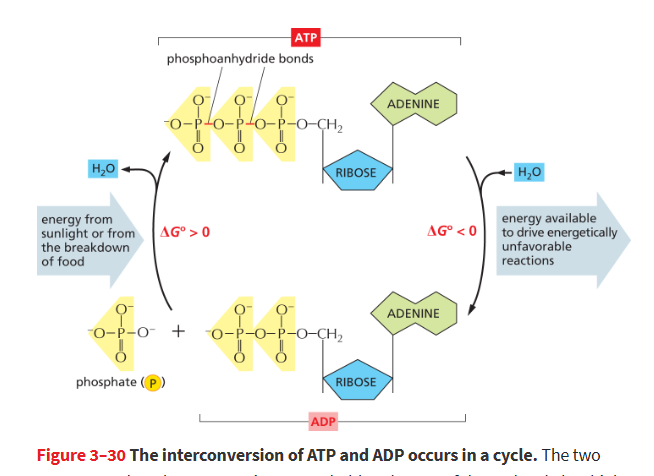
phosphorylation
any rxn involving the transfer of a phosphate group to a molecule
phosphorylations r considered condensation rxns cuz a water molecule is released
ATP hydrolysis
very enegetically favorable, releases energy
release of terminal P group removes unfav. repulsion btwn adjacent negative charges.
The P ion released is stabilized by favorable H-bond formation w/ water
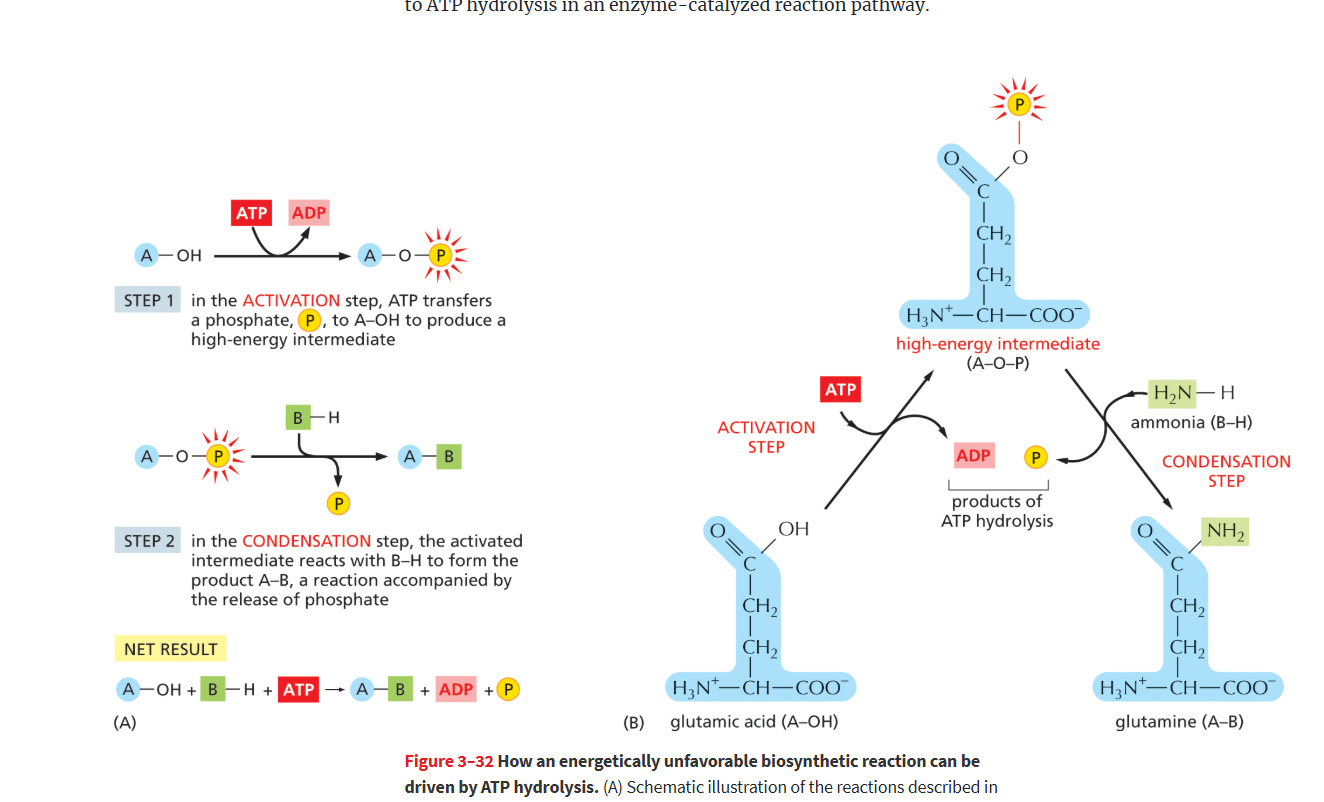
How does ATP join 2 molecules together?
Activation step: ATP is used to make a high-energy intermediate
Condensation step: This activated intermediate then reacts with B to form A–B.
By coupling the reaction to ATP hydrolysis, the cell can drive an otherwise unfavorable reaction forward.
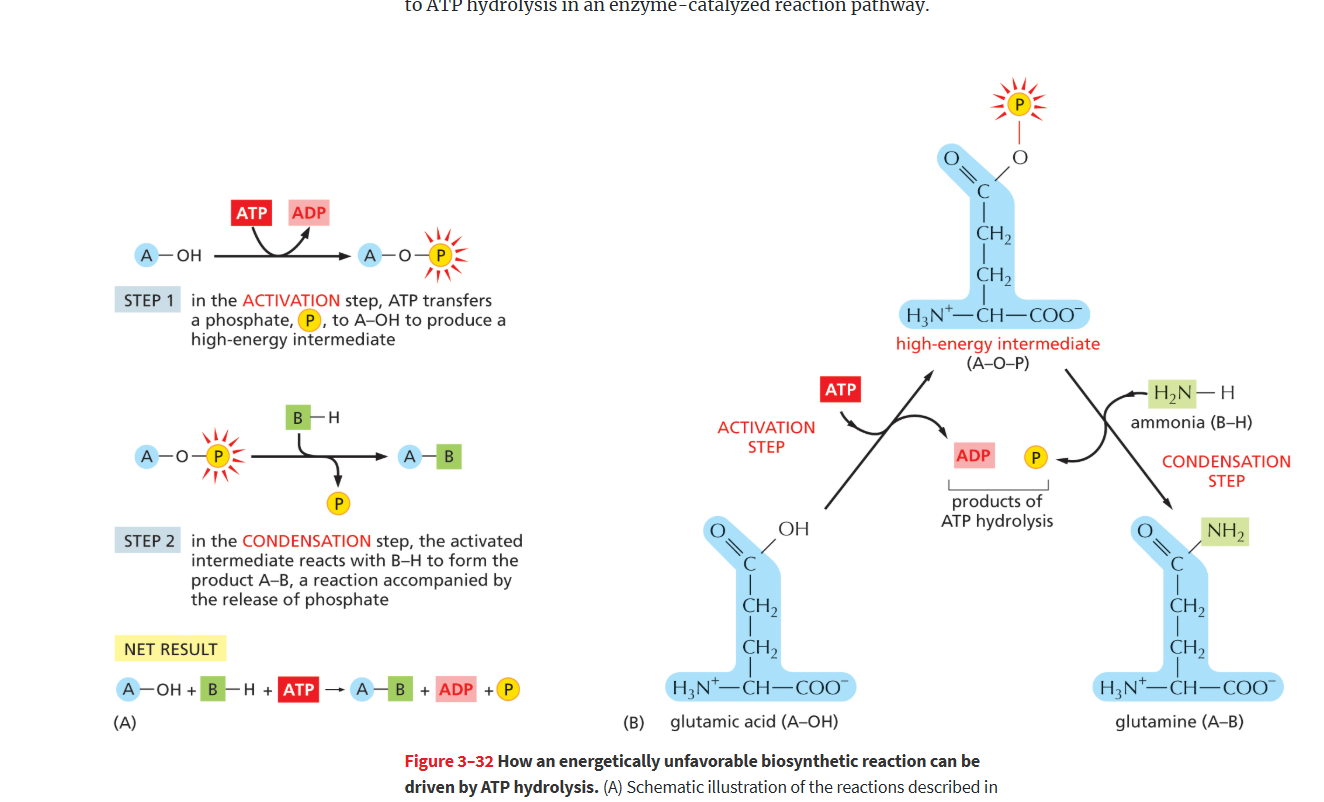
1) Activation step in ATP rxn coupling
ATP transfers a P to one reactant to produce a high-energy intermediate
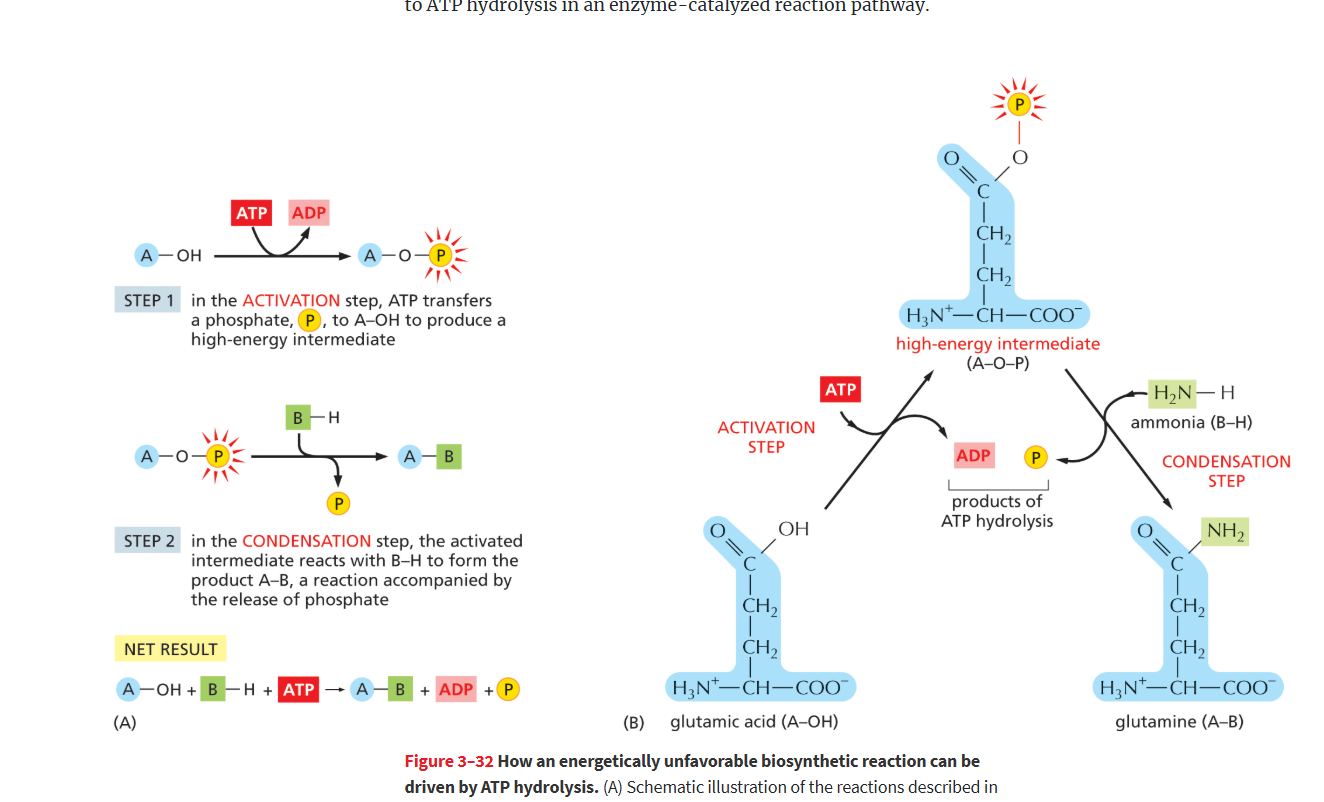
2) condensation step in ATP rxn coupling
The activated intermediate reacts w/ B-H to form A-B, and releases the phosphate
this condensation rxn is unfavorable but it has been coupled to ATP hydrolysis so itll occur
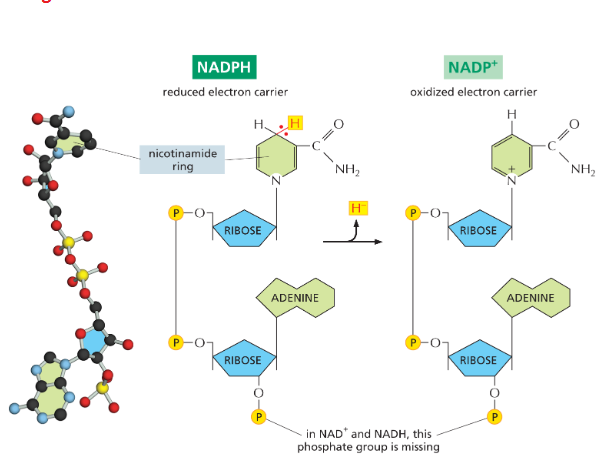
NADH and NADPH
They r activated carriers that both carry energy in the form of 2 high energy e- and 1H+
together form a hydride ion (H-)
when they pass their hydride ion to a donor molecule, they become oxidized to NAD+ and NADP+
NADPH
an activated carrier that participates in many important biosynthetic reactions that would otherwise be energetically unfavorable
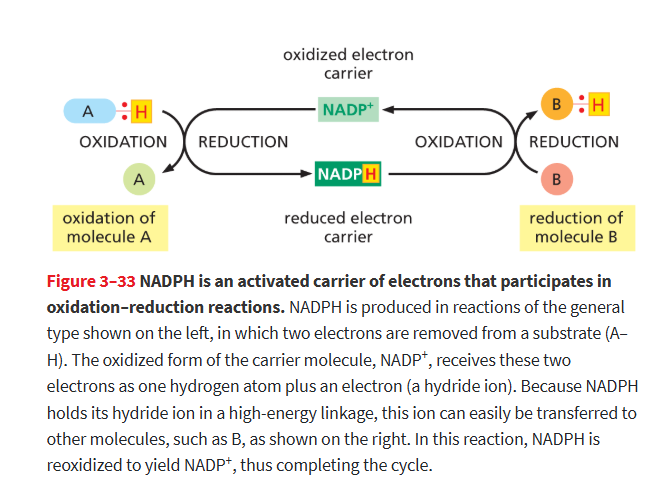
How is NADPH made?
a hydride ion is removed from the substrate molecule and added to the nicotinamide ring of NADP+ to form NADPH.
This is a typical oxidation–reduction reaction: the substrate is oxidized and NADP+ is reduced
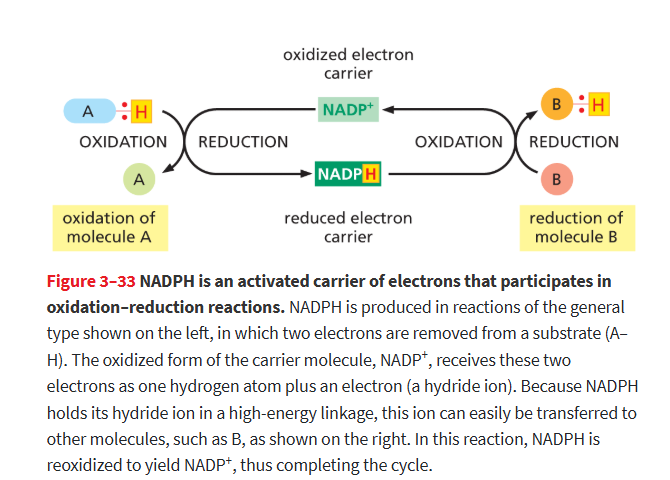
When is NADPH stable?
NADPH donates its high energy H- which oxidizes NADPH to NADP+
This reaction releases energy because NADP⁺ is more stable/favorable after losing those electrons.
NADPH → NADP⁺ + electrons
is a favorable (energy-releasing) oxidation reaction.
NAD+ is a ____________ used during cellular respiration
oxidizing agent
NADPH is produced during photosynthesis and used as a __________ during glucose metabolism
reducing agent
NADH and NADPH different roles
NADPH has one extra phosphate group. This small difference lets them bind to different enzymes, so they do different jobs in the cell.
NADPH is mainly used in anabolic reactions (building molecules). It provides high-energy electrons to help make things like fats and other biomolecules.
NADH is mainly used in catabolic reactions (breaking down molecules). It helps generate ATP by transferring electrons during cellular respiration.
when is NADPH used?
in REDUCING AGENT IN anabolic rxns (building molecules). It provides high-energy electrons to help make things like fats and other biomolecules.
High NADPH and low NADP⁺ → so NADPH can help build molecules. (reduce)
NADPH = building up (anabolism)
reduction = anabolism
when is NADH used?
in OXIDIZING AGENT IN catabolic reactions (breaking down molecules). It helps generate ATP by transferring electrons during cellular respiration.
High NAD⁺ and low NADH → so NAD⁺ can help break down food.(oxidize)
NADH = breaking down (catabolism)
oxidation = catabolism
acetyl-CoA
another important activated carrier that contains an acetyl group attached via a high energy sulfur bond
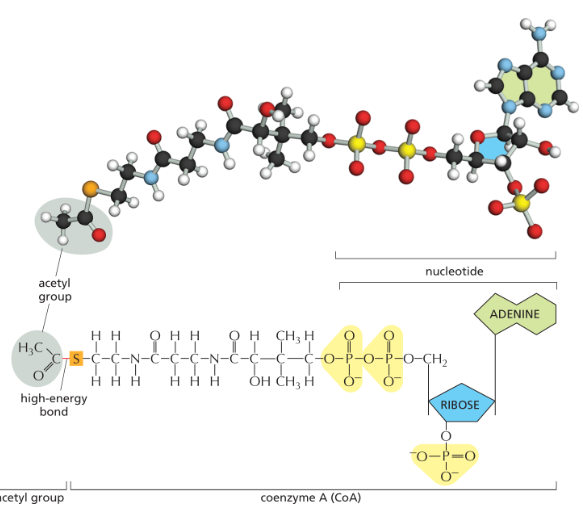
Other activated carriers in cells
Activated carriers are usually generated in reactions coupled to ATP hydrolysis cuz they r unfavorable to make
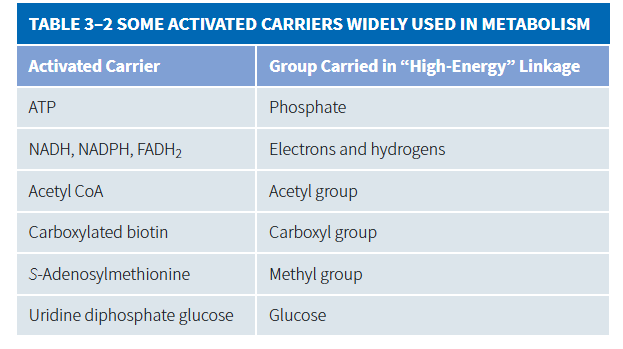
hydrolysis rxn
breaking the bond using water
Energetically favorable
Happens easily during digestion and metabolism
Does NOT use ATP
Releases energy
polymers broken down
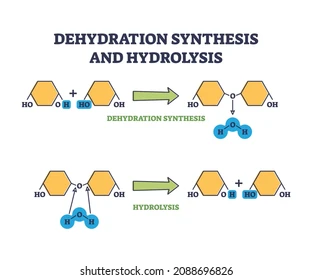
condensation rxn
They require an input of energy, so energetically UNFAVORABLE
In cells, enzymes and activated intermediates are used to make this happen
Requires energy → ATP (directly or indirectly)
produce water as a byproduct when two molecules combine to form a larger on
How does a spontaneous reaction differ from a nonspontaneous reaction?
A spontaneous reaction releases free energy and can occur on its own (ΔG < 0), while a nonspontaneous reaction requires an input of energy to proceed (ΔG > 0). Spontaneous does not mean fast—it only means energetically favorable.
What is the activation energy barrier of a chemical reaction and how can it
be overcome?
the initial energy needed to start a reaction. Cells overcome this barrier using enzymes, which lower the activation energy and speed up the reaction without being used up.
What is the equilibrium point of a chemical reaction?
when the forward and reverse reactions occur at the same rate, so the concentrations of reactants and products remain constant.
What are energy carrying molecules and how do they carry and transfer
energy?
Energy-carrying molecules like ATP, NADH, and NADPH temporarily store energy and transfer it by donating phosphate groups or high-energy electrons to power cellular reactions.
Carbon atoms cycle continuously through the biosphere. Which of these is produced by cell respiration, and what state of carbon does this by-product represent?
CO2; completely oxidized carbon
Small molecules diffuse through the cytosol very efficiently by doing what?
Although it doesn’t sound very efficient, small molecules in solution are bounced around by moving randomly getting knocked around and colliding with other molecules. Such interactions allow them to diffuse through the cytosol randomly but rapidly.