chem instrumentation 2
 Call Kai
 Learn
Learn Practice Test
 Spaced Repetition
 Match
Match Flashcards
 Knowt Play
1/73

There's no tags or description
Looks like no tags are added yet.
Name | Mastery | Learn | Test | Matching | Spaced | Call with Kai | Chat |
|---|
No analytics yet
Send a link to your students to track their progress
74 Terms
Spectrophotometry
measurement of intensity of light at selected wavelengths, photometric instruments measure light intensity, radiant energy that passes through an object will be partially reflected, absorbed, and transmitted
Spectrophotometry principles: energy is transmitted via electromagnetic waves that are characterized by their frequency and wavelength, frequency:
how often a repeating even takes place. It is the number of waves occurring per unit of time
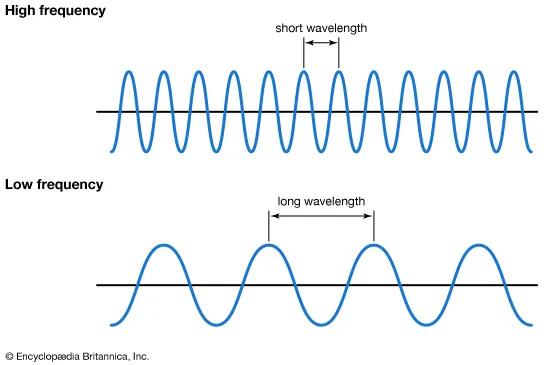
Spectrophotometry principles: energy is transmitted via electromagnetic waves that are characterized by their frequency and wavelength, wavelength:
the distance between two crests that is measured in nanometers !, the frequency of a wave is inversely proportional to the wavelength, therefore the energy of electromagnetic radiation is inversely proportional to wavelength

spectrophotometry principles: light is composed of discrete energy packets called
photons, whose energy is inversely proportional to the wavelength (visible light between 380-400 violet and 700-750 red) !
absorbance and transmittance steps
a beam of monochromatic light enters a solution
some of the light is absorbed
the remainder light passes through, strikes a light detector, and is converted to an electric signal (% transmittance= the ratio of the radiant energy transmitted (T) divided by the radiant energy incident on the sample (I))
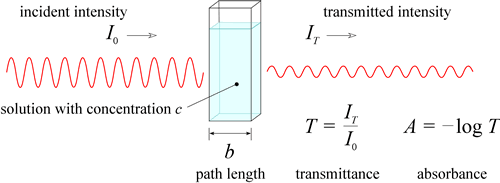
reason for running blank on absorbance and transmittance
some of the incident light may be reflected by the surface of the cell or absorbed by the cell wall or solvent, this is eliminated by using a reference cell, blank, that is identical to the sample cell. (blank is 100% T, the sample is %T= sample bean sample/blank beam signal x 100)
absorbance
amount of light absorbed as incident light passes through a sample. It is derived mathematically from %T from %T = transmitted light/incident light x 100, so absorbance A= -logT or A= 2 -log%T !
Beer’s law
the concentration of a substance is directly proportional to the amount of light absorbed or inversely proportional to the logarithm of the transmitted light, beers law is A = Ebc (E = constant, b = distance that light travels in cm, c = concentration of the absorbing compound usually in grams/liters) A = c absorbance is directly proportional to concentration !, absorptivity x light path x concentration !
rank of electromagnetic radiation from low energy to high energy
microwaves, infrared, visible, UV, x-rays, gamma
absorbance of a solution in spectrophotometric formula
absorptivity x light path x concentration !
Spectrophotometer
an instrument used to measure the light transmitted by a solution to determine the concentration of the light absorbing a substance in the solution
spectrophotometric instrument principle of operation
beam of light is passed through monochromator that isolates the desired region of the spectrum to be used for measurements
slits are used to isolate in narrow beams of the light and improve its chromatic purity
light passes through the sample cell (cuvette), where a portion of the radiant energy is absorbed depending on the nature and concentration of the substance in the solution
any light not absorbed is transmitted to a photodetector, which converts light energy to electrical energy that is registered on a meter or recorder or digitally displayed
light source of spectrophotometer visible range
the incandescent tungsten or tungsten-iodide lamp is the most common source of light for work in the visible and near-infrared regions. A heat-absorbed filter is often inserted between the lamp and the sample to absorb the infrared radiation
light source of spectrophotometer UV range
the lamps usually used for ultraviolet (UV) work are the deuterium discharge lamp and the mercury arc lamp
the most important factors for a light source are in spectrophotometer
range and special distribution within the range, source of radiation production, stability of the radiant energy, temperature
components of a spectrophotometer: monochromator
optical device that provides a means to isolate a single wavelength or band of wavelengths of light ! while excluding other wavelength (stray light) !
monochromator 3 components
colored glass filter: pass a relatively wide band of light and have a low transmittance of the selected wavelength, simple and inexpensive
simple glass prism: a narrow beam of light focused on a prism is refracted as it enters the denser glass
diffraction gratings: commonly used, diffraction is the separation of light into component wavelengths. Diffraction gratings consist of many parallel grooves etched onto a polished surface. Wavelengths bend as they pass a sharp corner. The degree of bending depends on the wavelength
components of a spectrophotometer, sample cell (curvette)
quality: each cuvette to be tested is filled, readings are taken, and results are compared against an acceptable tolerance range
light path: the light path must be kept constant to have absorbance proportional to concentration
shape: cuvettes typically have a flat surface; square cuvettes have plane-parallel optical surfaces and a constant light path
surfaces: cuvettes with scratched surfaces scatter light and should be discarded
types: glass cuvettes (inexpensive) are for the visible ranges, but absorb light in the UV region; quartz cuvettes (expensive) enable transmission of light are used when substances absorb in the UV region
components of a spectrophotometer, photodetector (converts light into an electrical signal that is proportional to the number of photons striking its photosensitive surface)
Barrier-layer cells (photocells): contains a photosensitive material that gives off electrons when light energy strikes it; it requires no external voltage source but relies on internal electron transfer to produce a current in an external circuit; inexpensive and durable but temperature sensitive and nonlinear at very low/high levels of illumination
phototube: contains cathodes that emit electrons when exposed to light; an outside voltage is required for operation
photomultiplier (PM) tube: detects and amplifies radiant energy; uses amplification techniques to make this type of photodector 200 times more sensitive than a phototube
photodiode: not as sensitive as PM tubes; but have excellent linearity, speed, and a small size, has the ability to read the whole visible spectrum in less than 1 second
Spectrophotometric instruments, single-beam vs double-beam spectrophotometers
single-beam: the absorbance reading from the sample must be blanked using an appropriate reference solution that does not contain the compound of interest
double-beam: permit automatic correction of sample and reference absorbance
what is the purpose of a monochromator
to isolate a single wavelength or band of wavelengths of light !
spectrophotometer quality assurance
wavelength accuracy: the wavelength indicated on the control dial is the actual wavelength of light passed by monochromator
stray light: refers to any wavelengths outside the band transmitted by the monochromator; stray light causes include reflection of light from scratches on the optical surfaces or from dust particles anywhere in the light path; the major effect is absorbance error in the high absorbance range, limits accurate measurement of upper end of linearity !
linearity: demonstrated when a change in concentration results in a straight-line calibration curve
Spectrophotometer QA, finding the concentration of an unknown sample
if a linear relationship between absorbance and concentration exists, concentrations of unknown solutions can be calculated by comparing it to a known calibrating solution. std absorbance/std conc = unknown absorbance/unknown conc ! or unknown conc = unknown absorbance x std conc/std absorbance
Spectrophotometer QA, linearity and measurement errors
absorbance should be 0.1-0.7 or transmittance of 20%-80% (if transmittance <20 dilution, >80 check calibration, absorbance >0.7 dilution,<0.1 rerun! )
stray light in a spectrophotometer places limits on the instruments ability to accurately measure
absorbance at the upper end of the range of linearity !
a manual glucose assay is performed using a single 175 mg/dl standard. Upon analysis, the absorbance of the standard is 0.655. the absorbance of a patient sample is 0.455 what is the concentration of the patients sample
119 mg/dl
atomic absorption spectrophotometry (AAS) overview
AAS is used to measure concentration by detecting the absorption of electromagnetic radiation by atoms rather than by molecules !, sensitive and precise, used for trace metals: aluminum, calcium, copper, lead, lithium, magnesium, and zinc, element is excited and radiant energy is produced and measured as light at a particular wavelength from a hollow cathode lamp is emitted !
AAS step by step
sample is heated to form a vapor gas; the element is excited to cause dissociation from its chemical bonds (atomized)
sample is atomized or nebulized into the flame
the atoms in the flame are capable of absorbing light which correspond to its own line spectrum
a hollow cathode lamp is used to emit a wavelength of light specific to the material being analyzed; the cathode is made of the material to be analyzed highly specific from the element being measured
when the light beam enter the flame, some of the light is absorbed by the atoms in the flame, resulting in a net decrease into the intensity of the beam from the lamp
the light transmitted is measured by the detector
AAS limitations
inability of the flame to dissociate samples into free atoms, ioization of atoms follwoing dissociation by the flame, which can be decreased by reducing the flame temperature, matrix interference
fluorometry
occurs when a molecule absorbs light as a one wavelength and reemits light as a longer wavelength (lower engery) !; fluorometers measure the concentrations of solutions that contain fluoresecning molecule (fluorophores), measurements are related to molar absorptivity of the compound, F = K I O Ebc
fluorometry equation meaning
F = measured fluorscence intensity, K = instrument constant, I = intensity of the excitation light source, O = quantam yield (the fraction of absorbed photons that actually get re-emitted as flueorscent light) E = molar absorptivity, b = path length of the cuvette, c = concentration of the compound (increasing concentration decreases absorbance and vise versa)
fluorometry sequence of events
the absorption of light energy by a fluorophore causes an electron to change from the ground state to an excited state
once excited the molecule than loses some of the energy before returning to a lower energy state with the emission of light energy
the emitted fluorescence light has less energy than the excitation light
the difference between the excitation wavelength and the emitted wavelength light has a constant for each molecule, which is referred to as the Stokes shift ! (a measure of energy lost during the lifetime of the excited state before return to the ground state)
Fluorometry instrumentation
excitation source: emits short-wavelength high-energy excitation light, attenuator: controls light intensity, primary filter: selects the wavelength that is best absorbed by the solution to be measured sample holder: the fluorescing sample in the cuvette emits radiant energy in all directions, secondary filter: passes the longer wavelengths of fluorescent light and prevents incident light from striking the photodetector, detector: placed at right angles to the sample cell, the electrical output of the photodetector is proportional to the intensity of fluorescent energy
Fluorescence polarization
FPIA: emits polarized light along the same plane as the incident light if the fluorophore does not rotate in solution, widely used for the detection of therapeutic and abused drugs, in the procedure the sample analyte is allowed to compete with a fluorophore-labeled analyte for a limited antibody to the analyte, technique using rotation of small vs large labeled molecules !
Fluorometry advantages and disadvantages
specificity and sensitivity, disadvantages is that fluorescence is very sensitive to environmental changes
found only in a fluorometer used to make measurements of emitted fluorescent light as opposed to in a spectrophotometer used to make measurements of absorbed/transmitted light !
an excitation source
Chemiluminescence overview
chemical energy generated produced excited intermediates that decay to a ground state with the emission of photons, emission of light when an electron returns to a lower energy state from a higher energy state; the excitation even is caused by a chemical reaction (no excitation radiation is required and no monochromators are needed because the chemiluminescence arise from one species)
Chemiluminescence advantages and disadvantages
subpicomolar detection limits, speed measured for, ease of use, and simple instrumentation, disadvantage impurities can cause a background signal that degrades the sensitivity and specificity
Turbidimetry and nephelometry overview
methods used to measure scattered light, light scattering: a physical phenomenon that results from the interaction o flight with particles in solution
Nephelometry
detection and measurement of light energy scattered or reflected toward a detector that is not in the direct path of the transmitted light; common nephelometers measure scattered light at right angles to the incident light !(some are designed to measure scattered light at an angle ither than 90)
Turbidimetry
detection and measurement of a decrease in intensity of an incident beam of light as it passes through a solution of particles; measurement is made at a 190 orientation to the incident light
turbidimetry and nephelometry factors affecting light scatter include:
particle size
wavelength of incident light: the intensity of light scattering increases as the wavelength of the incident light is decreased
distance of observation: light intensity decreases as the distance from the detector increases; the detector should be located close to the analytical cell
effect of polarization of incident light: polarized light also has specific pattern of scatter depending on the size of the particle
concentration of the particles: there is a direct relationship of light scattering to the concentration of particles
molecular weight of particles: there is direct relationship of light scattering to the molecular weight of particles
particle size turbidimetry and nephelometry
smaller than the wavelength of the incident light, each particle is subjected to the same electrical field strength at the same time; the scattered light waves are in phase and reinforce each other, as particles become larger than the incident light wave - the wave are no longer all in phase; reinforcement of radiation occurs in some directions, and destructive interference occurs in others
Turbidimetry and nephelometry limitations of light scattering measurements: antigen excess
third phase of kinetics of immune complex formation measured, 1. antibody excess 2. equivalance
limitations of light scattering measurements: matrix effects
any particles, such as dust or serum macromolecules, that are present in solution can scatter light
what nephelometry is correct
In a nephelometric procedure, the measurement of scattered light that is not in the direct path of the transmitted light is made at right angles to the incident light
what will a elevated lipid (milky appearance) do to the light scatter
the lipemic specimen will produce interfering background light intensity and excess light scatter in this type of assay !
Electrochemical analysis takes advantage of
the electrical properties of the analyte to accomplish a measurement
Electrochemistry formula and meaning
E = l x R, Electrical potential (E): the work required to move an electrical charge and measured in volts, resistance (R): opposing force to flow of electrons (in ohms), current (I): electrical charge, if two are constant then the third is measured and relates to the activity of the ion
Electrochemical principles, methodologies that apply to Ohm’s law include:
potentiometry (ion-selective electrode): measures an electrical potential difference (voltage) between two electrodes (half-cells) ! immersed in solution in an electrochemical cell, measures serum/plasma chloride ! voltammetry: process that measures the current at an electrode using a specific voltage generated at another electrodes, amperometry: process in which current is monitored in amperes at a fixed (controlled) voltage between working and reference electrodes in an electrochemical cell, conductometry: determines the quantity of an analyte present in a mixture by measuring the combined ability of all ions in a solution to conduct or carry an electrical charge, coulometry: measures aspects of current, including rate of electron flow; often used in titration of ions; considered the gold standard to measure chloride in serum or plasma
electrode
also referred to as a half cell, an electrode consists of a single metallic conductor that is in contact with an electrolyte solution; one of the electrolyte solutions is the sample containing the analyte to be measured
electromotive force (EMF)
the maximum difference in potential between two electrodes obtained when the cell current is zero !
potential difference
the work required to move an electrical charge and measured in volts’ the potential difference between the two electrode (half-cells) is measured using a potentiometer
direct reading potentiometer
a voltmeter that measures the potential in millivolts across an electrochemical cell (between two electrodes)
ionic activity
measurement of the concentration of free, unbound ions in solution
galvanic cells
spontaneous, a device that consists of two electrodes that are connected by an electrolyte solution that conducts ions ! (potentiometric measurement)
electrolytic cells
electro splitting require voltage, a device in which an external voltage is applied to a polarizable working electrode with the resulting cathodic or anodic current of the cell during monitored
a substance that loses/donates an electron is called
reductant
a substance that gains/receives an electron is called
oxidant
redox potential
the voltage difference due to electron transfer between a reductant and an oxidant in a balanced chemical reaction !
redox couple
a conjugate pair of substances that consists of any substance that accepts electrons (like oxidant) and any substance that donates electrons (like reductants)
the hydrogen electrode is a special redox electrode for pH measurement consisting of
platinum or gold
indicator electrode (sensors)
responds to changes in the activity of a particular ion, relative response to one species over another is defined as the selectivity of the electrode
predominant type of potentiometric electrode used in clinical laboratories (potassium, K+ ISE)
polymer membranes electrodes !
Polymer membranes with a number of naturally occuring and synthetic ionophores may be used in polymer membranes, with what antibiotic
valinomycin is highly selective for potassium, ! methylmonensin is highly selective selective for sodium
commonly used glass reference electrode, usually for pH measurement on blood gas machines
pH electrodes with calomel
PCO2 electrodes
potentiometric cell in which carbon dioxide gas from the sample diffuses through a membrane and forms carbonic acid
an electrochemical technique that measures aspects of current, and is the gold standard used to measure chloride in serum or plasma is !
coulometry
50%T on either side of peak transmittance
bandpass or spectral bandwidth
pathway through a single beam spectrophotometer
source, monochromator, sample, detector, readout
luminscent labels
luminol and acrinium esters
voltammetry and amperometry are
electrolytic cell based
emission technique
fluorometry, chemiluminescence
more sensitive at low analyte concentration
Fluorescence is measured against a dark (zero) background