Lecture 2: Wildlife Food and Nutrition
 Call Kai
 Learn
Learn Practice Test
 Spaced Repetition
 Match
Match Flashcards
 Knowt Play
1/22

There's no tags or description
Looks like no tags are added yet.
Name | Mastery | Learn | Test | Matching | Spaced | Call with Kai | Chat |
|---|
No analytics yet
Send a link to your students to track their progress
23 Terms
Population
a group of co-existing individuals of the same species
How is energy measured?
In calories or joules (1 cal = 4.184J)
doubly labelled water method is used to measure (rate of CO2 production = measure of energy expenditure).
Highest in energy would be hare, then beaked hazelnut, then common cattail
What are the classes of nutrients and body composition of each?
Water (40-60%)
Proteins (15-20%)
Minerals (2-5%)
Vitamins
Carbohydrates (1%)
Fats (variable)
What is the order of energy content from highest to lowest?
Fats, proteins, sugars & starches, seeds, plant tissue
Water
water is obtained from three sources:
Free water → external sources (rivers, ponds)
Preformed water → from food (high in animal tissues, succulent plants, roots, tubers)
Metabolic water → produced in body from oxidation of organic compounds
Proteins
High molecular weight compounds made up of 25 amino acids linked together through nitrogen-carbon peptide bonds. (Nitrogen - 16%)
Essential amino acids → forms that cannot be synthesized by the animal and must be obtained in the diet
Non-essential a.a. → can be synthesized in the body
Highest rate of production of metabolic water comes from oxidation
Minerals
Macroelements → larger amount in diet (mg/g), trace element are smaller amount (ug/g)
Vitamins (definition, difference between the two and what vitamins for each)
Essential for use of energy
Fat soluble (A,D,E,K) vs. Water Soluble (C, B)
Which type of vitamin can lead to overdose toxicities?
Fat soluble (harder to dissolve)
Variation in food supply; seasonality and year-to-year
Winter → higher energy demands, less energy available
Spring → adjust breeding patterns. When food availability is highest
Fall → store fat for winter
Mast years will influence feeding behaviours and movement of different species.
What determines use of foods?
1) Physical availability → presence, abundance, plant structure, human, season
2) Physiological Factors →
i. palatability → secondary compounds chemicals that deter herbivores
ii. nutrient quality (varies with season)
Digestion
Carnivores and omnivores have their digestion in the stomache and small intestine
Herbivores have their digestion in much longer small intestines, use microrganisms, some have low metabolic rates which leads to longer retention times.
Ruminants
bovids, cervids, tylopodids (camels, giraffes).
They have a rumen which acts as the fermentation chamber. Rumen stores unchewed food for fermentation. microorganisms break down cellulose and proteins.
Hindgut fermentators
Enlarged colon/caecum holds fiber for microbial digestion.
i. Colon fermentors → parissodactyls (horses, rhinos, tapirs), larger mammals.
ii. Caecum fermentors → small mammals, have a relatively high metabolic rate.
coprophagy → consumption of nutrient rich feces
Energy flow through body

Basal Metabolic Rate
required for basic body functions
measured from expired air volume (remember water and CO2 as products of oxidation of fats, proteins, and carbs)
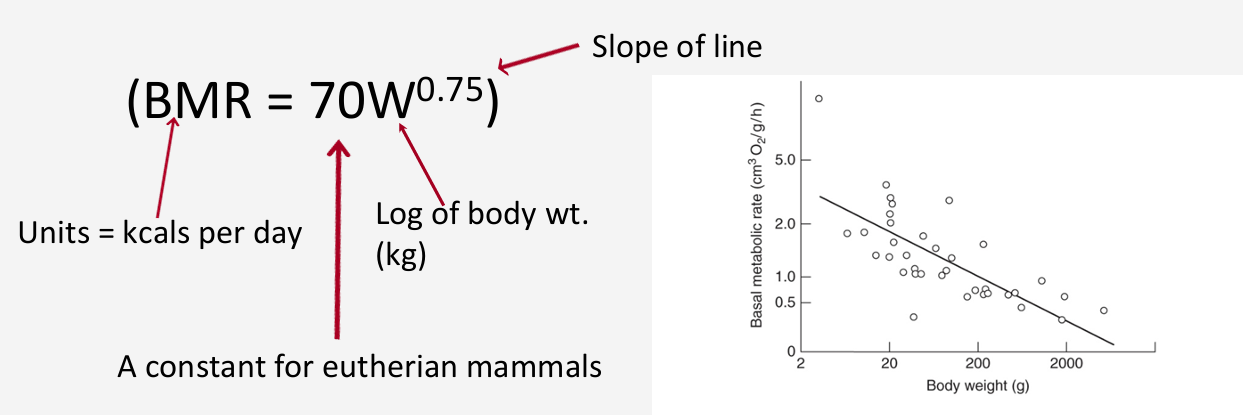
ADMR
Average daily metabolic rate = resting rate + activity rate
How do you measure the food supply?
Direct measures → insect traps, prey counts, clipped grass, feeding experiments. manipulating the food source.
Problem being assuming measuring same amount animal would
Indirect measures → fecal protein, diet protein. mainly ungulates, observe what animal eat then determine the chemical composition of the diet. meased as fecal nitrogen (FN) - linked to protein and food quality
Body condition and nutrition
body weight as a function of body size (genetics and age) and amount of stored fat and protein
Condition indices - regression models
foot length
body length
Kidney fat - many ungulates and African ruminants
Bone Marrow fat - declines after most kidney fast is used. deer show rapid decline in marrow fat with low total body fat.
Bioelectrical impedence - uses electrical current
Blood and urine parameters
doubly labelled water method
rate of CO2 production = measure of energy expenditure. determines total energy (J)
Mast year
Trees and shrubs produce unusually large amounts of seeds at the same time
will influence the feeding behaviours and movements of different species
crude protein
estimate of total protein content in food based on nitrogen level
Secondary compounds
chemicals that deter herbivores