Chapter 1: Part 1: EXAM 1
 Call Kai
 Learn
Learn Practice Test
 Spaced Repetition
 Match
Match Flashcards
 Knowt Play
1/171

There's no tags or description
Looks like no tags are added yet.
Name | Mastery | Learn | Test | Matching | Spaced | Call with Kai | Chat |
|---|
No analytics yet
Send a link to your students to track their progress
172 Terms
Anatomy
The study, classification, and description of the structure and organs of the human body
Physiology
the study of the functions and processes of the body
Radiographic study of the human body
primarily a study of the anatomy of various systems with lesser emphasis on physiology
Chemical level
lowest level of organization
chemical level, molecular level, cellular level, tissue level, organ level, organ system, organism
levels of organizaiton
skeletal, circulatory, digestive, respiratory, urinary, reproductive, nervous, muscular, endocrine, integumentary
name the 10 body systems
epithelial tissue
tissue that covers internal and external surfaces of the body; includes the lining of vessels and organs (stomach and intestine)
connective tissue
tissue that binds and supports various structures (cartilage)
muscular tissue
tissue that makes up the substance of muscle
nervous tissue
tissue that makes up nerves and nerve centers
cell
basic structural and functional unit of all living tissue
skeletal system
includes 206 separate bones of the body; associated cartilages and joints. Terms: Osteology and Arthrology
axial skeleton and appendicular skeleton
Two subdivisions of the skeleton
axial skeleton
80 bones: lie on or near central axis of body
skull, vertebral column, ribs, and sternum
The axial skeleton consists of
appendicular skeleton
126 bones
shoulder girdle, pelvic girdle, upper/lower limbs
what does the appendicular skeleton include?
support and protect soft tissues (ribs/thorax protects lungs, heart, and great vessels), movement with muscles, blood cell production (RBC), stores calcium
4 Functions of skeletal system
heart, blood, blood vessels (cardiovascular), lymph nodes, lymph vessels, glands, and spleen (lymphatic).
7 structures that make up the circulatory system.
transports oxygen, nutrients, wastes, water/ electrolytes, hormones, and enzymes. protects from disease, prevents hemorrhage by forming blood clots, and regulates body temperature
6 functions of the circulatory system
alimentary canal
the part of the digestive system that includes the mouth, pharynx, esophagus, stomach, small intestine, large intestiine, and anus
accessory organs
includes salivary glands, liver, gallbladder, and pancreas
Absorption (through physical and chemical breakdown) and Elimination (solid waste)
2 functions of the digestive system
small bowel
responsible for absorption
large bowel
responsible for elimination
respiratory system
consists of two lungs; series of passageways: (exterior to alveoli). Includes nose, mouth, pharynx, larynx, trachea, and broncial tree
supplies oxygen to blood and cells, eliminates carbon dioxide from blood, and regulates the acid-base balance of blood.
3 functions of the respiratory system
urinary system
includes: organs that produce, collect, and eliminate urine (kidneys, ureters, bladder, and urethra)
regulates chemical composition of blood, eliminates waste, regulates fluid and electrolyte balance, and maintains acid-base balance of body
functions of the urinary system
reproductive system
includes organs that oroduce, transport, and store germ cells (reproductive cells) function is to reproduce an organism
nervous system
composed of the brain, spinal cord, nerves, ganglia, and special sense organs (eyes and ears)
regulates body activities with electrical impulses traveling along various nerves.
function of the nervous system
Muscular System
allows for movement, maintains posture, and produces heat
skeletal muscle
43% of body weight
smooth muscle
located in the walls of hollow internal organs
cardiac muscle
only found in walls of the heart; involuntary and striated
endocrine system
Regulates bodily activities through the various hormones
pituitary, pineal, thyroid, parathyroid, thymus, adrenals, pancreas, testes, ovaries, and placenta (temporary gland)
ductless glands of the endocrine system
integumentary system
composed of skin and all structures from the skin: hair, nails, sweat and oil glands
7620 square cm (8% total body mass)
how much of the surface does skin cover
temperature regulation, protection, waste elimination, sensory reception, vitamin D synthesis
5 functions of integumentary system
206
how many bones are in the adult skeleton?
sesamoid bones
small, oval-shaped bones. found in tendons (mostly near joints) or the area of the thumb. not counted as part of axial or appendicular skeleton; the largest are the patella
patella
largest sesamoid bone
long, short, flat, irregular
4 bone shapes
long bones
limbs, compact bone, spongy bone, periosteum (humerus, tibia, femur)
short bones
carpal and tarsal bones are considered
flat bones
consist of two plates of compact bone with cancellous bone and bone marrow between them.
irregular bones
peculiar shapes (vertebrae, facial bones, and pelvic bones)
compact bone
outer shell of most bones, dense bone tissue, body/shaft (contains thicker layer - resist stress), serves to support and protect entire bone
flat bones
calvaria (skull cap), sternum, ribs, and scapulae
spongy (cancellous) bone
found inside shell of compact bone and at both ends of long bones. highly porous; contains red bone marrow (responsible for production of red blood cells)
medullar cavity
the hollow part of long bones that contains yellow marrow in adults
periosteum
A dense fibrous membrane that covers bones except at articulating (joint) surfaces (hyaline); essential for bone growth, repair, and nutrition.
nutrient artery
Near the center of the body of long bones; passes obliquely through the compact bone via a nutrient foramen into the medullary cavity.
hyaline
glassy or clear, common type of cartilage/connective tissue; "gristle"; called articular cartilage
short bones
roughly cuboidal. found only in wrists and ankles; consists mainly of cancellous (spongy) tissue with thin covering of compact bone.
8
how many carpal bones
7
how many tarsal bones
scaphoid bone
most commonly fractured bone in the wrist
flat bones
consists of 2 plates of compact bone; cancellous bone and marrow between them. includes: calvarium, sternum, ribs, and scapulae
irregular bones
include vertebrae, facial bones, bones of the base of cranium, and bones of pelvis.
ossification
process of bone formation; begins about the 6th embryonic week into and proceeds into adulthood
intramembranous and endochondral
two types of ossification
in the diaphysis (shaft of long bone)
Where do primary ossification centers (appear before birth) occur
in the epiphyses (ends of long bone)
Where do secondary ossification centers (after birth) occur
metaphysis
area between the diaphysis and epiphysis where growth occurs; the WIDER PORTION of a long bone adjacent to the epiphyseal plate. where bone growth in length occurs
intramembranous ossification
occurs rapidly and takes place in bones that are needed for protection, such as sutures of the flat bones of the calvaria (skull cap), which are centers of growth in EARLY bone development. occurs when bone replaces membranes
endochondral ossification
occurs in most parts of the skeleton, especially in long bones. occurs when bone replaces cartilage (occurs slower)
arthrology
Study of joints and their function
sternum, ribs, vertebrae, pelvis (and at the end of long bones)
what bones produce red blood cells produced by red bone marrow
from puberty to full maturity (about 25 year)
when does epiphyseal fusion occur
Functional and Structural
two classifications of joints
fibrous, cartilaginous, synovial
3 structural classifications of joints are
synarthrosis, amphiarthrosis, diarthrosis
3 functional classifications of joints?
Synarthrosis
no movement; (immovable). ex. skull
syndesmosis, suture, gomphosis
three types of fibrous joints
Amphiarthrosis
little or limited movement (slight movement); ex. AC joint/tib-fib joint
diarthrosis
freely movable. synovial joint; ex. knee, hip, shoulder, wrist, elbow, ankle.
cartilaginous joints
amphiarthrodial (limited movement)
synovial joints
diarthrodial (freely movable); most of the upper and lower limbs; reinforced by accessory ligaments; articular cartilage; fibrous capsule that contains synovial fluid
Gomphosis
only limited movement; periodontal ligaments between teeth and bone. A type of fibrous joint, such as a tooth inserted into the alveolus.
symphyses and synchondroses
two types of cartilaginous joints
symphyses
cartilaginous joint that is a broad, flattened disk of fibrocartilage between bones; can be compressed or displaced; (ex. pu
synchondroses joint
temporary type of joint; hyaline cartilage converted into bone
plane (gliding), ginglymus (hinge), trochoid (pivot), ellipsoid (condyloid), sellar (saddle), spheroidal (ball and socket), bicondylar
7 movement types of synovial joints
plane (gliding) joint
sliding and gliding motion between articulating surfaces; two or more bones sliding against each other
ginglymus (hinge) joint
flexion and extension only (knee, elbow, fingers)
Trochoid (pivot) joint
rotational motion. proximal/distal radioulnar joints of the forearm, between C1-C2 (dens of the axis forms the pivot, anterior arch of the atlas combined with posterior ligaments forms the ring) (radius, ulna, humerus)
ellipsoid (condylar) joint
flexion and extension
abduction and adduction
circumduction
(ex. metacarpophalangeal joint, wrist joint and knee)
Sellar (saddle) joint
flexion, extension, abduction, adduction, circumduction; 1st carpometacarpal joint (thumb) (ankle)
Spheroidal (ball and socket) joint
medial and lateral rotation; hip and shoulder joint
bicondylar joint
provides movement in a single axis (flexion and extension); limited rotation; 2 convex condyles; TMJ and knee.
Sthenic Body Habitus
on average 50% of the population. Average in size and organ location
hypersthenic (sthenic) body habitus
A body style that has a broad frame as compared with the sthenic body habitus. Approximately 5% of the population; exposure factors are higher
hyposthenic (asthenic) body habitus
slender body style; 35% of the population
film-screen (analog) technology
image stored and displayed on film
digital technology
image viewed and stored on display monitors
x-ray film
Physical piece of material on which a latent radiographic image is stored
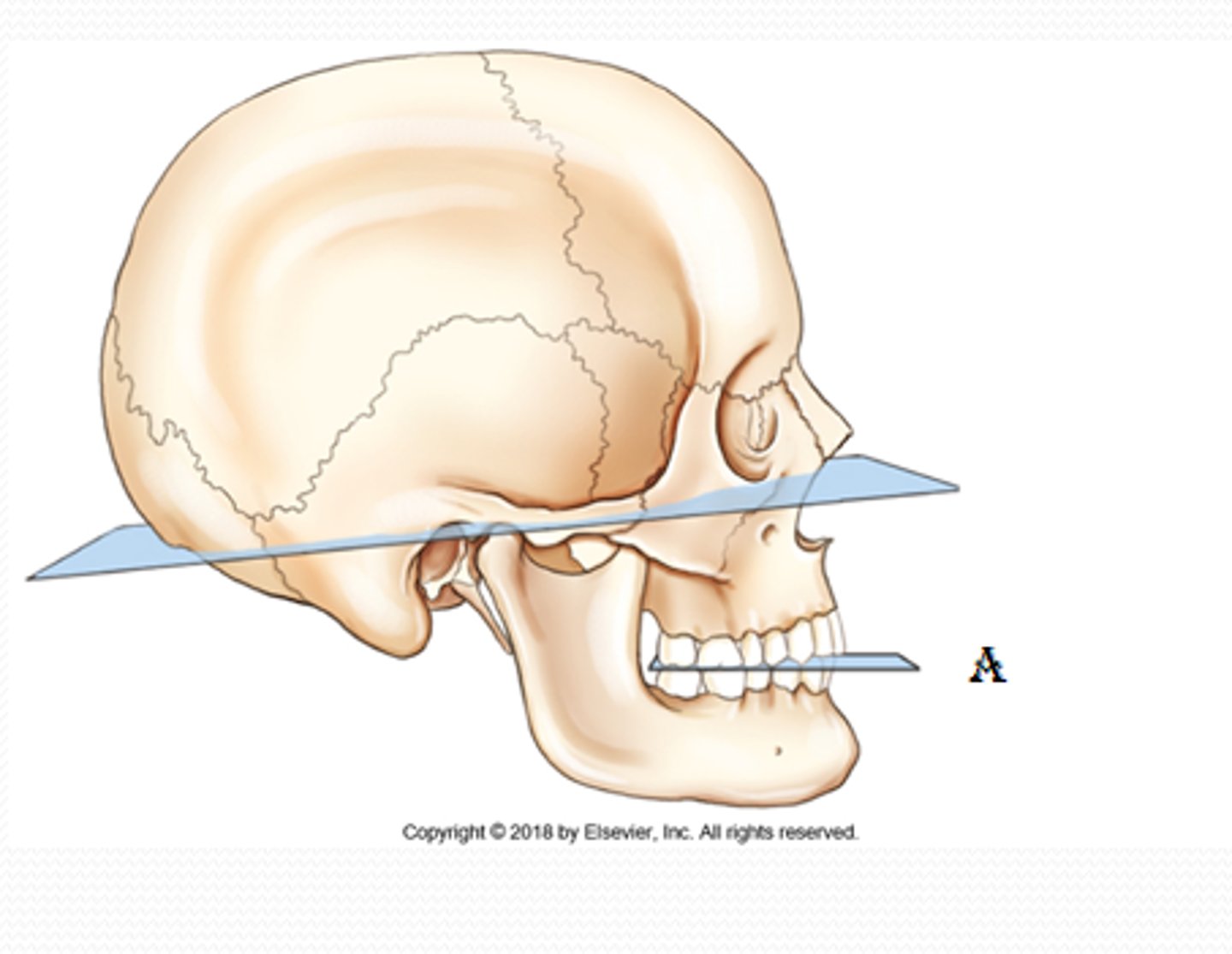
occlusal plane
Identify A: plane of the skull that is a horizontal plane and is formed by biting surfaces of upper and lower teeth with jaws closed.